
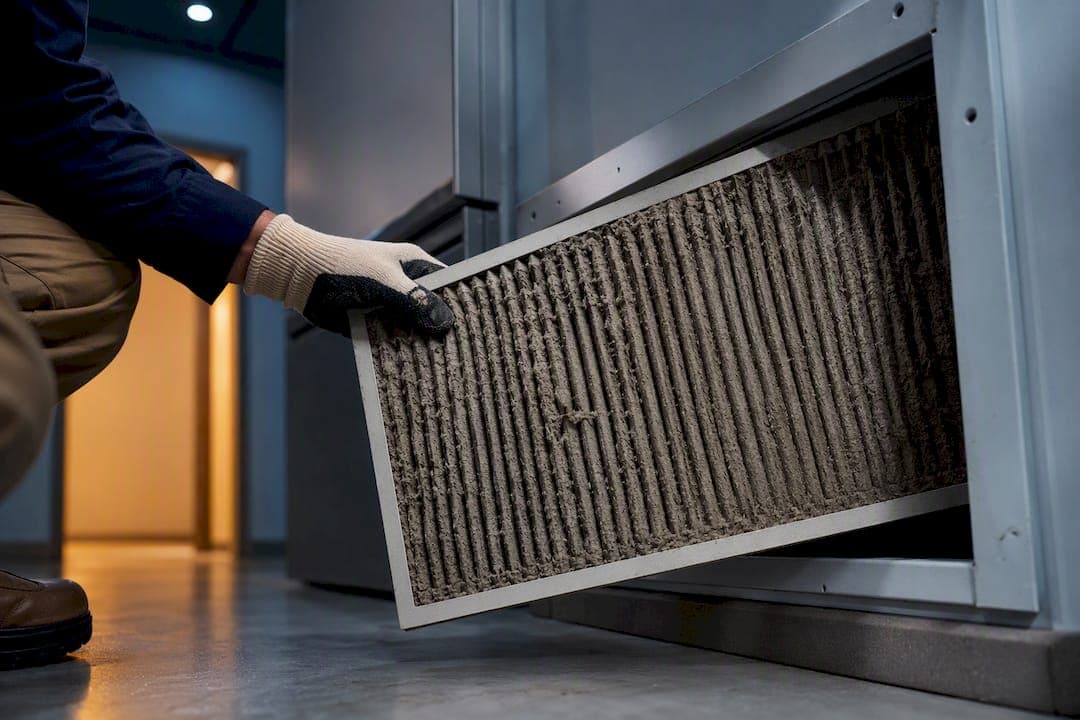
Replace 1" fiberglass panel filters every 30 days, pleated filters every 60 to 90 days, and 4"+ media or HEPA filters every 6 to 36 months. Those are starting points, not rules. The better trigger is differential pressure (ΔP) across the filter, which tells you exactly when airflow has dropped enough to matter. If tracking that yourself sounds like one more job you don't have time for, professional services run managed replacement schedules that handle it.
TL;DR:
- Differential pressure monitoring is crucial because it provides an exact indicator of when a filter needs replacement, rather than relying on fixed schedules.
- Heavy-use environments, such as active remodeling or wildfire seasons, can require filter checks every 20 to 45 days to prevent airflow loss.
- For typical residential use, pleated filters should be checked around 60 to 90 days, with heavier conditions prompting more frequent assessments.
- Managing ΔP readings with tools like pressure gauges or system transmitters helps ensure filters are replaced before airflow drops below system requirements.
- Professional services can coordinate scheduled replacement and indoor air quality testing across multiple properties, saving time and maintaining consistent air standards.
Table of Contents
- Air Filter Replacement Schedule by Filter Type
- What Shortens Filter Life Faster Than the Calendar Predicts
- Using Differential Pressure to Time Replacements
- A Practical Maintenance Checklist for Multi-Property Portfolios
- What Years in Avondale HVAC Systems Have Taught Us
- Managed Filter Replacement and Air Quality Testing in Avondale
- Sources
- FAQ
Air Filter Replacement Schedule by Filter Type
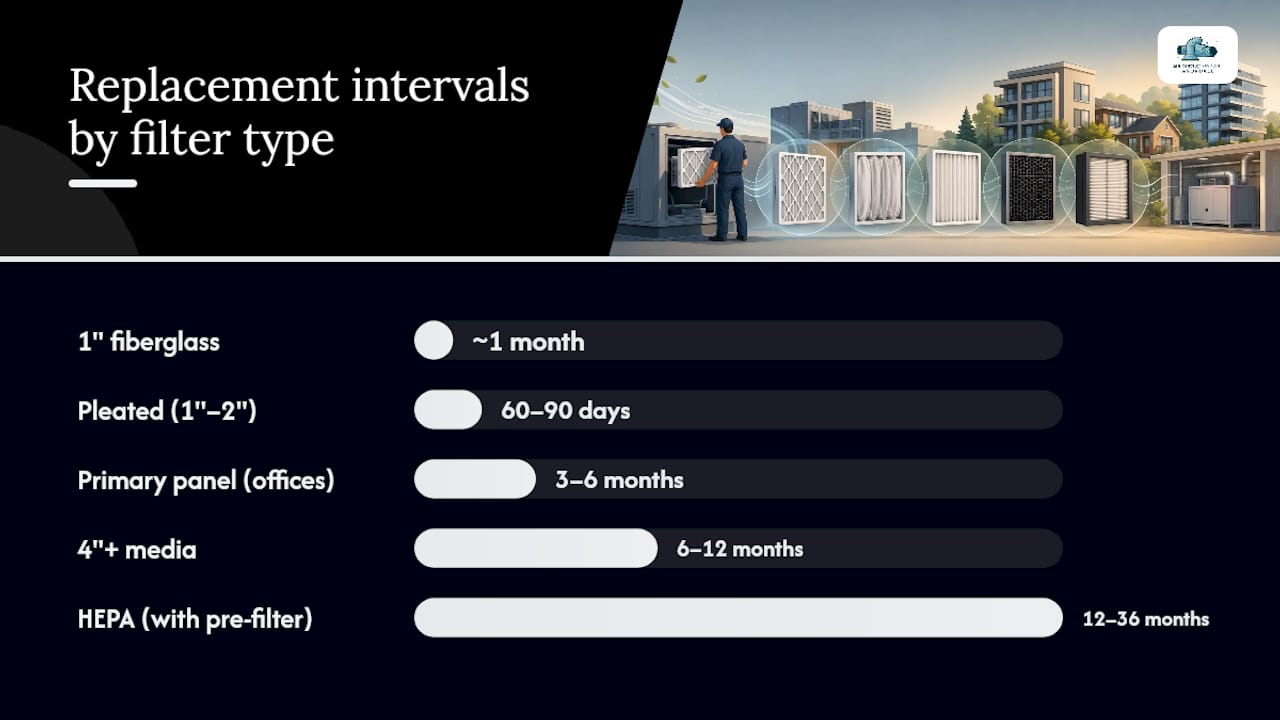
Filter thickness and surface area drive how long a filter actually lasts, and that's the single biggest reason two households on the "same" schedule get wildly different results. A thin 1" fiberglass panel has almost no pleated surface area, so it loads up with dust fast. A 4" media cabinet filter folds many square feet of filtering material into the same footprint, spreading the dust load thin and stretching service life to months instead of weeks.
That's the physical logic behind every baseline interval you'll see quoted, including these:
- 1" fiberglass panel filters: about 30 days. Cheap, low resistance, but limited capacity means they clog fast even in average homes.
- Pleated filters (1"–2"): 60 to 90 days for most residential systems, based on homeowner-facing guidance that also flags visible dust and airflow loss as reasons to move sooner.
- 4"+ media filters: 6 to 12 months in typical commercial and residential setups, with primary panel filters in offices commonly rated 3 to 6 months and bag filters 6 to 12 months depending on filter class.
- HEPA filters: 12 to 36 months when a pre-filter is doing the heavy lifting and catching coarse debris before it ever reaches the HEPA media.
Facility type matters as much as filter type. For example, a single-family home with low occupancy and no pets might extend pleated filter use longer, while busier offices with continuous fan operation and heavy traffic require more frequent replacements. High-use environments like hotels typically need panel filters checked monthly, and data centers often require thicker media or HEPA filters with monitoring beyond simple calendar schedules.
Manufacturer intervals come from controlled lab testing under ASHRAE 52.2 protocols, which is useful for setting a baseline but doesn't account for how dusty your specific duct system, neighborhood, or household actually is. That gap between lab rating and field reality is exactly why the next section matters.
What Shortens Filter Life Faster Than the Calendar Predicts
A calendar tells you when 30 or 90 days have passed. It says nothing about whether your filter is actually loaded. Several common conditions push real-world replacement need well ahead of any printed schedule, and recognizing which "lane" your property falls into keeps you from either overpaying on filters or running a starved system.
Three lanes cover most situations:
- Heavy lane: multiple pets, active construction or renovation nearby, high occupancy, or a wildfire smoke event. Check every 20 to 45 days, and expect to replace more often than the baseline suggests.
- Moderate lane: average single-family home, one pet, normal occupancy, no nearby construction. Stick close to the baseline intervals, checking monthly during pollen season just to confirm.
- Light lane: low occupancy, no pets, filtered outdoor air, minimal dust sources. You can often push toward the upper end of the baseline range, or slightly beyond it, if ΔP readings support it.
Pollen season typically brings 1.5 to 2.5 times normal loading, while wildfire smoke events can push loading 5 to 10 times above baseline, which is enough to choke a pleated filter in days rather than weeks. Renovation dust behaves similarly. Treat any active construction phase as heavy lane by default, even if the property was light lane the week before.
Pro Tip: Set a phone reminder the day any nearby construction starts, not the day it finishes. Drywall dust and sawdust load a filter fast, and waiting until the project wraps up to check means you've likely already lost airflow for weeks.
Using Differential Pressure to Time Replacements
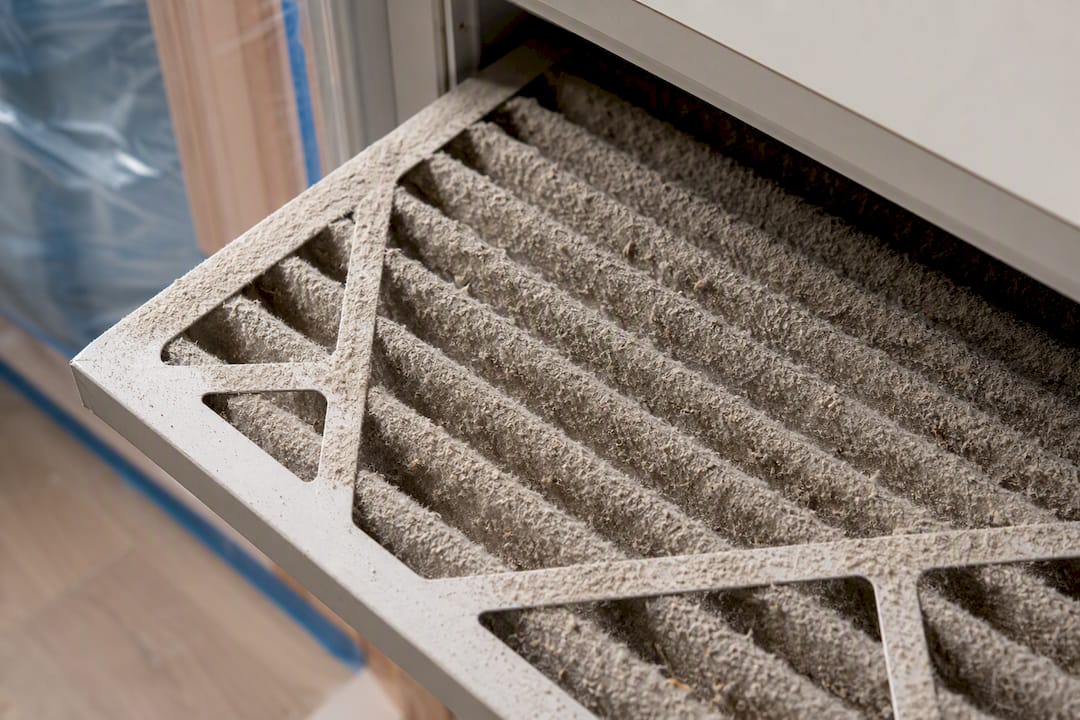
Calendar schedules are a starting point. Differential pressure, or ΔP, is the actual signal that tells you whether a filter still has capacity or needs to come out now. ΔP measures the pressure drop across the filter, and as dust accumulates, that resistance climbs. ASHRAE's preventive maintenance guidance recommends monthly to quarterly inspection paired with ΔP readings, rather than leaning on calendar time alone.
Start by recording the initial clean ΔP for each installed filter. That baseline number is what everything else gets measured against.
- Warning threshold: roughly 70% to 80% of the filter's rated final ΔP. Time to order a replacement, not yet urgent.
- Replace threshold: 90% to 100% of rated final ΔP, or whatever limit your equipment's operations manual sets. At this point airflow and system efficiency are measurably suffering.
- Monitoring tools: hand-held ΔP gauges for spot checks, digital ΔP transmitters wired into a building automation system (BAS) for continuous trending, and simple visual or airflow checks between formal readings.
ΔP replacement thresholds vary by filter class, with primary panel filters typically changed around 100 to 110 Pa, bag filters between 150 and 250 Pa, and HEPA filters at 400 to 600 Pa. A workable routine for a small property: measure baseline ΔP at installation, check weekly during high-load season (wildfire smoke, pollen, active renovation) and biweekly otherwise, then order the replacement filter the moment you hit the warning threshold rather than waiting for the alarm.
A Practical Maintenance Checklist for Multi-Property Portfolios
Running filter replacements across several properties turns a simple task into a logistics problem fast. A short recurring checklist keeps it from becoming a crisis call; for more detailed guidance, see our commercial HVAC maintenance checklist for Billings facilities.
- Weekly or monthly patrol: visual filter check, quick airflow test at a nearby vent, and a log of any occupant complaints about odors, dust, or uneven temperatures.
- Periodic review: pull the ΔP log for each property, flag anything approaching its warning threshold, and audit filter inventory against upcoming replacement dates.
- Recordkeeping: for every filter, log the filter type, MERV rating, installation date, initial clean ΔP, and the date of last replacement. A simple spreadsheet works; a CMMS platform works better once you're managing more than a handful of units.
- Spares and lead times: keep at least one spare of each common size on hand, since running the wrong or an ill-fitting size strains the system just as much as skipping a change. Order 4"+ media and HEPA filters well ahead of need. Their lead times run longer than a standard 1" panel, and thicker media often extends service life significantly but only if your system's fan can handle the added static pressure.
What Years in Avondale HVAC Systems Have Taught Us
Post-construction properties are the pattern that surprises new landlords most. Drywall dust settles into ductwork for weeks after a remodel finishes, and a filter that looked fine on day one is choked by day twenty. Pet households run a close second, and wildfire smoke season in Arizona now regularly spikes loading rates that used to be rare events.
Managed ΔP checks catch these swings before they turn into a strained blower motor or a stack of occupant complaints. That's the whole case for replacing calendar guesswork with a monitored schedule.
— Shaun
Managed Filter Replacement and Air Quality Testing in Avondale
Skipping a filter change doesn't save money. It shortens blower motor life, spikes energy bills, and lets dust recirculate through every room on the system. Professional providers can run scheduled filter replacement, ΔP checks, and indoor air quality testing as one coordinated service, so you're not stuck tracking pressure readings on a spreadsheet between other jobs.
For homeowners, that means a technician who shows up on the interval your specific system needs, not a generic 90-day guess. For landlords and commercial property managers, it can mean one vendor handling recurring visits across multiple units, with consistent records for every filter installed. Pair a replacement visit with an indoor air quality test to confirm the schedule is actually working, or start with scheduled air filter replacement and let the technician set the baseline ΔP for you. Book a visit and get a real interval instead of a guess.
Sources
- ASHRAE IAQ preventive maintenance checklist
- How Often Should You Replace Air Filters in Commercial HVAC — KWS
- Purdue research on filter detection algorithm and real-world replacement frequency
- Clogged air filter symptoms and frequency guidance — Today's Homeowner
FAQ
How Often Should You Change Your HVAC Air Filter?
Change 1" fiberglass filters every 30 days, pleated filters every 60 to 90 days, and 4"+ media or HEPA filters every 6 to 36 months, adjusted by ΔP readings and household conditions.
How Often Should You Change an HVAC Filter With Pets in the House?
Pet households usually fall into the heavy lane, meaning checks every 20 to 45 days rather than the standard baseline, since pet hair and dander load filters faster than typical dust.
How Do I Know if My Air Filter Is the Wrong Size?
An undersized filter lets unfiltered air bypass the frame, while an oversized one won't seat properly. Measure the existing filter's printed dimensions or the slot opening directly rather than guessing from memory.
What Are the Signs an Air Filter Needs Replacing Now?
Reduced airflow at vents, rising energy bills, dusty surfaces returning faster than usual, and lingering odors are all signs to check and likely replace the filter early.
Is ΔP Monitoring Only for Commercial Buildings?
No. Hand-held ΔP gauges are affordable enough for single-family homes, and ASHRAE's own preventive maintenance guidance recommends inspection-and-pressure-based triggers over calendar time alone for any building type.