

TL;DR:
- Understanding air quality terminology helps distinguish between indoor and outdoor pollutants, enabling effective decision-making. The AQI measures outdoor air risks, while indoor air quality depends on direct pollutant concentrations and specific sources. Properly understanding these differences ensures targeted interventions that protect health and improve indoor environments.
When a service provider mentions "PM2.5 levels" and your phone's weather app shows an AQI of 87, do those two numbers mean the same thing? For most homeowners and small business owners in Avondale, Arizona, the answer is a frustrated shrug. Getting air quality terminology explained clearly is not a luxury. It is the difference between choosing the right indoor air service and paying for one that does not address your actual problem. This guide breaks down the terms that matter, in plain language, so you can make decisions with confidence.
Table of Contents
- Understanding the foundation: key air pollutants and standards
- Decoding the Air Quality Index (AQI) and its health categories
- Critical pollutants: PM2.5 and ground-level ozone explained
- Indoor vs outdoor air quality terminology: what you need to know
- Practical air quality terms for managing your home or business in Avondale
- Why mastering air quality terminology matters more than you think
- Protect your Avondale home with expert air quality services
- Frequently asked questions
Understanding the foundation: key air pollutants and standards
Before any number or index makes sense, you need to know what is actually being measured. The U.S. Environmental Protection Agency sets National Ambient Air Quality Standards for six common pollutants called criteria air pollutants. These six were chosen because they are widespread, come from many sources, and have well-documented health effects. Every major air quality report, alert, and index you encounter is built on this foundation.
Here are the six criteria air pollutants you need to know:
- Ozone (O3): A gas formed when sunlight reacts with vehicle exhaust and industrial emissions. At ground level, it irritates your lungs. Do not confuse it with the protective ozone layer high in the atmosphere.
- PM2.5 (fine particulate matter): Tiny solid or liquid particles smaller than 2.5 micrometers. These are so small they can pass through your nose, travel into your lungs, and even enter your bloodstream.
- PM10 (coarse particulate matter): Larger particles up to 10 micrometers, including dust, pollen, and mold spores. Still harmful when inhaled, but your airways catch more of them before they reach your lungs.
- Carbon monoxide (CO): A colorless, odorless gas produced by burning fuel. It reduces your blood's ability to carry oxygen and can be lethal at high concentrations.
- Nitrogen dioxide (NO2): Comes from vehicle exhaust and gas stoves. Linked to respiratory disease and is a precursor to ground-level ozone formation.
- Sulfur dioxide (SO2): Released by burning coal and oil. Triggers asthma attacks and damages lung tissue with repeated exposure.
These are regulated under the Clean Air Act, which directs the EPA to set legal concentration limits. Those limits are called NAAQS (National Ambient Air Quality Standards). When you see a report saying your area is in violation of a standard, it means measured concentrations exceeded one of these legal thresholds. Understanding these indoor air pollutants explained helps clarify why some services target gases while others focus on particles.
Now that we know why certain pollutants get special attention, let's explore how their levels translate into understandable air quality measurements you see every day.
Decoding the Air Quality Index (AQI) and its health categories
The AQI, or Air Quality Index, is the number you see on weather apps, local news broadcasts, and government air monitoring websites. It was created specifically to translate complex pollutant data into something the public can act on. The AQI is a 0 to 500 scale where higher values mean worse pollution and greater health concern. A value of 100 corresponds exactly to the national NAAQS standard for that pollutant.
The index is divided into six color-coded categories:
| AQI range | Category | Color | Recommended action |
|---|---|---|---|
| 0 to 50 | Good | Green | No action needed |
| 51 to 100 | Moderate | Yellow | Unusually sensitive people should consider limiting prolonged outdoor exertion |
| 101 to 150 | Unhealthy for sensitive groups | Orange | People with asthma, heart disease, children, and the elderly should limit outdoor activity |
| 151 to 200 | Unhealthy | Red | Everyone should reduce prolonged outdoor exertion |
| 201 to 300 | Very Unhealthy | Purple | Everyone should avoid outdoor exertion; sensitive groups should stay indoors |
| 301 to 500 | Hazardous | Maroon | All outdoor physical activity should be avoided; stay indoors and minimize indoor air infiltration |
One critical thing many people miss: the AQI reflects outdoor air. It is a daily snapshot for a specific geographic area based on monitoring stations. It does not tell you what is happening inside your home or office. A day with an AQI of 45 outdoors can still mean poor air quality indoors if your ducts are loaded with dust or your HVAC filter is long overdue for a change. You can learn more about testing home air quality as a separate and necessary step from watching your local AQI forecast.
Pro Tip: Set up a free alert through AirNow.gov for Avondale so you receive automatic notifications when the AQI crosses into the orange category or higher. Use those alerts as triggers to keep windows closed and run your HVAC system on recirculate. For a deeper look at air quality testing explained, especially indoors, those resources go well beyond what any outdoor index tells you.
With AQI in mind, let's look closer at the two most impactful pollutants you'll hear about that often drive these index values.
Critical pollutants: PM2.5 and ground-level ozone explained
Of all six criteria pollutants, PM2.5 and ground-level ozone are the two that drive the most air quality alerts in the greater Phoenix area, including Avondale. Understanding them in detail is central to understanding air quality indicators explained in any local report.
PM2.5 in detail
PM2.5 particles are small enough to penetrate deep into your lungs and enter your bloodstream, and they are linked to serious cardiovascular and respiratory health effects. Sources include vehicle combustion, wildfires, agricultural burning, industrial facilities, and even cooking indoors. During wildfire events that affect Arizona seasonally, outdoor PM2.5 can spike dramatically within hours.
Key facts about PM2.5:
- Measured in micrograms per cubic meter of air (µg/m³)
- The EPA's 24-hour average NAAQS standard is 35 µg/m³
- Annual average standard is 9 µg/m³ as of the 2024 update
- Long-term exposure is associated with heart disease, lung cancer, and premature death
- Particles this small pass through standard fiberglass furnace filters easily
Ground-level ozone in detail
Ground-level ozone forms from reactions between nitrogen oxides (NOx) and volatile organic compounds (VOCs) in the presence of sunlight, typically peaking during hot summer afternoons. In Avondale, summer conditions create ideal circumstances for high ozone days. It is not emitted directly; it builds up as a reaction product, which means reducing it requires cutting NOx and VOC emissions upstream.
Health effects include:
- Chest tightness and shortness of breath
- Aggravation of asthma and other lung diseases
- Throat irritation that worsens with outdoor exercise
- Repeated exposure reduces long-term lung function
The HVAC impact on air quality is significant here because your system draws in outdoor air. On high-ozone days, proper filtration and recirculation settings matter. For improving indoor air quality during these events, the strategies for particles and gases differ significantly.
Pro Tip: HEPA filters and high-MERV air filters capture particles like PM2.5 effectively, but they do not remove ozone or other gases. On high-ozone alert days, activated carbon filters or limiting outdoor air intake is more useful than upgrading your particle filter.
Having dissected key pollutants and the AQI, let's clarify common confusions between indoor and outdoor air quality terms to avoid costly mistakes.
Indoor vs outdoor air quality terminology: what you need to know
This is where the most expensive misunderstandings happen. When understanding air quality terms, the indoor and outdoor worlds operate on different scales, use different methods, and require different interventions. Mixing them up leads to paying for services that do not solve your actual problem.
Here are five key differences every Avondale homeowner and business owner should know:
-
The AQI is outdoor-only. AQI terminology is designed for outdoor air and is not interchangeable with indoor particle monitor readings. Your indoor air sensor showing a particle count of 25 µg/m³ does not translate directly to an AQI of 25.
-
Indoor monitors use raw concentration values. Most consumer and professional indoor monitors report µg/m³ for particles or parts per million (ppm) for gases. These are direct measurements, not index scores. A reading of 12 µg/m³ for PM2.5 indoors is good. The same number labeled as "AQI" would mean something entirely different.
-
Indoor sources are fundamentally different. Outdoor air quality is dominated by traffic, industry, and weather. Indoors, the biggest contributors are dust buildup in ducts, pet dander, mold, cooking fumes, cleaning products, and off-gassing from furniture and building materials. Understanding the causes of indoor air pollution helps you target the right source.
-
Filtration strategies do not carry over directly. Outdoor ozone levels rarely tell you whether your indoor air ducts need cleaning. High outdoor PM2.5 days increase the importance of air pollutant testing indoors, but the two measurements are not the same thing.
-
Health thresholds differ by context. Outdoor AQI categories were developed for brief exposure during outdoor activity. Indoor air standards account for the fact that Americans spend approximately 90% of their time indoors, meaning lower particle concentrations are tolerable for shorter periods outside but become significant when you breathe them continuously for 8 to 12 hours a day.
Pro Tip: Before accepting any indoor air quality reading from a service provider, ask two questions: "What pollutant are you measuring?" and "What unit of measurement are you using?" If they answer with vague references to AQI without clarifying that is an outdoor standard, that is a sign to push for more detail.
Now that you can distinguish between indoor and outdoor air quality terms, let's explore practical steps you can take to monitor and improve your indoor environment effectively.
Practical air quality terms for managing your home or business in Avondale
Knowing the definitions is only half the job. The other half is translating them into decisions. Here are key terms that come up directly when you hire an indoor air quality service or review your HVAC maintenance plan.
Terms to know before calling a service provider:
- MERV rating: Minimum Efficiency Reporting Value. A MERV 8 filter catches large particles; a MERV 13 catches fine particles including PM2.5. Higher is not always better if your HVAC blower cannot handle the airflow restriction.
- HEPA filter: High Efficiency Particulate Air filter. Captures 99.97% of particles 0.3 microns or larger. Standard in hospital-grade air purifiers.
- VOCs (volatile organic compounds): Gases emitted from paints, adhesives, cleaning products, and furniture. Common indoors. Not captured by particle filters.
- Air changes per hour (ACH): How many times the total air volume in a space is replaced or filtered per hour. Higher ACH generally means better pollutant removal.
- Source control: Eliminating or reducing the pollutant at its origin rather than filtering it afterward. The most effective first step in most indoor air strategies.
Filtering and source control differ by pollutant type. A HEPA filter works for particles, but ventilation and source elimination address gases and VOCs. Applying the wrong strategy costs time and money.
| Pollutant type | Primary concern | Recommended intervention |
|---|---|---|
| PM2.5 and PM10 (fine and coarse particles) | Respiratory and cardiovascular damage | HEPA filtration, air duct cleaning, regular HVAC filter replacement |
| Ground-level ozone | Lung irritation | Limit outdoor air intake on high-ozone days, activated carbon filters |
| VOCs | Long-term exposure risks | Ventilation, source control, avoiding high-emission products |
| Carbon monoxide | Oxygen displacement, toxicity | CO detectors, appliance maintenance, never idling vehicles indoors |
| Mold spores | Allergies, respiratory disease | Duct cleaning, moisture control, vent cleaning |
Keeping your air quality testing methods updated and your HVAC system in good shape are the two highest-leverage actions most homeowners can take. Neglecting duct cleaning means particles that enter your system during wildfire season or high-dust summer months stay in circulation for months.
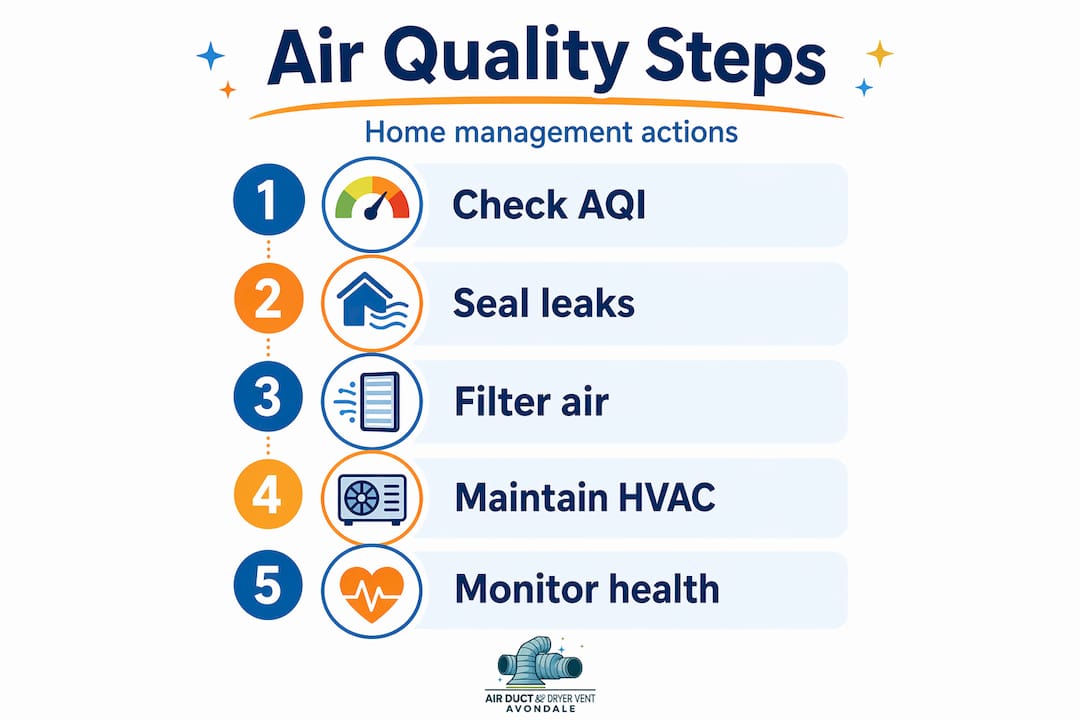
Pro Tip: Schedule HVAC maintenance for air quality at minimum twice per year in the Avondale area: once before summer ozone and heat season starts, and once before winter when homes are sealed up and indoor pollutants concentrate. This simple schedule catches most filter and duct issues before they become health concerns.
With clear definitions and practical guidance, let's share an expert perspective on how this terminology shapes best practices for air quality management in Avondale.
Why mastering air quality terminology matters more than you think
Here is what we see repeatedly in our work with Avondale homeowners and businesses: people make expensive decisions based on mixed-up terminology. A homeowner sees an indoor monitor showing elevated particle levels, assumes it matches the outdoor AQI, decides the problem is coming from outside, and does nothing about their dusty air ducts. Months later, a family member with asthma is still struggling.
The confusion between indoor monitor readings and outdoor AQI is more common than most providers will admit. These are genuinely different measurements that require different responses. Treating them as interchangeable is not just a terminology error. It is a health risk.
"The AQI is a health communication yardstick, not a direct measurement of a single pollutant in your specific space. It represents the worst-case pollutant reading across a monitored outdoor area. Your indoor air is a completely separate environment that requires its own measurement and its own strategy."
Professionals who know air quality definitions treat particle-based problems differently from gas-based problems. PM2.5 from wildfire smoke calls for running your HVAC on recirculate with a high-MERV filter and sealing gaps in your building envelope. Ground-level ozone on a hot Avondale afternoon calls for limiting intake of outdoor air rather than filtering it. Mold spores in your ductwork call for physical cleaning, not just a new filter.
The practical lesson: knowing terminology protects you from paying for ineffective services. If a provider quotes you for an air purifier to address CO levels, you now know that is wrong. Carbon monoxide requires eliminating the source and improving ventilation, not filtration. That is not a small distinction. It is the difference between a safe home and a dangerous one.
Reviewing trusted air quality testing options is a practical first step before committing to any service. Know what you are measuring before you decide how to fix it.
Pro Tip: When an indoor air quality company gives you a report, ask them to label every reading with its pollutant name, measurement unit, and the threshold they are comparing it to. If they cannot or will not answer that question clearly, their data cannot tell you whether you actually have a problem.
Protect your Avondale home with expert air quality services
Understanding the terminology is step one. Putting it into action is where the real improvement happens. At Air Duct and Dryer Vent Cleaning Avondale, we offer professional indoor air quality testing that measures specific pollutants with clear units and thresholds, so you always know exactly what you are dealing with. We do not hand you vague numbers and call it done.
Our air vent cleaning services directly address the particle buildup that drives indoor PM2.5 and mold spore levels in Avondale homes, especially after construction, renovation, or a heavy dust season. For businesses, our commercial air duct cleaning service keeps your workplace compliant, your employees healthier, and your HVAC system running efficiently. We use the terminology from this guide every day, and we are happy to walk you through exactly what we are measuring and why it matters for your specific situation.
Frequently asked questions
What are the main air pollutants I should know about for my home in Avondale?
The six criteria pollutants are ozone, PM2.5, PM10, carbon monoxide, nitrogen dioxide, and sulfur dioxide; they form the basis of most pollution reporting and health guidelines for outdoor air quality monitoring.
How does the Air Quality Index (AQI) affect decisions about going outside in Avondale?
AQI values above 100 are considered unhealthy with color-coded categories for health guidance; values below 100 generally indicate satisfactory outdoor air, but sensitive groups should always check the specific category color before outdoor activity.
Is the AQI number on my indoor air monitor the same as the official AQI outside?
No. AQI is designed for outdoor air and is not interchangeable with indoor particle monitor readings, which report direct concentration values in different units and against different health thresholds.
Why is PM2.5 emphasized more during wildfire season in air quality reports?
PM2.5 particles penetrate deep into lungs and the bloodstream and increase health risks significantly during wildfire events because fires produce extremely high concentrations of fine particles in a short period of time.
How can understanding air quality terms help me choose the right indoor air quality service?
Filtering and source control differ by pollutant type, so knowing whether your problem is particles, gases, or VOCs helps you ask the right questions and select services that actually target your specific indoor air concern rather than generic treatments.