
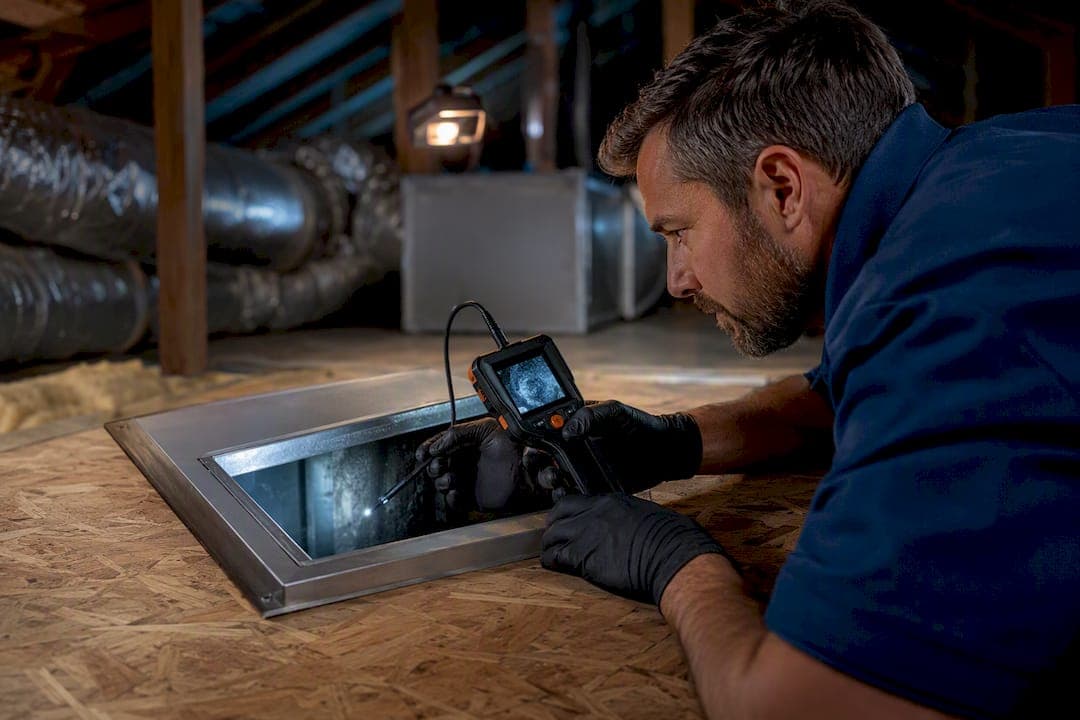
Antimicrobial duct treatment is a supplemental chemical application that should only be used after mechanical cleaning and when biological contamination is confirmed. The EPA and NADCA-aligned industry standards agree: treatment isn't a stand-alone fix, and it isn't recommended for porous fiberglass duct liners at all. Some professional duct cleaning companies treat it the same way. A bad smell coming from your vents is not, by itself, a reason to authorize chemicals.
TL;DR:
- Antimicrobial duct treatments should only follow mechanical cleaning and be used specifically for confirmed mold, water damage, fire residues, or rodent contamination.
- EPA-registered products are limited to metal and hard surfaces; treatment of fiberglass-lined ducts is ineffective and not legally permitted.
- Proper application requires system inspection, targeted cleaning, and verification methods like coverage testing; improper use risks off-gassing and warranty voidance.
- Moisture control and fixing water ingress issues are more effective for preventing microbial regrowth than chemical treatments alone.
- Pricing depends on system size, contamination severity, and treatment method, with treatments never recommended as default or without prior inspection.
Table of Contents
- What Antimicrobial Treatment In Ducts Actually Means
- When Duct Antimicrobial Solutions Are Actually Warranted
- How Professionals Apply Antimicrobial Duct Treatments
- Product Types, EPA Registration, and Where They Can Legally Go
- Safety Precautions and Warning Signs of a Bad Job
- Stopping Regrowth Starts With Moisture, Not Chemicals
- What Kind Of Antimicrobial Actually Works Best
- What Happens To These Chemicals After They're Applied
- Do Commercial Buildings Face Different Rules Than Homes
- What Antimicrobial Duct Treatment Typically Costs
- How A Responsible Local Provider Approaches This Decision
- The Gap Between What Gets Marketed and What Actually Holds Up
- Sources
- FAQ
What Antimicrobial Treatment In Ducts Actually Means
Antimicrobial treatment in ducts refers to applying an EPA-registered product to sheet metal or hard-surface duct components to reduce mold, bacteria, or fungal growth. Legally, these products are pesticides under FIFRA (the Federal Insecticide, Fungicide, and Rodenticide Act), and each one carries a label spelling out exactly where and how it can be used. That label isn't a suggestion. It's the law governing the application.
Not all products do the same job:
- Sanitizers reduce microbial populations to a safe level without claiming full elimination.
- Disinfectants kill a broader range of organisms and typically require longer surface contact time.
- Encapsulants/coatings create a physical barrier, like PermaSafe's All-Surface Antimicrobial SHIELD, a water-based coating marketed for up to 3 months of inhibited regrowth on treated surfaces.
Substrate matters enormously here. Bare metal ductwork can be treated because it's non-porous and cleanable. Insulated or fiberglass-lined duct board absorbs contamination into the material itself, which is a different problem entirely.
When Duct Antimicrobial Solutions Are Actually Warranted
Treatment earns its place in specific, confirmable situations, not as a routine add-on to every cleaning job.
- Confirmed mold growth. A visual inspection or lab sample identifies active fungal colonization, not just discoloration or dust.
- Post-flood or water intrusion. Ductwork that sat wet for more than 24 to 48 hours is a legitimate candidate for sanitizing after drying and cleaning.
- Post-fire and smoke cleanup. Soot and combustion residue create conditions where biocide application, following mechanical cleaning, makes sense.
- Rodent contamination. Droppings and nesting material introduce bacteria that source removal alone may not fully address.
What doesn't justify treatment: musty odors with no visible contamination, "we always do it" upsells, or routine annual maintenance with no evidence of biological growth. If a technician can't point to something they saw or tested, ask for an inspection or lab sample before signing off on any chemical add-on. HVAC odors usually trace back to trapped moisture or debris, not something a spray fixes.
How Professionals Apply Antimicrobial Duct Treatments
Mechanical cleaning always comes first. NADCA-standard practice calls for source removal, brush agitation, and HEPA vacuuming of the entire system before any chemical touches a surface. Spraying biocide over dust and debris just traps contaminants under a wet layer instead of removing them, which is one of the most common failure modes in the industry.
Once the system is clean, technicians choose an application method based on the job:
- Fogging (ULV) disperses a fine mist, often using chlorine dioxide products, throughout the ductwork for broad coverage.
- Spray-and-wipe targets accessible sections like plenums, boots, and takeoffs where direct contact matters more than mist coverage.
- Coil and drain pan spot treatments address the areas most prone to standing moisture and biofilm.
- Polymer coatings go on after cleaning to extend protection on bare metal surfaces.
Nu-Calgon's Bio-Fresh cd application bulletin gives a sense of what a properly run fogging job looks like: roughly 1 gallon of product per 2,000 square feet, droplet sizes around 30 to 50 microns for even surface wetting, and a check step where technicians tape butcher paper over registers to confirm the mist actually reached them. Expect the crew to run the blower in sequence to help distribute and then purge the product, observe the labeled dwell time before the system goes back into normal operation, and do a post-job visual check.
Pro Tip: Ask your technician to show you the register-check paper or explain their coverage verification method. If they can't describe one, they probably aren't following manufacturer application guidance.
Product Types, EPA Registration, and Where They Can Legally Go
Every antimicrobial product used in ductwork needs EPA registration for that specific use site. A disinfectant registered for hard, non-porous surfaces cannot legally be applied to a fabric filter or an insulated liner, regardless of what a salesperson claims it does.
Common product categories include:
- Chlorine dioxide foggers, registered for broad-coverage sanitizing on metal duct interiors.
- Quaternary ammonium compounds (quats), used for spray-and-wipe applications on accessible metal surfaces.
- Polymer/coating products like PermaSafe's SHIELD, applied to coils, pans, and bare sheet metal for longer-lasting surface protection.
Here's the constraint that trips up a lot of homeowners: the EPA notes that no products are currently registered for use inside fiberglass-lined or internally insulated duct board. That material absorbs moisture and contamination in a way sheet metal doesn't, and there's no legal chemical fix for it. Replacement, not treatment, is the recommended remedy for contaminated porous liners.
Applying the wrong product to the wrong substrate isn't just ineffective. It can mean off-gassing into your living space, a void warranty, and a straight-up label violation, since the EPA registration governs exactly where a product may legally go.
Safety Precautions and Warning Signs of a Bad Job
Improperly applied antimicrobials can aerosolize residues that irritate airways, especially for anyone with asthma or chemical sensitivities. Follow whatever the product label says about occupancy during and after application. Some labels call for vacating the treated area until surfaces dry and the space airs out; that instruction exists for a reason.
Three questions worth asking any technician before they touch your system:
- What's the exact product name and EPA registration number?
- Is this product labeled for my duct material, metal or insulated?
- Can you show me that mechanical cleaning happened before any chemical went on?
Watch for these red flags:
- No inspection or documentation of contamination before quoting treatment.
- No mechanical cleaning step, or a vague answer about it.
- Promises of "permanent" mold elimination. No coating lasts forever, and claiming otherwise contradicts every manufacturer label on the market.
- A plan to chemically treat fiberglass-lined ductwork instead of recommending replacement.
A 2001 laboratory and field study testing three antimicrobial coatings found mixed results: two limited fungal regrowth over a 3-month span, one didn't. That's the honest state of the science, and it's exactly why "guaranteed permanent" claims deserve skepticism.
Stopping Regrowth Starts With Moisture, Not Chemicals
No antimicrobial coating outlasts an unaddressed moisture problem, making measures like new interior doors to improve energy efficiency in older homes important to reducing moisture and dust ingress. Leaking roof flashing, a clogged condensate drain, or indoor humidity sitting above 60% will feed fungal regrowth right through any treatment you paid for. Fixing the moisture source comes before, or at minimum alongside, any chemical application.
Practical maintenance that actually reduces the odds you'll need treatment again:
- Change air filters on a regular schedule, tied to your filter's MERV rating and household conditions.
- Schedule periodic duct inspections rather than waiting for a smell or a visible problem.
- HEPA-vacuum accessible components as part of routine service, not just during a full cleaning.
- Replace contaminated porous materials rather than attempting to coat over them.
- Have a facility maintenance plan that flags moisture sources before they become contamination problems.
Coatings like PermaSafe's SHIELD are marketed with roughly a 3-month effectiveness window. That's a maintenance interval, not a one-time cure. If moisture keeps returning, replacement of affected materials is the correct remedy, not another round of spray.
What Kind Of Antimicrobial Actually Works Best
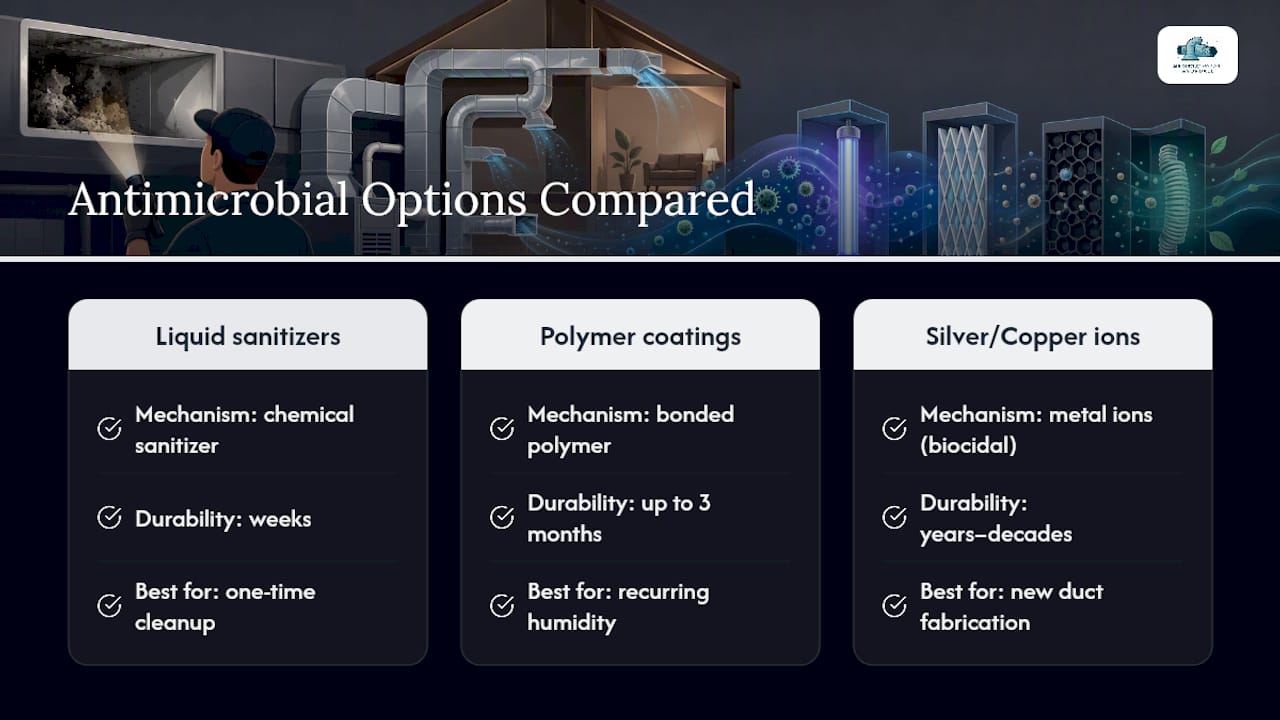
Effectiveness varies more by mechanism than by marketing claim. Liquid sanitizers and disinfectants, whether chlorine dioxide or quat-based, work fast but wear off. Once the treated surface gets dusty again or humidity climbs, that protection is gone, often within weeks rather than months.
Polymer coatings and encapsulants last longer because they physically bond to the surface instead of just wetting it. PermaSafe's SHIELD claims up to 3 months of inhibited regrowth on treated components like evaporator coils and drain pans. That's a meaningfully different mechanism than a one-time fog treatment, and it's why coatings tend to cost more per application.
There's also a category worth knowing about even if it's less common in residential HVAC retrofits: factory-applied antimicrobial materials using silver or copper ions. Trade coverage on silver-ion duct protection describes ion-based materials that resist microbial growth for years, sometimes decades, after application, because the metal ions themselves are toxic to microorganisms rather than relying on a chemical that degrades over time. That's mostly relevant for new duct fabrication, not a retrofit spray job on your existing system.
The honest takeaway: no single antimicrobial agent is universally "best." A liquid sanitizer suits a one-time post-flood cleanup. A coating suits a system with recurring humidity issues where you want a few months of buffer while you fix the root cause. Match the mechanism to the actual problem instead of assuming stronger chemicals equal better outcomes.
What Happens To These Chemicals After They're Applied
Antimicrobial products used in ducts are regulated pesticides, and that status carries disposal implications most homeowners never think about. Unused concentrate, rinse water from application equipment, and used rags or wipes all fall under the product label's disposal instructions, which technicians are legally required to follow under FIFRA.
Most residential-scale duct treatments use small enough quantities that runoff and indoor air impact are limited when applied correctly, per label directions and at labeled dilution rates. The bigger environmental concern is misapplication: overspray that drifts beyond the ductwork, product poured down a drain instead of disposed of per label instructions, or excess fogging that saturates porous materials it was never meant to touch.
Ask your provider how they handle leftover product and equipment rinsing. A technician following label protocol will have a straightforward answer. One who shrugs off the question probably isn't tracking it closely, which matters more than it sounds like it should, given that these are legally classified pesticides being applied inside the air you breathe every day.
Coatings present a different disposal question at end of life. Because they bond to duct surfaces, removing them typically means replacing the ductwork section rather than trying to strip the coating separately, another reason coating decisions deserve some thought before you commit.
Do Commercial Buildings Face Different Rules Than Homes
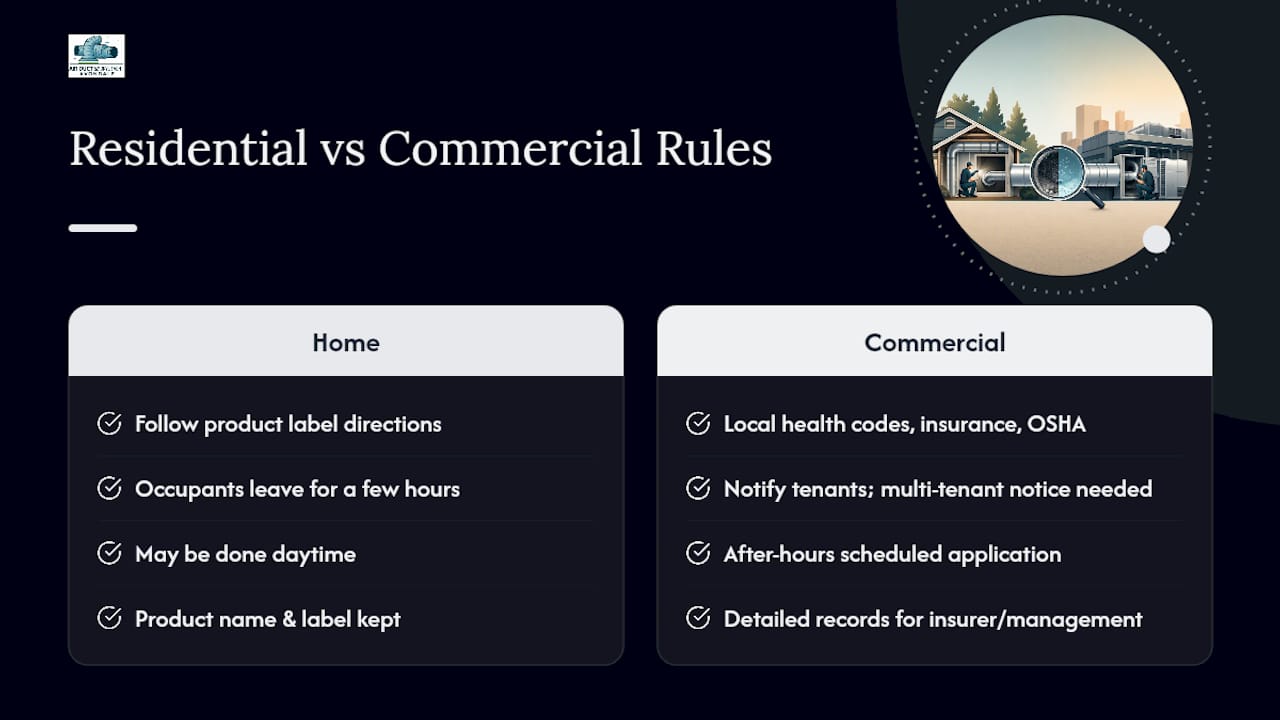
The chemistry doesn't change between a house and an office building, but the compliance stakes often do. Commercial properties frequently answer to additional layers: local health codes, insurance requirements, and in some cases OSHA workplace exposure considerations for employees who'll be in the building during and after treatment.
Multi-tenant commercial buildings also raise a practical issue residential jobs rarely face: notifying occupants. A single-family home might just need the occupants to leave for a few hours per the product label. An office building or retail space may need a scheduled after-hours application specifically so no one is present during the dwell-time window, plus documentation for building management or a property insurer showing what was applied, when, and by whom.
Property managers should ask for the same core documentation homeowners should demand, product name, EPA registration number, and substrate compatibility, but should also keep written records for liability and lease-compliance purposes. If a tenant later reports respiratory symptoms, having the application date, product label, and technician's proof of mechanical cleaning beforehand is the difference between a quick resolution and a drawn-out dispute.
Air Duct and Dryer Vent Cleaning Avondale's commercial air duct cleaning services are built around this reality: commercial jobs generally need more scheduling coordination and documentation than a residential visit, even when the underlying cleaning and treatment steps look similar.
What Antimicrobial Duct Treatment Typically Costs
Pricing depends heavily on square footage, system accessibility, and which method the job calls for. A straightforward spray-and-wipe application on a handful of accessible components costs less than a full-system fogging treatment on a large home or commercial building, and a polymer coating job costs more than either because of labor time and material.
Several variables push price up or down on any given quote:
- System size and duct run length. More linear feet of ductwork means more product and more labor time.
- Application method. Fogging a whole system costs more than spot-treating a drain pan and a few register boots.
- Access difficulty. Crawl spaces, attics, and tight mechanical rooms slow the job down and raise labor cost.
- Contamination severity. Confirmed mold or post-flood jobs sometimes need a more intensive cleaning pass before treatment can even start, which adds to the total.
Treatment should never be quoted as a flat add-on before an inspection happens. A legitimate quote separates the mechanical cleaning cost from the treatment cost, and it should explain why treatment is being recommended for your specific situation rather than bundling it in by default. If a quote lists antimicrobial treatment as a line item with no explanation of what contamination it's addressing, ask why it's there before you approve it.
How A Responsible Local Provider Approaches This Decision
A responsible local provider's field approach follows the same sequence this whole guide has walked through: inspect first, clean to NADCA-aligned standards, and only recommend targeted treatment when contamination actually warrants it. That includes access to air quality testing when a homeowner wants confirmation before authorizing anything beyond standard cleaning.
Before you approve any quote from any provider, run it through a short checklist:
- Did they inspect or test before recommending treatment, or just quote it upfront?
- Does the quote separate mechanical cleaning from any chemical add-on, with a clear reason for each?
- Can they name the product and its EPA registration number if you ask?
Homeowners who want a full picture of their air quality before deciding on treatment can start with professional air duct cleaning and go from there based on what an inspection actually finds.
The Gap Between What Gets Marketed and What Actually Holds Up
Most of the antimicrobial pitches homeowners hear are built backward. A technician notices a musty smell, mentions "mold spores," and offers a spray treatment as the fix, all without ever opening the ductwork to check. That sequence should worry you more than the smell does.
The regulatory reality is blunter than most sales conversations let on. These are pesticides. They're registered for specific surfaces and specific uses, and the EPA has been explicit that there's no registered product for insulated duct liners because the material itself is the problem, not something a chemical can neutralize. When a company treats that limitation as a technicality instead of a hard stop, that's the moment to get a second opinion.
What actually holds up under scrutiny is unglamorous: clean the system properly first, test before you spray anything, match the product to the surface, and fix the moisture source that caused the contamination in the first place. None of that sells as easily as a "permanent protection" coating. All of it is what separates a job that solves the problem from one that just delays it three months and rebills you.
— Shaun
Sources
FAQ
What Is The Best Antimicrobial Spray For Ductwork?
There's no universal "best" product. Chlorine dioxide foggers and quat-based sprays work well for accessible metal surfaces after cleaning, while polymer coatings like PermaSafe's SHIELD suit situations needing longer protection on coils and pans. The right choice depends on your substrate and confirmed contamination type.
How Can I Disinfect My Air Ducts Myself?
You legally can't apply most EPA-registered duct disinfectants yourself, since labels typically restrict use to trained applicators. Homeowners can, and should, handle the basics: change filters regularly, clear condensate drains, and control indoor humidity, which do more to prevent regrowth than any DIY spray.
What Causes Microbial Growth In Air Vents?
Microbial growth almost always traces back to moisture, from condensation, a leaking roof, high indoor humidity, or a clogged condensate drain, combined with organic debris like dust for the microorganisms to feed on. Fix the moisture source, and you remove the condition that made growth possible.
Does Cleaning Your Air Ducts Really Work?
Mechanical duct cleaning, done to NADCA-aligned standards, effectively removes dust, debris, and surface contamination that antimicrobial products alone cannot address. It's the necessary first step before any chemical treatment, and for most routine cases with no confirmed biological contamination, it's the only step you need.