
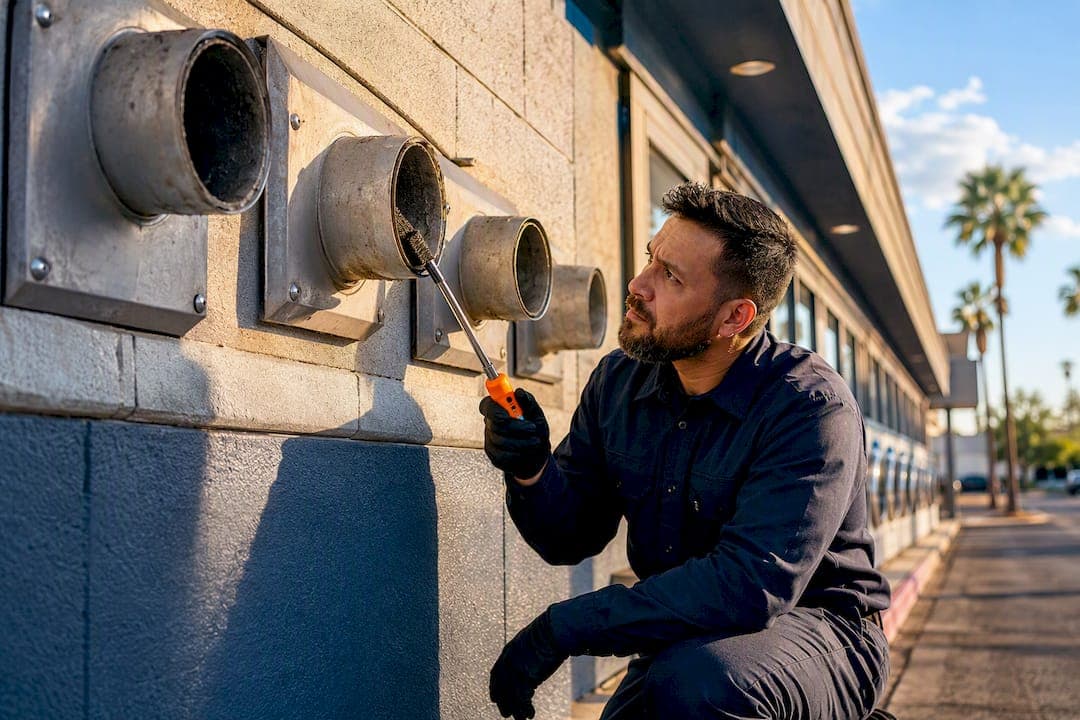
Commercial dryer vent cleaning cost in Avondale typically runs $100 to $200 per unit for straightforward setups, with multi-unit and rooftop-terminated systems priced as projects that climb higher based on access and vent length. The two biggest swing factors are system complexity and how hard the vents are to reach. The fastest way to lock in a real number is a site inspection and itemized estimate rather than a phone guess.
TL;DR:
- Commercial dryer vent cleaning costs depend heavily on system complexity, access difficulty, and whether it's a single unit or full project, with prices ranging from $100 to over $200 per unit.
- Additional fees, such as roof access, booster fan service, or blockage removal, can significantly increase the total cost, making itemized quotes essential for accurate budgeting.
- Property types like laundromats, hotels, and apartment complexes require regular cleaning every 3 to 6 months to prevent fire hazards and maintain efficiency.
- Getting an on-site inspection and detailed, written estimates before work begins ensures accurate pricing and helps avoid hidden charges or incomplete bids.
- Comparing bids requires understanding the different pricing models and requesting itemized breakdowns for upfront clarity, especially when multiple sites or complex vent systems are involved.
Table of Contents
- How Commercial Dryer Vent Cleaning Pricing Is Calculated
- Which Commercial Properties Need Professional Dryer Vent Cleaning?
- Typical Price Ranges and Example Scenarios for Avondale Properties
- What a Professional Commercial Dryer Vent Cleaning Service Delivers
- Checklist to Get an Accurate Quote Quickly
- Cleaning Frequency and the Cost of Skipping It
- What to Expect When You Hire Air Duct and Dryer Vent Cleaning Avondale
- Contract Terms and Cancellation Policies to Check Before You Sign
- What Avondale Property Managers Get Wrong About This Cost
- Book a Commercial Inspection and Get an Itemized Quote
- Sources
- FAQ
How Commercial Dryer Vent Cleaning Pricing Is Calculated
Vendors quote commercial jobs three different ways, and knowing which model applies to your property changes how you read a bid. Per-linear-foot pricing charges based on vent run length, commonly landing between $3 and $7 per foot depending on the pricing factors vendors use like contamination level and access. Per-unit pricing charges a flat rate for each dryer, which works well for standardized laundry rooms with identical setups. Project-based pricing covers everything as one bundled fee, typical for large laundromats or buildings with shared risers feeding a single rooftop termination.
Add-on fees are where quotes diverge the most, and they're worth asking about before you compare two bids side by side:
- Roof access surcharge: $75 to $150 when technicians need ladder or rooftop work to reach terminations
- Booster fan service: $50 to $100 for inspecting and cleaning inline fans that push exhaust through long runs
- Heavy blockage or bird nest removal: $120 to $250 when lint has compacted or wildlife has nested in the vent
- After-hours premiums: 25% to 50% above standard rates for evening or weekend service to avoid disrupting business operations
Volume discounts matter too. A property with 20 dryers on one site pays less per unit than a property with three, since the vendor's travel and setup costs get spread across more work. Ask any provider directly whether their quote already reflects a volume rate or whether it's still priced at single-unit levels.
Which Commercial Properties Need Professional Dryer Vent Cleaning?
If your property runs dryers for anyone other than a single household, you're almost certainly in commercial territory. Laundromats, apartment complex laundry rooms, hotels, assisted living facilities, and salons that use dryers all fall into this category, and each has cleaning needs that scale with usage.
Certain building configurations push a job into commercial scope even at moderate dryer counts:
- Shared vertical risers feeding multiple units into one exhaust line
- Rooftop terminations requiring ladder access or fall protection
- Booster fans installed to overcome long horizontal or vertical runs
- Multiple dryers venting into a single manifold system
Watch for warning signs that your current schedule isn't keeping up: dryers taking noticeably longer to finish a load, recurring lint blockages between service visits, or clothes still damp after a full cycle. These point to airflow problems that routine dryer vent cleaning usually resolves.
Typical Price Ranges and Example Scenarios for Avondale Properties
Budgeting gets easier once you can match your property to a realistic price band. Here's how three common Avondale scenarios typically shake out:
- Single-unit or simple run: A standalone commercial dryer with a short, straight vent run typically falls in the $100 to $200 range per unit, the same baseline commercial pricing cited across the industry for uncomplicated setups.
- Small laundromat bundle: A facility with 8 to 12 dryers sharing similar vent configurations often qualifies for a volume discount, bringing the per-unit average down even though the total project cost is higher.
- Complex shared-system or rooftop project: Buildings with manifolds, booster fans, or roof terminations get quoted as full projects rather than per unit, with roof access ($75 to $150), booster fan service ($50 to $100), and heavy blockage removal ($120 to $250) added as line items on top of the base cleaning fee.
Property managers overseeing multiple sites should request the same itemized breakdown for each location. Costs vary block to block based on building age, vent routing, and how the original HVAC contractor ran the ductwork.
What a Professional Commercial Dryer Vent Cleaning Service Delivers
A real commercial cleaning service starts with an inspection, not a hose. Ask any vendor to document the scope with photos or video before work begins, since before/after documentation and written reports are standard trust signals for commercial accounts, not optional extras.
The actual cleaning method depends on the vent configuration:
- Rotary brush and vacuum systems handle most straight or gently curved runs and remove compacted lint efficiently
- Rod and line cleaning works better for long or oddly angled runs where a rotary head can't maneuver
- Booster fan servicing and minor repairs get flagged during inspection when airflow problems trace back to hardware rather than lint buildup
A complete job ends with a written report and some form of warranty or service guarantee, giving you a paper trail if problems recur before the next scheduled cleaning.
Checklist to Get an Accurate Quote Quickly
Vendors give sharper, faster quotes when you hand them the right details upfront instead of making them guess over the phone.
- Count your dryers and note their locations across the property
- Sketch or photograph the vent routing, including any shared risers or rooftop terminations
- Note the date of the last professional cleaning, if known
- Take a few photos of visible vent hardware, especially exterior terminations
- Ask the vendor directly: what equipment do they use, do they charge access surcharges, do they provide written documentation, are they insured, and can they provide references from other commercial accounts?
Watch for vendors who won't put a scope of work in writing before starting. That's a red flag worth walking away from.
Pro Tip: Send photos of your vent terminations and a rough floor plan before the site visit. Vendors who can pre-scope the job from photos usually give tighter, more accurate quotes on the spot instead of padding for unknowns.
Cleaning Frequency and the Cost of Skipping It
Recommended intervals depend heavily on usage. Laundromats and high-throughput facilities should schedule cleaning every 3 to 6 months, while apartment complexes and hotels can usually stretch to 6 to 12 months. Lower-use properties like small salons often do fine on an annual schedule.
Skipping maintenance carries real risk. The U.S. Fire Administration identifies lint accumulation as a leading cause of dryer-related fires, and neglected vents also waste energy by forcing dryers to run longer per cycle. Scheduled cleaning tends to pay for itself within a single service cycle through lower energy costs and fewer emergency repair calls.
What to Expect When You Hire Air Duct and Dryer Vent Cleaning Avondale
Air Duct and Dryer Vent Cleaning Avondale handles commercial air duct cleaning and dryer vent service for laundromats, apartment complexes, and other Avondale businesses, with flexible scheduling that includes after-hours appointments so cleaning doesn't interrupt operations. Every commercial job starts with an on-site inspection and an itemized estimate, so free inspections and clear quotes are the standard path to an accurate price rather than a phone-guess figure. Services come backed by warranties, giving property managers a documented record for insurance or compliance purposes.
Contract Terms and Cancellation Policies to Check Before You Sign
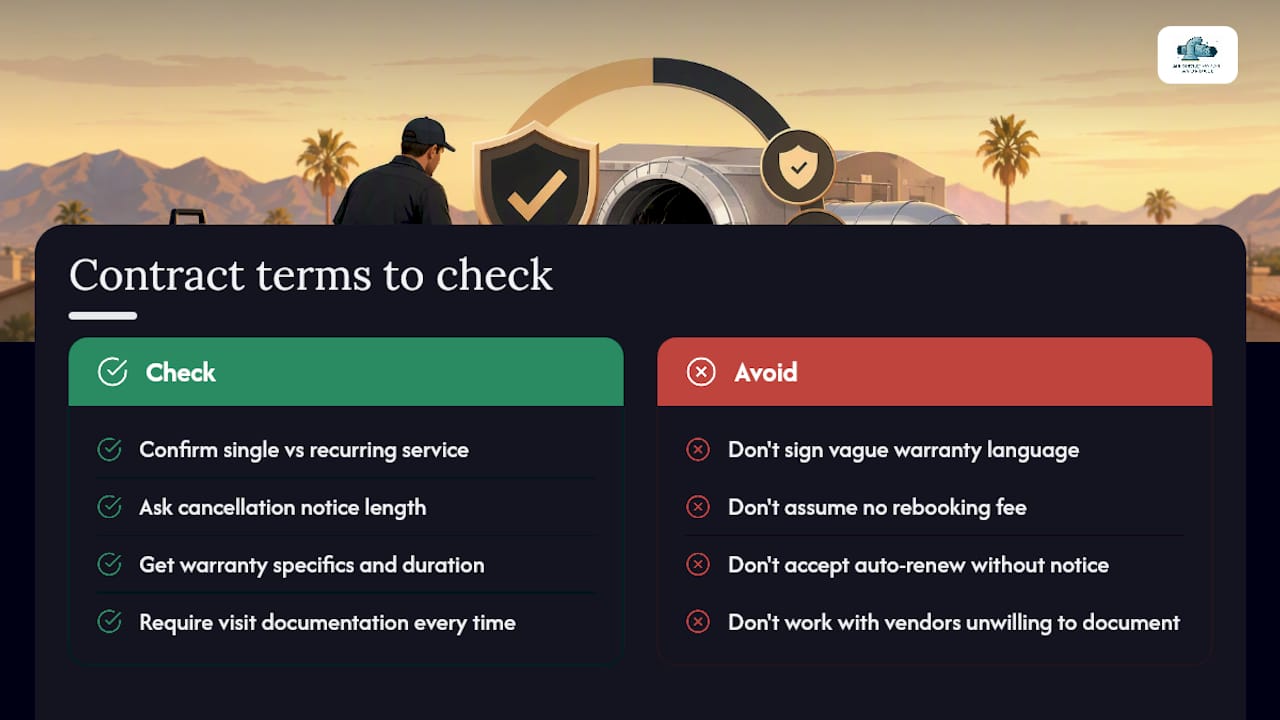
Commercial vent cleaning agreements vary more than most property managers expect, and the fine print matters as much as the price. Before signing anything, confirm whether you're agreeing to a single service or a recurring maintenance contract. Recurring agreements often lock in a lower per-visit rate in exchange for a commitment to quarterly or semiannual service, but that commitment usually comes with a cancellation window. Some vendors require 30 days' written notice to cancel a standing service agreement; others allow month-to-month cancellation with no penalty.
Ask specifically about what happens if a scheduled visit gets skipped or rescheduled. Some contracts charge a rebooking fee for same-week cancellations, especially if a crew was already dispatched or blocked off the time slot. Others build flexibility into the agreement at no extra cost, which matters more for property managers juggling tenant schedules or seasonal closures.
Get the warranty terms in writing too. A cleaning guarantee that covers "airflow restoration" for 90 days means something different than one that only covers "service performed as described." Vague warranty language gives a vendor room to dispute a claim later. Before you sign, ask whether the agreement auto-renews, what triggers a price increase, and whether you can request documentation (photos, written reports) for every visit, not just the first one. A vendor unwilling to spell these terms out clearly is telling you something about how they'll handle a dispute down the line.
What Avondale Property Managers Get Wrong About This Cost
Most budgeting mistakes on this topic come from treating commercial dryer vent cleaning like a bigger version of a residential job. It isn't. A residential quote is basically a fixed number; a commercial quote is a formula built from vent length, unit count, access difficulty, and contamination level, and property managers who don't understand that formula end up comparing bids that aren't actually comparable.
The conventional advice, "get three quotes and pick the cheapest," falls apart here because the cheapest bid often excludes access fees or documentation that a competing bid includes. That's not a lower price, it's an incomplete one that surfaces as a change order mid-job.
What should come first: match your property type to a realistic price band before you call anyone, using the ranges in this guide as a starting point. Then request the same itemized breakdown from every vendor you contact, specifically listing roof access, booster fan service, and blockage removal as separate line items. A vendor who can't itemize a quote that way usually hasn't inspected the site closely enough to know what the job actually requires.
— Shaun
Book a Commercial Inspection and Get an Itemized Quote
Skip the guesswork and get a real number for your property. Commercial customers can often arrange for an on-site inspection followed by an itemized estimate, ensuring clarity about costs before work starts, without bundled mystery fees or vague "commercial rate" quotes given over the phone.
Flexible scheduling, including after-hours appointments, means service can happen without shutting down a laundromat or interrupting hotel operations during business hours. Whether you manage a single laundry room or a multi-building apartment complex, the same inspection process applies: a technician documents vent routing, checks for booster fans or rooftop terminations, and hands you a written scope before quoting a final price. Start by requesting an inspection through the dryer vent cleaning page, and get a number you can actually budget around instead of a placeholder estimate that changes once the crew shows up.
Sources
FAQ
What Is the Average Cost to Clean a Commercial Dryer Vent?
Simple per-unit commercial jobs typically run $100 to $200 per unit, while complex systems with rooftop terminations or shared risers are quoted as projects with additional access and equipment fees.
How Long Does a Professional Commercial Dryer Vent Cleaning Take?
Most single-unit cleanings take about 30 minutes, but multi-unit laundromats or buildings with rooftop access can take several hours depending on vent count and complexity.
Is Professional Dryer Vent Cleaning Necessary for Commercial Properties?
Yes. Commercial dryers run far more cycles than residential units, and the U.S. Fire Administration flags lint buildup as a leading cause of dryer-related fires, making regular professional cleaning a safety and efficiency necessity.
Can a Handyman Clean a Commercial Dryer Vent?
A handyman can handle basic lint removal on simple, accessible vents, but commercial systems with booster fans, rooftop terminations, or shared risers need a technician equipped for rotary brush or rod cleaning and proper documentation.
How Often Should Commercial Properties Schedule Dryer Vent Cleaning?
Laundromats and high-throughput facilities should schedule cleaning every 3 to 6 months, apartment complexes and hotels every 6 to 12 months, and lower-use properties annually.