
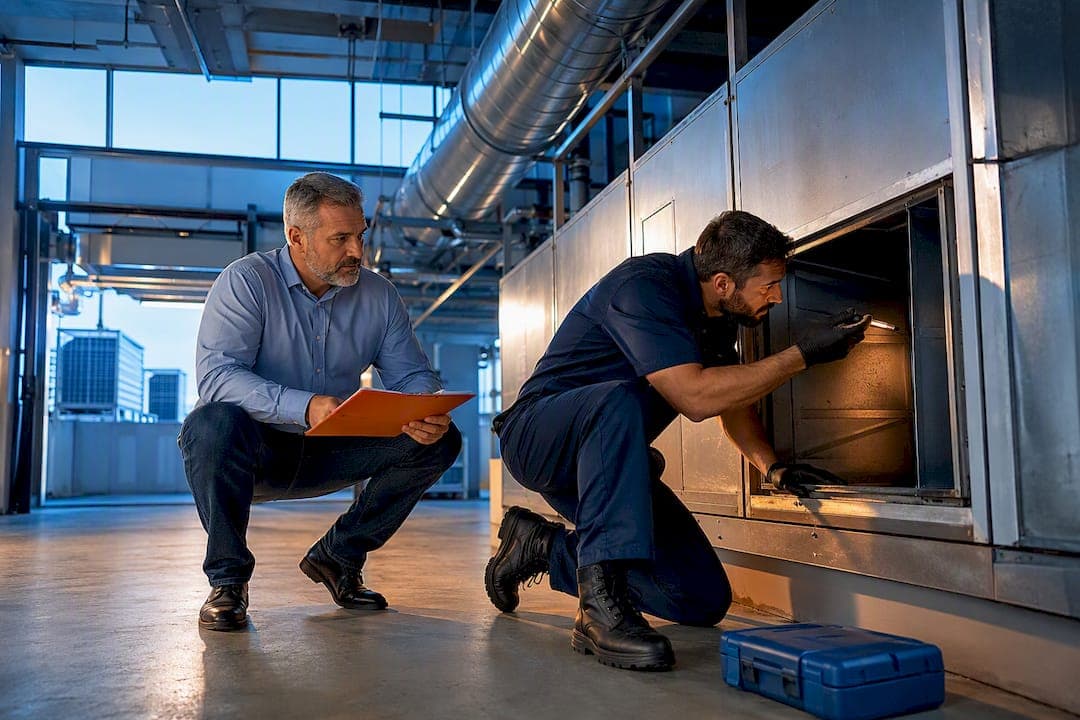
Most commercial duct cleaning jobs run between $0.15 and $0.60 per square foot, with small systems landing around $600 to $2,000 and large or contaminated systems climbing past $3,000. Some contractors charge hourly instead, typically $90 to $150 per hour. The real number for your building depends on square footage, ductwork access, and contamination type, which is why NADCA-affiliated firms and groups like Airanddryerventcleaningavondale insist on a site walkthrough before quoting.
TL;DR:
- Most commercial duct cleaning costs range from $0.15 to $0.60 per square foot, with larger or contaminated systems exceeding $3,000.
- Prices vary significantly based on building type, ductwork access, contamination severity, and the number of HVAC units involved.
- Contractors use different pricing models, including per square foot, per system, hourly, or flat bids, so comparing bids requires understanding these structures.
- Additional charges for coil cleaning, antimicrobial treatment, permits, or after-hours work often inflate the total, so ask for detailed, itemized quotes.
- Skipping a site walkthrough and accepting verbal estimates can lead to underbidding or missing scope details; always request a comprehensive, written quote.
Table of Contents
- How Much Does Commercial Duct Cleaning Cost by Building Type?
- What Factors Actually Drive Your Commercial Quote?
- Which Pricing Model Should You Expect on Your Quote?
- What Add-Ons and Hidden Fees Should You Watch For?
- How Do You Get an Accurate Commercial Duct Cleaning Quote?
- How Often Should Commercial Ductwork Get Cleaned?
- What Does a Proper Commercial Duct Cleaning Scope Look Like?
- What Actually Matters When You're Budgeting This
- Get a Free Commercial Walkthrough and Itemized Quote
- Where to Verify These Numbers Yourself
- Sources
- FAQ
How Much Does Commercial Duct Cleaning Cost by Building Type?
The building type on your quote matters almost as much as the square footage. A single-story office with standard rooftop units costs far less to clean than a restaurant kitchen fighting years of grease buildup, and pricing guides reflect that gap consistently.
Published industry ranges put commercial duct cleaning service prices at $0.30 to $0.60 per square foot on average, with hourly rates between $90 and $150 for smaller jobs where square footage alone doesn't capture the labor involved. Other sources report a wider band, from $0.15 to $0.85 per square foot, which tells you how much local market and scope shift the final bid.
Sample totals for common building types vary significantly. For example, smaller office spaces usually cost less, retail shops somewhat more, and medical or dental offices often require specialized service leading to moderate pricing. Large office buildings, restaurants with kitchen exhaust cleaning, and warehouses or industrial facilities generally require higher overall budgets due to size or specialized cleaning needs.
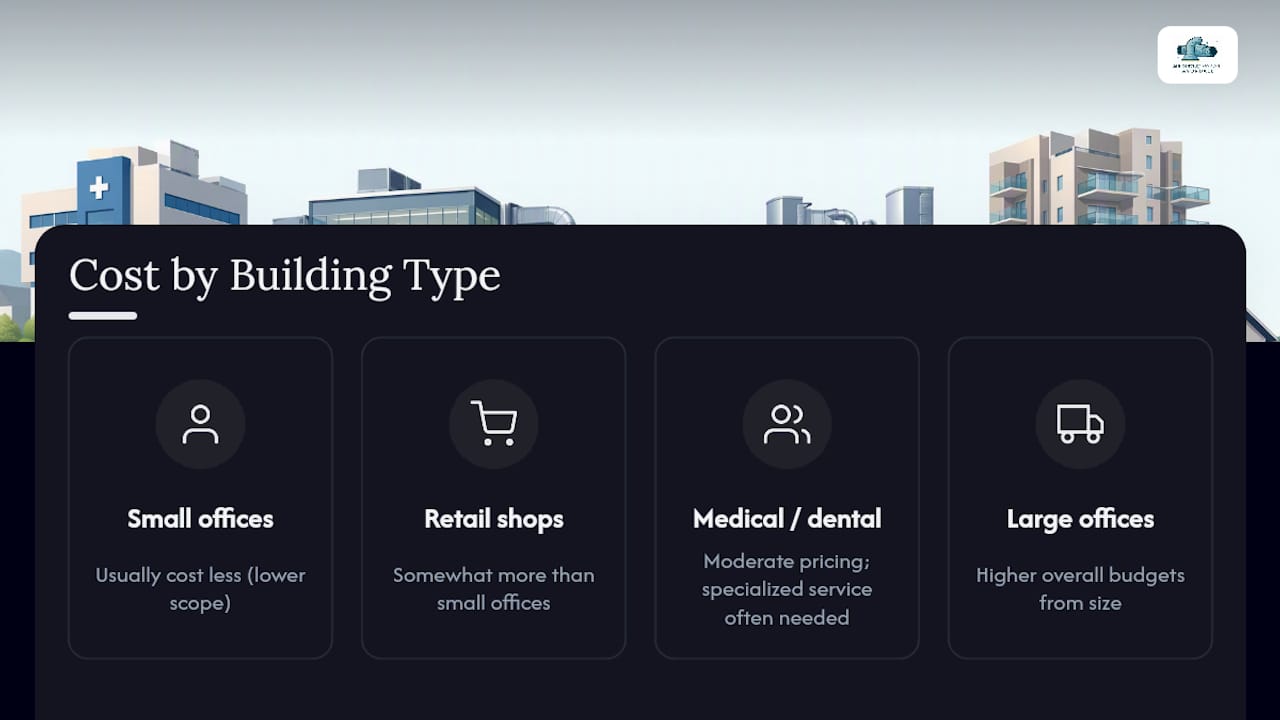
Restaurants and healthcare facilities sit at the top of that range because grease and stricter air-quality standards demand extra labor and specialized equipment. Warehouses often look cheap per square foot, but a sprawling 100,000-square-foot facility can still land in the thousands once you multiply that low rate across the whole system.
What Factors Actually Drive Your Commercial Quote?
Contractors don't price commercial jobs off a single number. They build the quote from several variables, and understanding each one helps you spot a lazy estimate before you sign anything.
Square footage versus linear feet. Small, simple systems get priced per square foot. Larger commercial buildings with sprawling ductwork often get measured in linear feet instead, especially when the ducts run through multiple zones or floors.
Number and type of units. A building with three rooftop units (RTUs) costs less to service than one with twelve air handling units (AHUs) feeding different zones. Multi-zone complexity adds inspection time and equipment setup at each access point.
Access and labor complexity. Ductwork above a 20-foot ceiling requires a lift. Rooftop units mean a crew climbing onto the roof with equipment. Confined crawlspaces slow everything down. Each of these adds labor hours that show up as line items.
Contamination type. Dust and pollen are the cheapest problem to solve. Mold requires containment and sometimes remediation protocols. Grease, common in commercial kitchens, needs degreasing agents and often falls under NFPA 96 compliance requirements.
Labor rates and overhead. After-hours work, permits, and insurance requirements all get baked into the final number, particularly for facilities that can't shut down HVAC systems during business hours.
- Square footage or linear footage of ductwork
- Number and type of HVAC units
- Ceiling height and access difficulty
- Contamination severity
- Labor rate, permits, and after-hours premiums
Pro Tip: Ask your contractor to separate the quote into "access and labor" versus "cleaning and materials." That split alone reveals whether a low bid is skipping a step or genuinely running a leaner operation.
Which Pricing Model Should You Expect on Your Quote?
Commercial contractors use four common pricing structures, and knowing which one you're looking at makes comparing bids far easier.
- Per square foot. Best for straightforward buildings with open, accessible ductwork. A 10,000-square-foot office at $0.40 per square foot lands at $4,000.
- Per system or RTU. Common when a building has a handful of distinct HVAC units rather than one continuous network. Pricing might run $150 to $400 per unit depending on size.
- Hourly. Used for smaller or unusually complex jobs where square footage doesn't reflect the labor. Expect $90 to $150 per hour.
- Flat bid. Larger facilities often get one negotiated number covering the entire scope, built from a walkthrough rather than a formula.
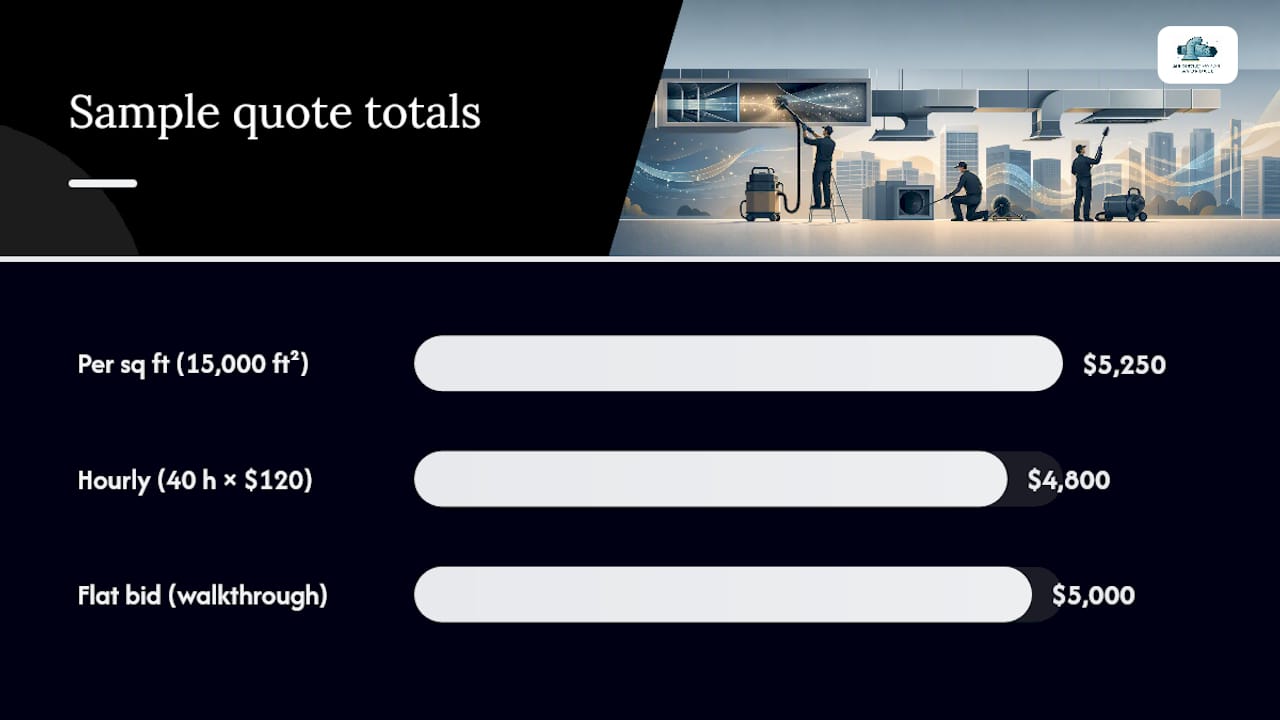
Take a 15,000-square-foot retail building as an example. Priced per square foot at $0.35, that's $5,250. Priced hourly at an estimated 40 hours and $120 per hour, that's $4,800. Priced as a flat bid after a walkthrough, a contractor might land at $5,000 once they've accounted for four rooftop units and moderate dust buildup. All three should land in a similar range. If one bid comes in dramatically lower, ask what's missing before you assume you found a deal.
Add-ons like coil sanitizing or antimicrobial treatment sit on top of whichever base model you're comparing, so factor those in before judging which bid actually wins.
What Add-Ons and Hidden Fees Should You Watch For?
The base cleaning number rarely tells the whole story. Most commercial invoices include extras that either apply to your specific building or get tacked on as upsells you didn't need.
Common legitimate add-ons include coil and blower cleaning, antimicrobial or sanitizing treatment, access panel installation where none currently exists, filter replacement, and kitchen hood or grease exhaust cleaning. That last one often gets billed separately because NFPA 96 compliance requires specific methods and documentation that standard duct cleaning doesn't cover.
Environmental testing, asbestos or lead abatement, and permit fees apply in older buildings or heavily regulated facilities like healthcare offices. These aren't universal costs, but when they apply, they can add several hundred dollars or more depending on scope.
- Coil, blower, or grease-exhaust cleaning
- Antimicrobial treatment or air-quality testing
- Access panel installation
- Permit fees and after-hours or emergency premiums
- Travel or equipment surcharges for large facilities
One overlooked reality: entry-level "special" pricing in the commercial space is a known bait tactic. NADCA warns explicitly that advertised low-cost offers often precede aggressive upsells once a crew is already on site. Ask for a written, itemized estimate for every add-on before work begins, not a verbal "we'll figure it out once we're there."
How Do You Get an Accurate Commercial Duct Cleaning Quote?
Getting a number you can actually trust takes a bit of preparation on your end, not just a phone call.
- Request a free on-site walkthrough. Any reputable contractor needs to see your ductwork, unit count, and access points before quoting real numbers. Provide mechanical drawings if you have them.
- Insist on an itemized quote. It should list scope, equipment used, estimated labor hours, and deliverables like before-and-after photos or test reports.
- Get three quotes and standardize the ask. Give each contractor the same assumptions: same square footage, same after-hours requirements, same number of units.
- Ask direct qualification questions. Are technicians NADCA certified? Is the company insured? Can they provide references from similar commercial jobs? What equipment and chemicals will they use?
- Watch for red flags. A $99 whole-building offer, refusal to itemize scope, or high-pressure upselling on-site are all signs to walk away.
Pro Tip: Save every quote in writing, even the ones you reject. If a contractor later tries to add charges mid-job, you have a documented baseline to push back against.
How Often Should Commercial Ductwork Get Cleaned?
Recommended intervals vary sharply by building type. Restaurants often need attention every three to six months because of grease accumulation. Healthcare facilities typically run on annual schedules tied to air-quality standards. General offices and retail spaces usually do fine every two to three years, while warehouses depend heavily on what's stored and how much dust the operation generates.
Recurring maintenance contracts tend to lower the per-visit rate compared to one-off emergency calls, and they make annual budgeting far more predictable. There's also a performance angle: buildup in ductwork restricts airflow, and cleaner systems typically run more efficiently, which can shorten equipment strain over time.
When negotiating a contract, ask for:
- Defined service intervals in writing
- Emergency response terms and turnaround time
- Documentation deliverables after every visit
What Does a Proper Commercial Duct Cleaning Scope Look Like?
A trustworthy quote isn't just a number. It's backed by a process. Airanddryerventcleaningavondale's commercial air duct cleaning service starts with exactly the walkthrough this guide keeps recommending, followed by an itemized quote that spells out scope, equipment, and cost before anyone touches a duct.
That process typically produces:
- A written scope covering square footage, unit count, and contamination level
- Before-and-after photo documentation
- Optional air-quality testing when a facility needs it for compliance or tenant concerns
- Warranty terms on completed work
- Flexible and after-hours scheduling so cleaning doesn't disrupt business operations
If a vendor can't produce this list on request, that's worth noting before you sign anything.
What Actually Matters When You're Budgeting This
Here's my honest read after going through the pricing mechanics above: the cheapest quote is rarely the smartest one. Facility managers who get burned usually skipped the walkthrough step and took a phone quote at face value.
Do three things before you approve any budget line. Schedule a walkthrough. Collect three itemized quotes built on the same assumptions. Compare scope, not just the bottom-line number. A quote that's $500 cheaper but skips coil cleaning or documentation isn't actually cheaper once you account for what it leaves out.
Prioritize documented process and NADCA-aligned methods over the lowest bid, and think in terms of total cost of ownership rather than a single invoice.
— Shaun
Get a Free Commercial Walkthrough and Itemized Quote
Skipping the guesswork on commercial pricing starts with getting an actual number for your building, not a phone estimate based on square footage alone. Airanddryerventcleaningavondale handles commercial duct cleaning across office buildings, retail spaces, restaurants, and warehouses, with every job starting from a free on-site walkthrough rather than a blind bid.
That walkthrough turns into a written, itemized quote covering scope, equipment, and labor, backed by before-and-after photo documentation and optional air-quality testing when your facility needs it for compliance or tenant peace of mind. Work comes with warranty coverage and flexible scheduling, including after-hours service so cleaning crews aren't disrupting your business day. If your facility is overdue for a real assessment instead of a guess, request a free commercial duct cleaning quote and get an itemized number based on your actual building, not an industry average.
Where to Verify These Numbers Yourself
- NADCA — industry standards for duct cleaning methods and guidance on avoiding pricing scams
- Housecall Pro — published rate guides covering per-square-foot and hourly commercial pricing
- AirDuctIQ — building-type cost breakdowns, including restaurant and healthcare specifics
- U.S. Department of Energy — background on airflow efficiency and HVAC energy performance
- American Lung Association — health-based guidance on when indoor air issues warrant inspection
Sources
- Duct Cleaning Price Guide 2026: Average Rates & How to Charge
- Commercial Air Duct Cleaning Cost: What Businesses Should Expect | AirDuctIQ
- Pro tips: avoiding air duct cleaning scams | NADCA
FAQ
How much does commercial duct cleaning typically cost?
Most jobs fall between $0.15 and $0.60 per square foot, with small systems costing $600 to $2,000 total and large or heavily contaminated systems running $3,000 or more. Hourly rates typically run $90 to $150 when square footage doesn't fit the job.
Why do restaurants pay more than offices for duct cleaning?
Grease buildup in kitchen exhaust systems requires specialized degreasing methods and often falls under NFPA 96 compliance rules, which adds labor and equipment costs that standard office ductwork doesn't require.
How often should a commercial building get its ducts cleaned?
Intervals vary by building type: restaurants often need service every three to six months, healthcare facilities typically go annually, and general offices or retail spaces usually run every two to three years.
What's a red flag when comparing commercial quotes?
A rock-bottom flat rate like a $99 whole-building special, refusal to provide an itemized written scope, or aggressive on-site upselling are all signs of a bait-and-switch tactic rather than a genuine estimate.
Should I get multiple quotes before choosing a contractor?
Yes. Getting three quotes built on the same assumptions, same square footage, same after-hours needs, is the most reliable way to catch a bid that's cutting corners rather than genuinely running lean.