
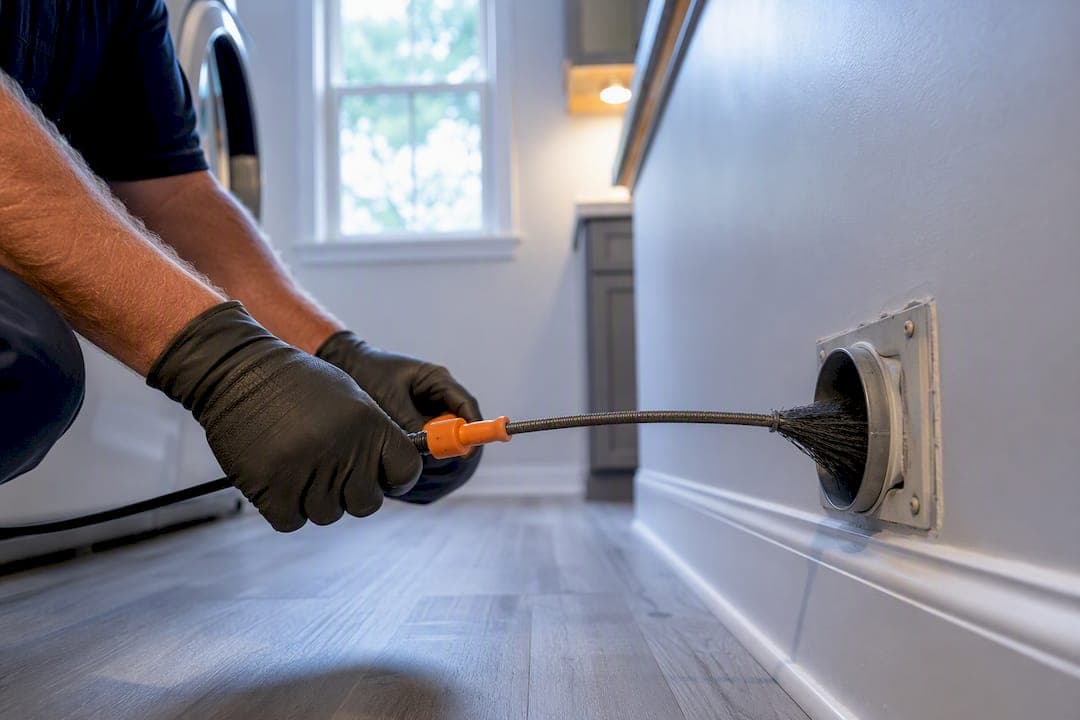
Clean your dryer vent at least once a year, full stop. That single habit cuts your risk of a dryer fire and keeps your machine running efficiently, since the CPSC links thousands of home fires annually to clothes dryers and lint buildup. Households with pets, big laundry loads, or long vent runs need to shorten that interval, sometimes to twice a year.
TL;DR:
- Cleaning your dryer vent at least once a year is essential, but households with pets, large loads, or long vents should consider more frequent service.
- Heavy usage, long vent runs, multiple bends, or uninsulated ducts increase the need for cleaning beyond the annual minimum.
- Signs of a clogged vent include longer drying times, hot laundry rooms, a burning smell, weak airflow, or visible lint at the exterior hood.
- DIY maintenance involves cleaning the lint trap daily, clearing the exterior of lint every few months, and vacuuming accessible duct sections; professional cleaning is necessary for long or obstructed ducts.
- Professional services include comprehensive inspection, rotary brushing, vacuuming, and airflow testing, typically taking 30 to 90 minutes and addressing hidden issues that DIY methods can't reach.
Table of Contents
- How Often to Clean a Dryer Vent: Frequency Guidelines
- What Makes a Dryer Vent Need More Frequent Cleaning?
- How Do You Know If Your Dryer Vent Is Clogged?
- DIY Dryer Vent Maintenance You Can Do Between Cleanings
- What Does a Professional Dryer Vent Cleaning Involve?
- When Should You Schedule Cleaning, and What Should You Tell the Technician?
- Field Notes: What Actually Goes Wrong in Homes and Rentals
- Book Dryer Vent Cleaning With Air Duct and Dryer Vent Cleaning Avondale
- Sources
- FAQ
How Often to Clean a Dryer Vent: Frequency Guidelines
Most homeowner guidance settles on a simple number: once a year. AHS recommends cleaning dryer vents at least annually as a baseline, and that advice holds up whether you live alone or run a full household. But "once a year" isn't a universal rule so much as a starting point that shifts based on how hard you work your dryer.
Think of it less as a calendar reminder and more as a formula tied to usage. Here's how that breaks down in practice:
- Single-person households: Annual cleaning is usually enough, since laundry volume stays low.
- Families of four or more: Plan on cleaning every 6 to 9 months, since laundry volume climbs fast with kids in the house.
- Heavy-use homes (daily loads, large families, home businesses): More frequent cleaning than annually is recommended.
- Rental units and multi-family properties: Property managers should schedule cleaning annually at minimum, more often if turnover is high or tenants run dryers constantly.
SERVPRO's guidance echoes this pattern, pointing out that heavy laundry households often need service twice a year rather than once. The exceptions matter more than the baseline. A vent that runs 30 feet with four bends behaves nothing like a straight 6 foot shot to an exterior wall, and that difference alone can double how often lint needs to come out.
What Makes a Dryer Vent Need More Frequent Cleaning?
Some households simply generate more lint, faster. Pets that shed heavily add fur to every load, and towels or bedding shed more fiber than a standard wardrobe wash. If you're doing multiple loads a day, whether from a large family or a small home business, lint accumulates on a compressed timeline that a once-a-year schedule can't keep up with.
Vent geometry matters just as much as usage. A few conditions that push you toward more frequent service:
- Long vent runs (over 25 feet) or vents with multiple 90 degree bends.
- Uninsulated ducts running through unconditioned attics or crawl spaces.
- Roof or wall terminations, which trap moisture and lint more than a simple exterior wall vent.
- A history of vent problems, animal nests, or nonstandard vent materials like foil ducting instead of rigid or semi-rigid metal.
Pro Tip: If your dryer vent terminates on the roof, check it twice a year instead of once. Birds and rodents are drawn to the warm, moist airflow, and a nest can block a vent completely within a season.
How Do You Know If Your Dryer Vent Is Clogged?
A clogged vent rarely stays quiet about it. The signs show up in your laundry routine before they show up as a fire hazard, if you know what to watch for.
- Drying takes longer than it used to. If a load that dried in 40 minutes now takes over an hour, restricted airflow is the likely culprit, according to Whirlpool's product guidance on blocked vents.
- The laundry room feels noticeably hot or the dryer itself is hot to the touch on the outside panel.
- You smell something burning or musty, which signals trapped lint or moisture buildup inside the duct.
- Little to no airflow at the exterior hood. Hold your hand near the outside vent while the dryer runs; weak or absent airflow means lint is blocking the path.
- Visible lint clinging to the exterior hood flap, which often means the interior duct is worse than what you can see.
A burning smell demands you stop the dryer and call a professional immediately. Slower drying times without an odor can usually wait for a scheduled cleaning, but don't let it wait too long.
DIY Dryer Vent Maintenance You Can Do Between Cleanings
Good habits between professional visits do more to prevent buildup than any single deep clean. Clean the lint trap after every load. Sounds obvious, but skipping it even occasionally lets fine lint escape into the duct where it's much harder to remove.
Beyond that daily habit, a few periodic tasks keep the system in check:
- Clear the exterior hood flap of visible lint every few months.
- Vacuum accessible sections of ducting, especially near the dryer connection.
- Wash the lint screen with soap and a soft brush every month or two to clear the fabric-softener film that regular brushing misses, a tip Home Depot covers in its dryer vent guide.
Avoid pushing lint deeper into the duct with a vacuum hose that isn't long enough to actually pull it out. Never use flammable solvents to clean lint residue. And don't ignore the exterior termination just because the interior looks fine.
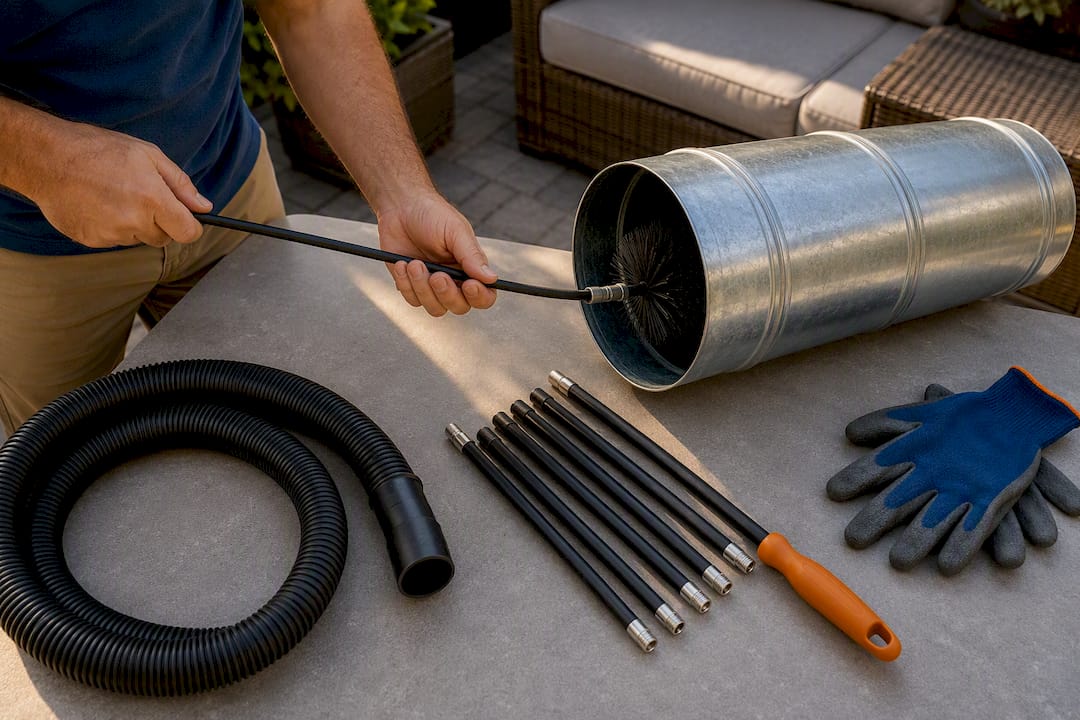
Pro Tip: A flexible brush kit reaches farther than a vacuum hose alone. Once your duct run exceeds 10 or 15 feet, DIY tools stop being enough, and that's your cue to bring in a professional.
What Does a Professional Dryer Vent Cleaning Involve?
A professional visit covers ground that DIY tools generally can't reach. The typical process includes:
- A full inspection of the vent run, from the dryer connection to the exterior termination.
- Rotary brushing to dislodge compacted lint along the entire duct length.
- High-powered vacuuming to remove loosened debris rather than just push it around.
- Cleaning both the interior connection point and the exterior hood.
- An airflow check after cleaning to confirm the fix worked.
- A written report flagging any damage, disconnected sections, or code issues found along the way.
Most residential jobs take 30 to 90 minutes, depending on vent length, number of bends, and how accessible the duct run is. Pricing is typically based on that same complexity, not a flat fee across every home. If a technician finds crushed ducting, disconnected joints, or a vent that terminates incorrectly, they'll usually recommend repair or replacement before continuing, since cleaning around a structural problem doesn't fix the underlying risk.
When Should You Schedule Cleaning, and What Should You Tell the Technician?
Some signs mean you call today, not next month. Others just mean it's time to put something on the calendar.
- Call immediately if you notice a burning smell, visible smoke, or a dryer that shuts off mid-cycle from overheating.
- Schedule routine service soon if drying times have crept up despite a clean lint trap, or if you see lint collecting at the exterior hood.
- When you book, tell the technician your dryer's brand and type (gas or electric), the approximate vent route and length, any recent renovations near the laundry area, signs of animals near the exterior vent, and roughly how many loads you run per week.
- Expect the technician to deliver a safety check, a measured airflow reading before and after cleaning, and a written estimate for any repairs beyond standard cleaning.
Field Notes: What Actually Goes Wrong in Homes and Rentals
The pattern shows up over and over: long vent runs with too many bends, exterior hoods clogged by nests, and homeowners who assume a clean lint trap means a clean system. It doesn't. The rest travels down the duct and settles wherever airflow slows down, usually at a bend or a loose joint.
If you manage a rental property, don't wait for a tenant complaint to trigger an inspection. Annual cleaning as a floor, six months for high-turnover units, will save you a fire claim down the road.
— Shaun
Book Dryer Vent Cleaning With Air Duct and Dryer Vent Cleaning Avondale
Skipping a year (or two) of dryer vent maintenance is an easy mistake to make and a hard one to catch yourself, since lint buildup happens gradually, out of sight, inside a duct you never look at. Professional companies handle the inspection, cleaning, and any minor repairs in one visit, so you get a documented airflow check instead of a guess about whether your vent is safe.
A professional visit catches what DIY brushing misses: long duct runs, hidden bends, and exterior terminations that trap moisture and nests. That's exactly where fire risk builds. If you manage multiple units, the commercial air duct cleaning service covers larger properties on a schedule that fits turnover cycles. For a single home, book a visit through the dryer vent cleaning page and get a technician out to inspect, clean, and flag any repairs before they turn into a bigger problem.
Sources
For safety data, see the CPSC's dryer safety guidance and USFA's appliance fire prevention resource. For maintenance value, Guestly Homes explains how professional cleaning protects property value.
- CPSC - Electric clothes dryer safety guidance
- AHS - How often should you clean your dryer vent?
- Whirlpool - Dryer vent may be blocked or restricted
- SERVPRO - How to clean dryer duct vents
FAQ
What happens if you never clean your dryer vent?
Lint keeps accumulating until airflow is severely restricted, which raises the internal temperature of the dryer and significantly increases fire risk. The CPSC ties this exact scenario to thousands of home fires every year.
How do you know if your dryer ducts need cleaning?
Watch for longer drying times, a hot laundry room, a burning or musty smell, and lint visible at the exterior vent hood. Any one of these is a sign the duct is restricted and due for cleaning.
How long does it take a professional to clean a dryer vent?
Most residential jobs take 30 to 90 minutes, depending on vent length, the number of bends, and how accessible the ductwork is.
What are the common dryer vent cleaning mistakes?
The biggest ones are relying on the lint trap alone, using a vacuum hose too short to reach the full duct, pushing lint deeper instead of pulling it out, and neglecting the exterior hood termination where nests and debris commonly build up.