
TL;DR:
- Duct sanitizing involves applying EPA-registered antimicrobials after cleaning to eliminate bacteria, mold, and allergens, improving indoor air quality. It must follow thorough cleaning, use EPA-approved products, and include verification steps; sanitizing alone is ineffective. Proper process reduces health risks and ensures lasting air quality, whereas DIY methods or shortcuts often lead to poor results or damage.
Duct sanitizing is the process of applying EPA-registered antimicrobial treatments to HVAC ductwork after mechanical cleaning to eliminate bacteria, mold, and allergens that degrade indoor air quality. This guide to duct sanitizing covers everything homeowners and property managers need to know: what the process involves, how it differs from standard duct cleaning, and the exact steps professionals follow to do it right. Duct sanitizing improves air quality by targeting bacteria, mold, allergens, and odor-causing organisms that mechanical cleaning alone cannot destroy. Done correctly, it supports respiratory health and makes your home or commercial property noticeably more comfortable to breathe in.
What is the difference between duct cleaning and duct sanitizing?
Duct cleaning and duct sanitizing are two separate processes that work together. Confusing them is one of the most common mistakes homeowners make when trying to improve indoor air quality.
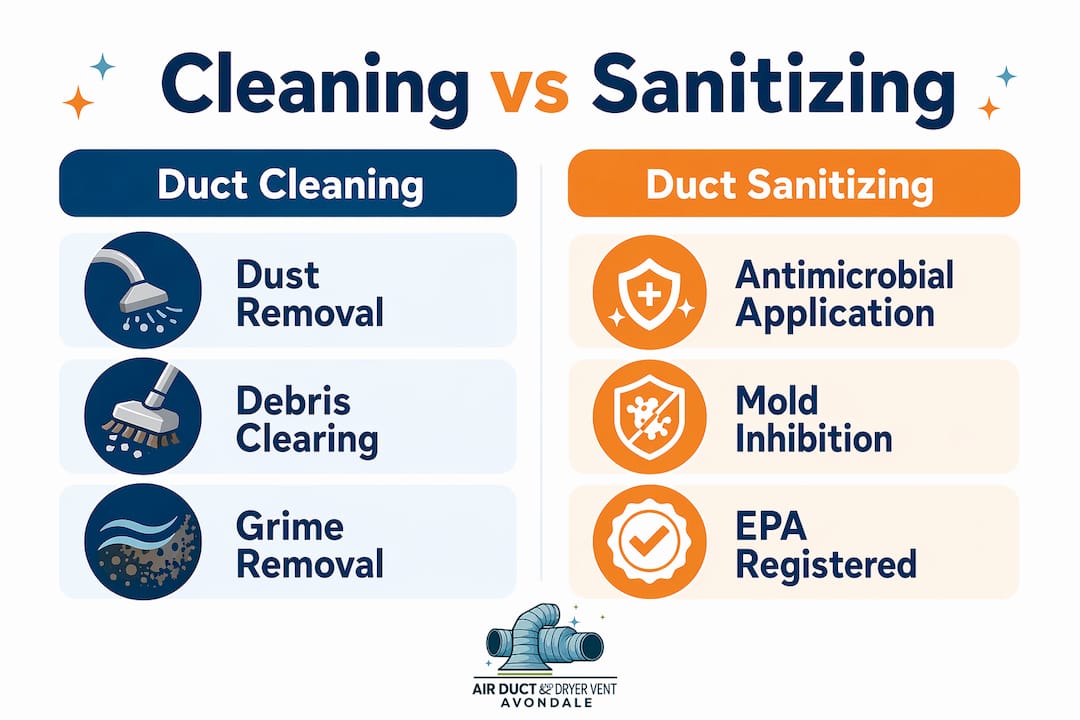
Duct cleaning removes physical debris: dust, pet dander, construction particles, and accumulated grime from duct walls and vents. Technicians use high-powered vacuums, rotary brushes, and compressed air tools to dislodge and extract this material. The goal is a physically clean surface. Think of it as scrubbing a cutting board before you disinfect it.
Duct sanitizing comes after cleaning. It applies an antimicrobial agent to the now-exposed duct surfaces to kill bacteria, mold spores, and other microorganisms. Sanitizing over dirty ducts is ineffective because debris blocks the antimicrobial agent from making contact with duct walls. You cannot skip cleaning and expect sanitizing to work.
When does each service apply?
- Cleaning alone is appropriate for routine maintenance, post-construction dust removal, or when there is no evidence of biological contamination.
- Sanitizing after cleaning is warranted after water damage, confirmed mold growth, pest infestations, or persistent allergy symptoms that do not resolve after cleaning.
- Both together are the standard recommendation after flooding, sewage backup, or any event that introduces biological material into the duct system.
- Sanitizing alone, without prior cleaning, is never appropriate. EPA guidance advises against routine biocide application inside ductwork and specifies that sanitizers should only follow thorough cleaning.
The industry term for the combined process is HVAC hygiene treatment. You will hear both "duct sanitizing" and "duct disinfection" used interchangeably in the field, though sanitizing technically refers to reducing microbial counts while disinfection implies a higher kill rate. For residential purposes, sanitizing is the standard service.
Understanding this distinction protects you from paying for a service that delivers no real benefit. A contractor who offers to sanitize without cleaning first is either cutting corners or does not know what they are doing.
Step-by-step guide to sanitizing air ducts after cleaning
This step-by-step duct sanitizing process reflects professional standards used by certified HVAC technicians. Follow it in order. Skipping steps reduces effectiveness and can create safety risks.
-
Inspect the duct system. Before any work begins, a technician inspects all accessible ductwork for visible mold, pest debris, moisture damage, or physical deterioration. This inspection determines which sections need treatment and whether any repairs are needed before sanitizing.
-
Shut down the HVAC system. Turn off the air handler and seal all supply and return vents. This prevents the sanitizing agent from being distributed through the system before it has had time to work, and it protects the blower motor and coils from chemical exposure.
-
Complete mechanical cleaning first. Use a HEPA-filtered vacuum system and rotary brush tools to remove all physical debris from duct walls. Cleaning must come first because sanitizing agents cannot penetrate dust or debris layers. This step is non-negotiable. Airanddryerventcleaningavondale performs this thorough duct cleaning as the foundation of every sanitizing job.
-
Select an EPA-registered antimicrobial product. Duct sanitizing products must be EPA-registered specifically for HVAC systems. General household disinfectants like bleach or Lysol are not rated for duct interiors and can damage materials or leave harmful residues. Common professional-grade products include quaternary ammonium compounds and hydrogen peroxide-based formulas approved for HVAC use.
-
Dilute and prepare the product correctly. Follow the manufacturer's dilution ratio exactly. Over-concentrating the solution does not improve results and can corrode duct materials. Under-diluting reduces kill rates. Mix in a clean sprayer or fogging machine.
-
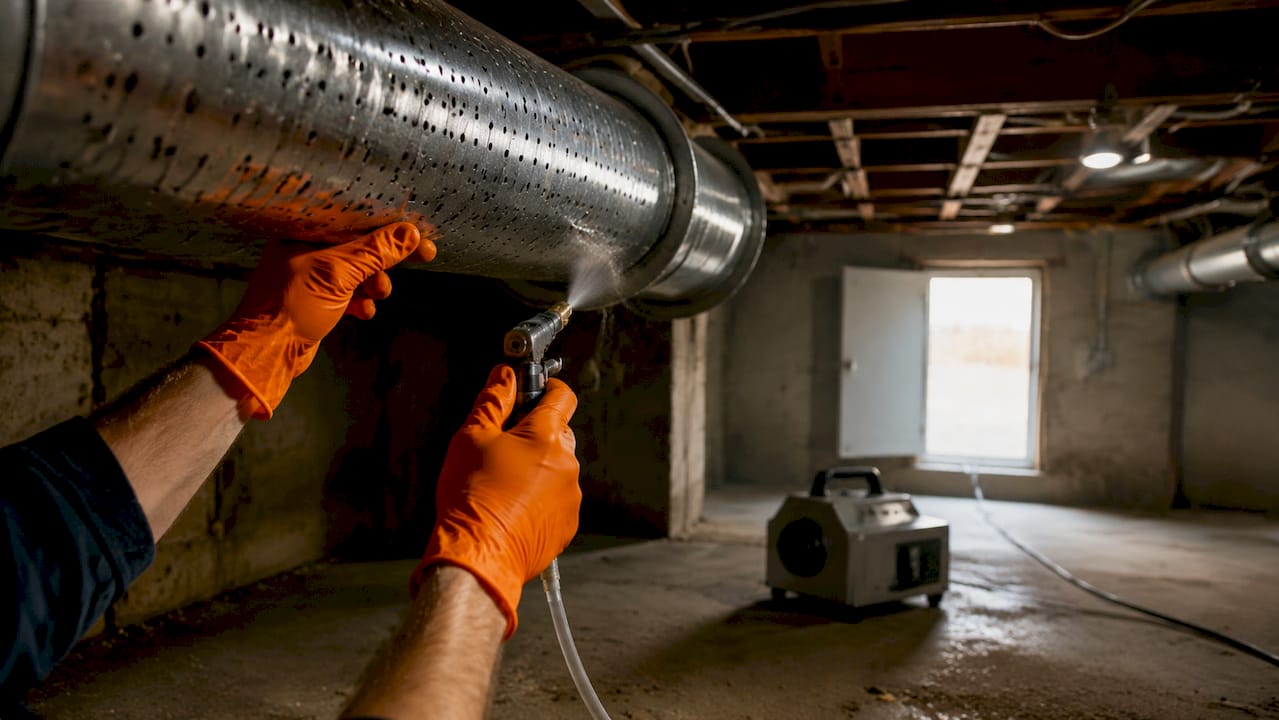
Apply using fogging or direct spraying. Fogging machines distribute a fine mist throughout the duct system and are preferred for large or complex duct networks. Direct spraying with an extension wand works well for accessible sections and spot treatments. Both methods must coat all interior surfaces evenly.
-
Allow the correct dwell time. Dwell time runs 5–20 minutes of wet contact, depending on the product and contamination level. This is the most critical variable in the entire process. Wiping or drying the surface before the dwell time is complete kills far fewer microorganisms and wastes the treatment.
Pro Tip: Set a timer the moment application is complete. Do not rely on visual inspection to judge dwell time. The surface may look dry before the antimicrobial reaction is finished.
-
Ventilate the space. After dwell time is complete, open windows and run exhaust fans to clear any residual chemical odor before turning the HVAC system back on. Occupants and pets should stay out of the treated area during this phase.
-
Reassemble and seal all vents. Reinstall vent covers, check that all access panels are secured, and confirm no tools or materials were left inside the duct system.
| Step | Action | Key Detail |
|---|---|---|
| Inspection | Assess contamination level | Identifies scope and repair needs |
| Mechanical cleaning | Remove all physical debris | Required before any sanitizer application |
| Product selection | Choose EPA-registered formula | HVAC-specific rating is mandatory |
| Application | Fog or spray all surfaces | Even coverage is critical |
| Dwell time | 5–20 minutes wet contact | Do not rush or wipe early |
| Ventilation | Clear residual odors | Before restarting HVAC system |
How do you verify that duct sanitizing worked?
Verification is a step many contractors skip, but it is what separates a professional job from a rushed one. Verification involves airflow performance review and checking for residual odors post-sanitizing to confirm the treatment was successful.
Here is what a proper post-treatment check covers:
- Airflow test. Run the HVAC system and check that airflow from all supply vents is consistent and unobstructed. Reduced airflow can indicate a blocked vent or improperly sealed access panel.
- Odor check. A faint chemical smell immediately after treatment is normal. A persistent chemical odor after 24 hours suggests insufficient ventilation or over-application of the sanitizer.
- Visual inspection. Re-inspect accessible duct sections for any remaining visible mold or debris. If contamination is still visible, the cleaning step was incomplete.
- Air quality testing. For confirmed mold cases or post-flood treatments, an indoor air quality test provides objective data on airborne particle counts and microbial levels before and after treatment. This is the gold standard for verification.
Pro Tip: Use a mold testing checklist from a resource like The Mold Genius to confirm mold removal was successful before closing out the job.
How often should you sanitize ducts?
Sanitizing treatment effects last about 6 months and are recommended after specific contamination events, not as routine maintenance. This means you should not schedule sanitizing on a fixed annual calendar the way you would an air filter change. Instead, trigger it based on conditions: water intrusion, confirmed mold, pest activity, or persistent allergy symptoms that return after cleaning.
Routine maintenance between sanitizing treatments should include replacing air filters every 60–90 days, scheduling air vent cleaning every 3–5 years, and controlling indoor humidity below 50% to prevent mold regrowth. Addressing moisture at the source is the single most effective way to extend the life of a sanitizing treatment.
What are the most common duct sanitizing mistakes?
Mistakes in step-by-step duct disinfection are more common than most homeowners realize. Some are made by inexperienced contractors. Others happen when property managers try to cut costs with DIY approaches.
- Sanitizing over uncleaned ducts. This is the most damaging mistake. Debris on duct walls blocks the antimicrobial agent from reaching the surface. The treatment looks complete but delivers almost no microbial reduction.
- Using non-EPA-registered products. Household cleaners, bleach solutions, and off-label disinfectants are not formulated for HVAC duct interiors. They can corrode metal, degrade flexible duct materials, and leave chemical residues that circulate through your air supply.
- Skipping or shortening dwell time. Rushing the contact time is the second most common error. Experts confirm that improper dwell time undermines results regardless of product quality or application method.
- Over-sanitizing as routine maintenance. Overusing chemical sanitizers can degrade HVAC duct materials over time. Sanitizing is a reactive treatment for specific contamination events, not a monthly or quarterly service.
- Ignoring the root cause. Sanitizing treats the symptom, not the source. If your ducts have mold because of a leaking air handler or high indoor humidity, sanitizing will provide temporary relief at best. Fix the moisture problem first.
- Hiring unqualified contractors. DIY sanitizing without specialized equipment poses safety risks and may not comply with EPA restrictions. Look for contractors certified by NADCA (National Air Duct Cleaners Association) or with verifiable HVAC cleaning credentials.
Professional duct sanitizing vs. DIY: which is right for you?
The choice between professional service and a DIY approach comes down to three factors: access to proper equipment, knowledge of EPA compliance requirements, and the severity of the contamination.
| Factor | Professional Service | DIY Approach |
|---|---|---|
| Equipment | Industrial foggers, HEPA vacuums, extension wands | Consumer sprayers, limited reach |
| Product access | EPA-registered HVAC-specific formulas | Limited to retail products, often not HVAC-rated |
| EPA compliance | Trained in regulatory requirements | High risk of non-compliance |
| Effectiveness | Treats full duct network including hard-to-reach areas | Effective only for accessible sections |
| Cost | $200–$500 for a typical residential job | $30–$80 in materials, but limited results |
| Best for | Mold, post-flood, pest contamination, commercial properties | Light odor treatment in accessible vents only |
DIY sanitizing without proper training poses real safety risks and often fails to meet EPA standards. For any situation involving confirmed mold, water damage, or a commercial property, professional service is the correct choice. The cost difference is small compared to the liability of an incomplete treatment.
Property managers overseeing multiple units should consider commercial air duct cleaning contracts that bundle cleaning and sanitizing into a single scheduled service. This approach reduces per-unit costs and creates a documented maintenance record, which matters for tenant health complaints and building inspections.
When selecting a provider, ask for proof of EPA-compliant product use, a written scope of work that separates cleaning from sanitizing, and a post-treatment verification report. Any contractor who cannot provide these three items is not operating to professional standards.
Key takeaways
Effective duct sanitizing requires thorough mechanical cleaning first, EPA-registered products, correct dwell time, and post-treatment verification to deliver lasting air quality improvement.
| Point | Details |
|---|---|
| Cleaning must come first | Sanitizing over dirty ducts blocks antimicrobial contact and wastes the treatment entirely. |
| Use EPA-registered products only | HVAC-specific formulas are mandatory; household cleaners can damage ducts and leave harmful residues. |
| Dwell time is non-negotiable | Allow 5–20 minutes of wet contact time for the sanitizer to achieve full microbial kill rates. |
| Sanitizing is reactive, not routine | Treatments last about 6 months and should follow contamination events, not a fixed calendar. |
| Verify results before finishing | Airflow testing, odor checks, and air quality testing confirm the treatment was successful. |
Why most homeowners get duct sanitizing backwards
I have seen the same pattern repeat itself more times than I can count. A homeowner notices a musty smell from their vents, calls a contractor, and gets a fogging treatment without any cleaning beforehand. The smell fades for a few weeks, then comes back. They assume sanitizing does not work. The real problem is that the job was done in the wrong order.
The most common misconception I encounter is that sanitizing is a stronger version of cleaning. It is not. Cleaning and sanitizing target completely different problems. Cleaning removes physical material. Sanitizing kills living organisms on a clean surface. Trying to combine them into one step is like mopping a muddy floor with disinfectant and expecting it to be sterile.
The other thing I push back on is the idea that more frequent sanitizing means cleaner air. It does not. Overuse of chemical sanitizers deteriorates duct materials over time. I have inspected flexible ductwork that was visibly degraded from repeated chemical treatments applied by well-meaning but misinformed contractors. The right frequency is event-driven, not calendar-driven.
What actually produces long-term results is a combination of proper cleaning, targeted sanitizing when conditions warrant it, and consistent humidity control. Removing allergens from ducts is a process that requires discipline and the right sequence, not just the right chemical. If you take one thing from this guide, let it be this: hire someone who can explain the difference between cleaning and sanitizing before they start the job. If they cannot, find someone who can.
— Shaun
Get professional duct sanitizing service in avondale
If you are ready to move from reading to results, Airanddryerventcleaningavondale provides professional duct cleaning and sanitizing services for homeowners and property managers throughout Avondale, Arizona. Every job starts with thorough mechanical cleaning before any antimicrobial treatment is applied, using only EPA-registered products rated for HVAC systems.
Airanddryerventcleaningavondale offers professional air vent cleaning that prepares your duct system for effective sanitizing, along with commercial duct cleaning contracts for property managers who need documented, repeatable results. Flexible scheduling, after-hours availability, and a customer-first approach make it easy to get the job done right. Contact Airanddryerventcleaningavondale to schedule your service and start breathing cleaner air.
FAQ
What does duct sanitizing actually do?
Duct sanitizing applies an EPA-registered antimicrobial agent to cleaned duct surfaces to kill bacteria, mold spores, and odor-causing organisms. It reduces microbial contamination that mechanical cleaning alone cannot eliminate.
How long does duct sanitizing last?
Sanitizing treatment effects typically last about 6 months. The duration depends on indoor humidity levels, air filter maintenance, and whether the underlying contamination source has been addressed.
Can i sanitize my ducts without cleaning them first?
No. Applying sanitizer over debris-covered ducts blocks the antimicrobial agent from reaching duct surfaces, making the treatment ineffective. Mechanical cleaning is always the required first step.
How do i know if my ducts need sanitizing?
Persistent musty odors from vents, confirmed mold growth, recent water damage, pest activity inside ductwork, or allergy symptoms that do not improve after cleaning are all indicators that sanitizing is warranted.
Is DIY duct sanitizing safe?
DIY sanitizing without proper training and equipment poses safety risks and often fails EPA compliance standards. For confirmed mold or post-flood situations, professional service from a certified HVAC cleaning contractor is the appropriate choice.