
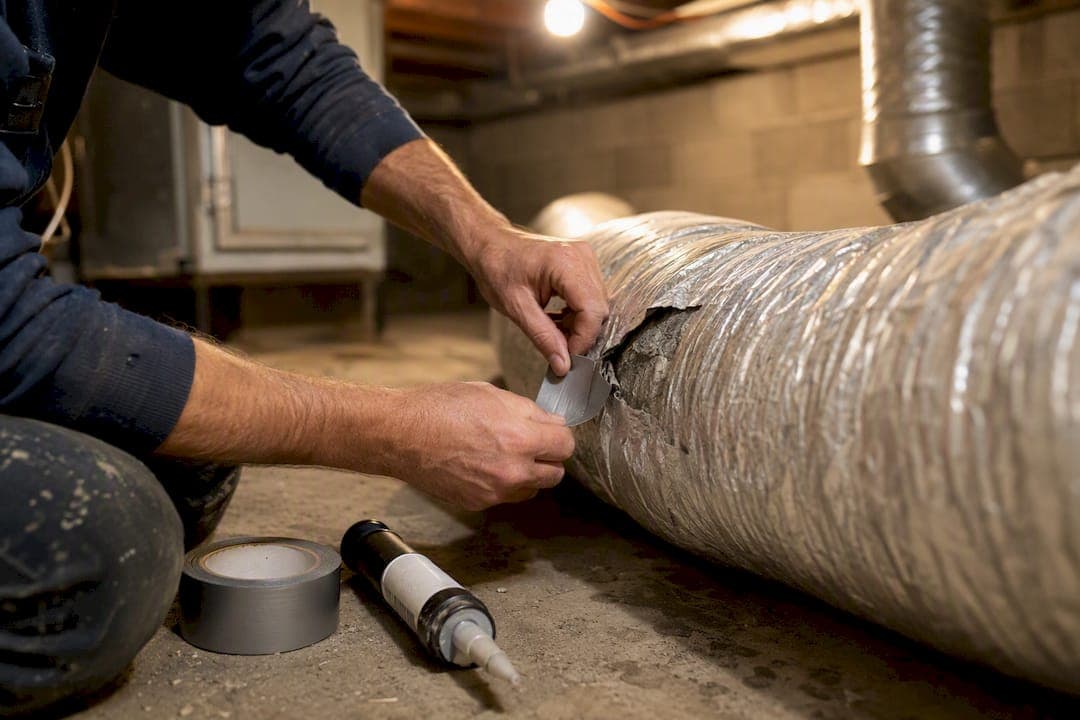
Expect to pay between $200 and $2,100 for ductwork repair, with most homeowners landing near $600 to $660 for a standard job. A quick fix, like sealing one accessible joint or swapping a damaged boot, can run as low as $100. On the other end, mold remediation or a multi-section rebuild can push past $6,000.
The single biggest swing factor isn't the size of the repair. It's whether your technician can reach the duct without tearing anything apart. A leak in an open basement is a different job, price-wise, than the same leak buried behind drywall or crammed into a three-foot crawl space. Everything else in this guide (materials, labor rates, repair type) matters, but accessibility is what actually moves your final invoice up or down.
Key Takeaways
Ductwork repair costs are driven less by the type of damage than by how hard the duct is to reach, with accessibility routinely doubling or tripling labor time on otherwise identical jobs.
| Point | Details |
|---|---|
| National range holds steady | Most repairs fall between $200 and $2,100, averaging around $600 to $660. |
| Accessibility drives price more than damage type | The same leak can cost hundreds more behind drywall or in a crawl space than in an open basement. |
| Repair vs. replace has a clear threshold | Once cumulative repair costs near 40% to 60% of replacement cost, replacing usually makes more financial sense. |
| Sealing method depends on access | Manual sealing ($350–$1,000) suits reachable joints; Aeroseal ($1,500–$4,000) suits hidden leaks. |
| Local expertise matters for accurate quotes | Airanddryerventcleaningavondale provides repair, replacement, and air quality testing for Avondale homes and businesses facing these exact cost decisions. |
Table of Contents
- Ductwork Repair Cost by Type of Damage
- How Location and Accessibility Change the Price
- What Duct Material Costs Per Linear Foot
- Should You Repair or Replace the Ductwork?
- What Goes Into a Contractor's Estimate
- Cheaper Ways to Fix Leaky Ducts
- Does Insurance Cover Ductwork Repairs?
- Who's Behind This Guide
- Why the "Just Get It Fixed" Advice Misses the Point
- Get an Honest Ductwork Estimate in Avondale
- Sources
- FAQ
Ductwork Repair Cost by Type of Damage
Your quote depends heavily on what's actually broken. A disconnected boot and a collapsed trunk line are both "duct repairs," but they're not remotely the same price.
Here's how the numbers typically break down, based on national repair data and detailed per-problem cost tables:
- Vent or register replacement: $100 to $300, usually one visit and minimal labor
- Small hole or seam patch: $150 to $500, depending on how many spots need mastic or foil tape
- Leak sealing (multiple joints): $350 to $700 for manual work across a full system
- Flex duct section replacement: $250 to $800, more if the run is long or oddly routed
- Collapsed or crushed duct run: $500 to $2,500, since this often means cutting into insulation or drywall
- Mold remediation: $2,000 to $6,000, factoring in testing, containment, and sometimes partial duct removal
A single patched hole in an easy-to-reach attic run is a one-hour job with maybe $150 in materials and labor combined. Compare that to a collapsed section under a house with three feet of crawl space clearance, where the technician spends more time getting to the problem than fixing it. Same category of repair. Wildly different bill.
Most jobs also carry small add-ons that inflate the base price: a new insulated boot, a section of insulation wrap, or foam board to reseal an access panel. None of these cost much individually ($20 to $80 each) but they add up on a multi-repair invoice. If your contractor's estimate feels higher than the ranges above, ask which extras are baked in before assuming you're being overcharged.
Pro Tip: Ask your technician to photograph the problem area before and after the repair. It gives you a paper trail if the issue recurs, and most reputable companies will do this without being asked.
How Location and Accessibility Change the Price
Two identical leaks, two very different bills. That's the reality once you factor in where the duct actually sits in your house.
Ducts running through an open, unfinished basement are the cheapest to fix because a technician can walk up, see the problem, and get to work. Attic runs come next, assuming there's enough clearance to move around and the insulation isn't packed in tight. Crawl spaces and in-wall ducts are the expensive end of the spectrum, since they often require drywall repair, extra time crouched in tight quarters, or even multiple visits if a patch needs to cure before it's covered back up.
| Location | Typical Repair Cost Range | Why |
|---|---|---|
| Basement (exposed) | $200–$800 | Easy access, minimal setup time |
| Attic | $200–$2,100 | Depends on insulation depth and headroom |
| Crawl space | $300–$2,500 | Confined space slows labor significantly |
| In-wall | $300–$1,000+ | Often requires drywall cutting and patching |
Labor rates for HVAC technicians generally run $50 to $150 per hour, and a difficult-access job simply burns more billable hours. A one-hour attic fix can turn into a half-day project once you add crawling, staging tools, and patching drywall afterward.
You can shave real money off your quote by clearing the path before the technician arrives. Move storage boxes out of the attic, clear a path to the crawl space access panel, and note ahead of time whether any finished walls will need to be opened. Pro Tip: Send a quick phone video of the affected area to your contractor before the visit. Many companies will give you a tighter estimate upfront if they can see the access situation in advance.
What Duct Material Costs Per Linear Foot
If your contractor quotes by the foot instead of a flat repair price, it usually means you're replacing a run rather than patching one. Material choice drives that per-foot number more than anything else.
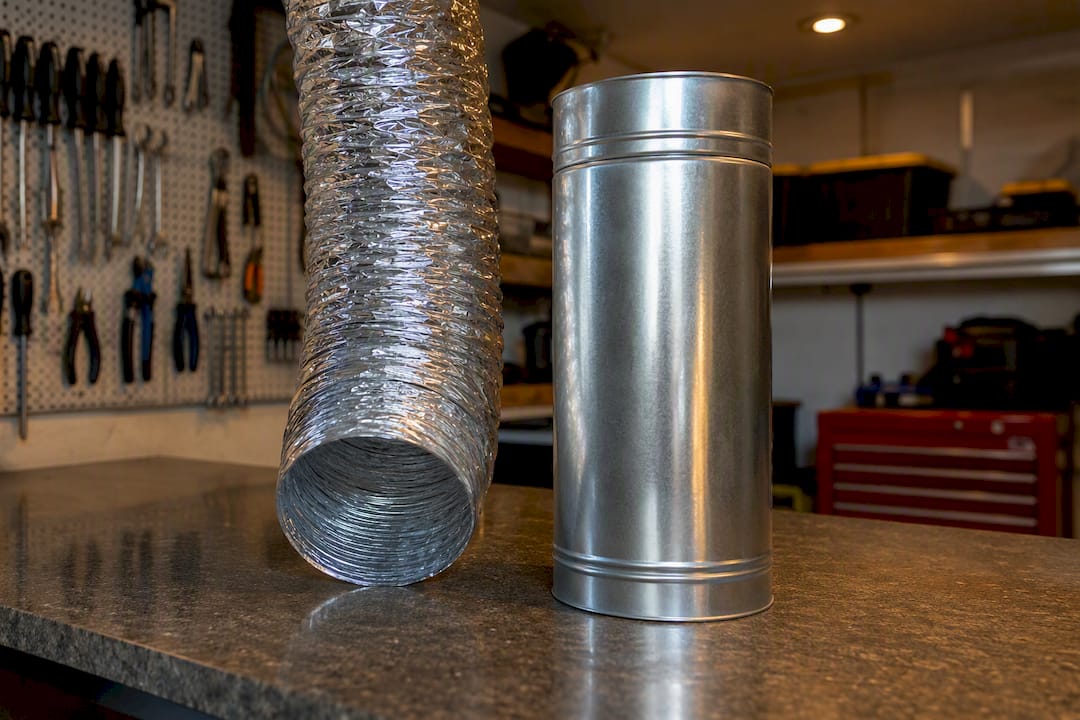
Flex duct is the default for most residential branch lines because it's cheap, flexible around joists and framing, and fast to install. It's also the most common point of failure. Flex tends to sag, kink, or tear over time, which is exactly why so many "leak sealing" jobs happen on flex runs.
Sheet metal costs more but earns its keep on main trunk lines and any exposed run where durability matters more than upfront savings. It resists crushing, holds its shape for decades, and doesn't degrade the way flex insulation can. If a technician recommends spot-replacing a flex section with rigid metal in a high-traffic mechanical area, that's usually sound advice, not an upsell. Full-system replacement using a mix of these materials typically runs $1,400 to $7,000 depending on home size and material mix.
Should You Repair or Replace the Ductwork?
Localized damage almost always favors repair. Industry guidance consistently points to replacement only when the problem is systemic rather than isolated.
Consider replacement when you see:
- Leaks scattered across multiple sections rather than one or two spots
- Confirmed mold or contamination inside the duct material itself
- Ductwork sized for a smaller, older HVAC system now running a larger unit
- A pattern of repeat repairs on the same system within a year or two
- Widespread crushing, rust, or disconnected sections found during inspection
A useful rule of thumb: once your cumulative repair estimates start approaching 40% to 60% of what full replacement would cost, replacement usually wins on value. You're not just avoiding the next service call. You're eliminating ongoing energy loss and comfort complaints tied to a system that's failing in multiple places at once.
| Decision Factor | What It Tells You |
|---|---|
| Repair cost vs. replacement cost | Above 40–60% of replacement cost, replacing usually makes more sense |
| Age and material condition | Rusted or crushed metal ducts near end of life favor replacement |
| Airflow test results | Poor airflow across many rooms suggests systemic sizing or leak issues |
Before committing either way, ask for a diagnostic airflow test or a second opinion. It's a small cost that prevents an expensive misjudgment.
What Goes Into a Contractor's Estimate
A fair estimate isn't just a single number. It should break down diagnostics, labor, materials, and any access-related work separately.
Most contractors start with a visual inspection, sometimes followed by a smoke test or a duct blaster test to locate leaks you can't see. Some diagnostic visits are free if you move forward with the repair; others carry a flat fee, typically $75 to $150, that gets applied toward the final bill.
Labor is usually the largest line item, running 40% to 60% of total cost at hourly rates of $50 to $150. Watch for these common add-ons that catch homeowners off guard:
- Drywall cutting and patching after in-wall repairs
- Mold testing and remediation if contamination is found mid-job
- Permit fees for larger replacement projects
- Asbestos handling in homes built before the 1980s with older duct wrap
Get two to three written quotes before signing anything, and ask each contractor to itemize labor hours, materials, and access work separately. Pro Tip: If one quote is dramatically lower than the others, ask specifically whether it includes drywall repair and disposal. Those two line items are the most commonly left off a lowball bid.
Cheaper Ways to Fix Leaky Ducts
Not every leaky duct needs a technician crawling through your attic for hours. Two sealing methods dominate the lower end of the price range, and picking the right one depends on how accessible your ducts actually are.
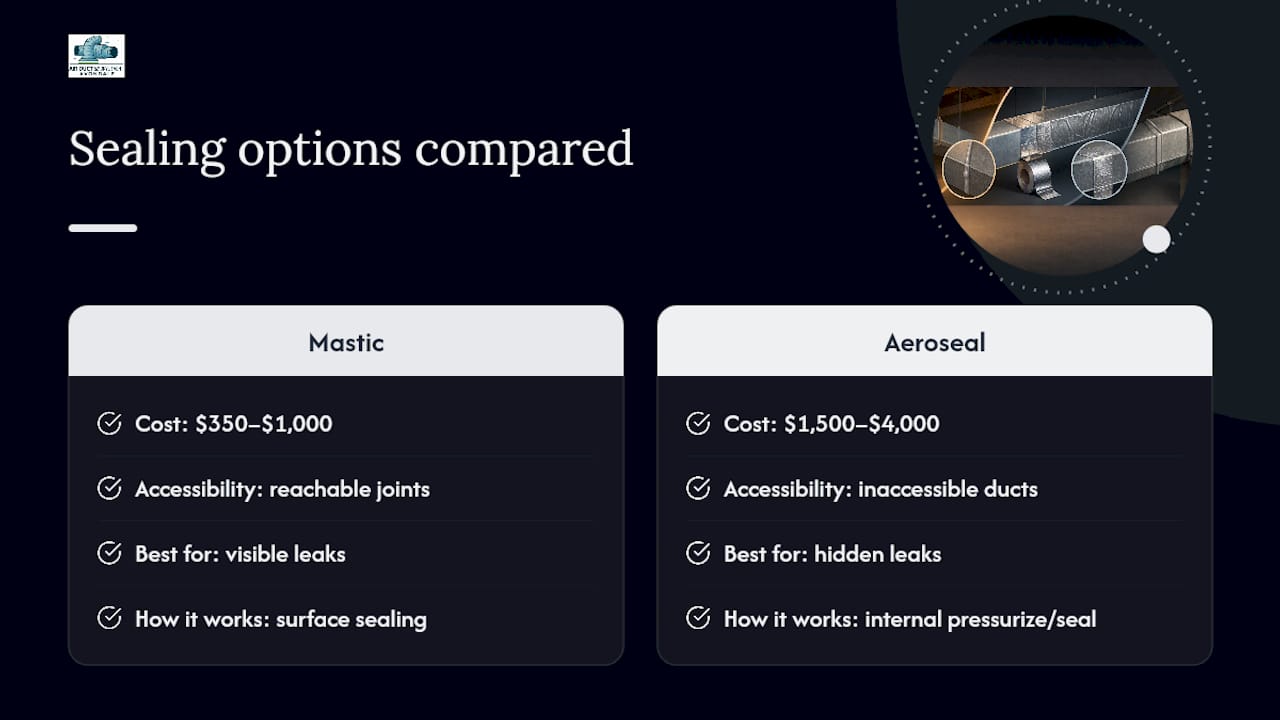
Manual mastic sealing costs $350 to $1,000 and works well when joints are reachable and the leaks are visible or easily located with a smoke test. Aeroseal, an internal sealing process that pressurizes the system and seals leaks from the inside, runs $1,500 to $4,000 but shines when leaks are hidden behind walls or in spots where cutting access would cost more than the sealing itself.
Either approach addresses a real problem: the Department of Energy estimates that leaky duct systems lose 20% to 30% of conditioned air before it ever reaches a vent. That's a direct hit to your energy bills, which makes sealing one of the better dollar-for-dollar investments in home efficiency.
A few prep steps also shrink your invoice: clear the attic or crawl space before the visit, be home for the inspection so nothing gets rescheduled, and ask whether your contractor offers phased work if you can't cover a full repair bill at once.
Does Insurance Cover Ductwork Repairs?
Homeowners insurance covers ductwork damage in limited, specific circumstances, and it's worth understanding the line before you file a claim you'll end up paying for anyway.
Sudden, accidental damage, like ducts crushed by a fallen tree branch or corroded after a burst pipe, is often covered. Ordinary wear and tear, age-related rust, or gradual leak development almost never is. Insurers treat routine maintenance as the homeowner's responsibility, not theirs.
If you're filing a claim, document everything:
- Time-stamped photos of the damage before any repair begins
- A written inspection report from a licensed HVAC technician
- A detailed repair estimate itemizing labor and materials
- Mold test results, if contamination is part of the damage
Whatever contractor you hire, get warranty terms in writing: parts coverage, labor coverage, and a specific duration, not a vague "we stand by our work" promise.
Who's Behind This Guide
This guide draws on cost data from national HVAC pricing sources alongside real repair and replacement work performed across Avondale, Arizona homes and businesses. Airanddryerventcleaningavondale handles the exact problems covered here: leak sealing, duct patching, flex section replacement, and full system evaluation when repair no longer makes financial sense.
Services directly relevant to what's discussed above include:
- Air duct repair and replacement for everything from single-section patches to full runs
- Air vent cleaning for systems where debris and contamination are complicating a repair
- Commercial air duct cleaning for property managers handling multi-unit or business systems
- Indoor air quality testing when mold or contamination is suspected alongside physical duct damage
Why the "Just Get It Fixed" Advice Misses the Point
Most cost guides hand you a price range and call it done. That's not enough. The number that matters isn't the national average, it's the threshold where repair stops making sense and replacement takes over, and almost nobody explains how to find that line for your own house.
Here's what the research actually supports: accessibility, not damage severity, decides your bill. A homeowner who clears their attic and crawl space before a technician arrives can shave real money off a quote, yet almost no guide mentions it. Meanwhile, the fixation on repair-type pricing tables leads people to underestimate how quickly repeated small repairs add up to replacement-level spending.
My take is simple. Get the diagnostic first, even if it costs $75 to $150. Skipping it to save money upfront is how homeowners end up paying for three "small fixes" that add up to more than one honest replacement conversation would have cost.
— Shaun
Get an Honest Ductwork Estimate in Avondale
If you're staring at a duct problem and trying to decide between a patch job and something bigger, Airanddryerventcleaningavondale gives Avondale homeowners a straightforward path: a real inspection, a written estimate broken down by labor and materials, and no pressure toward replacement when a repair will genuinely solve the problem.
What sets this apart from guessing your way through a national price range is local knowledge of Avondale's housing stock, from older homes with tight crawl spaces to newer builds with attic-run ductwork that's easy to access and quick to fix. That local context is exactly what turns a generic cost estimate into an accurate one. Whether you're dealing with a suspected leak, a collapsed section, or mold contamination that needs testing before any repair begins, air duct repair and replacement services cover the full range discussed in this guide.
Ready to find out what your specific repair actually costs? Reach out to schedule an inspection and get a written, itemized estimate before any work begins.
Sources
- How Much Does Ductwork Repair Cost? 2026 Data | Angi
- Air Duct Replacement Cost in 2026: By Foot, By Home Size, and When to Seal Instead | Home Energy Decisions
- Ductwork repair cost — Fixr
- How Much Does It Cost To Repair Air Ducts? | Forbes
- Cost to Repair HVAC Duct Line - HomeWyse
FAQ
How much does it cost to repair ductwork?
Most repairs cost between $200 and $2,100, with a typical job averaging $600 to $660. Simple fixes like a vent replacement start around $100, while mold remediation or multi-section repairs can reach $6,000.
Can ductwork be repaired, or does it need full replacement?
Localized damage, like a single leak, hole, or disconnected section, is usually repairable. Replacement makes more sense when leaks are widespread, ducts are contaminated with mold, or the system is undersized for your current HVAC equipment.
Is ductwork covered by homeowners insurance?
Sudden accidental damage, such as harm from a fallen tree or burst pipe, is often covered. Gradual wear and tear or age-related deterioration is typically excluded, so document damage thoroughly before filing a claim.
How much does it cost to replace ductwork in a 2,000-square-foot house?
Full replacement for a home this size typically falls within the $1,400 to $7,000 range, depending on material choice and how accessible the ductwork is throughout the house.
What's the difference between duct sealing and duct repair?
Sealing addresses air leaks at joints and seams, either manually ($350–$1,000) or through Aeroseal ($1,500–$4,000), while repair typically involves fixing or replacing damaged sections, patches, or collapsed runs.