
TL;DR:
- Most homes in Avondale do not require annual air duct cleaning unless there is visible mold, vermin infestation, or excessive debris releasing particles. Professionals should follow NADCA standards, use proper equipment, and provide evidence of contamination before recommending service. While duct cleaning can improve airflow and energy efficiency if significant buildup exists, routine cleaning is generally unnecessary without documented issues.
If you've ever searched for advice on air duct cleaning, you already know the problem: one source says clean every year, another says never bother, and a third is trying to sell you a $99 "special" that sounds too good to be true. For homeowners and business owners in Avondale, Arizona, where desert dust, scorching summers, and near-constant HVAC use create a very specific set of challenges, cutting through that noise matters. This article gives you expert-backed answers to the questions that actually drive smart decisions about your indoor air quality and energy costs.
Table of Contents
- When is air duct cleaning actually needed?
- What questions should you ask before hiring a duct cleaner?
- How can you verify if mold or contamination is present?
- What air duct cleaning standards and methods should a reputable contractor follow?
- Does duct cleaning really improve energy efficiency and air quality?
- Our take: Setting realistic air duct cleaning expectations in Avondale
- Take the next step to clean, efficient air in Avondale
- Frequently asked questions
Key Takeaways
| Point | Details |
|---|---|
| No universal cleaning need | Only clean ducts when there is visible mold, vermin, or heavy dust released into your space. |
| Ask the right questions | Specific questions about system location, scope, and credentials help avoid incomplete or scam cleanings. |
| Require proof of contamination | Demand visual or lab evidence for mold claims, especially for insulated ducts. |
| Insist on proven standards | Choose contractors following NADCA methods to ensure safe and complete cleaning. |
| Results depend on system condition | Duct cleaning boosts efficiency and air quality only if your system has significant contamination. |
When is air duct cleaning actually needed?
Many people believe air ducts should be cleaned on a schedule, like changing your oil every 3,000 miles. The real answer is more nuanced, and it's actually good news for your wallet.
The EPA's guidance is clear: there is no blanket recommendation for routine duct cleaning. The agency does not endorse cleaning air ducts on a fixed schedule simply because time has passed or because a company is running a promotion. That's a meaningful statement coming from a federal authority on indoor air quality. It means the burden of proof falls on actual evidence of a problem, not on a calendar.
So what does warrant a call to a professional? According to the EPA, the primary triggers for duct cleaning are:
- Substantial visible mold growth inside the hard surface ducts or on other components of your HVAC system.
- Vermin or insect infestation inside the ducts, such as rodents or cockroaches that have nested in the system.
- Excessive dust and debris clogging the ducts to the point where particles are visibly being released into your living or working space.
Notice that all three of these triggers are concrete and observable. They're not "it's been a while" or "I sneezed twice this week." That specificity protects you from paying for a service you don't need.
There are additional situations where cleaning makes practical sense, even if they don't fit neatly into the EPA's three triggers. If you've just completed a major home renovation, especially one involving drywall work or demolition, construction dust has almost certainly entered your duct system. Moving into a previously owned home is another strong case, since you simply don't know what the previous occupants' maintenance habits looked like. Anyone in Avondale who has lived through a dust storm season knows how fine particulate matter finds its way into every gap in a structure, including your return air vents.
"Duct cleaning is not considered to be a necessary part of yearly maintenance of your heating and cooling system, but it may be useful under certain circumstances." — U.S. Environmental Protection Agency
Before you schedule any service, take a look at the signs you need duct cleaning so you can match your situation to the right response. Going in informed means you won't be upsold on services you don't need.
What questions should you ask before hiring a duct cleaner?
Once you know when duct cleaning is needed, it's important to choose the right professional by asking the right questions. Not all contractors operate the same way, and some rely on the fact that most homeowners don't know what "good" looks like.
A practical checklist for vetting contractors covers several key areas before you hand over a dime:
- Where is your air handler or furnace located? A professional cleaner needs to know the layout of your system before they can give you an accurate quote. If a contractor tries to give you a firm price before asking this, that's a warning sign.
- What type of HVAC system do you have? Older systems with fiberglass duct board require different handling than modern sheet metal ducts. A contractor should ask this upfront.
- How large is your home or commercial space? Pricing that ignores square footage or the number of vents is almost always a bait-and-switch setup.
- What exactly does the service include? Ask specifically whether they clean the air handler, blower, evaporator coil, and registers, or just the duct runs. Many cheap services only do a surface sweep.
- Do you use negative pressure equipment? A truck-mounted or portable vacuum system that creates negative pressure inside the duct is the industry-standard method for thorough cleaning.
- What certifications do your technicians hold? NADCA (National Air Duct Cleaners Association) certification is the gold standard. Ask for the actual certification number, not just a verbal claim.
- Do you carry liability insurance? Any professional working inside your walls should be fully insured. No exceptions.
- Can you provide references or before-and-after documentation? Reputable cleaners are happy to show their work.
Pro Tip: Call at least two or three contractors and ask each one the same set of questions. You'll quickly notice which ones are vague, evasive, or try to rush you into booking before addressing your concerns. A contractor who welcomes your questions is usually the one worth hiring.
Also consider timing. In Avondale, the best windows for scheduling duct service are typically spring (before the monsoon season) and fall (before you run your heater heavily). Scheduling during these shoulder seasons often means faster appointment availability and more thorough work because technicians aren't rushing between jobs.
Pay attention to whether the contractor asks about the signs you need cleaning rather than assuming you automatically need a full service. That kind of intake conversation shows they care about diagnosing your actual situation rather than just filling a time slot.
How can you verify if mold or contamination is present?
With scammers so common in the industry, it's essential that any claims about contamination are backed by firm evidence. Some contractors will claim your ducts are "full of mold" based on nothing more than a phone photo taken in poor lighting. Don't accept that.
Here's how to handle contamination claims responsibly:
- Ask to see the evidence. If a technician tells you there's mold, ask them to show you exactly where. They should be able to physically point to or photograph the growth inside the duct or on system components.
- Request lab confirmation. Mold identification by appearance alone is not reliable. A professional can take a sample and send it to a certified laboratory for analysis. This step costs a modest fee but protects you from unnecessary remediation work that can run into thousands of dollars.
- Get a second opinion. If you're told you need major mold remediation, consult a separate contractor or a certified indoor air quality specialist before committing.
- Ask about the type of ductwork involved. This is critical. Flexible or fiberglass-insulated ducts that have been contaminated with mold cannot simply be cleaned and left in place.
The EPA is explicit on this point: if insulated ductwork gets wet or develops mold growth, it must be removed and replaced, not cleaned. No amount of antimicrobial spray or brush scrubbing will resolve the problem. If a contractor claims they can clean moldy insulated flex duct and make it safe, walk away.
"If you have insulated air ducts and the insulation gets wet or moldy, it cannot be effectively cleaned and should be removed and replaced." — U.S. Environmental Protection Agency
For situations where you have genuine concerns about your indoor air, professional air quality testing can provide an objective baseline. Testing measures actual contaminants present in your air, giving you data rather than guesswork. It's one of the smartest investments you can make before or after a duct cleaning service.
Pro Tip: Take your own photos during the inspection. If a technician points out mold or debris, photograph it yourself on your phone with the date and time stamp on. This documentation protects you legally and gives you leverage if a dispute arises later.
What air duct cleaning standards and methods should a reputable contractor follow?
Knowing how to avoid misleading or incomplete work means understanding the standards every reputable contractor should follow. The industry has a defined benchmark, and it's worth knowing what it looks like before anyone sets foot in your home.
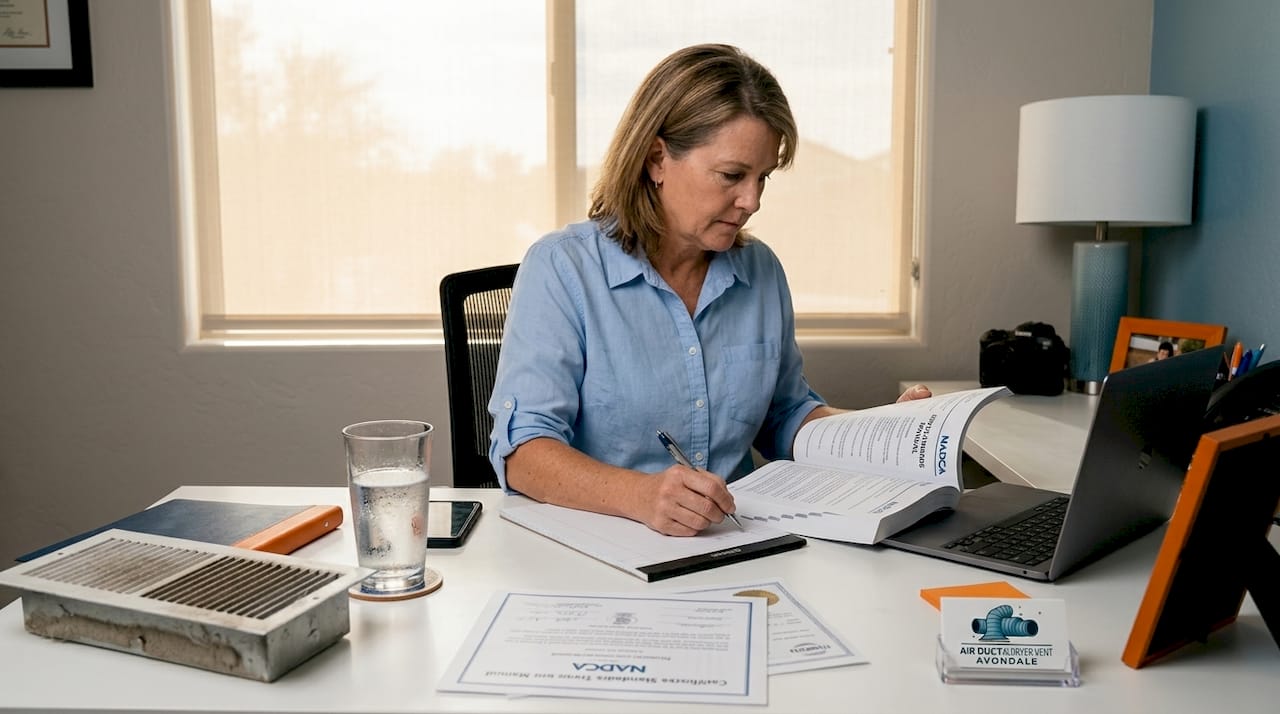
NADCA publishes the ACR standard (Assessment, Cleaning, and Restoration of HVAC Systems), which is the definitive guide for professional duct cleaning. The new ACR 2025 edition includes updated procedures for containment and engineering controls, component-by-component inspections, multiple cleaning methods, and cleanliness verification. A contractor following ACR doesn't just run a vacuum through your vents. They systematically work through every section of your system, confirm results, and document the process.
Here's how a standard-compliant cleaning compares to a shortcut service:
| Feature | ACR-compliant cleaning | Shortcut or cosmetic cleaning |
|---|---|---|
| Equipment | Truck-mounted or high-powered portable vacuum | Household-grade shop vac |
| Negative pressure | Required throughout process | Rarely used |
| Component cleaning | All accessible components | Vent covers only |
| Verification | Visual inspection and documentation | None |
| Containment | Proper sealing to prevent cross-contamination | Absent |
| Duration (avg. home) | 3 to 5 hours | 1 hour or less |
| Certification | NADCA or equivalent | No verifiable credential |
Beyond this table, watch for these quality indicators when a contractor arrives:
- They inspect the system before starting and discuss findings with you.
- They use proper containment methods to avoid spreading debris into your living space.
- They clean registers, grilles, and the air handler components, not just duct runs.
- They offer before-and-after photos or video documentation.
One reliable way to verify contractor credentials is to ask for their NADCA membership number and check it directly on the NADCA website. Avoiding scams in this industry means specifically looking for verified credentials and matching the scope of the job to a recognized standard like NADCA. Some companies display NADCA logos on their websites without holding an active membership. Always verify directly.
For commercial properties in Avondale, the stakes are even higher. Larger systems, more complex duct layouts, and regulatory considerations around air quality in workplaces mean that commercial duct cleaning methods require specialized equipment and crew experience beyond what typical residential contractors provide.
Does duct cleaning really improve energy efficiency and air quality?
With standards in mind, it's natural to ask whether duct cleaning will pay off in lower energy bills or simply contribute to healthier air. The honest answer is: it depends on what's actually in your ducts right now.
Consider this: dirty air ducts restrict airflow, forcing your HVAC unit to work harder to push conditioned air through a clogged system. In Avondale's climate, where your air conditioner can run for eight or more months of the year, that extra strain adds up on your energy bill. When cleaning removes those restrictions, air moves more easily, your system cycles less, and efficiency goes up.
The research backs this up in striking numbers. A peer-reviewed study on HVAC cleaning found that professional cleaning reduced fan and blower energy consumption by 41 to 60 percent and increased supply airflow by up to 46 percent. Those are not minor improvements.
| Outcome metric | Before cleaning | After professional cleaning |
|---|---|---|
| Fan/blower energy use | Baseline | 41 to 60% reduction |
| Supply airflow volume | Baseline | Up to 46% increase |
| HVAC system strain | High | Significantly reduced |
| Indoor particulate levels | Elevated | Measurably reduced |
That said, these dramatic gains occurred in systems that were substantially contaminated. If your ducts have only a thin layer of everyday dust and your filters are changed regularly, a cleaning is unlikely to produce the same dramatic energy savings. The honest framing is this: cleaning delivers the most measurable efficiency gains when there's a real blockage or buildup problem to solve. In other cases, the primary benefit is hygiene and peace of mind.
For Avondale residents specifically, services that improve airflow address the very real issue of desert particulate matter that infiltrates homes year-round, especially after dust storms. Understanding how air ducts impact energy savings in this specific climate helps you prioritize which services will actually move the needle on your utility bill.
Pro Tip: Before and after your duct cleaning, write down your HVAC runtime and compare your next utility bill to the same period from the prior year. Real results show up in the data. If you don't see any change in a system that was visibly dirty, that's useful information too.
When you're ready to act on the evidence, scheduling a duct cleaning with a verified local professional is the most direct path to lower bills and cleaner air.
Our take: Setting realistic air duct cleaning expectations in Avondale
Here's the thing nobody in this industry wants to say out loud: most homes don't need their air ducts cleaned every year. We know that's a bold statement for a cleaning company to make, but it's the truth, and it's backed by the same EPA guidance we've referenced throughout this article.
What we've seen in Avondale homes and businesses is that the biggest problem isn't neglected ducts. It's homeowners who were talked into a cheap cleaning that did nothing, or worse, one that used harsh biocides on surfaces not approved for such treatment, creating new problems. The "too cheap to be true" $99 duct cleaning special almost always means someone ran a shop vac near your registers and called it done.
The evidence-based approach flips the script. Instead of cleaning on a schedule, you monitor for the EPA's defined triggers: mold, vermin, or visible dust discharge. You schedule cleaning when there's documented need: after construction, before moving into a new home, after a vermin issue is resolved, or when your HVAC performance has measurably declined.
The contractors worth hiring are the ones who might tell you that your ducts actually look fine right now. That honesty is rare, and it's the clearest signal you've found someone operating with integrity. When they do recommend cleaning, they show you the evidence, explain the method, and verify the results.
What most homeowners and businesses get wrong about energy efficiency is assuming a duct cleaning alone will transform their utility bills. It won't, unless there's a significant obstruction. The bigger energy wins come from combining duct cleaning with proper sealing of leaky ducts, regular filter changes, and HVAC tune-ups. These are interconnected systems, and treating them as a whole produces compounding benefits.
We also encourage you to look at the DIY cleaning vs. professional comparison before attempting any at-home work. There are genuine maintenance steps homeowners can do themselves, like cleaning vent covers and changing filters. But the inside of a duct system, especially near the air handler and blower, requires professional equipment and expertise to clean without causing damage or spreading contamination.
The bottom line from years of working with Avondale families and businesses: demand evidence, ask sharp questions, hire certified professionals, and clean when there's a documented reason. That approach protects your budget, your health, and your HVAC investment.
Take the next step to clean, efficient air in Avondale
Ready to put these answers into action and improve your home's or business's air quality? Armed with the right questions and a clear understanding of what good service looks like, you're in a strong position to make a decision grounded in evidence rather than sales pressure.
Air Duct and Dryer Vent Cleaning Avondale offers professional air duct cleaning that follows industry-recognized standards, with full documentation of findings and results. Not sure if you have a contamination issue? Start with indoor air quality testing to get objective data before committing to any service. For businesses, our commercial duct cleaning team is equipped for complex systems and larger properties across Avondale. Flexible scheduling, after-hours availability, and a customer-first approach mean you get real answers and real results, not a rushed job and an invoice.
Frequently asked questions
How do I know if my air ducts need cleaning?
The primary EPA triggers are visible mold growth inside ducts, evidence of vermin infestation, or ducts so clogged with debris that particles are being released into your living space. If none of these apply, routine cleaning may not be necessary.
Can duct cleaning reduce allergy symptoms?
It may help if your system has confirmed contamination contributing to poor air quality, but the EPA notes clearly that effectiveness for health symptoms is unproven except in specific contamination cases, so it's not a guaranteed fix.
How should mold in air ducts be handled?
Ask the contractor to physically show you the mold and request a lab sample for confirmation. If the affected ductwork is insulated, the EPA advises that moldy insulated ducts should be removed and replaced entirely, not cleaned.
Will air duct cleaning lower my energy bills?
It can, particularly when ducts are substantially obstructed. Dirty ducts force harder HVAC work, and removing blockages improves airflow and efficiency. However, the gains are most significant when there's a real problem present.
What credentials should I look for in an air duct cleaner?
Look for NADCA certification and verify the membership number directly through the NADCA website. As consumer guidance on avoiding scams highlights, some companies display certification logos without holding active membership, so always confirm independently.