
If your doors slam on their own, a room smells musty no matter how much you clean, or your furnace pilot light keeps acting strange, you likely have a home air pressure imbalance, not a haunted house. Most cases are fixable with duct sealing, a return-air adjustment, or better exhaust venting. But if you smell gas, see soot around an appliance, or notice a lingering combustion odor, stop reading and get everyone outside, then call your gas utility or 911. That's not a maintenance issue. That's a backdrafting risk.
Once you've ruled out immediate danger, here's how to figure out what's actually happening:
- Crack open a door to the outside and watch which way it swings or pulls.
- Hold a tissue near doors and window gaps to see which way air is moving.
- Check for soot marks near your furnace, water heater, or fireplace.
- Note whether interior doors slam shut or won't stay open.
The EPA, ENERGY STAR, and ASHRAE 62.2 all treat pressure and ventilation as core indoor air quality issues, not cosmetic annoyances. Airanddryerventcleaningavondale performs this kind of diagnostic work locally in Avondale, Arizona, if you'd rather skip the guesswork.
Pro Tip: If any test near a gas appliance gives you a bad feeling, stop testing. Combustion safety checks require a trained technician with a combustion analyzer, not a tissue and a hunch.
Key Takeaways
Home air pressure problems stem from an imbalance between exhaust airflow and makeup air, and fixing that imbalance almost always resolves the drafts, odors, and temperature swings behind them.
| Point | Details |
|---|---|
| Safety comes first | Soot, gas smell, or a dying pilot light means evacuate and call for emergency service immediately. |
| Quick test available | A tissue held at a door crack with exhaust fans running shows the direction of airflow in minutes. |
| Three root causes | Wind, stack effect, and mechanical exhaust systems each push or pull house pressure differently. |
| Fix in cost order | Start with vents, filters, and transfer grilles before duct sealing, Aeroseal, or an HRV/ERV. |
| Verification matters | Ask any contractor for before-and-after blower-door numbers, not just a repair invoice. |
| Local diagnostics available | Airanddryerventcleaningavondale offers duct sealing, dryer vent cleaning, and air quality testing in Avondale. |
Table of Contents
- Signs Your Home Has an Air Pressure Problem
- What Causes Pressure Imbalances in a House?
- Why Air Pressure Imbalances Are a Safety Issue
- How to Test for Air Pressure Problems Yourself
- Fixing Air Pressure Problems: Cheapest to Most Expensive
- When Should You Call an HVAC Professional?
- What a Professional Diagnostic Sequence Actually Looks Like
- Sources
- FAQ
Signs Your Home Has an Air Pressure Problem
Pressure imbalances announce themselves in small, annoying ways long before they become expensive ones. The pattern usually shows up room by room, not all at once.
Watch for these signs:
- Interior doors that swing shut, stick, or feel hard to open on certain days.
- A high-pitched whistle around window frames or exterior doors when the HVAC system runs.
- Cold drafts near electrical outlets, baseboards, or recessed lighting.
- Cooking or bathroom odors that linger for hours instead of clearing out.
- Soot streaks near a furnace, water heater, or fireplace, or a pilot light that won't stay lit.
- Rooms far from the thermostat that never seem to reach the right temperature.
Soot and pilot light problems deserve immediate attention. That combination often points to backdrafting, where combustion gases get pulled back into the house instead of venting outside. Everything else on this list is more of an efficiency and comfort issue, and it lines up with the ventilation concerns ENERGY STAR flags when duct systems and envelopes aren't sealed properly.
Pro Tip: Track which rooms feel off and when. A pattern tied to weather (windy days, cold snaps) points to stack effect or wind pressure. A pattern tied to appliance use points to a mechanical cause like a bath fan or range hood.
What Causes Pressure Imbalances in a House?
Three forces fight for control of your home's air: wind, stack effect, and your own mechanical systems. Wind pushes air against one side of the house and pulls it away from the other, creating pressure differences that shift with every gust. Stack effect is the chimney-like pull that happens when warm indoor air rises and escapes through upper leaks, drawing replacement air in through lower gaps. It's why pressure problems tend to worsen in winter, when the temperature gap between inside and outside is largest.
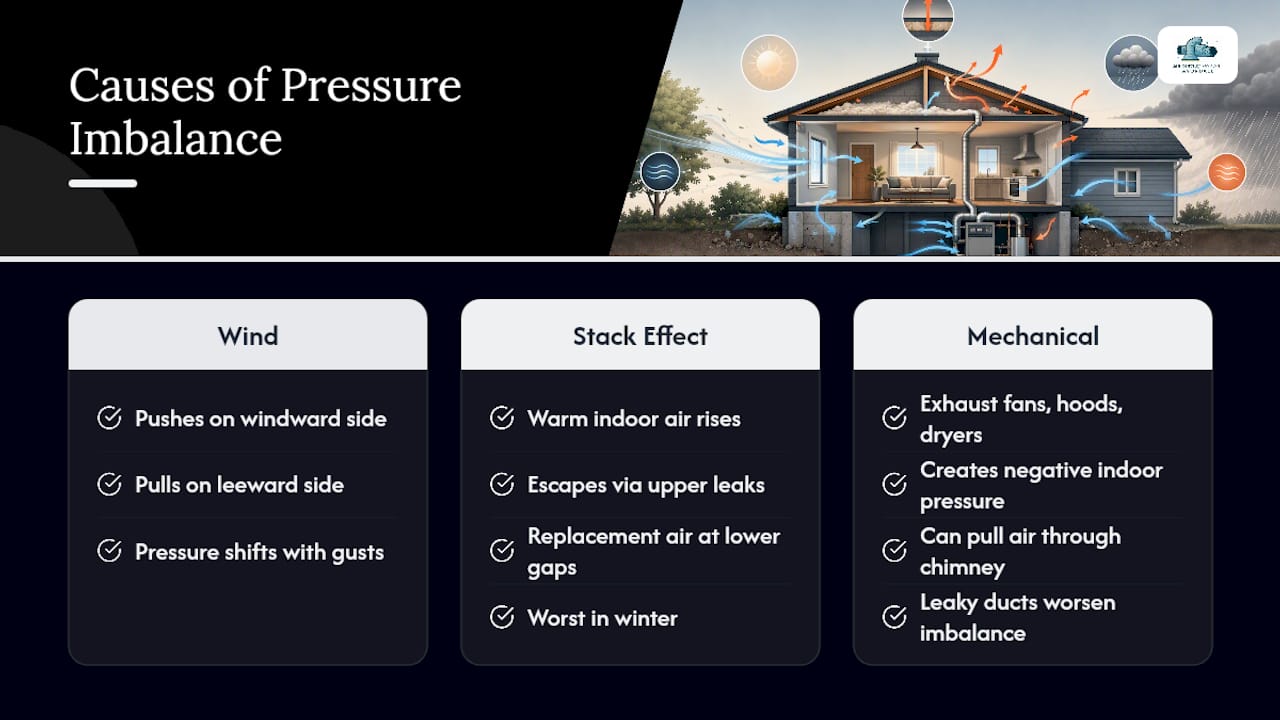
Mechanical systems are the wild card. Range hoods, bathroom exhaust fans, clothes dryers, and powered attic ventilators all remove air from the house. Run enough of them at once without a way to replace that air, and you create negative pressure that pulls air in wherever it can, including through your chimney flue.
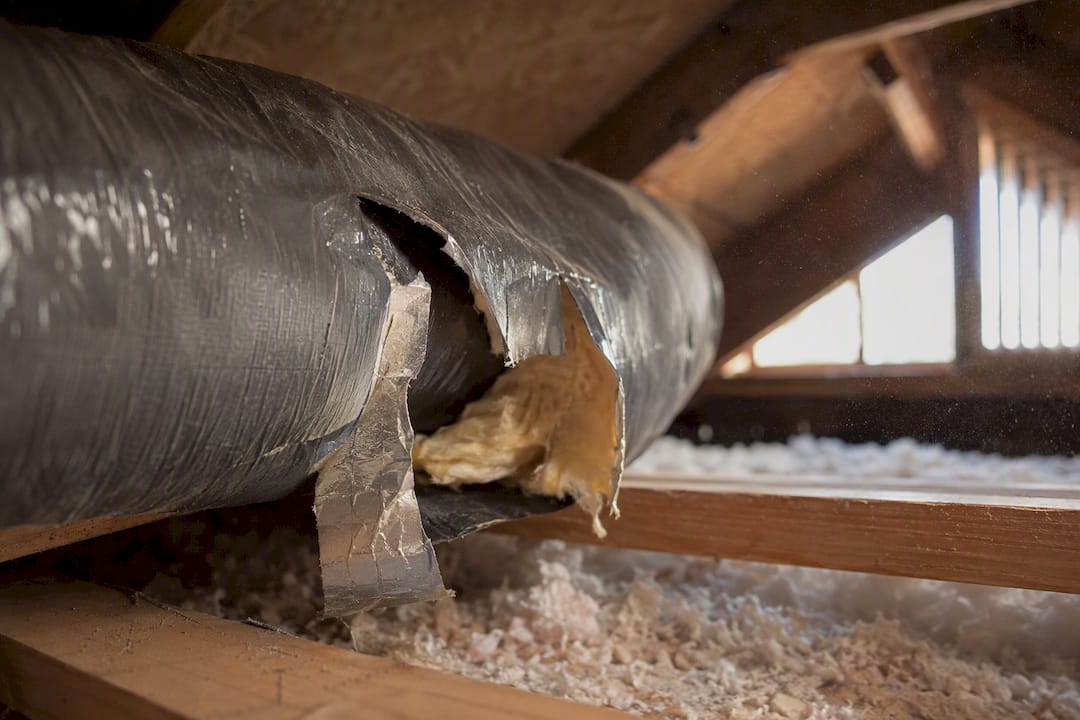
Leaky ductwork compounds all of this. A supply duct leaking into the attic pushes conditioned air outside your living space, and a return leak pulls in unconditioned attic or crawlspace air. Picture your ducts as a closed loop; every leak is a place where that loop springs open and pressure escapes with it. Newer, tightly sealed homes make this worse, not better, because there's less accidental airflow to balance things out.
Pro Tip: If pressure problems started right after a home addition or a bathroom fan upgrade, the new equipment is probably outpacing your home's fresh-air supply.
Why Air Pressure Imbalances Are a Safety Issue
The real danger isn't a drafty window. It's what negative pressure pulls into your home when it goes looking for makeup air. That includes carbon monoxide pulled back down a flue, radon seeping up through foundation cracks, and moisture that gets drawn into wall cavities where it feeds mold growth.
Here's how the risks break down:
- Backdrafting and carbon monoxide: Negative pressure can reverse the flow in a furnace or water heater flue, pushing exhaust gases back into living space. The CPSC treats this as a leading cause of home carbon monoxide poisoning. Immediate action: ventilate, evacuate, call a professional.
- Radon and stale air: Sustained negative pressure pulls soil gases and allergens indoors faster than normal air exchange can dilute them. Immediate action: schedule a radon test and an air quality check.
- Moisture and structural rot: Pressure differences push humid air into wall cavities, where it condenses and feeds mold over months or years. Immediate action: address the pressure source before repainting or resealing.
Energy loss is the quieter cost. Every uncontrolled leak your HVAC system fights against is money spent conditioning air that leaves through a gap, not a vent.
How to Test for Air Pressure Problems Yourself
Start with the tests that cost nothing and take five minutes:
- Close all interior doors and turn on your kitchen exhaust fan and any bathroom fans at once.
- Hold a lit incense stick or a tissue near the crack of an exterior door and watch which way the smoke or fabric moves.
- Repeat the test with the fans off to see if the airflow direction changes.
- Check your dryer vent hose for kinks, disconnections, or excessive length, since a poorly routed vent restricts exhaust and skews pressure.
- Note any smell of exhaust, gas, or persistent mustiness that shows up only when fans are running.
A tissue moving strongly inward when your exhaust fans run is a good qualitative signal that your house is depressurized and short on makeup air. It won't tell you by how much.
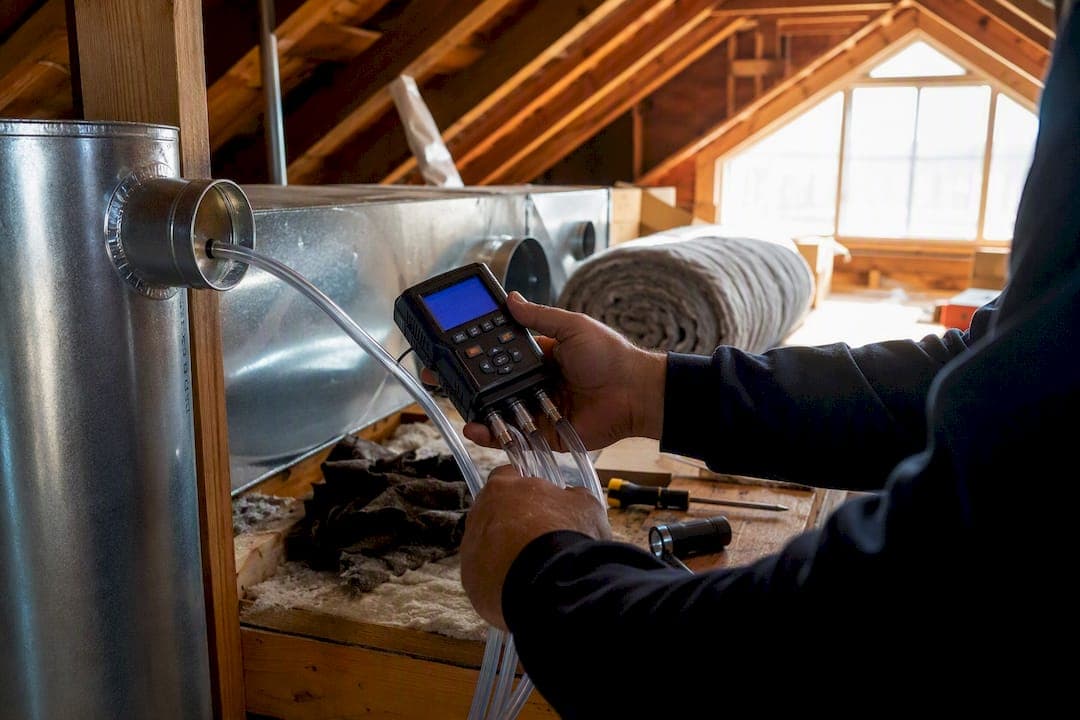
That's where professional measurement comes in. A technician uses a manometer to record precise pressure differences in pascals between rooms or between the house and outside. A blower-door test depressurizes the entire house with a calibrated fan to measure total leakage in cubic feet per minute, and a duct blaster isolates your ductwork to measure leakage as a percentage of total airflow. A worst-case depressurization test runs every exhaust device simultaneously to see if it's enough to reverse flow in a combustion appliance flue, which is exactly the scenario that concerns the negative pressure guidance from HVAC researchers.
Pro Tip: If your dryer runs and a nearby door suddenly gets harder to open, that's a strong, immediate clue the dryer vent and makeup air supply aren't matched.
Fixing Air Pressure Problems: Cheapest to Most Expensive
Work through fixes in order of cost before jumping to a full ventilation overhaul.
Free to under $50:
- Open all supply and return vents, and check that furniture or rugs aren't blocking them.
- Replace a clogged air filter, since restricted airflow at the air handler throws off pressure throughout the duct system.
- Add or open a transfer grille between a closed bedroom and the hallway to let return air flow more freely.
Mid-cost, roughly $150 to $2,500: 4. Seal accessible duct joints with mastic sealant, or hire a pro for full duct sealing, which ENERGY STAR recommends specifically to cut uncontrolled airflow loss. 5. Reroute or shorten an overly long dryer vent run, a common fix covered in how dryer vent blockage affects your home's airflow. 6. Add a dedicated return duct to a room that consistently runs hot or cold. 7. Swap an undersized bathroom fan for a properly rated one, matched to the room's volume, following the fan-selection guidance in this bathroom ventilation fan explainer.
Higher investment, $1,500 and up: 8. Have a contractor run Aeroseal or an equivalent internal duct-sealing process, which pressurizes the duct system and seals leaks from the inside without tearing open walls. 9. Install a dedicated makeup-air system so exhaust fans and dryers have replacement air to draw on instead of pulling it through your chimney. 10. Add a heat-recovery or energy-recovery ventilator (HRV/ERV) to bring in fresh air continuously while recovering heating or cooling energy, a common answer for airtight modern homes. 11. Have a full system balancing done, where a technician adjusts dampers and registers across the whole house rather than treating one symptom room.
DIY is fine for filters, vents, and transfer grilles. Duct sealing, Aeroseal, makeup-air installs, and any test involving a gas appliance belong to a licensed technician, since a mistake there risks combustion safety, not just comfort. Winter magnifies every one of these problems, so if you're on the fence about timing, don't wait for the coldest month to find out your stack effect is worse than you thought.
When Should You Call an HVAC Professional?
Call immediately if you notice soot, a gas smell, a pilot light that won't stay lit, or a door that gets noticeably harder to open whenever exhaust fans run. Those are signs of backdrafting, not just an annoying draft.
Ask any contractor you're vetting to run these diagnostics before quoting repairs:
- A blower-door test to quantify total house leakage.
- A duct leakage test (duct blaster) to isolate how much air your ducts are losing.
- A worst-case depressurization test if you have any gas appliances.
- A combustion-safety check on your furnace, water heater, or fireplace.
Before hiring, ask whether they provide a written duct leakage report, whether they recommend an HRV/ERV or makeup-air system for your situation, and what the warranty covers. Our HVAC air balance testing guide for homeowners walks through what a proper visit should include.
What Do Diagnostics and Fixes Typically Cost?
Expect diagnostic testing (blower-door plus duct blaster) to run $80 to $350 depending on home size and region. Basic duct sealing on a typical house lands between $500 and $2,500, while Aeroseal, makeup-air systems, and HRV/ERV installations often start around $1,500 and climb from there based on ductwork access and system size.
- Quick fixes: same-day, often under an hour.
- Duct sealing: one day for smaller systems, up to several days for complex layouts.
- Whole-house ventilation installs (HRV/ERV, makeup air): one to three days.
Costs shift with local labor rates, attic or crawlspace access, and how much of the ductwork needs replacing versus sealing.
What a Professional Diagnostic Sequence Actually Looks Like
A properly run visit follows a set order, not a guess-and-check approach. First comes a visual inspection of ducts, vents, and combustion appliances. Next is measurement: a manometer records pressure in pascals room by room, a blower-door test measures whole-house leakage in cfm50 (cubic feet per minute at 50 pascals of pressure difference), and a duct blaster isolates duct leakage as a percentage of system airflow. A worst-case depressurization test follows, running every exhaust device at once to check for flue reversal.
A contractor who skips the worst-case depressurization test on a home with gas appliances is skipping the single check that catches carbon monoxide risk before it becomes a 911 call.
- Visual inspection of ducts, vents, and appliances.
- Manometer and blower-door measurement of baseline pressure and leakage.
- Duct blaster test to isolate duct-specific leakage percentage.
- Combustion-safety and worst-case depressurization check.
- Repair plan, then verification testing with before-and-after airflow numbers.
Ask for that before-and-after report. Without it, you have no way to confirm the fix actually worked.
A Local Perspective on Getting This Right
Combustion safety comes first, always, before any comfort fix. A duct-sealing job that isn't verified with a follow-up blower-door reading is a job that might not have worked at all. Homeowners can run the tissue test and check for soot themselves, but anything touching a gas appliance or requiring calibrated equipment belongs to a trained technician.
Local Help for Duct, Vent, and Pressure Problems
If the tissue test, the slamming doors, and the musty smell all point to a real problem, you don't have to chase it down alone. Airanddryerventcleaningavondale handles the diagnostic and repair work that actually fixes home pressure issues at the source, not just the symptoms: duct sealing, dryer vent cleaning, blower-door and duct leakage testing, and indoor air quality testing for homes showing signs of radon intrusion or lingering odors.
A blocked or poorly routed dryer vent is one of the most common, most overlooked causes of pressure imbalance in Avondale homes, and it's also one of the fastest to fix once it's properly diagnosed. If you're seeing soot, smelling gas, or just tired of doors that won't stay open, schedule a diagnostic visit with Airanddryerventcleaningavondale and get a real pressure reading instead of a guess.
Sources
- Negative Air Pressure: Fix Drafts, Smells & Backdrafting Dangers
- Introduction to Indoor Air Quality (EPA)
- Carbon Monoxide Information Center | CPSC
- Is Negative Pressure Causing a Problem in Your Home? | Green Building Advisor
FAQ
Why am I so sensitive to changes in air pressure at home?
Some people notice sinus pressure, headaches, or joint discomfort when indoor air pressure shifts, often because their body reacts to rapid changes in barometric conditions combined with poor indoor ventilation. Improving air exchange with proper ventilation, per EPA guidance, can reduce how sharply indoor pressure swings.
What are the symptoms of a home with low or negative air pressure?
Doors that pull shut on their own, whistling around windows, lingering odors, and backdrafting near combustion appliances all point to negative pressure. Soot or a struggling pilot light are the signs that require immediate professional attention.
How does air pressure in a house affect indoor air quality?
Negative pressure draws in radon, carbon monoxide, and outdoor allergens through any available gap, while positive pressure can push moist conditioned air into wall cavities where it feeds mold. Both directions of imbalance degrade indoor air quality over time.
How can I keep pressure imbalances from affecting my home?
Balance exhaust fan use with adequate makeup air, seal duct leaks, and consider an HRV or ERV in a tightly sealed home. Airanddryerventcleaningavondale performs duct sealing and diagnostic testing in Avondale for homeowners who want a measured fix rather than a guess.
When should I call a professional instead of testing myself?
Call immediately if you smell gas or exhaust, see soot near an appliance, or notice a pilot light that won't stay lit. Otherwise, a professional blower-door and duct blaster test is worth scheduling once your own tissue test suggests a persistent imbalance.