
TL;DR:
- Many Avondale homeowners select filters based on sale prices, risking increased energy costs and HVAC wear. Properly rated filters, especially MERV 11 to 13, are essential for capturing desert-specific pollutants and maintaining system efficiency. Regular replacement, tailored to local dust loads, prevents airflow restrictions and improves indoor air quality and energy savings.
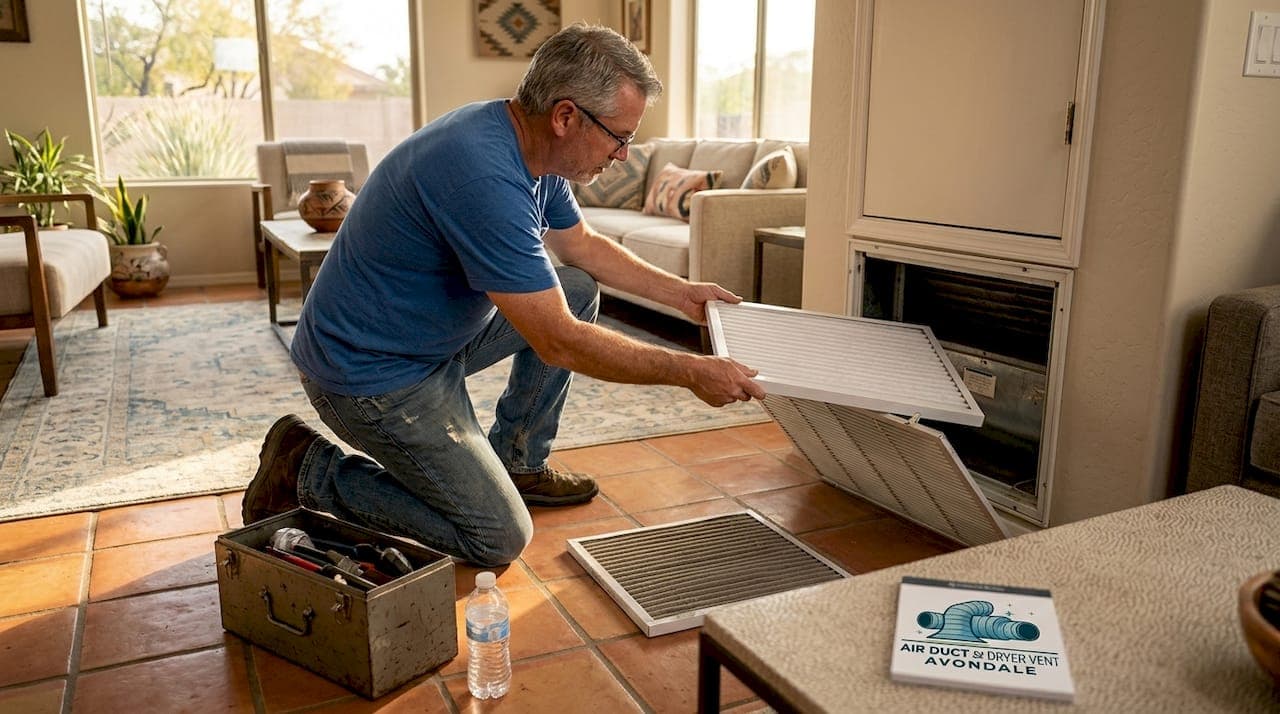
Most homeowners in Avondale pick up whatever air filter is on sale and call it a day. That single habit quietly drives up energy bills, shortens HVAC life, and keeps allergens circulating through the home. The filter sitting in your return vent is not just a dust collector. It is the first and most consistent defense your home has against the desert air that pushes through every crack and vent. This guide breaks down exactly how filters work, which ratings matter for Avondale's climate, how often to swap them out, and what the right choice means for your energy costs and your family's health.
Table of Contents
- Why air filters matter for Avondale homes
- How air filters work: capturing pollutants and protecting HVAC
- Choosing the right air filter: MERV ratings and options
- Maintaining your air filter: when and how to change it
- How the right filter improves energy efficiency and lowers costs
- What most people miss about air filter choices in the desert
- Upgrade your home's air quality and efficiency with expert help
- Frequently asked questions
Key Takeaways
| Point | Details |
|---|---|
| Choose filters wisely | Select filters with the proper MERV rating for your HVAC to maximize air quality and system efficiency. |
| Replace regularly | Change air filters every 1-3 months or more frequently in Avondale's dusty climate for healthy indoor air. |
| Boost efficiency | A clean, high-quality filter reduces energy costs by supporting efficient HVAC operation. |
| Beware of overfiltering | Using a filter that's too restrictive for your system can reduce airflow and increase energy bills. |
Why air filters matter for Avondale homes
With the stage set on the importance of filter choice, let's break down exactly how air filters work in the typical Avondale household.
Avondale sits in the heart of the Sonoran Desert. That means your home faces a constant assault of fine particulate dust, pollen from desert plants, wildfire smoke during certain seasons, and the kind of air quality challenges that homes in cooler, wetter climates simply never deal with. Your HVAC runs nearly year-round here, cycling air through the house dozens of times a day. Every cycle sends that desert air through one critical checkpoint: your air filter.
Residential HVAC filters capture airborne particles including dust, pollen, pet dander, mold spores, bacteria, smoke, and viruses, improving indoor air quality by reducing allergens and pollutants. But the filter only does that job well when it is the right type, rated correctly for your system, and replaced on schedule. A cheap fiberglass filter at MERV 1 lets most of those particles sail right through.
There are real health consequences to breathing poorly filtered indoor air every day. Aggravated asthma, increased allergy symptoms, respiratory irritation, and fatigue are all documented effects of chronic exposure to indoor allergens. When you work to improve indoor air quality at home, the first and most impactful step is almost always choosing and maintaining the right air filter.
Here is what an effective air filter protects against in a typical Avondale home:
- Dust and desert particulate: Fine sand and soil particles suspended in the air, especially after monsoon storms or windy days
- Pollen: Saguaro, mesquite, olive, and mulberry trees are all heavy pollen producers in the Phoenix metro area
- Pet dander: A top trigger for indoor allergy sufferers, and it sticks around longer than most people realize
- Mold spores: Humidity spikes during monsoon season create brief but serious mold risk, even in a desert climate
- Bacteria and viruses: Higher-rated filters actually catch a meaningful percentage of airborne pathogens
- Smoke particles: Wildfire events in the region push fine smoke into homes that are not well sealed
A well-chosen air filter does two jobs at once. It keeps the air your family breathes cleaner, and it keeps the mechanical components of your HVAC system free from the grit and debris that cause early wear and expensive repairs.
How air filters work: capturing pollutants and protecting HVAC
Understanding the job your filter performs sets the stage for comparing your filter choices.
Air filtration in a residential HVAC system is not just about blocking particles the way a screen door blocks insects. The physics of filtration involve three distinct mechanisms working together: interception, where particles following an air stream touch a fiber and stick; impaction, where heavier particles cannot follow the air's curve around a fiber and collide with it instead; and diffusion, where ultrafine particles move erratically and bump into fibers. Higher quality filters use denser fiber arrangements to take advantage of all three, which is why they catch particles far smaller than their fiber gaps.
Here is a step-by-step look at what happens every time your HVAC runs a cycle:
- Return air is pulled in: Your system draws air from the rooms in your home through return vents. That air carries everything floating in your living space, including dust, dander, and pollen.
- Air hits the filter: The air stream passes through the filter media. Particles get trapped by interception, impaction, or diffusion depending on their size.
- Cleaned air enters the air handler: The filtered air moves into the blower and then to the heat exchanger or evaporator coil.
- Air is conditioned: The system heats or cools the air as intended.
- Conditioned air is distributed: Clean, conditioned air travels through supply ducts and out through vents into your living spaces.
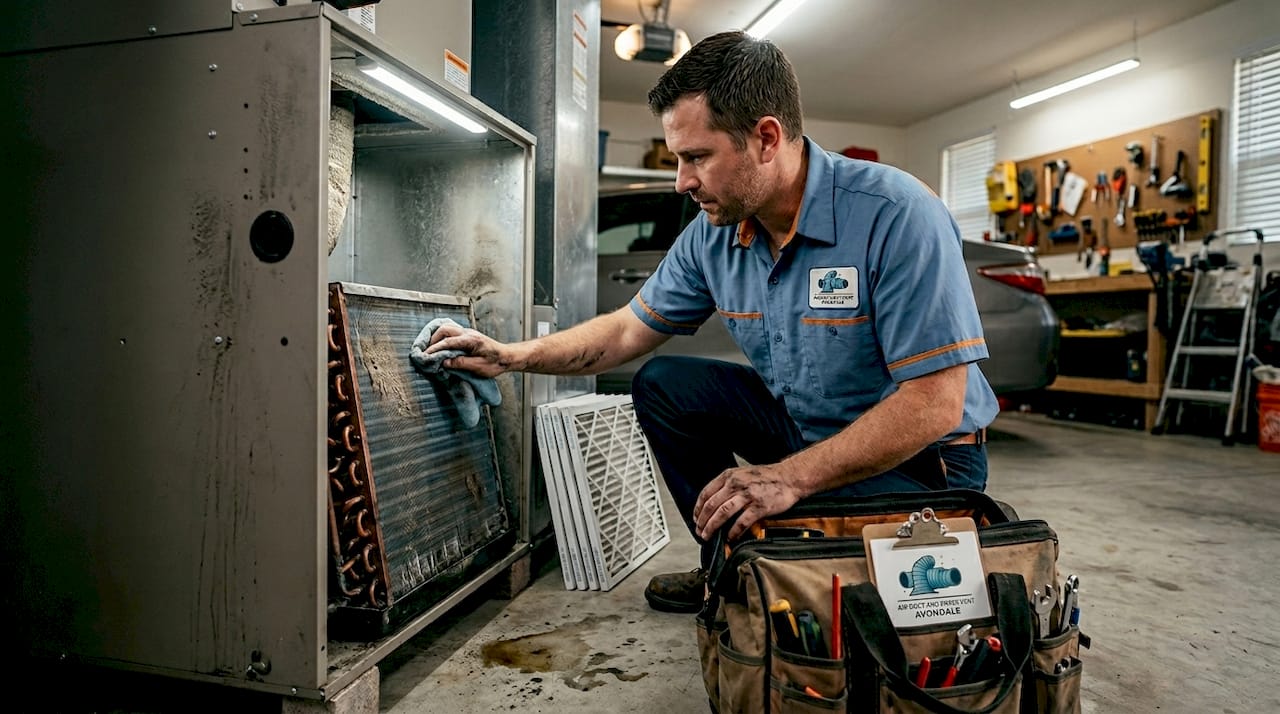
Understanding how dust impacts HVAC at every stage of that cycle helps you see why the filter is so important to the overall system. When the filter fails or becomes clogged, unfiltered air bypasses it and deposits particulate directly onto the blower motor, evaporator coil, and ductwork. That buildup restricts airflow, reduces efficiency, and creates the conditions for mold growth on a wet evaporator coil.
Tracking HVAC system wear caused by dirty filters is something we see regularly in Avondale homes. Coils caked in dust cannot transfer heat efficiently. Blower motors running against restricted airflow draw more electricity and run hotter. These are not hypothetical problems. They are expensive repairs that a proper filter schedule could have prevented.
Pro Tip: Hold your old filter up to a window before tossing it. If you cannot see light through it, it was overdue for replacement by at least a few weeks. In Avondale's dusty environment, visual checks every 3 to 4 weeks are smart even if your replacement schedule says monthly.
Choosing the right air filter: MERV ratings and options
After seeing how filters work, matching a filter to your needs is key for both air quality and system health.
MERV stands for Minimum Efficiency Reporting Value. It is a standardized scale from 1 to 20 that measures how well a filter captures particles of different sizes. A higher MERV means the filter catches smaller particles more effectively. The EPA recommends MERV 13 or the highest rating compatible with your HVAC system for optimal indoor air quality. MERV 13 captures at least 50% of particles in the 0.3 to 1 micron range, at least 85% in the 1 to 3 micron range, and at least 90% of particles in the 3 to 10 micron range.
The critical word in that EPA guidance is "compatible." A MERV 16 filter installed in a system designed for MERV 8 will cause significant airflow restriction. That restriction forces the blower to work harder, raises energy consumption, can freeze the evaporator coil in cooling season, and can crack the heat exchanger in heating season. More filtration is only better when your system can handle it.
You can explore the full range of types of air filters available for residential use, but here is a practical comparison to guide your decision:
| Filter type | MERV range | Best for | Limitations |
|---|---|---|---|
| Fiberglass | 1 to 4 | Basic system protection only | Minimal air quality improvement |
| Pleated polyester | 8 to 13 | Most Avondale homes | Replace more often in dusty conditions |
| Electrostatic | 10 to 14 | Allergy sufferers | Needs washing; can become less effective |
| HEPA (portable) | 17 to 20 | Standalone purifiers | Not compatible with standard HVAC ductwork |
| High-capacity pleated | 13 to 16 | Upgraded HVAC systems | Verify system compatibility first |
HEPA filters capture 99.97% of particles at 0.3 microns, which sounds ideal. The problem is that they create a pressure drop far too high for standard residential HVAC systems to overcome. Forcing air through a HEPA filter in a regular duct system damages the blower motor and dramatically reduces airflow to all your rooms. They belong in portable air purifiers or specialized bypass systems, not in the standard return vent slot.
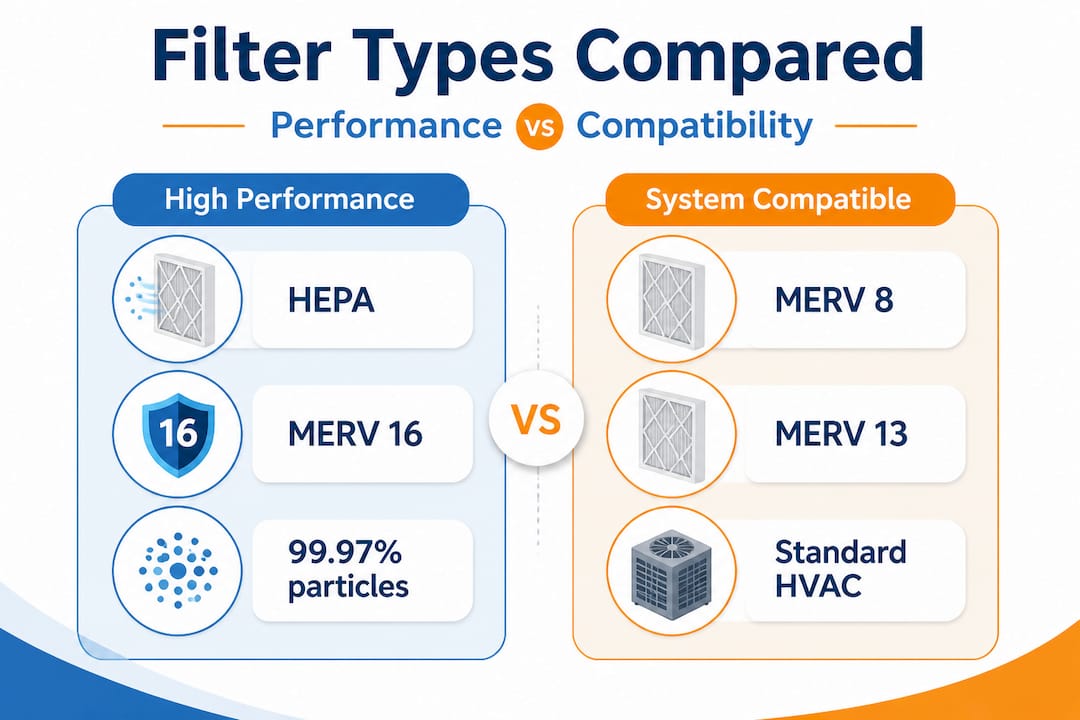
For most Avondale homeowners, a high-quality pleated filter rated MERV 11 to MERV 13 hits the sweet spot. It captures the particles most relevant to desert air quality without choking your system. If you want to see real-world filter examples for cleaner air that work well in our local conditions, that resource breaks it down with specific product comparisons.
Key factors to consider when selecting a filter for your Avondale home:
- Your HVAC system's age and design: Older systems often have weaker blowers and need lower MERV ratings
- Household members with allergies or asthma: Prioritize MERV 11 to 13 range filters
- Pets in the home: Pet dander demands at least MERV 8, ideally MERV 11 or higher
- Construction or renovation nearby: Temporary upgrade to a higher-rated filter during and after construction
- Monsoon season: Mold spore counts spike, making higher filtration especially valuable from July through September
Maintaining your air filter: when and how to change it
With smart filter choices and regular maintenance, you protect your home—but let's see how these factors add up in the bigger picture.
Avondale's desert climate demands more frequent filter changes than the national average. Dust storms, construction activity across the fast-growing West Valley, and high pollen counts all accelerate filter loading. A filter that might last 90 days in a home in Seattle may need replacement after just 30 to 45 days here.
Residential HVAC filters require consistent maintenance to keep allergens from recirculating through the home. The following table gives a realistic replacement schedule for Avondale conditions:
| Filter type | Standard recommendation | Avondale adjustment |
|---|---|---|
| Fiberglass (MERV 1 to 4) | Every 30 days | Every 20 to 25 days |
| Pleated (MERV 8 to 11) | Every 60 to 90 days | Every 30 to 45 days |
| Pleated (MERV 12 to 13) | Every 60 to 90 days | Every 45 to 60 days |
| High-capacity (MERV 14 to 16) | Every 6 to 12 months | Every 3 to 6 months |
| Electrostatic (washable) | Monthly cleaning | Every 2 to 3 weeks cleaning |
A thorough air filter replacement guide walks through the full process in detail, but here is the core step-by-step process every Avondale homeowner should know:
- Turn off the HVAC system before touching the filter. This prevents unfiltered air from being drawn through the open slot and depositing dust directly on the coil.
- Note the airflow direction arrow on the existing filter before removing it. The arrow must point toward the air handler, not toward the return duct.
- Remove the old filter carefully and place it in a plastic bag immediately. Desert filters are loaded with fine particulate you do not want redistributed into the air.
- Inspect the filter slot for dust buildup, mold, or damage. Wipe with a dry cloth if needed.
- Insert the new filter with the arrow pointing toward the air handler and the filter seated firmly with no gaps around the edges.
- Mark the replacement date on the filter frame with a permanent marker. Set a phone reminder for the next swap date.
- Turn the system back on and verify normal airflow at your supply vents.
The health and efficiency benefits of regular filter replacement are well-documented. Respiratory health improves, sleep quality often gets better, and HVAC efficiency rises noticeably. Many homeowners also find that investing in scheduled replacement saves significant money compared to the cost of a single HVAC repair caused by a neglected filter.
One thing most homeowners forget: the filter slot seal. If the filter fits loosely or if the access panel does not close tightly, dirty air bypasses the filter entirely. Check filter replacement benefits for guidance on how to address gaps and get the full value from your filter investment.
Pro Tip: Buy filters in multi-packs and store them near your air handler. When replacement is this easy, you are far more likely to actually do it on schedule. Set a recurring calendar reminder on your phone every 30 days so the check never slips.
How the right filter improves energy efficiency and lowers costs
The value of a quality air filter goes beyond clean air. It is about real savings for your home and your wallet.
Energy costs in Avondale are significant. Running an HVAC system through a Phoenix-area summer is one of the biggest household expenses you face. A clogged or undersized filter makes that cost worse in ways that compound over time. When the filter blocks airflow, the blower motor has to work harder to move air through the system. That means more electricity consumed for the same result, often much less of it.
The EPA's filter efficiency data shows that MERV 13 filtration is achievable in most modern systems, and matching your filter to your system's design allows the blower to operate at its intended resistance level. That efficiency directly reduces energy consumption and extends component life.
Here is what a clean, appropriately rated filter does for your energy picture:
- Lowers blower motor strain: Proper airflow means the motor runs at its designed operating point, not against a vacuum
- Keeps coils clean: A clean evaporator coil transfers heat more efficiently, reducing the time your compressor needs to run
- Reduces repair frequency: Systems that breathe well break down less often, saving on service calls
- Maintains consistent comfort: Unrestricted airflow means every room gets its share of conditioned air, not just the rooms closest to the air handler
- Extends system life: HVAC replacement in Avondale can cost $8,000 to $15,000 or more. A $15 filter changed regularly protects that investment
Understanding your HVAC system and energy efficiency relationship makes it clear why filter selection is not a minor detail. Utility bills in the Phoenix metro average over $200 per month during peak cooling season. Even a 10 to 15% improvement in HVAC efficiency translates to meaningful annual savings.
A clogged filter also raises humidity in summer. When the evaporator coil cannot move enough air, it gets colder than designed and may freeze. That stops cooling entirely until the ice thaws. Then the cycle repeats. This is not just an inconvenience. It causes water damage to the air handler cabinet and accelerates compressor wear. Getting HVAC filters explained in context of your specific system type is the smartest way to connect filter choice to real cost savings.
What most people miss about air filter choices in the desert
Here is the perspective that years of working in Avondale homes has built: the "higher is always better" mindset around MERV ratings causes real problems. Homeowners read that MERV 13 is recommended and assume MERV 16 must be even better for them. They swap in a dense, high-resistance filter without checking their system's specifications, and within weeks the airflow through the house drops noticeably. Rooms feel stuffy. The system runs longer to reach setpoint. Energy bills climb. And ironically, the filter loads up faster because the reduced airflow concentrates particles on a smaller effective area.
The desert makes this worse in a specific way. Avondale dust is not just abundant. It is fine. The particles from desert soil and construction sites in the West Valley are small enough to clog a high-MERV filter in a fraction of the time it would take in a cleaner air environment. So that MERV 16 filter you bought to run for six months might be functionally spent in eight weeks. Now you are paying premium filter prices and replacing them as often as basic pleated filters, with the added bonus of reduced airflow damaging your system the whole time.
The smarter approach is to find the highest MERV your system comfortably handles, which for most Avondale homes with standard equipment means MERV 11 to MERV 13, and then change it more often than the package suggests. That combination gives you meaningful filtration without restricting airflow. You can read more about how to protect your HVAC from both dirty air and improper filter choices.
Balance is the operating principle. Filter performance, airflow compatibility, and replacement frequency all work together. Getting one right while ignoring the others is a partial solution at best. The homeowners who spend the least on HVAC repairs and energy over time are almost always the ones who found that balance and built a consistent maintenance habit around it.
Upgrade your home's air quality and efficiency with expert help
Getting your filter right is a strong start, but it is only one part of a truly healthy and efficient home air system. If your ducts are coated in years of desert dust and debris, even the best filter cannot compensate for the contamination recirculating through your vents every time your system runs.
At Air Duct and Dryer Vent Cleaning Avondale, we work with homeowners across the West Valley to assess exactly what their indoor air needs. We offer indoor air quality testing that identifies specific pollutants and helps you make informed decisions about your system. Our air vent cleaning service removes the accumulated desert dust and debris that filters alone cannot address once it has built up inside your ductwork. We also provide dryer vent cleaning to protect your home from a fire risk that most homeowners overlook entirely. Flexible scheduling, local expertise, and results you can feel are what we bring to every Avondale home we service.
Frequently asked questions
What is the best MERV rating for Avondale homes?
The EPA recommends MERV 13 or the highest rating compatible with your HVAC system, which for most standard Avondale systems means targeting MERV 11 to 13 for the best balance of filtration and airflow.
Are HEPA filters safe for my standard HVAC system?
No. HEPA filters create pressure drops that standard residential HVAC blowers cannot overcome, restricting airflow and stressing the system. Use them in portable air purifiers or bypass systems designed specifically for them.
How often should I replace my air filter in Avondale?
Replace your filter every 30 to 45 days for most pleated filters in Avondale, because desert conditions accelerate filter loading much faster than national averages suggest. Check it visually every two to three weeks during dusty periods.
Do air filters affect my energy bills?
Yes. A clean, properly rated filter lets your HVAC blower operate efficiently, and filter efficiency directly reduces the energy your system consumes by keeping airflow resistance at its designed level.
Can better air filters help with allergies?
Absolutely. Filters rated MERV 11 and above capture the small airborne allergens that trigger allergy symptoms, including fine pollen, pet dander, and mold spores, delivering measurable relief for allergy and asthma sufferers indoors.