
TL;DR:
- Dust buildup inside HVAC systems can reduce efficiency by up to 40 percent.
- Regular professional cleaning and frequent filter changes are essential in dusty Arizona climates.
- Proper maintenance improves indoor air quality and extends system lifespan.
A barely visible layer of dust, just 0.04 inches thick, is enough to cut HVAC efficiency by 21%. Most Avondale homeowners and small business owners don't realize their cooling system is quietly losing power every single day, not from a mechanical failure, but from ordinary dust. Arizona's dry, windy climate pushes this problem further than nearly anywhere else in the country. Between haboobs, desert soil tracked indoors, and homes that run their HVAC almost year-round, dust accumulates fast and hits hard. This guide breaks down exactly how dust degrades your HVAC performance, drives up your energy bills, compromises your air quality, and what you can do right now to stop it.
Table of Contents
- Why dust is a major issue for Avondale HVAC systems
- How dust affects HVAC performance and energy bills
- The link between HVAC dust and indoor air quality
- Prevention strategies: Keeping HVAC systems clean in a dusty climate
- The overlooked truth: Why most HVAC dust solutions miss the mark in Avondale
- Take control of your indoor air and HVAC efficiency today
- Frequently asked questions
Key Takeaways
| Point | Details |
|---|---|
| Dust slashes HVAC efficiency | Just a thin layer of dust can cause up to 40% loss in system efficiency and drive up your energy bills. |
| Indoor air worsens with dust | Dust in HVAC systems circulates allergens and irritants, impacting comfort and health. |
| Regular maintenance prevents costly problems | Changing filters and professional cleaning are vital to keep your system running efficiently in Avondale. |
| Choose balanced filters for best results | Opt for MERV 8-13 filters to maximize dust control without sacrificing airflow or straining your system. |
Why dust is a major issue for Avondale HVAC systems
Household dust is not just the light film you wipe off a shelf. It is a mixture of dead skin cells, pet dander, pollen, textile fibers, soil particles, and construction debris. In Avondale and across the broader Phoenix metro area, the composition of that dust is uniquely aggressive. Desert soils here are fine-grained and silica-rich, meaning even a brief wind event can push large volumes of particulates into your home through doors, windows, and air gaps in your building envelope.
Arizona's climate amplifies this problem in several ways. The low humidity keeps particles airborne longer than in wetter climates. Frequent temperature swings cause building materials to expand and contract, opening tiny gaps that let outside air and dust infiltrate your home. Many Avondale homes also have tile flooring, which looks clean but acts as a launching pad for fine particles to re-enter the air every time someone walks across the room.
"Frequent filter changes every 1 to 3 months and professional maintenance are critical in dusty Arizona to prevent efficiency losses up to 40% and indoor air quality degradation."
Understanding why dust accumulates so fast starts with recognizing the causes of ductwork dust specific to this region. Once dust enters the system, it coats the internal components that your HVAC depends on to move and condition air.
The HVAC components most affected by dust buildup include:
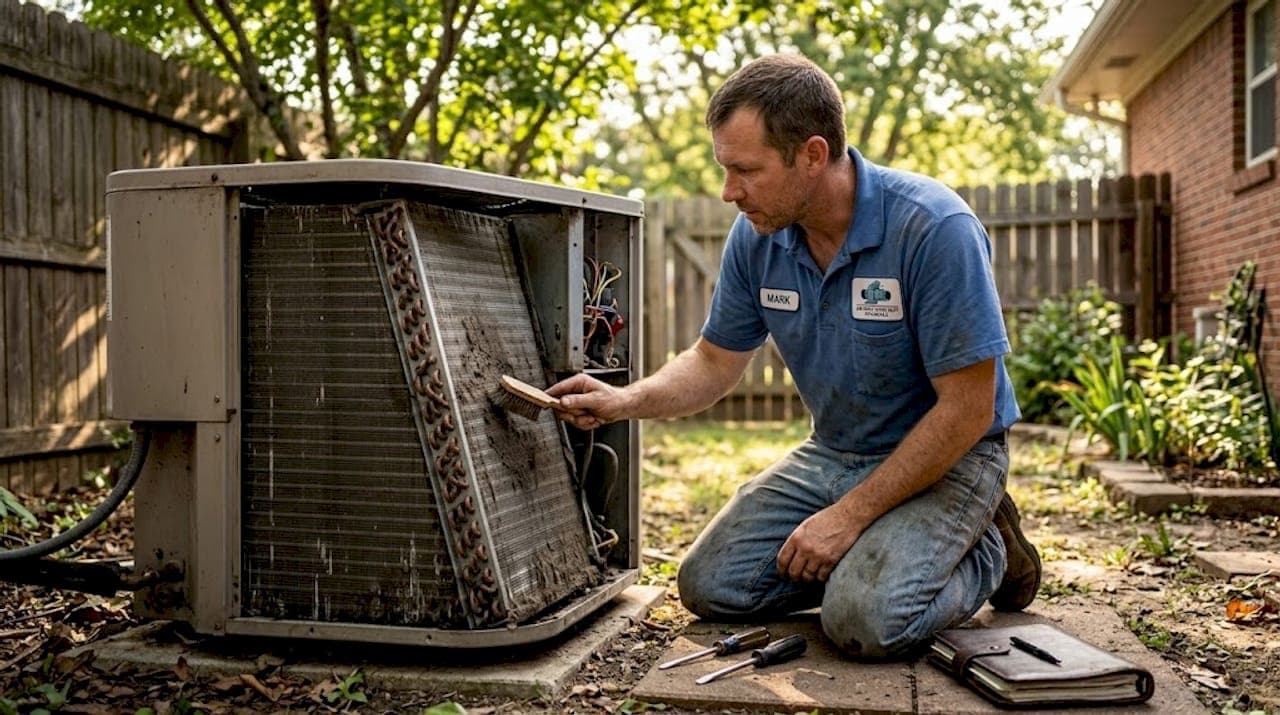
- Evaporator and condenser coils, which lose heat transfer ability when coated
- Blower motor and fan blades, which strain under added weight and friction
- Air filters, which clog and restrict airflow far faster in dusty climates
- Ductwork interior surfaces, which hold and circulate dust into living spaces
- Drain pans and lines, which collect dust-mixed moisture and risk mold growth
When these components are compromised, your system works harder, runs longer, and costs more to operate. And in Avondale, where your HVAC runs practically nonstop through the summer months, that added strain builds up quickly. Most homeowners only notice when the energy bill spikes or the system stops keeping up. By then, the damage is already done.
How dust affects HVAC performance and energy bills
Dust does not just sit quietly inside your system. It actively disrupts the physics your HVAC relies on. The coils in your system work by transferring heat between refrigerant and air. When dust coats those coils, it acts as insulation, blocking the heat exchange process. The system then runs longer cycles trying to reach your thermostat setting, burning more electricity in the process.
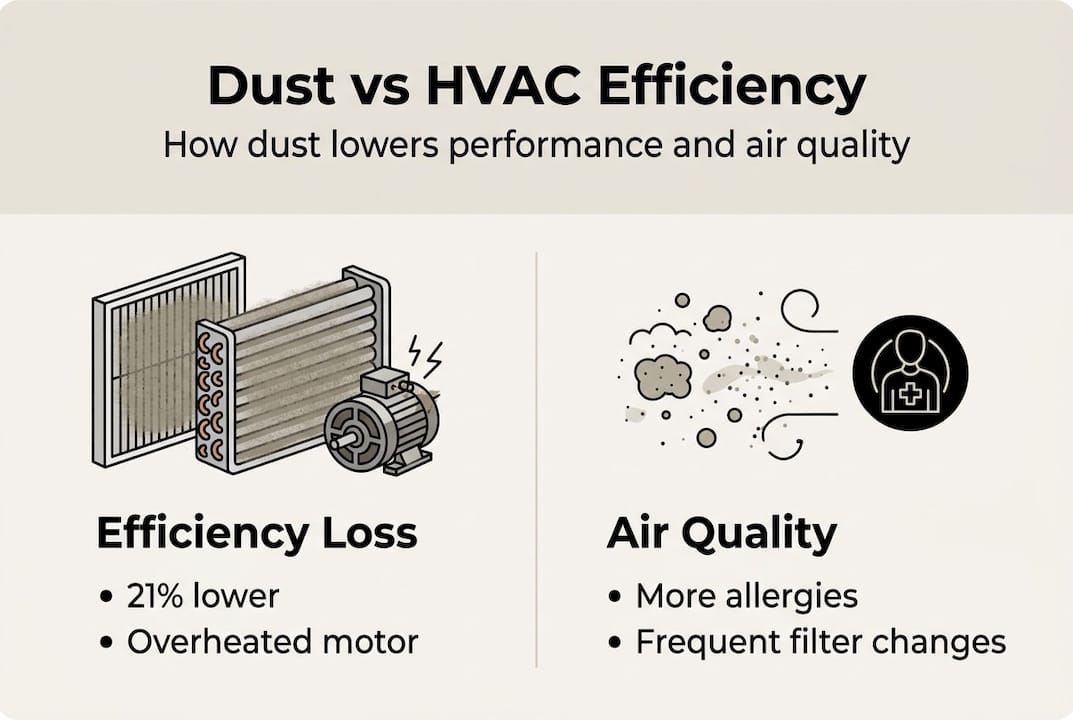
The numbers here are worth taking seriously. A 0.04-inch dust layer on HVAC coils cuts efficiency by 21%, dirty systems overall can lose up to 40% efficiency, and clogged filters alone can increase energy use by 15%. In a climate where your system runs six to eight months at high intensity, even a 15% increase in energy use translates to real money.
| Dust thickness on coils | Estimated efficiency loss |
|---|---|
| 0.01 inches | 5% loss |
| 0.02 inches | 11% loss |
| 0.04 inches | 21% loss |
| 0.08 inches or more | Up to 40% loss |
The mechanical wear is just as costly as the energy waste. Blower motors running under restricted airflow overheat faster. Fan blades coated with dust vibrate unevenly, accelerating bearing wear. Capacitors and contactors that cycle on and off more frequently wear out sooner. These are not theoretical concerns. They are the real reasons HVAC systems in dusty climates tend to fail earlier than their rated lifespan.
For improving air quality with HVAC and protecting equipment, it helps to understand your HVAC filter options before they become a problem.
Pro Tip: Check your supply vents monthly. If you see a gray or brownish film building up around the vent edges, your filter is likely overdue for a change and dust has already entered the duct system. Don't wait for your energy bill to tell you.
The link between HVAC dust and indoor air quality
Efficiency losses are only part of the story. HVAC dust also impacts something you experience every day: the air you breathe. Your HVAC system functions as the lungs of your home or business. When it circulates air through dusty ducts and dirty components, it also circulates everything that dust carries.
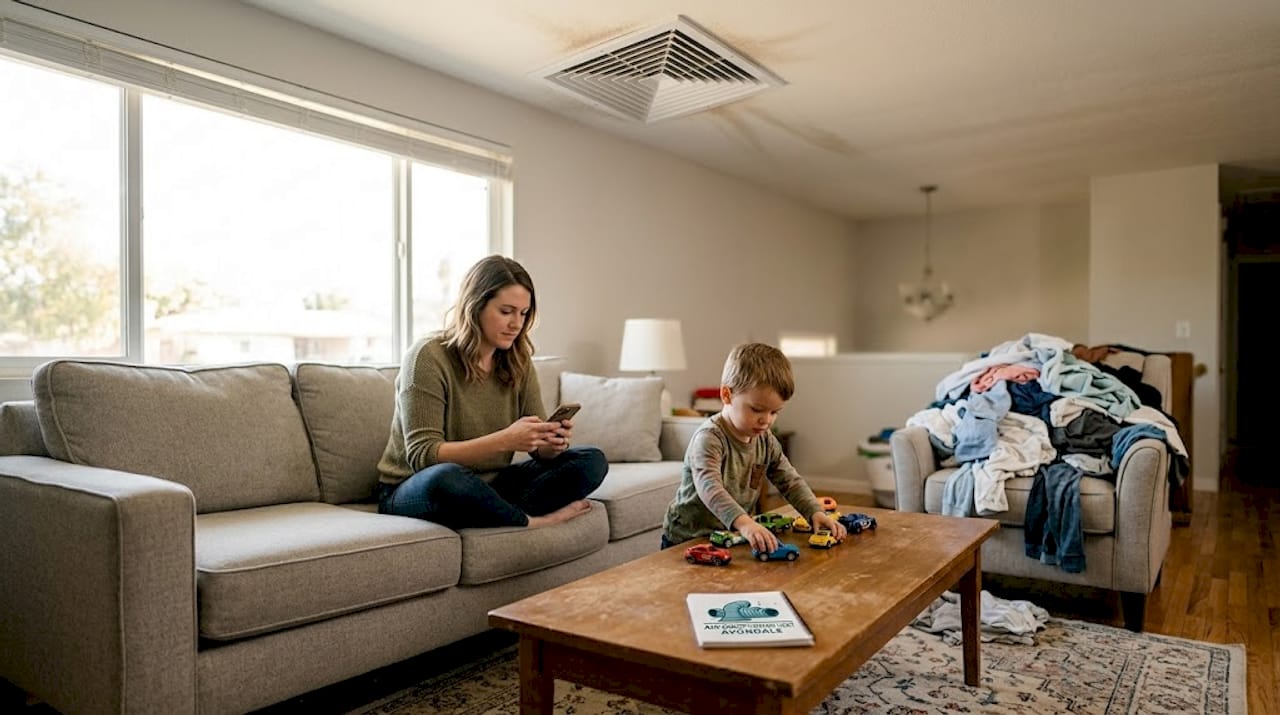
Dust inside duct systems travels with every air cycle. The blower pushes air through the ducts at high speed, picking up particles settled on interior surfaces and delivering them directly to your living or working spaces. Over time, the buildup inside ducts becomes a reservoir that continuously recontaminates your indoor air, even after you've vacuumed and cleaned the visible surfaces.
Common particles and irritants found inside dirty HVAC duct systems include:
- Pollen from Arizona's native plants and landscaping
- Pet dander from dogs, cats, and other common household pets
- Dust mites and their waste particles, which are a leading allergen trigger
- Mold spores, especially where moisture from condensation has collected
- Construction debris from renovations or nearby building activity
- Fine desert soil particles high in silica, irritating to lungs and sinuses
- Volatile organic compounds absorbed into dust from household chemicals
Frequent filter changes and professional maintenance in Arizona settings directly prevent indoor air quality degradation by stopping these particles from cycling through your system. For a deeper look at what HVAC cleaning benefits look like in practice, the improvements go well beyond what a filter swap alone can achieve.
Pro Tip: If family members or employees are experiencing more allergy symptoms, headaches, or sinus irritation indoors than outside, your HVAC system may be the source. Schedule an air quality check before assuming it is seasonal allergies.
Prevention strategies: Keeping HVAC systems clean in a dusty climate
After understanding the risks, the next step is clear: proactive, local-specific prevention tailored for the Valley's unique conditions. In Avondale, the standard advice of changing your filter every three months simply does not go far enough. The dust load here demands a faster, more deliberate schedule.
Here is a practical maintenance routine built for Avondale's climate:
- Inspect your filter every 30 days. In peak dust season (spring and monsoon), monthly checks are essential. Replace immediately if you see visible gray buildup, regardless of how long it has been installed.
- Seal gaps around doors, windows, and ductwork. Every gap is an entry point for desert dust. Use weatherstripping and duct mastic where needed.
- Clean supply and return vents with a damp cloth monthly. This removes surface buildup before it enters the duct system.
- Schedule professional coil cleaning at least once a year. Preferably before peak summer cooling season begins in May.
- Have ductwork professionally inspected every 3 to 5 years, or sooner after construction, renovation, or a major dust event like a haboob.
- Install whole-home air purifiers or UV treatment systems if allergies or respiratory conditions are a concern.
Choosing the right filter matters as much as changing it on time. Here is a comparison of common MERV ratings for Avondale homes:
| MERV rating | Particle capture | Airflow impact | Best for |
|---|---|---|---|
| MERV 8 | Dust, lint, pollen | Low restriction | Standard homes, budget-friendly |
| MERV 11 | Mold, pet dander, finer dust | Moderate restriction | Homes with pets or mild allergies |
| MERV 13 | Bacteria, smoke, fine particles | Higher restriction | Allergy sufferers, high-dust areas |
Frequent filter changes every 1 to 3 months and professional maintenance are critical in dusty Arizona, and choosing between MERV 8 and MERV 13 depends on both your health needs and your system's fan capacity. Check your unit specs before upgrading to a MERV 13, since higher-rated filters can restrict airflow in older systems not built to handle the added resistance.
For more guidance, the filter replacement guide and the HVAC cleaning steps walk you through the process in detail.
Pro Tip: Never stack two filters to increase filtration. It dramatically restricts airflow and can overheat your blower motor. One correctly rated filter, changed on time, always outperforms two filters left too long.
The overlooked truth: Why most HVAC dust solutions miss the mark in Avondale
Here is something most articles on this topic won't tell you: filter swaps, even done perfectly on schedule with high-MERV filters, only address one entry point for dust. They catch what tries to enter through the return air side. They do nothing about the dust already inside your ducts, nothing about the coating building up on your evaporator coil, and nothing about the buildup inside your blower compartment.
We see this pattern regularly. A homeowner follows every piece of standard advice. They change their filter every month. They buy MERV 13 filters. Their energy bills still creep up. Their allergy symptoms don't improve. Then they get a professional cleaning and the technician pulls visible debris out of ducts that look like they haven't been touched in years, despite a conscientious filter routine.
The reason is straightforward. Avondale's dust is fine enough to partially bypass filters during high-load periods, infiltrate through duct leaks, and accumulate through normal system operation over years. Filters are a frontline defense, not a complete solution.
Scheduling professional cleaning at regular intervals is not optional maintenance in this climate. It is the reset your system needs to perform as designed. Without it, every dollar you spend on a premium filter is working against a system that is already losing efficiency from the inside.
The homeowners who avoid the biggest repair bills are the ones who treat duct and coil cleaning as a regular budget line, not an emergency response.
Take control of your indoor air and HVAC efficiency today
You now know the full picture: dust does not just irritate your sinuses, it actively drains your system's efficiency, drives up energy costs, and shortens equipment life. For Avondale homeowners and small business owners, that means the answer goes beyond filters and DIY cleaning.
At Air Duct and Dryer Vent Cleaning Avondale, we offer commercial air duct cleaning for businesses and residential air vent cleaning for homeowners, along with indoor air quality testing to give you a clear picture of what is actually circulating through your space. Our team works with Avondale's unique climate conditions in mind, so every cleaning is tailored to what local homes and businesses actually face. Flexible scheduling, including after-hours options, means you don't have to rearrange your life to get this done. Schedule your inspection today and start breathing easier tomorrow.
Frequently asked questions
How often should I change my HVAC filter in Avondale, AZ?
You should change your HVAC filter every 1 to 3 months in Avondale due to the region's high dust levels. During peak dust seasons like spring and monsoon, monthly replacement may be necessary to protect your system.
Can a little bit of dust really make my energy bills go up?
Yes. Even a 0.04-inch layer on HVAC coils cuts efficiency by 21%, and a fully dirty system can lose up to 40% of its efficiency, which shows up directly on your utility bill.
What are signs my HVAC system is struggling due to dust?
Sudden increases in your energy bill, uneven heating or cooling across rooms, more visible dust around vents, or unusual noises from your system are common warning signs that dust buildup has become a performance issue.
Is professional duct cleaning worth it for improving air quality?
Absolutely. Professional cleaning removes embedded dust and allergens that filters cannot reach, and prevents efficiency losses up to 40% while significantly improving the air quality circulating through your home or business.