

TL;DR:
- HVAC innovations in 2026 focus on AI-driven platforms, low-GWP refrigerant systems, and dual-fuel rooftop units. These technologies target energy waste, air quality, and future regulatory compliance while avoiding costly infrastructure overhauls. Prioritizing AI optimization and correct system sizing offers immediate and lasting savings for commercial buildings.
HVAC innovations for businesses are defined by one measurable outcome: HVAC accounts for 40% of commercial building energy consumption, making it the single largest controllable operating cost you manage. The technologies reshaping that number in 2026 include AI-driven optimization platforms, Variable Refrigerant Flow (VRF) systems, dual-fuel packaged rooftop units, and integrated air handling units using natural refrigerants. Each of these commercial HVAC advancements targets a specific gap: wasted energy, poor air quality, or regulatory exposure. None of them require you to gut your existing infrastructure to see results. This guide gives you the facts on what each technology does, what it costs in practical terms, and how to prioritize your next move.
1. How AI-driven platforms cut commercial energy waste
AI-driven HVAC optimization is the fastest path to energy savings without replacing equipment. These platforms connect to your existing controls and adjust ventilation in real time based on live occupancy data, outdoor conditions, and air quality readings. The result is a system that stops conditioning empty zones and starts responding to where people actually are.
AI-driven HVAC platforms reduce building energy use by 20–40% by matching ventilation output to actual occupancy rather than fixed schedules. That range holds across healthcare facilities, office buildings, and schools. The savings come from eliminating the gap between what your system assumes and what is actually happening in the building.
One problem these platforms solve is surprisingly common. Rooftop units can heat and cool simultaneously in adjacent zones without triggering any alarms. Your utility bill rises silently while your building management system reports normal operation. AI detects and corrects these conflicts automatically.
The business case for AI optimization is also unusually clean:
- No capital-intensive hardware replacement required
- Implementation typically causes no system downtime
- Savings begin within the first billing cycle after activation
- Predictive maintenance automation reduces unplanned equipment failures and lowers total cost of ownership
- Continuous data logging builds a performance baseline for future decisions
Pro Tip: Before deploying an AI platform, audit your existing sensor coverage. Gaps in occupancy sensing are the most common reason AI optimization underperforms its projected savings.
The shift AI enables is from reactive to proactive control. Industry experts describe this as a paradigm change where occupancy, weather, and air quality become live control inputs rather than scheduled assumptions. For facility managers running multi-zone commercial buildings, that shift changes how you staff maintenance and how you budget energy.
2. Variable Refrigerant Flow systems and low-GWP refrigerants
Variable Refrigerant Flow technology is the standard for zoned climate control in commercial buildings. VRF systems move refrigerant directly to indoor units on demand, rather than circulating chilled water or air through a central system. That precision eliminates the energy waste that comes with oversupplying conditioned air to zones that do not need it.
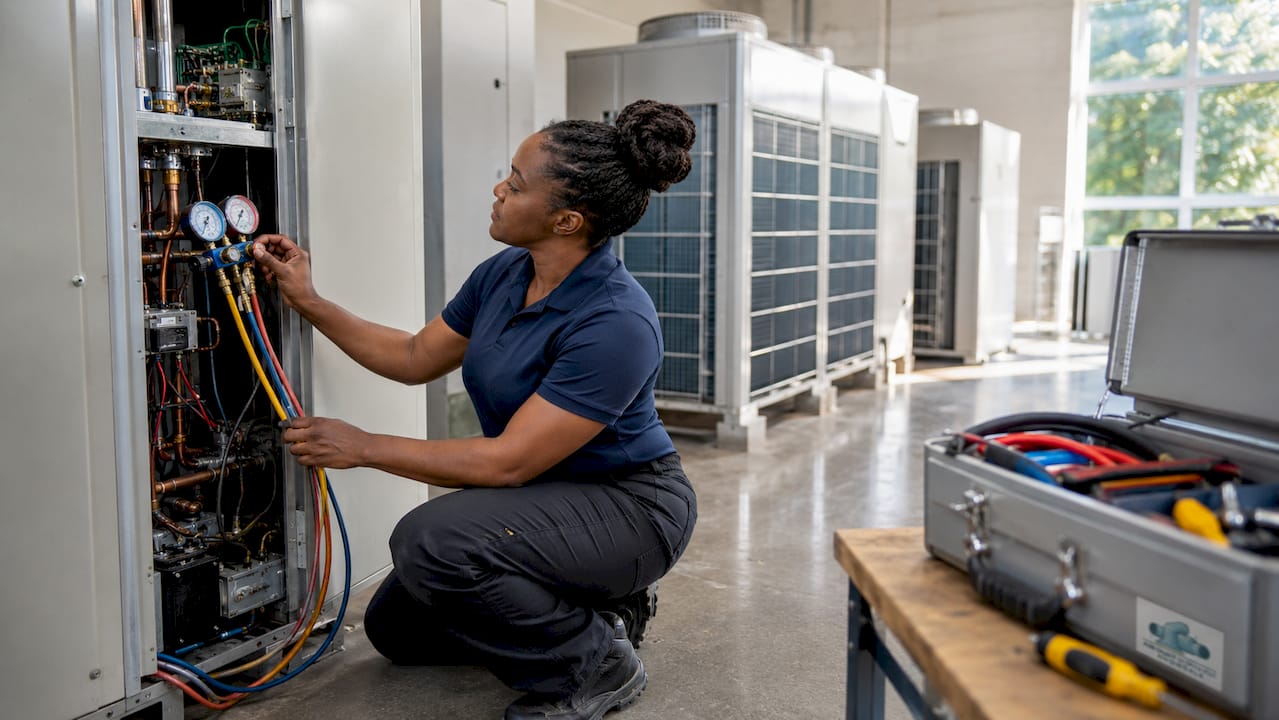
Modern VRF systems launched in 2026 deliver 15% improved outdoor unit energy efficiency compared to previous generations. They also operate stably down to -22°F, which matters for facilities in climates with harsh winters. That combination of efficiency and cold-weather reliability makes VRF a practical choice for a wider range of building types.
The refrigerant question is now central to any VRF purchase decision. Current systems use low global warming potential (GWP) refrigerants like R-32, which comply with tightening environmental regulations. Choosing a system with a compliant refrigerant today protects you from retrofit costs as those regulations tighten further.
Here is how modern VRF systems compare across key performance categories:
| Feature | Standard central system | Modern VRF system |
|---|---|---|
| Zone control | Fixed air distribution | Individual zone demand response |
| Cold weather operation | Performance drops below 20°F | Stable to -22°F |
| Refrigerant compliance | Varies by unit age | R-32, low-GWP compliant |
| Simultaneous heating and cooling | Not supported | Supported across zones |
| Outdoor unit efficiency | Baseline | 15% improvement over prior gen |
VRF systems also support simultaneous heating and cooling across different zones. A server room can run cooling while a conference room runs heat, from the same outdoor unit. That flexibility reduces the number of separate systems you need to maintain and the number of contractors you need to coordinate.
3. Dual-fuel packaged rooftop units for extreme weather
Dual-fuel packaged rooftop units solve a problem that standard heat pumps cannot. Heat pumps lose heating capacity as outdoor temperatures drop. Below a certain threshold, they cannot keep up with demand. Dual-fuel units solve this by pairing an electric heat pump with a natural gas furnace in a single package.
DOE-verified dual-fuel rooftop units maintain high-capacity heating down to -20°F. The gas furnace activates when the heat pump reaches its efficiency limit, keeping the building warm without oversizing the electric system. That design also reduces peak electricity demand during cold snaps, which cuts demand charges on your utility bill.
The regulatory angle matters here as well. These units are designed to meet the upcoming AHRI 1340 energy performance standard, which takes effect in 2029. Choosing AHRI 1340-compliant equipment now means your rooftop units will not need replacement or costly modification when that standard becomes mandatory.
Key advantages of dual-fuel rooftop units for commercial facilities:
- Verified heating performance to -20°F without auxiliary electric resistance heat
- Gas furnace backup activates automatically, with no manual switching required
- Single packaged unit reduces installation complexity versus split systems
- Forward-compatible with AHRI 1340 standards effective 2029
- Reduces peak electric demand during extreme cold, lowering utility costs
Dual-fuel technology is particularly relevant for businesses in the Southwest and Mountain West, where temperature swings between seasons are wide. A facility in a climate like Avondale, Arizona experiences both intense summer cooling loads and occasional hard freezes. A dual-fuel unit handles both extremes from one rooftop installation.
4. Integrated air handling units with natural refrigerants
Integrated air handling units (AHUs) with built-in heat pumps represent a different approach to the refrigerant compliance problem. Instead of retrofitting an existing system to use a new refrigerant, these units arrive pre-assembled with natural refrigerants already installed. The result is a plug-and-play installation that skips the complexity of field refrigerant conversion.
Systemair's integrated AHU uses R290, a natural refrigerant with a GWP of just 0.02. For context, R-410A, the refrigerant still found in many commercial systems, has a GWP of 2,088. Switching to R290 is not just a regulatory move. It is a meaningful reduction in the environmental footprint of your building's climate system.
Plug-and-play integrated AHUs reduce installation labor and operational complexity, which directly lowers your upfront project cost. Pre-assembled units also reduce the number of field connections that can fail, improving long-term reliability.
These systems combine ventilation, heat recovery, and cooling in a single unit. That integration matters for indoor air quality because heat recovery ventilation brings in fresh outdoor air without the energy penalty of conditioning unconditioned air from scratch. Your building gets better air exchange and lower energy bills at the same time.
Pro Tip: When specifying an integrated AHU, confirm that the unit's heat recovery efficiency rating meets ASHRAE 90.1 requirements for your climate zone. Units that fall short of that threshold will not deliver the projected energy savings.
Suitable applications include commercial offices, retail spaces, schools, and public buildings. The F-gas regulation compliance built into R290 systems also means you are positioned ahead of the regulatory curve rather than scrambling to catch up when phase-down deadlines arrive.
5. Smart sensors and demand-controlled ventilation
Demand-controlled ventilation (DCV) is the mechanical foundation that makes AI optimization and smart HVAC solutions for companies work. DCV systems use CO2 sensors and occupancy detectors to measure actual building use and adjust fresh air delivery accordingly. Without accurate sensor data, even the best AI platform is working from guesswork.
CO2-based DCV is recognized by ASHRAE Standard 62.1 as an accepted method for meeting ventilation requirements while reducing energy use. The standard sets minimum ventilation rates, and DCV allows your system to meet those rates precisely rather than overventilating at all times. Overventilation is one of the most common sources of wasted energy in commercial buildings.
Wireless sensor networks have made DCV practical for buildings that were not designed with sensor infrastructure in mind. Modern wireless sensors install without conduit runs or wall penetrations, which keeps retrofit costs low. Battery life on current-generation sensors typically runs several years before replacement is needed.
The data these sensors generate also feeds into clean vent performance. A sensor network that detects elevated CO2 in a zone is also detecting the conditions that accelerate dust and contaminant buildup in ducts. That data gives facility managers an early signal that duct cleaning or inspection is due, before air quality complaints start arriving from occupants.
6. Energy-efficient HVAC systems and right-sizing fundamentals
The highest-ROI decision in any HVAC project is not which technology you choose. It is whether the system is sized correctly for your building. Right-sizing using Manual S calculations is the industry standard method for matching equipment capacity to actual building load. Oversized units short-cycle, which means they run in short bursts rather than long, efficient cycles. That pattern increases wear, reduces dehumidification, and raises energy costs.
Manual S calculations account for local climate data, building envelope performance, internal heat gains from equipment and occupants, and duct system losses. A contractor who skips this step and sizes by rule of thumb is setting you up for a system that underperforms from day one. Require Manual S documentation before approving any equipment specification.
The connection between right-sizing and efficient HVAC systems for clean air is direct. An oversized system that short-cycles does not run long enough to filter and dehumidify air properly. The result is higher humidity, more dust circulation, and faster contaminant buildup in ducts. Getting the size right is not just an energy decision. It is an air quality decision.
7. Regulatory compliance and future-proofing your equipment choices
The regulatory environment for commercial HVAC is tightening on two fronts: refrigerant phase-downs and energy performance standards. Buying equipment that meets only current standards means you may face replacement costs before the equipment reaches the end of its useful life. Forward-compatible equipment avoids that trap.
AHRI 1340 compliance is the benchmark for rooftop unit performance standards taking effect in 2029. Equipment that meets this standard today will not require modification when the deadline arrives. That is three to five years of regulatory certainty built into your purchase decision.
On the refrigerant side, the EPA's AIM Act is driving a phased reduction of high-GWP refrigerants including R-410A. Systems using R-32 or natural refrigerants like R290 are already positioned for compliance. Systems still using R-410A will face increasing refrigerant costs and availability constraints as the phase-down progresses.
The practical approach is to treat regulatory compliance as a filter, not a feature. Before evaluating any equipment on efficiency or cost, confirm it meets or exceeds AHRI 1340 and uses a compliant refrigerant. That narrows your options to systems that will not create a compliance problem in three years. Then evaluate the remaining options on performance and total cost of ownership.
Key takeaways
The most effective approach to business HVAC technology trends combines AI-driven software retrofits for immediate savings with forward-compatible equipment choices that prevent regulatory obsolescence.
| Point | Details |
|---|---|
| AI delivers fastest ROI | AI optimization cuts energy use by 20–40% without replacing existing equipment. |
| VRF improves zone control | Modern VRF systems offer 15% better efficiency and stable operation to -22°F. |
| Dual-fuel handles extreme cold | DOE-verified units maintain heating to -20°F and meet AHRI 1340 standards. |
| Natural refrigerants reduce risk | R290 systems with GWP of 0.02 are already compliant with F-gas regulations. |
| Right-sizing is non-negotiable | Manual S calculations prevent oversizing, which raises energy costs and reduces air quality. |
What I've learned about prioritizing HVAC upgrades in commercial buildings
After working with facility managers across a range of commercial properties, one pattern stands out clearly. The businesses that get the best results do not start with the most advanced technology. They start with the most accessible win.
That win is almost always AI-driven software optimization. Retrofitting existing systems with AI platforms delivers 20–40% energy savings without the disruption of equipment replacement. For a facility spending $80,000 a year on HVAC energy, that is $16,000 to $32,000 back in the budget. No capital project required.
The mistake I see most often is skipping right-sizing. A facility manager invests in a high-efficiency VRF system, but the contractor sizes it by gut feel rather than Manual S calculations. The new system short-cycles, humidity climbs, and the air quality complaints start within six months. The technology was right. The process was wrong.
My honest recommendation is this: treat regulatory compliance as your baseline filter, not a bonus feature. Equipment that does not meet AHRI 1340 or uses a refrigerant on the phase-down list is a liability, not an asset. Buy forward-compatible systems, retrofit with AI where you can, and get the sizing right. That sequence delivers results that hold up over a full equipment lifecycle.
— Shaun
How Airanddryerventcleaningavondale supports your HVAC performance
Even the most advanced HVAC system underperforms when ducts and vents are clogged with dust, debris, or mold. Clean ductwork is the physical foundation that every energy-efficient technology depends on.
Airanddryerventcleaningavondale provides commercial air duct cleaning and AC vent cleaning services for businesses in Avondale, AZ. Professional cleaning removes the buildup that restricts airflow, forces your system to work harder, and degrades indoor air quality for your occupants. The team also offers air quality testing to give you a clear picture of what is circulating through your building. Flexible scheduling, including after-hours options, means service happens on your timeline, not at the cost of business operations. Contact Airanddryerventcleaningavondale to schedule a commercial evaluation and protect the investment you are making in your HVAC system.
FAQ
What are the biggest HVAC innovations for businesses in 2026?
The leading commercial HVAC advancements in 2026 are AI-driven optimization platforms, VRF systems with low-GWP refrigerants, dual-fuel packaged rooftop units, and integrated air handling units using natural refrigerants like R290. Each targets a specific gap in energy efficiency, air quality, or regulatory compliance.
How much energy can AI-driven HVAC optimization save?
AI-driven HVAC platforms reduce building energy use by 20–40% by adjusting ventilation based on live occupancy data rather than fixed schedules. That savings range applies across office buildings, healthcare facilities, and schools.
What is AHRI 1340 and why does it matter?
AHRI 1340 is an energy performance standard for commercial rooftop units that takes effect in 2029. Buying compliant equipment now protects your investment from mandatory replacement costs when the standard becomes enforceable.
What refrigerant should I look for in new commercial HVAC equipment?
Look for systems using R-32 or natural refrigerants like R290, both of which carry low global warming potential ratings and comply with current and upcoming EPA AIM Act phase-down requirements. Avoid systems still using R-410A, which faces increasing cost and availability pressure.
How does duct cleanliness affect HVAC efficiency?
Dirty ducts restrict airflow and force your system to run longer cycles to meet temperature setpoints, which directly increases energy consumption. Regular duct and vent cleaning maintains the airflow your system was designed to deliver and protects indoor air quality for building occupants.