
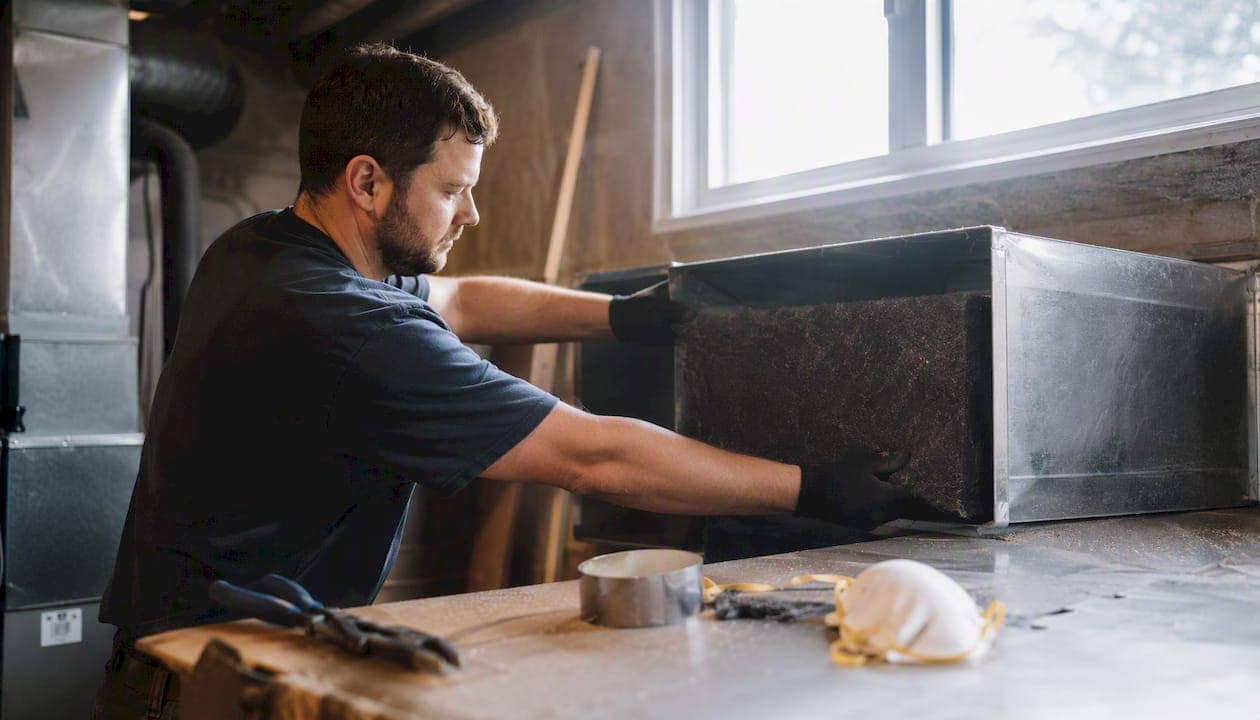
The fastest reliable way to cut HVAC noise is to match your fix to the source: quiet the equipment first, then control how sound travels through ducts and air, then cut off structure-borne vibration paths. That three-part sequence, endorsed by ASHRAE's noise and vibration guidance, is what separates a lasting result from a band-aid. Most noise complaints trace back to improper selection, design, or installation rather than a single broken part.
Five actions to take right now:
- Walk the system and listen at each register, at the air handler casing, and at the outdoor condenser to locate the loudest source.
- Check for loose grilles, rattling fasteners, and any rigid duct touching a wall or floor joist.
- Replace a clogged air filter — restricted airflow raises duct velocity and turbulence noise immediately.
- Slide rubber or spring isolation pads under the air handler or condenser if they are sitting directly on a hard surface.
- Schedule an octave-band measurement with a contractor who references ASHRAE, ASTM E477 silencer test data, and OSHA noise standards before specifying any products.
Pro Tip: Diagnose before you buy. Listen first, measure second, then apply the simplest matched fix. A $30 isolation pad sometimes solves what a $600 silencer cannot.
Key Takeaways
Matching the fix to the noise source is the single most important step in any HVAC noise reduction project.
| Point | Details |
|---|---|
| Three-part strategy | Quiet the source first, then control duct propagation, then isolate structure-borne vibration paths. |
| Silencer specs to demand | Always request octave-band insertion loss, generated noise, and pressure drop together; ASTM E477 lab data confirms the numbers. |
| Placement matters as much as product | Silencers too close to the AHU outlet create regenerated noise; maintain several duct diameters of straight run first. |
| Prevention vs. retrofit cost | Getting isolation right during installation costs roughly 1–2% of HVAC system cost; retrofitting it later costs far more. |
| Airanddryerventcleaningavondale | Provides on-site diagnostics, duct cleaning and repair, vibration isolation, and verification measurement for Avondale, AZ properties. |
Table of Contents
- What is causing your HVAC system to be so loud?
- Which products and materials actually reduce HVAC noise?
- Where should you place silencers and isolators to get full benefit?
- When should you call a professional for HVAC noise assessment?
- What do HVAC noise retrofits typically cost and how long do they take?
- What most contractors miss on noise jobs
- Airanddryerventcleaningavondale can handle your noise diagnostic and remediation
- Sources
- FAQ
What is causing your HVAC system to be so loud?
HVAC noise falls into four categories, and knowing which one you are dealing with changes everything about the fix you choose.
Mechanical noise comes from rotating equipment: fan blades, compressor pistons, worn bearings, and loose motor mounts. It tends to be rhythmic, often with a hum or thump that tracks the equipment's operating cycle. A compressor that knocks at startup and then settles is a classic mechanical signature. Bearings going bad produce a high-pitched whine that gets worse as the unit warms up.
Aerodynamic or flow noise is generated when air moves too fast or hits an abrupt change in direction. Elbows, reducers, and partially closed dampers all create turbulence. You will hear this as a rushing, hissing, or whooshing sound that intensifies when the system ramps up. Blocked registers are a common culprit: close half the supply registers in a house and the velocity in the remaining ducts climbs sharply, taking the noise with it.
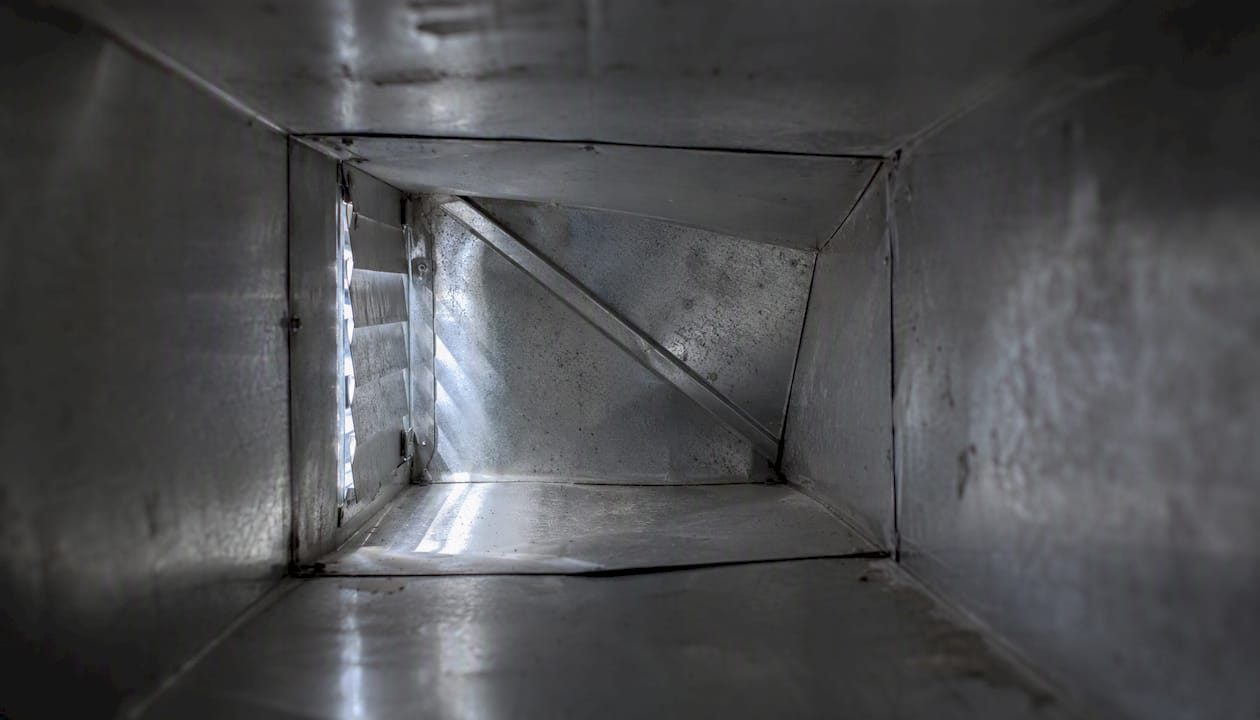
Duct breakout is the sound that radiates through the duct walls themselves rather than traveling out through the registers. A sheet-metal trunk line running through a bedroom ceiling can transmit fan noise even when the register is closed. It sounds like a low-level hum or buzz that seems to come from the ceiling rather than from a specific vent.
Structure-borne vibration happens when equipment couples mechanically into the building frame. A rooftop AHU sitting on a concrete curb without spring isolators can send vibration through the roof deck, down the walls, and into occupied spaces two floors below. This is the hardest category to fix after the fact because the transmission path runs through the building itself.
A quick on-site check: press your palm flat against the duct surface near the air handler. If you feel vibration, structure-borne transmission is part of the problem. Then stand at the farthest register from the unit. If the noise is loudest there, flow turbulence is the likely driver. Common HVAC problems often overlap, so expect more than one category simultaneously.
Which products and materials actually reduce HVAC noise?
Each product family targets a specific noise pathway. Buying the wrong one wastes money and sometimes makes things worse by adding pressure drop without meaningful attenuation.
AMCA's silencer guidance is clear that silencer performance must be evaluated on three numbers together: insertion loss, generated noise, and pressure drop. Ask for all three in octave-band format, not a single dBA figure. ASTM E477 is the standard lab test protocol for silencer insertion loss and pressure drop; if a manufacturer cannot provide E477 data, treat their insertion-loss claims skeptically.
Statistic to know: Properly installed exterior barrier walls provide up to 15 dB of attenuation in the mid-frequency range when they fully block the line of sight between equipment and the receiver.
For the replacement decision: Consumer Reports' central air buying guide identifies quiet operation as the single strongest predictor of owner satisfaction and specifically recommends ductless mini-splits for noise-sensitive spaces because the compressor sits entirely outside the occupied area.
Key specs to request from any silencer supplier:
- Octave-band insertion-loss curves (not just a single dBA number)
- Generated noise rating at your design airflow velocity
- Pressure-drop value at that same velocity
- ASTM E477 test report or equivalent lab data
- Packless or lined construction options for your application
Silencer design details matter too. Streamlined internal passages, rounded leading edges on baffles, and perforated containment all reduce self-noise at higher velocities. For low-frequency rumble below 63 Hz, expect to need longer silencer bodies, heavier enclosures, or multiple treatment layers rather than a single thin liner.
Where should you place silencers and isolators to get full benefit?
Placement is where most retrofits fail. A correctly specified silencer installed in the wrong location can actually add noise rather than remove it.
The core placement rules:
- Keep at least 2 ft of clear space around the air handler before any fitting or silencer. Turbulence at the AHU outlet needs distance to settle before it hits a silencer's baffles.
- Locate silencers a minimum of several duct diameters downstream of the AHU outlet. Placing one too close creates regenerated noise from turbulent airflow hitting the silencer's internal surfaces, a problem AMCA documents explicitly.
- Use in-branch silencers for localized sources (a noisy fan coil unit feeding one zone). Use trunk silencers for broadband noise affecting multiple branches.
- Install flexible duct connectors at every AHU connection point. A rigid sheet-metal connection between the unit and the duct system is a direct vibration bridge.
- Spring or rubber isolators belong under every piece of rotating equipment. Housekeeping pads under AHUs add mass and reduce coupling to the floor slab.
The pressure-drop budget matters as much as the insertion-loss number. A silencer that delivers 20 dB of attenuation but adds 0.6 in. wg of pressure drop will force the fan to work harder, raising velocity and potentially generating more noise downstream. Target pressure drops below 0.35 in. wg per silencer where possible, and add up all the drops in the system before finalizing a selection.
Common installation faults that negate products:
- Rigid duct touching a wall stud, floor joist, or ceiling hanger rod (bypasses all vibration isolation)
- Missing flexible connectors at the AHU supply and return connections
- Silencer installed immediately at the AHU outlet with no straight duct run upstream
- Acoustic liner terminating before the last elbow, leaving an untreated radiating surface
- No access panel left for liner inspection or silencer cleaning
Pro Tip: Before any contractor closes up a ceiling or wall, ask them to confirm that no rigid duct is in contact with the structure. A single missed hanger touching a joist can transmit enough vibration to undo $2,000 worth of silencers. This is the detail that prevention-focused guides flag most often.
For exterior installations, noise reduction with outdoor barriers and interior door treatments can complement duct-side work when sound is entering occupied spaces through building envelope paths rather than purely through the duct system.
When should you call a professional for HVAC noise assessment?
DIY checks get you to the right neighborhood. A professional measurement gets you to the right address.
Call a pro when: the noise is a low-frequency rumble that seems to come from everywhere at once, when you have already tightened fasteners and replaced the filter with no improvement, or when the complaint is in a commercial space with occupant comfort or code implications.
What a qualified contractor or acoustic consultant should deliver:
- A site walkthrough with sound power estimates at each major source (AHU, fans, compressors, diffusers).
- Octave-band measurements at the complaint location, compared against NC or RC target curves for the space type. RC curves are preferred over NC curves for spaces with low-frequency complaints because they extend down to the 16 Hz octave band.
- Source isolation tests: shut down equipment one at a time to confirm which unit is the dominant contributor.
- Vibration coupling inspection: check for rigid connections between rotating equipment and the building structure.
- A written silencer selection with insertion-loss and pressure-drop calculations for your specific duct geometry and airflow.
Questions to ask before hiring:
- Do you provide octave-band insertion-loss estimates, not just a single dBA number?
- Do you reference ASTM E477 test data when selecting silencers?
- Can you show expected pressure-drop values and confirm they fit within the system's static pressure budget?
- Does your scope include vibration isolation and flexible connectors, or only duct treatments?
- Will you take a verification measurement after the work is complete?
OSHA's noise guidance reinforces why octave-band analysis matters: a single A-weighted dBA reading can mask low-frequency energy that is the most objectionable component of HVAC noise in occupied spaces. A contractor who only quotes you one number is not giving you enough information to make a good decision.
Pro Tip: Insist on a before-and-after measurement plan written into the contract. Without a baseline octave-band reading before work starts, there is no way to verify what the retrofit actually achieved.
What do HVAC noise retrofits typically cost and how long do they take?
Cost scales with the source type, not just the product. Low-frequency problems are the most expensive because they require larger, heavier treatments and often structural coordination.
Timeline ranges for common fixes:
- Tightening mounts, adding isolation pads, replacing a filter: a few hours, same day.
- Adding flexible connectors and spring isolators to an existing AHU: half a day to one full day.
- Installing duct silencers on accessible trunk lines: 1–3 days depending on access and duct configuration.
- Wrapping a compressor or small AHU with sound blankets: 1 day.
- Building a mechanical room enclosure or exterior barrier wall: 1–3 weeks, including structural and firestop coordination.
- Full AHU replacement with a low-noise unit or ductless mini-split system: 1–5 days depending on scope.
Factors that push costs significantly higher:
- Low-frequency rumble requiring large silencers or heavy enclosures
- Rooftop AHU access requiring a crane or specialized rigging
- Firestop rework where duct penetrations must be re-sealed after modifications
- Airflow redesign needed because existing duct velocities are too high to treat acoustically without resizing
- Code compliance work triggered by the modification permit
The prevention argument is hard to ignore: practical noise control guides consistently show that getting vibration isolation and flexible connectors right during original installation costs roughly 1–2% of total HVAC system cost. Retrofitting those same details after a noise complaint is filed costs far more once access, demolition, and re-commissioning are included. Preventing HVAC wear early is the most cost-effective noise strategy available.
What most contractors miss on noise jobs
The pattern I see repeatedly on residential and commercial jobs in Avondale is this: the equipment itself is fine. The noise problem is almost always a detail that got skipped during installation or a maintenance item that compounded over time.
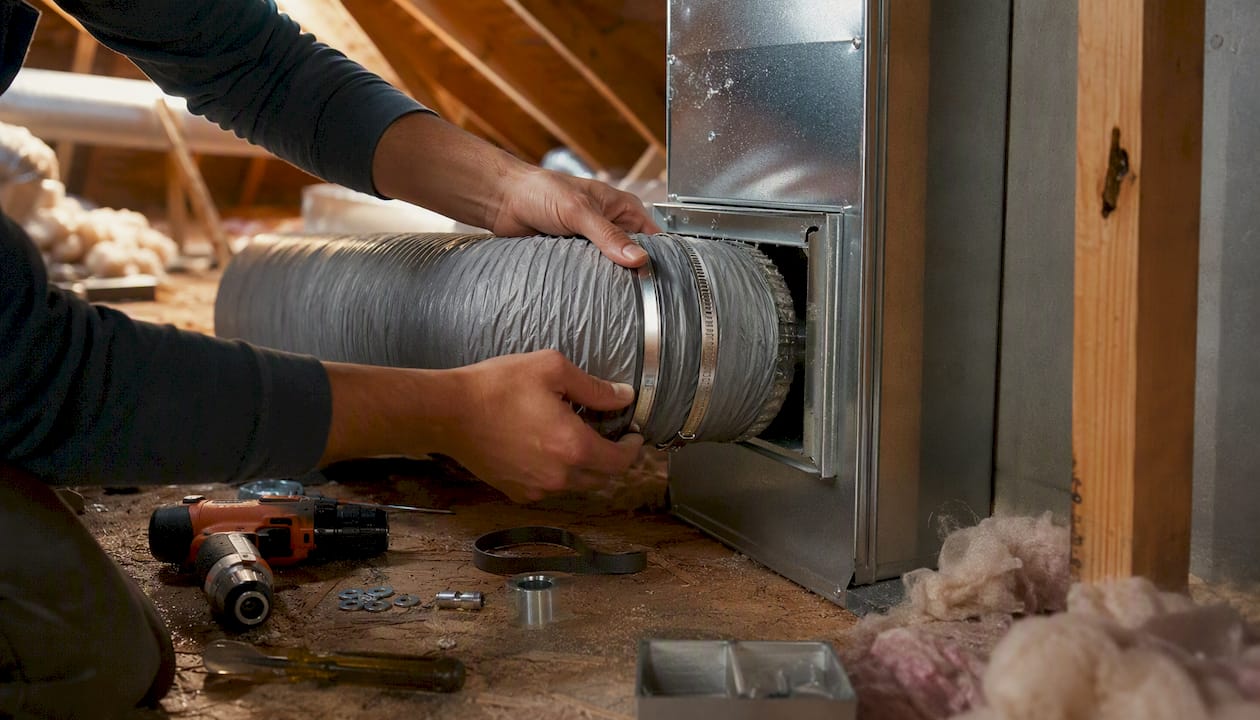
The most common missed detail is the flexible connector. A unit gets swapped out, the installer reuses the existing rigid sheet-metal boot, and within a week the homeowner is calling back because the new unit is just as loud as the old one. The compressor vibration is traveling straight into the duct system and from there into the ceiling. A $40 flex connector would have prevented it.
The second pattern is clogged ductwork raising system velocity. Debris and dust accumulation narrows the effective duct area, which means the fan has to push harder and the air moves faster. Faster air is louder air. A thorough duct cleaning often reduces perceived noise noticeably before any acoustic product is added, which is why I always recommend a diagnostic cleaning before specifying silencers.
For low-frequency rumble complaints, the fix is almost never a single product. It is usually a combination: spring isolators under the unit, flexible connectors at every penetration, and sometimes a lined enclosure around the mechanical room. Expecting one silencer to solve a 63 Hz problem is how budgets get wasted.
When Airanddryerventcleaningavondale handles a noise-related service call, the fastest route to a verified outcome is a diagnostic inspection first, then a written recommendation with specific products and expected results, then staged remediation with a verification check at the end.
Airanddryerventcleaningavondale can handle your noise diagnostic and remediation
Noisy HVAC systems in Avondale, AZ respond fastest to a local team that can inspect, clean, and repair in one visit rather than coordinating three separate contractors.
Airanddryerventcleaningavondale offers on-site diagnostic inspections that cover duct condition, vibration coupling, airflow velocity, and filter status, all the factors that drive noise before any acoustic product is specified. The service scope includes air duct cleaning and repair, vibration isolation installation, flexible connector replacement, and vent cleaning and replacement for residential and commercial properties. Commercial property owners can book through the commercial duct cleaning service page. After work is complete, a verification check confirms the result. Schedule your diagnostic visit today and get a written recommendation with cost options before any work begins.
Sources
The standards and guides below are the primary references for HVAC acoustic work in the United States. Ask any contractor or silencer supplier to cite them when presenting recommendations.
- CHAPTER 49. NOISE AND VIBRATION CONTROL
- Understanding & Reducing Air System Noise
- Best Central Air Conditioning Buying Guide - Consumer Reports
- Osha
- Practical Guide to Noise and Vibration Control, Second Edition
FAQ
What is the quickest fix for a loud HVAC system?
Check for a clogged filter and loose fasteners first — both are free or near-free and often reduce noise immediately. If the problem persists, add rubber or spring isolation pads under the air handler before spending money on silencers.
How do duct silencers work and what specs should I ask for?
Duct silencers absorb sound energy as air passes through lined baffles or chambers. Always request octave-band insertion-loss curves, generated noise ratings, and pressure-drop values at your design airflow; ASTM E477 lab data confirms those numbers are real.
When do quiet HVAC systems require professional acoustic measurement?
Call a professional when the noise is a low-frequency rumble that simple fixes have not resolved, or when the space has commercial occupant comfort requirements. OSHA noise guidance supports octave-band analysis over single dBA readings for these situations.
Are ductless mini-splits really quieter than central systems?
Yes, in most cases. Because the compressor sits entirely outside the occupied space, indoor units typically operate at 19–26 dBA. Consumer Reports identifies quiet operation as the top predictor of owner satisfaction and specifically recommends mini-splits for noise-sensitive rooms.
Can Airanddryerventcleaningavondale help with HVAC noise problems in Avondale, AZ?
Yes. Airanddryerventcleaningavondale provides on-site diagnostic inspections, duct cleaning and repair, vibration isolation installation, and verification checks for residential and commercial properties in Avondale, AZ.