

TL;DR:
- Indoor air pollutant levels are 2 to 5 times higher than outdoor levels, affecting health and comfort.
- Common indoor pollutants include mold, dust mites, VOCs, carbon monoxide, and particulate matter, especially in Avondale.
- Control strategies include sealing the building, improving ventilation, and using high-efficiency air filters.
Most Avondale homeowners and small business owners assume their biggest air quality threat sits outside, blowing in from the desert. The truth is the opposite. Indoor pollutant levels are often 2 to 5 times higher than outdoor levels, and most Americans spend roughly 90% of their time indoors. In a city like Avondale, where you keep windows shut for months to manage the heat and your HVAC runs almost nonstop, pollutants accumulate fast. Understanding what you are dealing with, where it comes from, and what you can do about it makes a real and immediate difference to how your family or employees feel every single day.
Table of Contents
- What qualifies as an indoor air pollutant?
- Top examples of indoor air pollutants in Avondale homes and businesses
- Comparing indoor air pollutants: how do they stack up?
- Reliable ways to reduce and prevent common indoor air pollutants
- What most guides get wrong about indoor air pollution in Arizona
- Get professional help for cleaner indoor air in Avondale
- Frequently asked questions
Key Takeaways
| Point | Details |
|---|---|
| Many pollutant types | Indoor air pollutants include biological, chemical, and particulate threats found in most homes and businesses. |
| Health risks are real | Problems range from allergies to serious conditions like asthma, cancer, and carbon monoxide poisoning. |
| Control is possible | Proven steps—source control, smart ventilation, filtration—can quickly reduce pollutant levels indoors. |
| Local factors matter | Avondale’s desert climate affects pollens, dust, and HVAC use in ways most guides overlook. |
| Professional help pays off | Testing and specialty cleaning make a significant difference, especially in stubborn or complex cases. |
What qualifies as an indoor air pollutant?
After setting the stage for the hidden risks inside our homes and businesses, let us start by clarifying what officially counts as an indoor air pollutant and why certain substances make the list.
An indoor air pollutant is any substance present inside a building at concentrations high enough to harm the health or comfort of occupants. The key word is "concentration." Mold spores exist almost everywhere, but when they multiply inside a wall cavity or duct system, the concentration climbs to a level that irritates airways and triggers reactions. The same logic applies to gases, particles, and chemical compounds. Source, quantity, and duration of exposure all matter.
Common indoor air pollutants fall into three broad categories:
- Biological contaminants: Mold, mildew, bacteria, viruses, pollen, dust mites, and pet dander. These thrive wherever moisture or organic material is present.
- Chemical pollutants: Carbon monoxide (CO), nitrogen dioxide (NO2), volatile organic compounds (VOCs from paints, cleaning products, and furniture), radon, pesticides, and secondhand smoke.
- Particulate matter (PM): Tiny solid or liquid particles suspended in air. PM2.5 refers to particles 2.5 microns or smaller, small enough to bypass your nose and throat and lodge deep in your lungs.
In Avondale's desert climate, you face a specific combination of challenges. Dust storms, or haboobs, push fine silica and mineral particles into every gap in a building envelope. The monsoon season then introduces humidity spikes that create brief but intense conditions for mold growth. Meanwhile, tight modern construction traps whatever is already inside. ASHRAE Standard 62.1 sets minimum outdoor air rates of roughly 5 to 10 cubic feet per minute per person plus 0.06 cfm per square foot of floor area, a benchmark that many older Avondale properties do not meet.
To officially qualify as a harmful indoor pollutant, a substance generally must: be measurably present above safe thresholds, have documented health effects at those levels, originate or accumulate indoors at higher concentrations than outdoors, and persist long enough for occupants to receive a meaningful dose. Understanding DIY duct cleaning tips can help you take early action before concentrations reach harmful levels. You can also review three common indoor air pollutants for a quick overview of where these threats typically begin.
Top examples of indoor air pollutants in Avondale homes and businesses
Now, with a clear definition and criteria, let us break down the most common indoor pollutants you might find right here in Avondale.
Biological contaminants
Mold and mildew are among the most frequently reported indoor air problems in the Southwest. Even though Avondale is dry for most of the year, monsoon rains in July and August push indoor humidity above 60%, which is the threshold where mold begins colonizing drywall, ceiling tiles, HVAC pans, and duct interiors. You may smell it before you see it. A musty odor when the AC kicks on is a classic warning sign.
Bacteria and viruses circulate through shared ventilation systems in offices, retail spaces, and multi-unit housing. Poor filter maintenance and infrequent duct cleaning allow biofilm to form on duct walls, which then broadcasts microorganisms every time air moves through.
Dust mites and pet dander are year-round residents in most Avondale homes. Dust mites thrive in bedding, carpet, and upholstery. Pet dander is microscopic and stays airborne for hours, which is why even a "pet-free" room can still trigger reactions if the HVAC is shared with areas where pets roam.
Pollen travels inside on clothing, through open windows during spring, and through leaky duct systems connected to unconditioned spaces like garages.
Health impact note: Biological contaminants trigger asthma and allergies in millions of Americans. Children, the elderly, and those with existing respiratory conditions face the greatest risk. CO becomes lethal at high levels, radon is the second leading cause of lung cancer in the U.S., and PM2.5 is small enough to enter the bloodstream directly.
Chemical gases
Carbon monoxide (CO) is produced by gas furnaces, water heaters, stoves, and attached garages. It is colorless and odorless, which is why it causes unconsciousness and death before most people realize something is wrong. Malfunctioning or unserviced gas appliances are the primary culprit.
Nitrogen dioxide (NO2) comes from gas cooking, unvented heaters, and vehicle exhaust that drifts in from garages. Long-term exposure inflames the airways and worsens asthma.
Radon seeps from uranium-containing soil and rock. It enters through foundation cracks and slab gaps. While radon levels tend to be lower in Avondale than in northern states, the only way to confirm your level is to test.
VOCs are released from new flooring, paints, adhesives, cleaning sprays, air fresheners, and even laser printers. "Off-gassing" is highest in the weeks after installation or in poorly ventilated spaces. VOC exposure causes headaches, eye irritation, and, with chronic exposure, liver and kidney stress.
Particulate matter and aerosols
PM2.5 and PM10 are the particles that cause the most concern in Avondale. A haboob can send outdoor PM10 levels soaring, and if your building envelope is not tight, those particles migrate inside. PM2.5 is the more dangerous fraction because of how deep it penetrates into lung tissue.
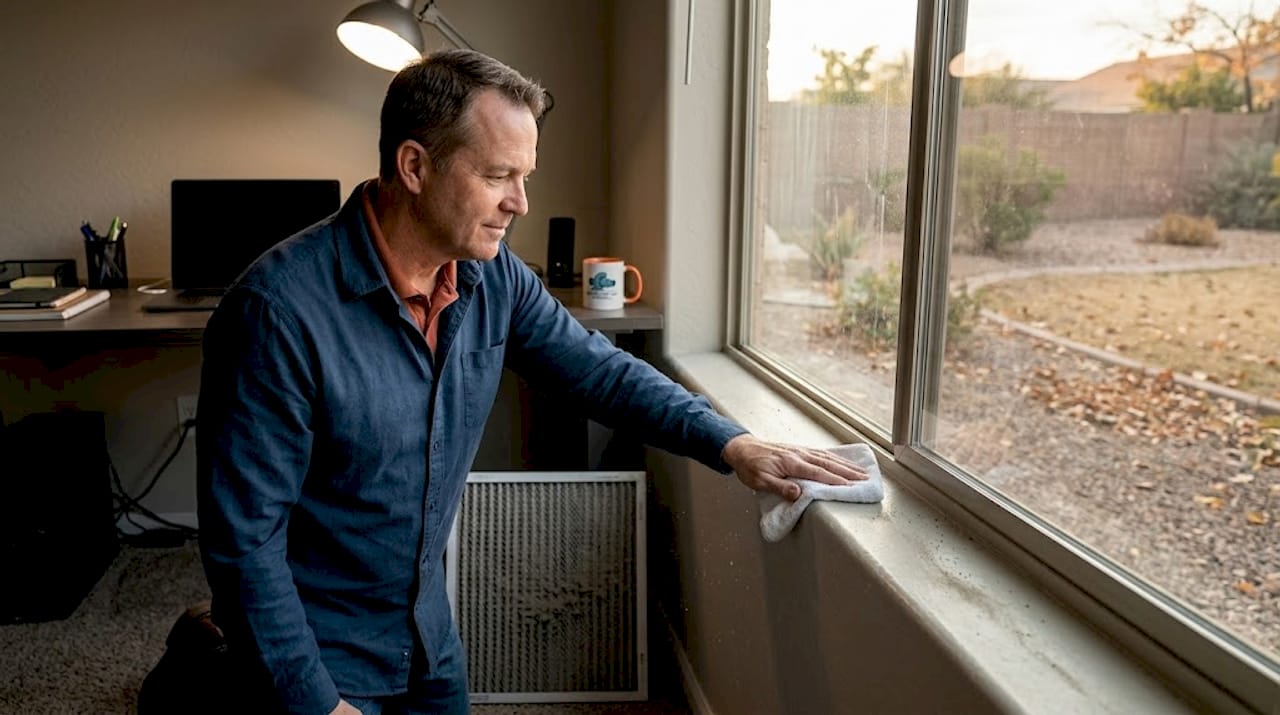
Wildfire smoke now affects the Phoenix metro area several weeks a year. Smoke particles carry a complex mixture of CO, VOCs, and ultra-fine particulates that are especially harmful to children and older adults.
Aerosols from sprays (cleaning products, hair sprays, and disinfectants) release both chemical compounds and fine liquid droplets into the air. In a small bathroom or office without ventilation, concentrations can spike quickly.
Pesticides and secondhand smoke
Pesticides are applied heavily in desert communities to control scorpions, ants, and cockroaches. Residues settle on surfaces and become resuspended as indoor dust. Secondhand smoke contains more than 7,000 chemical compounds and is among the most studied indoor air hazards documented.
Scheduling healthier air with duct cleaning removes accumulated particles and biological debris from the pathways that distribute air throughout your building. For a broader action plan, steps to improve air quality covers several additional measures that work well alongside professional cleaning.
Comparing indoor air pollutants: how do they stack up?
With each pollutant identified, it is helpful to see how they compare in terms of frequency, risk, and how easy they are to control in your own space.
| Pollutant | Health risk level | How common in Avondale | Ease of control |
|---|---|---|---|
| Mold / mildew | High | Very common (monsoon season) | Moderate (fix moisture source) |
| Dust mites / dander | Moderate | Very common | Easy (filter, vacuum) |
| PM2.5 / PM10 | High | Very common (dust storms) | Moderate (sealing + HEPA) |
| Carbon monoxide | Severe | Moderate | Easy (detector + service) |
| VOCs | Moderate to high | Common | Moderate (ventilation, low-VOC products) |
| Radon | High (long-term) | Low to moderate | Moderate (test + mitigation) |
| Nitrogen dioxide | Moderate | Moderate (gas appliances) | Easy (ventilation + servicing) |
| Secondhand smoke | High | Situational | Easy (no-smoking policy) |
| Wildfire smoke | High (seasonal) | Seasonal | Moderate (sealing + filtration) |
| Pesticide residues | Low to moderate | Common | Moderate (safer products + ventilation) |
Indoor pollutant levels run 2 to 5 times higher than outdoor air, which explains why the table above shows so many pollutants rated as "very common" or "common" right here in Avondale. Understanding how different air filter ratings work helps you match the right tool to the right pollutant. The air filter types guide breaks down MERV ratings and helps you pick filters that actually capture what you are most exposed to.
Understanding the benefits of air duct cleaning is useful context when deciding which pollutants on this table to prioritize first.
Pro Tip: Work from the top right of this table first. Pollutants that are both high-risk and easy to control (CO detectors, no-smoking policies, regular filter changes) give you the fastest, most cost-effective improvement. Tackle the harder items like radon mitigation and deep duct cleaning in a planned, sequential approach.
Reliable ways to reduce and prevent common indoor air pollutants
Having compared the pollutants and their risks, let us move on to the most effective ways you can take action to make your indoor air safer.
The EPA identifies three primary mitigation strategies: source control, improved ventilation, and air cleaning or filtration. These work best in combination, and the order matters.
1. Source control
Source control means eliminating or reducing the pollutant at its origin. This is always the most effective step. Specific actions include:
- Fix moisture problems promptly. Repair leaking pipes, seal roof penetrations, and check AC drain pans and condensate lines. Mold cannot grow without moisture. Most Avondale mold problems trace back to a slow leak that was ignored for months.
- Switch to low-VOC products. Choose paints, adhesives, and cleaning agents labeled as low-VOC or zero-VOC. Store products with tight lids in ventilated spaces, not inside living or working areas.
- Service gas appliances annually. A furnace or water heater that is not combusting properly produces far more CO and NO2 than one that is well maintained. Annual checks are inexpensive compared to the risk.
- Use integrated pest management (IPM). This approach minimizes pesticide use by focusing on prevention, traps, and targeted treatments rather than routine spraying throughout a building.
- Designate smoke-free zones. In commercial buildings, enforce no-smoking policies and provide outdoor areas away from air intakes.
- Seal the building envelope. Caulk gaps around windows, doors, and utility penetrations to reduce the intrusion of outdoor dust and smoke, particularly relevant during Avondale's dust storm season.
2. Improved ventilation
Ventilation brings in fresh air to dilute indoor pollutants. Source control is the most effective strategy, but ventilation is a critical complement. The challenge in Avondale is that outdoor air is not always clean air. During dust events, or when wildfire smoke is present, simply opening windows or increasing outdoor air intake makes things worse, not better.
The solution is demand-controlled ventilation paired with proper filtration. CO2 sensors measure occupant load and adjust ventilation rates accordingly, bringing in more fresh air when a space is busy and dialing back when it is empty. This approach prevents both under-ventilation (pollutant buildup) and over-ventilation (excessive dust and heat load).
Energy recovery ventilators (ERVs) are another strong option for Avondale buildings. An ERV transfers heat and moisture between incoming and outgoing air streams, so you get fresh air without spiking your energy bill. This matters a lot when summer temperatures regularly exceed 110°F.
3. Air filtration and cleaning
| Filtration method | What it removes | Best application |
|---|---|---|
| MERV 8 filter | Pollen, dust mites, larger particles | Basic residential use |
| MERV 13 filter | PM2.5, mold spores, bacteria, smoke | Recommended for most Avondale homes |
| HEPA portable unit | Ultra-fine particles, allergens | Bedrooms, offices, problem areas |
| UV-C air purifier | Bacteria, viruses, mold | Added protection in HVAC systems |
| Activated carbon filter | VOCs, odors, gases | Combined with MERV 13 in HVAC |
Upgrading to a MERV 13 or higher filter is one of the highest-impact, lowest-cost steps you can take today. Be sure your HVAC system can handle the increased resistance that higher-MERV filters create. A qualified technician can check static pressure in your system to confirm compatibility.
Looking at HVAC filter examples gives you a practical side-by-side look at real products and what they capture. Reviewing the air vent cleaning workflow shows you what a professional cleaning involves and why it matters for the overall system. Some people also find that plants to boost indoor air quality offer a small supplementary benefit for certain VOCs, though they should never replace mechanical filtration.
Pro Tip: Change your HVAC filter every 60 days in Avondale, not the 90-day cycle recommended for cooler, less dusty climates. During haboob season (May through September), check your filter every 30 days. A clogged filter does not just fail to clean the air; it restricts airflow, which causes your system to work harder and can accelerate mold growth on cooling coils.
What most guides get wrong about indoor air pollution in Arizona
Most guides on indoor air quality were written for northern climates or generic national audiences. They tell you to "open windows for fresh air" and "increase ventilation during cleaning." In Avondale, that advice can actively backfire, and it is important to understand why.
During a haboob, outdoor PM10 concentrations can exceed 4,000 micrograms per cubic meter, compared to the EPA's 24-hour safe threshold of 150 micrograms per cubic meter. Opening windows during or after a dust event floods your indoor space with the very pollutants you are trying to escape. We have spoken with homeowners who diligently followed general ventilation advice and ended up with a fine layer of desert dust coating every surface inside, including their duct system.
The monsoon season creates a second trap. Humidity spikes from 10% to over 60% within hours during a monsoon event. If you have any organic debris inside your ducts (and most systems do after a few years), that humidity creates perfect mold conditions. Standard guides rarely address this two-season problem because it is specific to the Sonoran Desert region.
The lesson from working with Avondale homes and businesses over the years is that local mitigation must combine two things that most guides treat as separate: air sealing and filtered makeup air. You need the building tight enough to exclude unfiltered outdoor air, and then you need a controlled, filtered pathway to bring in the ventilation that occupants and code require. Doing only one without the other creates problems.
We also see a recurring mistake with air fresheners and scented candles. Many residents use these to mask indoor odors, not realizing that both are significant VOC sources themselves. Masking a musty smell with a plug-in air freshener does not address the mold. It just adds another chemical layer on top. The odor is telling you something, and that message deserves a real investigation, not a cover-up.
Understanding HVAC system efficiency insights helps connect the dots between how your system is configured and how effectively it manages pollutants across different seasons. Ventilation must balance Arizona's poor outdoor air quality from dust and heat, which is why demand-controlled ventilation with CO2 sensors is far more appropriate for this region than the "open a window" advice you see in most generic guides.
The real goal is not just to reduce pollutants. It is to build an indoor environment that stays resilient through dust storms, monsoons, and wildfire smoke seasons without requiring you to choose between fresh air and clean air. That takes a layered, local approach.
Get professional help for cleaner indoor air in Avondale
With expert-backed steps in hand, you may want extra help for stubborn problems, thorough testing, or deep cleaning that goes beyond DIY solutions.
A professional air quality testing service gives you measured, actionable data rather than guesswork. You will learn exactly which pollutants are present in your space, at what concentrations, and where they are coming from. That information changes everything, because it lets you prioritize the right fixes rather than spending money on solutions aimed at the wrong problem. At Air Duct and Dryer Vent Cleaning Avondale, we provide comprehensive testing for residential and commercial clients across the city, with flexible scheduling that fits your calendar.
Regular air vent and duct cleaning removes the accumulated dust, mold spores, pet dander, and debris that become a reservoir for the pollutants described in this article. Clean ducts mean your filtration system is working on incoming air, not fighting a constant release from inside the ductwork itself. We also offer dryer vent cleaning, which reduces a fire hazard that most homeowners underestimate and which contributes lint particles and heat load to your indoor environment.
Frequently asked questions
How can I tell if my home has unhealthy indoor air?
Common signs include persistent dust buildup, musty odors, frequent respiratory symptoms indoors, or worsening allergies, but only air testing confirms which specific pollutants are present and at what levels.
What indoor air pollutant is most dangerous for children or seniors?
Fine particulates (PM2.5), carbon monoxide, and biological allergens pose the greatest risks because PM2.5 enters the bloodstream directly and CO can reach lethal concentrations before symptoms appear, both of which hit vulnerable groups hardest.
Can houseplants really help clean indoor air?
Houseplants may absorb small amounts of certain VOCs, but their impact is minimal compared to a properly rated HVAC filter or a HEPA portable unit in the same space.
How often should air ducts be cleaned to reduce indoor pollutants?
Ducts in Avondale homes should be inspected every 3 to 5 years under normal conditions, but if you notice visible dust discharge, musty odors, or recent pest activity, you should schedule a cleaning sooner regardless of the last service date.
Is radon a concern in Arizona homes and small businesses?
Arizona generally has lower radon levels than northern states, but radon is the second leading cause of lung cancer in the U.S. and testing is the only reliable way to confirm whether your specific property is safe.