
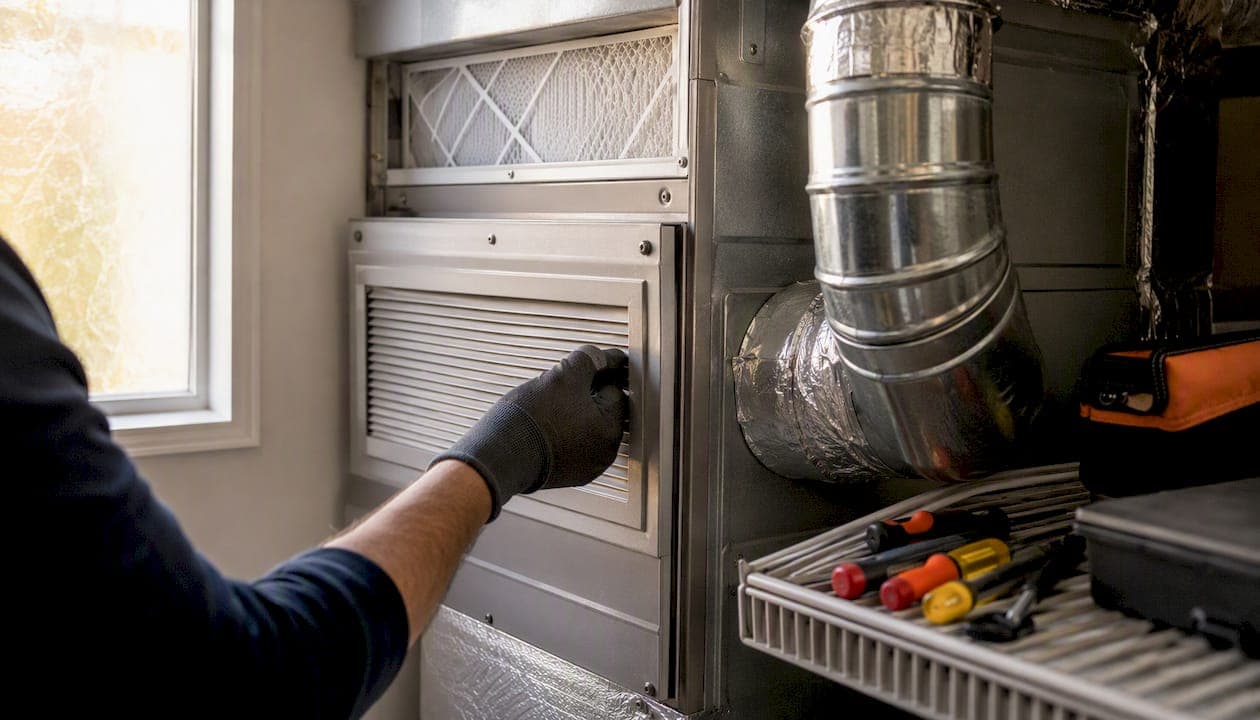
The key features of modern HVAC systems that actually move the needle are efficient heat-pump-based equipment, inverter/variable-speed compressors, smart connected controls, and IAQ-focused ventilation and filtration. Get those four areas right and you cover comfort, energy costs, and long-term serviceability in one decision.
Here is the short checklist to bring into any contractor conversation:
- Heat pumps (air-source or ground-source) for heating and cooling with lower emissions and strong incentive eligibility
- Inverter/variable-speed compressors for part-load efficiency and better humidity control
- SEER2/HSPF2/COP awareness so you can compare equipment on the same testing standard
- Smart thermostats and communicating diagnostics (Nest, Ecobee, Honeywell Home T10 Pro, or manufacturer-native controls) for scheduling, remote monitoring, and early fault alerts
- ERV or HRV ventilation to bring in fresh air without wasting conditioned air
- MERV 11–13 media filters or HEPA-grade whole-house filtration for allergens, wildfire smoke, and fine particulates
- Proper sizing (Manual J) and duct condition verified before any equipment goes in
- Advanced humidity control through variable-speed blowers and dedicated dehumidifiers where needed
- Low-GWP refrigerant readiness (R-32, R-454B) for serviceability over the next decade
- Solar or battery-storage compatibility if you have or plan renewable energy
Pro Tip: Before your first contractor meeting, write down this question: "Can you show me the Manual J load calculation and the duct static-pressure test results?" Any contractor who hesitates is a red flag.
Key Takeaways
Modern HVAC performance depends on inverter-driven equipment, verified duct condition, and IAQ-focused ventilation working together — no single upgrade delivers its full benefit without the others in place.
| Point | Details |
|---|---|
| Inverter/variable-speed first | Inverter compressors deliver better humidity control and part-load efficiency than single-stage systems in most climates. |
| Verify ducts before upgrading | A Manual J calculation and static-pressure test should precede any equipment purchase to avoid wasting the investment. |
| MERV 13 or ERV for IAQ | MERV 11–13 filters are the most cost-effective IAQ upgrade; add an ERV for fresh-air ventilation in tight homes. |
| Refrigerant future-proofing | Ask for R-454B or R-32 equipment and confirm the installer is A2L-certified for long-term serviceability. |
| Airanddryerventcleaningavondale | Provides duct inspection, cleaning, repair, and HVAC maintenance in Avondale, AZ, with NATE-certified technicians and written warranties. |
Table of Contents
- What are the most important energy efficiency features in modern HVAC?
- How do you improve indoor air quality with a modern HVAC system?
- What smart controls and connectivity features are worth paying for?
- How do variable-speed systems, zoning, and duct condition affect comfort?
- What should you know about refrigerant changes and future-proofing?
- Why does professional maintenance protect your HVAC investment?
- How do you choose an HVAC upgrade and spot contractor red flags?
- How does energy storage integration work with HVAC systems?
- A local provider's perspective on what actually matters in Avondale
- Professional services for HVAC upgrades, cleaning, and maintenance in Avondale
- Sources
- FAQ
What are the most important energy efficiency features in modern HVAC?
SEER2, HSPF2, and COP explained
SEER2 (Seasonal Energy Efficiency Ratio 2) measures cooling efficiency under the updated DOE test procedure that took effect in 2023. It runs at a slightly higher external static pressure than the old SEER test, so SEER2 numbers are a bit lower for the same unit. When you compare equipment, compare SEER2 to SEER2. HSPF2 does the same for heat-pump heating efficiency. COP (Coefficient of Performance) is the simpler metric: a COP of 3 means the system delivers three units of heat for every one unit of electricity consumed.
DOE regional standards affect which minimum ratings apply in your area. In the Southwest, minimum cooling efficiency requirements are higher than in northern states, so the floor is already elevated before you start comparing premium models.
Heat pumps vs. fossil heating
Heat pumps are the DOE's recommended low-emission option for most U.S. homes, and federal tax credits under the Inflation Reduction Act make the upfront cost more manageable. A modern cold-climate air-source heat pump operates efficiently down to around 0°F, which covers the vast majority of Arizona winters with room to spare. For Avondale specifically, where heating loads are modest and cooling loads are extreme, a heat pump is almost always the better long-term choice over a gas furnace paired with a separate AC.
Inverter compressors and real-world savings
Inverter technology lets the compressor ramp up or down to match the actual load rather than cycling on and off at full blast. The comfort difference is noticeable: steadier temperatures, quieter operation, and meaningfully better dehumidification because the system runs longer at lower capacity. Industry reporting on HVAC trends confirms that inverter compressors and connected controls are now central to the efficiency gains manufacturers are targeting.
Statistic callout: Practical buyer guidance from HVACDatabase notes that inverter compressors and communicating diagnostics deliver the best value for most homeowners, while chasing the highest SEER2 number alone is often situational and may not pay back in moderate climates.
Pro Tip: In hot-humid climates like Phoenix metro, prioritize a high EER2 alongside SEER2. EER2 reflects peak-load performance — exactly what your system faces during a 115°F July afternoon.
How do you improve indoor air quality with a modern HVAC system?
Filters: MERV ratings and when HEPA makes sense
A MERV 11–13 pleated media filter is the most cost-effective IAQ upgrade for most homes. It captures fine dust, pollen, pet dander, and many mold spores without restricting airflow the way a MERV 16 or HEPA filter can. HEPA filtration captures roughly 99.97% of particles at 0.3 microns and makes sense for households with severe allergies, immunocompromised occupants, or during wildfire smoke events. The trade-off is airflow resistance: whole-house HEPA systems require a larger blower or a bypass configuration to avoid starving the coil.
UV-C germicidal lights installed in the air handler can reduce mold and bacteria on the coil surface. They work, but the bulbs degrade and need annual replacement. An unserviced UV-C lamp is essentially decorative.
Safety note: Ozone-generating air purifiers and some plasma ionizers produce ozone as a byproduct. The EPA warns that ozone at concentrations that affect indoor air quality can irritate airways, even at levels below the smell threshold. Stick to filtration-based and UV-C solutions, and verify that any ionizer you consider is certified to produce ozone below 0.05 ppm.
ERV vs. HRV: which ventilation system fits your home?
An ERV (Energy Recovery Ventilator) transfers both heat and moisture between incoming and outgoing air streams. An HRV (Heat Recovery Ventilator) transfers heat only. In a dry, hot climate like Avondale, an ERV is generally the better choice because it limits how much dry outdoor air strips moisture from your conditioned space in winter and how much humid outdoor air enters in summer. In cold, dry northern climates, an HRV is often preferred to exhaust excess indoor moisture.
Practical IAQ upgrades in order of cost-effectiveness:
- MERV 11–13 cabinet filter upgrade — lowest cost, immediate improvement
- Upgraded variable-speed blower — improves filtration contact time and humidity control
- ERV or HRV installation — addresses ventilation adequacy (CO2 buildup is a reliable proxy for poor ventilation)
- Targeted HEPA bypass unit — for high-sensitivity occupants
- UV-C coil treatment — for mold-prone systems, with annual bulb replacement scheduled
For a deeper look at removing pollutants from HVAC systems, the approach depends on what is actually in your ducts and air stream, not just which device sounds most advanced.
What smart controls and connectivity features are worth paying for?
Communicating thermostats and connected diagnostics
A communicating thermostat talks directly to the air handler and outdoor unit using a proprietary or open protocol, rather than just switching stages on and off. The system can report fault codes, filter life, refrigerant pressure trends, and runtime data to an app or a service technician. That is the difference between finding out your system is struggling when your energy bill spikes and finding out three weeks earlier when a fault code appears on your phone.
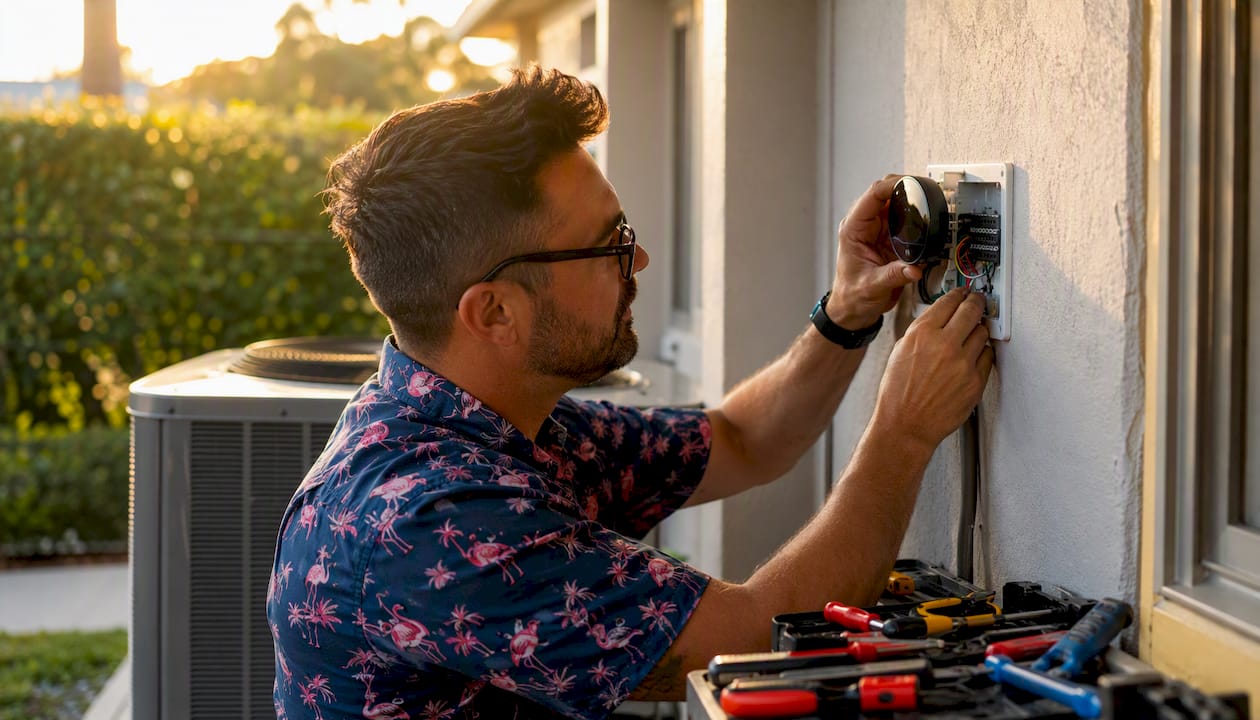
Connected monitoring and predictive maintenance improve reliability and can reduce unexpected failures in both residential and commercial systems. For property managers overseeing multiple units, remote diagnostics alone can justify the upgrade.
Key buyer benefits of smart HVAC controls:
- Energy scheduling tied to occupancy patterns and utility time-of-use rates
- Occupancy-based setback through geofencing or motion sensors
- Remote monitoring so you can adjust settings or catch problems from anywhere
- Earlier fault detection before a minor issue becomes a compressor replacement
- Demand-response participation with some utilities, which can offset operating costs
Trade-offs to know: some manufacturers lock communicating features to their own ecosystem, requiring proprietary service tools. Ask your installer whether the thermostat works with third-party service apps and whether a subscription is required for remote access after the first year.
Pro Tip: If you are on a time-of-use electricity rate, pair a communicating thermostat with a pre-cooling strategy: drop the house temperature during off-peak hours and let it drift up slightly during peak pricing windows. On a Phoenix-area summer day, this can meaningfully reduce your peak-demand charges.
How do variable-speed systems, zoning, and duct condition affect comfort?
Variable-speed vs. single-stage and two-stage systems
Sound levels drop noticeably at lower speeds. A variable-speed system at part load is often quieter than a ceiling fan.
Zoning and which homes benefit most
Motorized damper zoning divides the home into independently controlled areas. Multi-story homes benefit most because heat stratifies upward. Finished basements, home offices, and rarely used guest rooms are also strong candidates. Zoning without a variable-speed system can create static-pressure problems if too many dampers close simultaneously, so the two technologies work best together.
Pre-purchase duct and sizing checklist:
- Request the Manual J load calculation in writing before accepting any equipment proposal.
- Ask for a duct static-pressure test result (target: below 0.5 in. w.g. total external static pressure for most residential systems).
- Verify that supply and return duct sizes match the proposed equipment's airflow requirements.
- Inspect accessible duct sections for disconnections, crushing, or significant leakage.
- Confirm that zoning dampers are sized and positioned to avoid pressure spikes at partial load.
What should you know about refrigerant changes and future-proofing?
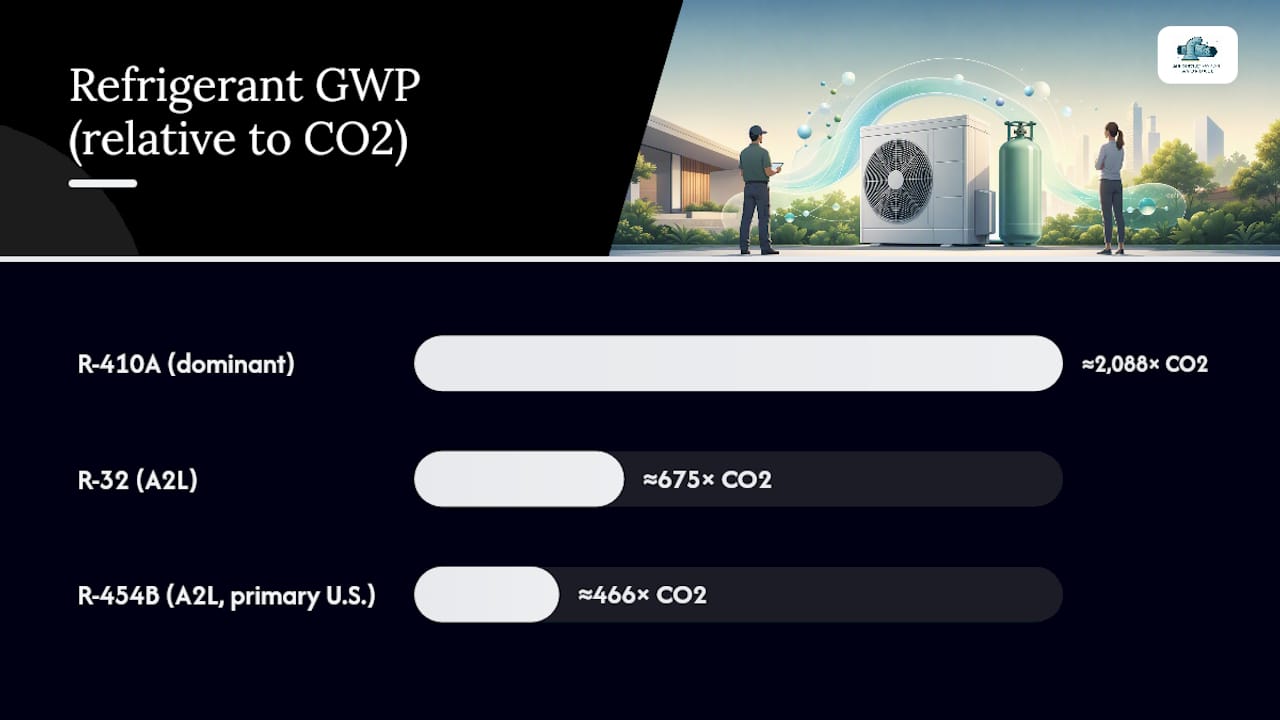
The HFC phasedown under the AIM Act is already affecting which refrigerants manufacturers can use in new equipment. R-410A, the dominant refrigerant for the past two decades, has a Global Warming Potential (GWP) roughly 2,088 times that of CO2. Newer low-GWP alternatives include R-32 (GWP ~675) and R-454B (GWP ~466), which is the primary replacement in many new U.S. residential systems.
What this means for buyers: A system installed today with R-454B will be easier to service in 2030 than one still using R-410A, because R-410A service refrigerant availability and pricing will tighten as the phasedown progresses. Ask your installer specifically: "What refrigerant does this system use, and is it classified as A2L under ASHRAE Standard 34?" A2L refrigerants are mildly flammable, which requires updated installation practices and certified technicians — not a reason to avoid them, but a reason to confirm your installer is trained for them.
R-32 and R-454B are both classified A2L under ASHRAE Standard 34, meaning they require specific handling protocols. Technicians working on these systems need updated certification. When vetting contractors, ask whether their technicians have completed A2L training.
Pro Tip: Before signing a service contract, ask the contractor to confirm parts and refrigerant availability for your specific model over a 10-year horizon. A system that is cheap today but uses a refrigerant being phased out is an expensive problem in year seven.
Why does professional maintenance protect your HVAC investment?
A system that runs dirty costs more to operate and fails sooner. Dust-coated evaporator coils reduce heat transfer, forcing the compressor to work harder. Clogged drain lines cause water damage and mold. Dirty blower wheels cut airflow, which raises static pressure and stresses the motor. None of these problems announce themselves until the damage is done.
What a thorough professional service visit should include:
- Visual duct inspection for disconnections, debris accumulation, and mold indicators
- Static-pressure test before and after cleaning to document airflow improvement
- Refrigerant charge verification against manufacturer specifications
- Evaporator and condenser coil cleaning
- Condensate drain flush and pan treatment
- Blower wheel cleaning and motor amperage check
- Filter replacement with the correct MERV rating for the system
For credentials, ask for NATE (North American Technician Excellence) certification, proof of licensing in Arizona, and written warranty terms on parts and labor. A contractor who cannot produce these on request is worth skipping.
Professional HVAC cleaners bring diagnostic tools that a homeowner inspection cannot replicate: manometers for static pressure, combustion analyzers, and refrigerant gauges. The difference between a visual check and a measured one is the difference between guessing and knowing.
For property managers, commercial HVAC breakdowns are disproportionately caused by deferred maintenance. Scheduling preventive service before peak cooling season is far cheaper than an emergency call in August.
How do you choose an HVAC upgrade and spot contractor red flags?
Questions every buyer should ask
- "Can you provide the Manual J load calculation and Manual D duct design in writing?"
- "What is the estimated SEER2 and HSPF2 for this specific system in my home's configuration?"
- "What refrigerant does this equipment use, and is the technician A2L-certified?"
- "What warranty does the manufacturer offer, and what does your labor warranty cover?"
- "Will you pull permits and schedule a city inspection?"
Red flags that should stop a conversation
- No Manual J offered, or a sizing estimate based only on square footage
- Vague efficiency claims without SEER2 numbers
- Refusal to show permitting records or explain the inspection process
- Proprietary controls with no third-party access option and no clear subscription terms
- A quote that arrives within minutes of a walkthrough, with no measurements taken
The Rule of 5000 and when to repair vs. replace
Multiply the system's age (in years) by the repair cost (in dollars). If the result exceeds $5,000, replacement is usually the better financial decision. A 12-year-old system facing a $500 repair scores 6,000 — replacement territory. A 4-year-old system with the same repair scores 2,000 — repair it. This heuristic is not a guarantee, but it gives you a defensible starting point before a contractor conversation.
Pro Tip: Always get at least two bids that include written Manual J calculations. If both calculations agree on the load, you can trust the sizing. If they disagree significantly, ask each contractor to explain their assumptions — one of them is wrong.
How does energy storage integration work with HVAC systems?
Battery storage systems paired with HVAC equipment let homeowners shift cooling loads away from peak utility pricing windows. The concept is straightforward: charge the battery (or pre-cool the home's thermal mass) during off-peak hours when electricity is cheap, then run the HVAC at reduced draw during peak-rate periods.
Grid-interactive HVAC controls, sometimes called GEBs (Grid-Interactive Efficient Buildings), go further by allowing the utility to send demand-response signals directly to the thermostat or battery management system. The homeowner sets comfort limits; the system optimizes within them automatically.
Academic reviews confirm that AI-driven controls and grid-interactive systems can materially reduce energy use. However, adoption is still limited by upfront cost and the complexity of integrating battery storage, solar inverters, and HVAC controls from different manufacturers. For most homeowners, the practical entry point is a communicating thermostat enrolled in a utility demand-response program, which costs little or nothing and still delivers bill savings. A full battery-plus-solar-plus-HVAC integration is a longer-term investment that makes the most sense when a battery is already planned for backup power or solar self-consumption.
For a broader view of HVAC innovations for commercial properties, the same grid-interactive principles apply at a larger scale, with demand charges making the payback math even more compelling.
A local provider's perspective on what actually matters in Avondale
The most common problems in Avondale homes are not exotic. Duct leakage is everywhere: systems that were installed correctly in new construction have often developed disconnections or crushed flex duct sections after years of attic heat cycling. Undersized return ducts are the second most frequent issue, and they quietly strangle efficiency regardless of how good the equipment is.
Wildfire smoke has become a real seasonal concern in the Phoenix metro area. Homeowners who upgraded to MERV 13 filters during smoke events noticed a genuine difference in indoor air quality. The ones who had not cleaned their ducts in several years found that the filter was doing double duty against both smoke and years of accumulated debris.
The fix path is almost always the same: start with a duct inspection and static-pressure test, address any leakage or sizing problems, then evaluate equipment. Skipping that sequence and installing a premium inverter heat pump into a leaky duct system is like putting new tires on a car with a bent frame.
Airanddryerventcleaningavondale offers flexible scheduling, including after-hours appointments, and backs its work with written warranties. For homeowners who want to know what they are actually dealing with before committing to an equipment purchase, a diagnostic visit is the right first step.
Professional services for HVAC upgrades, cleaning, and maintenance in Avondale
Dirty ducts and neglected vents quietly undercut even the best modern equipment. Airanddryerventcleaningavondale provides the diagnostic and cleaning foundation that makes an upgrade actually perform as advertised.
Services include air duct and vent cleaning, dryer vent cleaning, duct repair and replacement, air vent replacement, air quality testing, and full HVAC system installation and maintenance. Technicians are NATE-certified, licensed in Arizona, and carry written warranties on all work. After-hours scheduling is available for homeowners and property managers who cannot take time off during the week.
The recommended next step before any equipment purchase: book a duct inspection and static-pressure diagnostic. You will know exactly what your system needs before a contractor hands you a proposal. Schedule a diagnostic visit or request a written service estimate today.
Sources
Authoritative U.S. references for standards, technology, and homeowner guidance:
- What is HEPA filter - EPA
- What is inverter technology and how it benefits your indoor comfort - Daikin
- New HVAC Features: What to Buy & Skip (2025 Guide) - HVACDatabase
FAQ
What are the five main components of an HVAC system?
The five main components are the thermostat (control), the air handler or furnace (air distribution), the compressor/condenser unit (heat exchange), the evaporator coil (indoor heat absorption), and the ductwork (delivery). Modern systems add communicating controls and variable-speed motors as standard features in higher-efficiency configurations.
What does SEER2 mean and why does it matter for U.S. buyers?
SEER2 is the updated seasonal cooling efficiency rating that DOE adopted in 2023, using a higher static-pressure test condition than the original SEER. Comparing SEER2 to SEER2 gives you an accurate apples-to-apples comparison when evaluating equipment bids.
What is the Rule of 5000 for deciding whether to repair or replace an HVAC system?
Multiply the system's age in years by the estimated repair cost in dollars. If the result exceeds a certain financial threshold, replacement is generally the better financial decision. Older systems facing moderate to high repair costs often point toward replacement.
What are modern HVAC systems designed to do differently from older equipment?
Modern systems prioritize variable-speed operation, smart connectivity, low-GWP refrigerants, and integrated IAQ features like ERV/HRV ventilation and MERV 13 filtration. The shift is from simple on/off temperature control toward continuous comfort management, lower emissions, and remote diagnostics.
How often should air ducts be professionally cleaned?
The EPA recommends cleaning ducts when there is visible mold growth, evidence of pest infestation, or significant debris restricting airflow. For most homes, a professional inspection every 3–5 years is a practical baseline, with cleaning scheduled when the inspection reveals accumulation or airflow problems.