
TL;DR:
- A documented, ASHRAE 62.1-aligned maintenance program is the most effective way to ensure commercial ventilation systems stay efficient and compliant. Routine tasks include inspecting filters monthly, testing dampers quarterly, and calibrating sensors annually, with airflow verification every five years. Leveraging professional services and maintaining detailed records help facility managers sustain system performance and meet regulatory standards.
A documented preventative maintenance program aligned to ASHRAE 62.1 and Federal Energy Management Program (FEMP) guidance is the single most effective maintenance strategy for commercial vents. FEMP frames preventative maintenance as a low-cost, high-performance approach that extends equipment life and cuts energy waste. The core tasks are filters, dampers, coils, drain pans, sensors, and airflow verification, each on a defined schedule recommended by industry standards.
TL;DR: minimum recurring tasks and frequencies
- Filters: inspect monthly, replace per manufacturer spec or when pressure drop exceeds threshold
- Dampers and actuators: inspect and function-test every three months
- Drain pans and humidifiers: clean and inspect annually, or sooner if microbial growth is visible
- Sensors and DCV: calibrate annually; check for drift every six months
- Airflow verification and testing/balancing: every five years per ASHRAE 62.1
- Cooling towers: treat and document per a written water treatment program
Headline schedule: quarterly (dampers), biannual (sensor drift checks), annual (drain pans, coils, full AHU service), every five years (testing and balancing, airflow verification).
Airanddryerventcleaningavondale supports commercial facilities in Avondale, AZ with cleaning, duct inspection, and air quality testing that feed directly into this program.
Table of Contents
- Your at-a-glance maintenance calendar for commercial vents
- What to actually do for each ventilation component
- How to inspect and verify ventilation performance
- How to build and maintain your ventilation O&M manual
- How to decide what to outsource and how to vet contractors
- What commercial vent maintenance actually costs, and what it saves
- Key Takeaways
- The one thing most facility managers get wrong about vent maintenance
- What Airanddryerventcleaningavondale delivers for commercial properties in Avondale
- Useful sources
- FAQ
Your at-a-glance maintenance calendar for commercial vents
Use this table to plan recurring work and budget cycles. Intervals follow ASHRAE Table 8-1 minimum frequencies; shorten them for high-traffic retail, multi-family, or mixed-use buildings.
| Component | Minimum Frequency | Core Action | Typical Performer |
|---|---|---|---|
| Air filters | Monthly inspect / per spec replace | Inspect, replace at pressure drop or schedule | In-house |
| Outdoor air dampers | Every 3 months | Inspect, function-test actuator | In-house |
| Humidifiers | Annually | Clean, inspect for microbial growth | In-house / contractor |
| Dehumidification coils | Annually | Clean coil surface, inspect drain | In-house / contractor |
| Drain pans | Annually | Clean, treat, verify drainage | In-house |
| Intake louvers and bird screens | Every 6 months | Inspect, clear debris, repair screens | In-house |
| Sensors (CO₂, temp, pressure) | Annually (calibrate); every 6 months (drift check) | Recalibrate or replace | Contractor |
| Airflow verification | Every 5 years | Measure outdoor air in minimum-OA mode | Certified TAB contractor |
| Cooling towers | Per water treatment program | Treat, test, document | Specialist contractor |
For a commercial vent cleaning planning framework that maps these intervals to a property manager's budget cycle, that resource is worth bookmarking. Full duct cleaning falls outside this recurring table: the typical range is every two to five years, adjusted by occupancy density and system use.
What to actually do for each ventilation component
Filters and air cleaning devices
Replace filters at the manufacturer's recommended interval or when measured pressure drop exceeds the filter's rated final resistance, whichever comes first. MERV 8 is a common commercial baseline; MERV 13 is preferred where IAQ standards are tighter. Log the date, filter MERV rating, and measured pressure drop at each change.
Outdoor air dampers and actuators
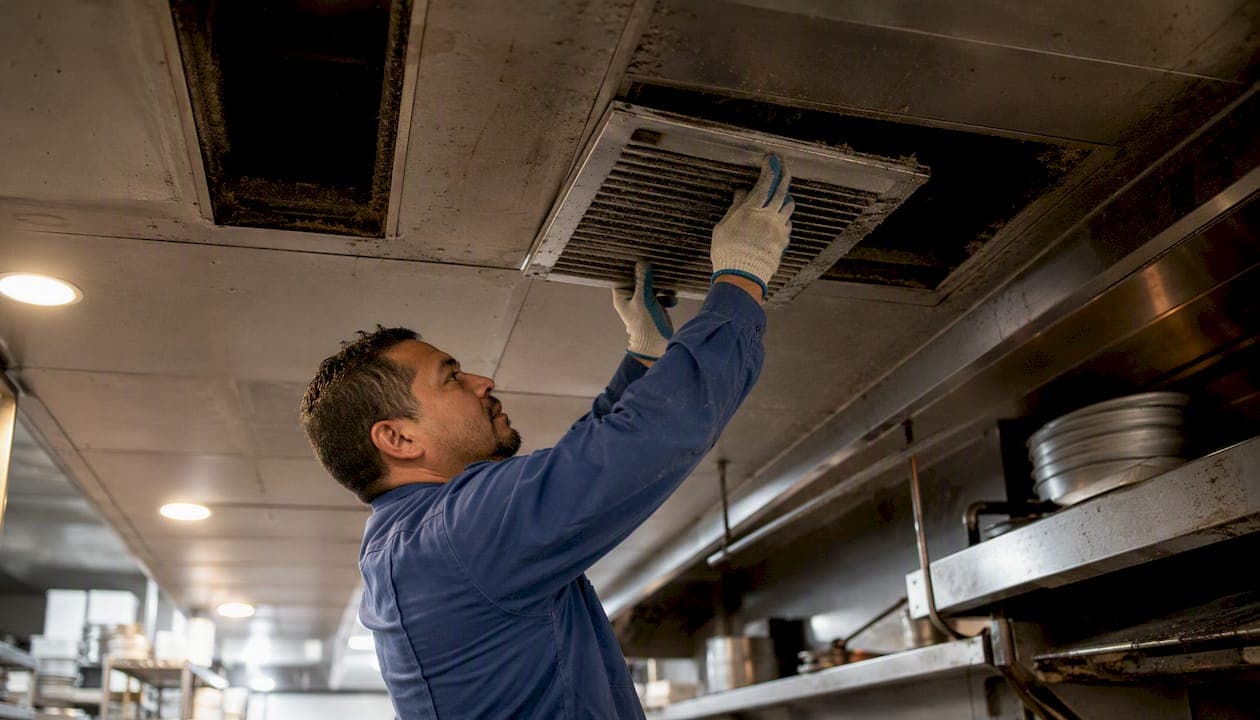
Visually inspect damper blades for physical damage and debris every three months. Run an actuator function test: command the damper to fully open and fully closed, then verify blade position matches the BAS readout. Stuck-open dampers waste energy; stuck-closed dampers cause ventilation failures. Both are common and both are easy to catch early.
Humidifiers, dehumidification coils, and drain pans
Clean humidifier pans and distribution lines annually. Visible slime, scale, or discoloration in a drain pan is an immediate-action item, not a "next scheduled visit" item. Drain pans that hold standing water become microbial incubators within days in warm climates.
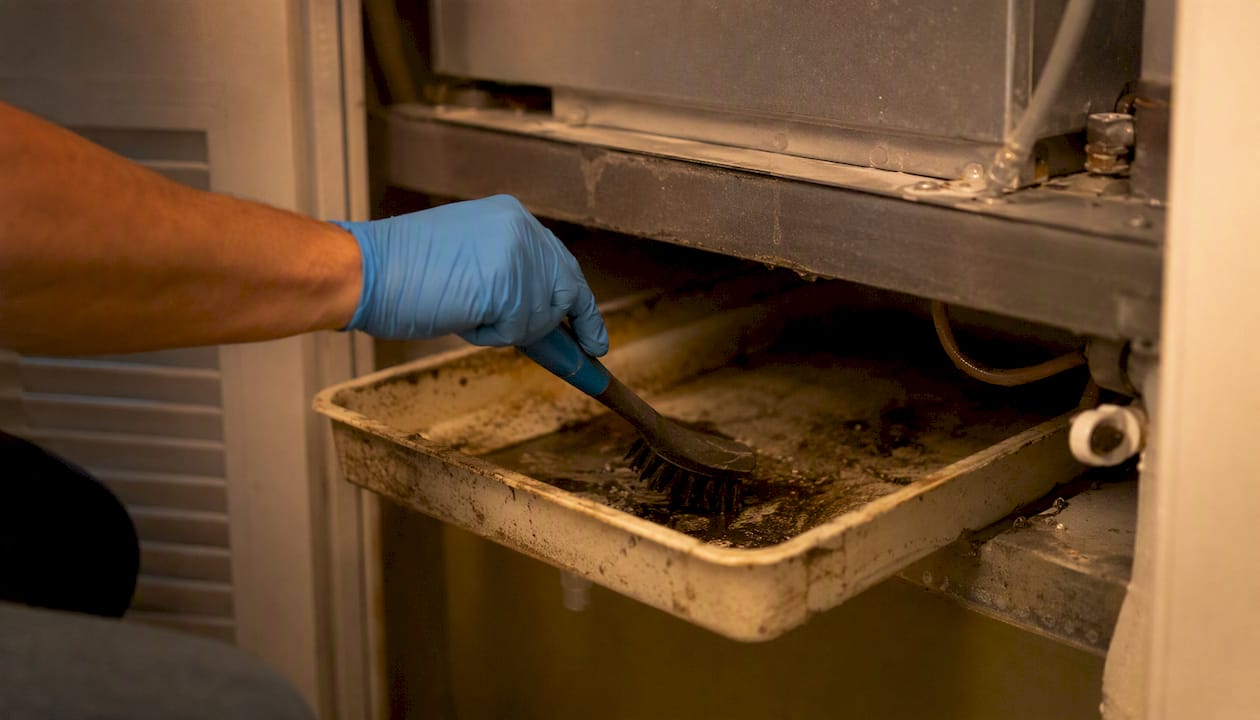
Pro Tip: Photograph drain pans at each inspection. A dated photo series is the fastest way to prove a pan was clean at handoff and to document when a problem first appeared.
Intake louvers and bird screens
Inspect every six months. Debris-blocked louvers reduce outdoor air intake and can trigger CO₂ alarms in occupied spaces. Damaged bird screens let nesting material enter the ductwork, which is a fire and contamination risk.
Sensors and demand-controlled ventilation (DCV)
CO₂ sensors drift over time. DCV systems that rely on uncalibrated sensors can under-ventilate a fully occupied space while the BAS reports everything as normal. Calibrate annually; check for drift at six months. Replace sensors that repeatedly fail calibration rather than recalibrating them repeatedly.
Air handlers and AHUs
Check belt tension and bearing condition annually. Inspect fan blades for dust buildup, which reduces airflow and increases motor load. AHUs have a typical service life of 20–30 years; when repair costs approach replacement cost, capital planning should take over from maintenance budgeting.
| Task | Acceptance Criterion | Safety Note |
|---|---|---|
| Filter replacement | Pressure drop within rated range | Lock out/tag out before accessing AHU |
| Damper function test | Blade position matches BAS command | Verify actuator power is isolated before manual override |
| Drain pan cleaning | No standing water, no visible growth | Use appropriate PPE; treat with EPA-registered biocide |
| Sensor calibration | Reading within ±50 ppm of reference gas (CO₂) | Follow manufacturer's span gas procedure |
| Airflow measurement | Outdoor air ≥ design minimum rate | Measure in minimum-OA mode per ASHRAE guidance |
How to inspect and verify ventilation performance
Baseline measurements taken at commissioning are the reference point for everything that follows. CCOHS industrial ventilation guidance is clear: a static pressure change greater than 20% from baseline is an early warning of system degradation and should trigger investigation before it becomes a failure.
Measurement workflow:
- Record supply and return static pressures at fixed monitoring points.
- Measure outdoor air velocity at the intake using a pitot tube or air velometer.
- Log CO₂ levels in occupied zones during peak occupancy.
- Verify damper position via BAS and physically.
- Compare all readings to the commissioning baseline.
Tools you need: air velometer or balometer, magnehelic gauge, manometer, CO₂ data logger, smoke tubes for airflow visualization, pitot tube for duct traverses, and BAS trend logs.
| Log Field | What to Record |
|---|---|
| Date and time | Exact timestamp of measurement |
| Tester name and credentials | Who performed the test |
| Device serial and calibration date | Instrument traceability |
| Reading and baseline value | Actual vs. expected |
| Deviation | % difference from baseline |
| Corrective action taken | What was done, or "none required" |
A measured outdoor air delivery below the ASHRAE-required minimum, or a static pressure deviation exceeding 20%, triggers rebalancing or specialist testing. Neither condition resolves itself.
How to build and maintain your ventilation O&M manual
FEMP requires that an O&M manual be kept on-site or centrally accessible for the life of the ventilation system. A manual that lives in a filing cabinet no one can find is functionally the same as no manual at all.
Minimum table of contents:
- Final design drawings and as-built documentation
- Equipment operation procedures and startup/shutdown sequences
- Maintenance schedules with minimum frequencies
- Approved spare parts list and supplier contacts
- Calibration records for all sensors and instruments
- Change log with dates, descriptions, and responsible parties
Store the manual in both a physical binder on-site and a shared digital location (a network drive or facilities management platform). Use version numbers and dates on every revision.
Update triggers:
- Building use change or significant renovation
- Occupancy density increase above design parameters
- Equipment replacement or major repair
- Failed airflow verification result
- New compliance requirement from a code update
After any contractor visit, require the contractor to provide updated as-built notes and any changed calibration records before closing the work order. Attach those documents to the manual the same day.
How to decide what to outsource and how to vet contractors
Some tasks genuinely require outside expertise. Testing and balancing, cooling tower water treatment, full duct cleaning when contamination is suspected, and complex airflow remediation all fall in that category. Routine filter changes, damper inspections, and sensor drift checks are reasonable in-house work.
Vendor questions to ask before signing anything:
- Ventilation Assessment and Action Guide
- Addendum m to ANSI/ASHRAE Standard 62-1999, Ventilation for Acceptable Indoor Air Quality
- Industrial Ventilation - 7. Installation and Maintenance (General)
- An Introduction to How to Ventilate Buildings
- Recommended Schedule for Cleaning Commercial Ducts & Vents
Red flags: vague scope with no measurable acceptance criteria, no written safety procedures, missing insurance documentation, or a contractor who cannot explain how they establish a baseline.
Pro Tip: Require every contractor to provide O&M manual updates as a deliverable in the contract, not as a verbal promise after the job. If it is not in the scope, it will not happen.
Sample contract scope items to include: measurable acceptance criteria for each task, required report format, O&M manual update deliverable, and a defined emergency response time. For HVAC safety standards that apply to contractor qualifications, that reference covers the key certification expectations. Understanding why preventive maintenance matters from a contractor's perspective also helps you ask sharper questions during vendor selection.
What commercial vent maintenance actually costs, and what it saves
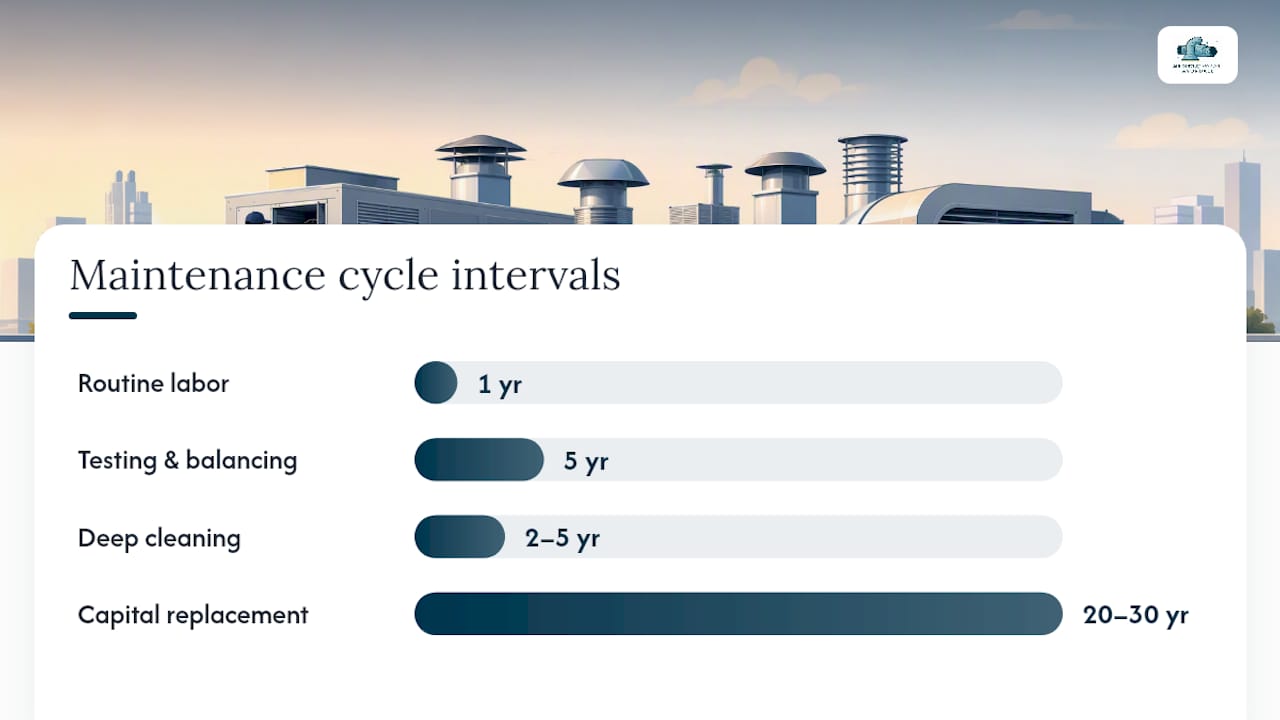
Maintenance spending falls into five buckets: routine labor, consumables (filters, belts, biocides), third-party testing and balancing, deep cleaning, and capital replacement. The first three are predictable and budgetable. The last two are what you are trying to avoid or at least schedule on your terms.
The ROI case is straightforward. An unplanned AHU failure costs far more than the annual service visits that would have prevented it. Cleaner filters and correctly balanced airflow reduce fan energy draw. Equipment that is serviced on schedule routinely reaches the upper end of its 20–30 year design life rather than failing at year 12.
| Cost Bucket | Budget Approach | ROI Driver |
|---|---|---|
| Routine labor | Annual contract or in-house FTE allocation | Prevents reactive call-outs |
| Consumables | Stock based on filter change intervals | Avoids emergency procurement markups |
| Testing and balancing | Every 5 years; budget as capital line item | Restores design airflow, reduces energy waste |
| Deep cleaning | Every 2–5 years depending on occupancy | Extends AHU and duct life; improves IAQ |
| Capital replacement | Multi-year plan tied to equipment age | Avoids unplanned replacement at peak cost |
Build a 10% contingency into your annual maintenance budget for emergency cleanings. Align duct cleaning cycles with your capital planning calendar so they do not compete with major equipment replacements for the same budget year. For more on energy savings from routine vent maintenance, that resource breaks down the bill-reduction side of the equation.
Key Takeaways
A documented, ASHRAE 62.1-aligned preventative maintenance program is the most cost-effective way to keep commercial ventilation systems compliant, efficient, and long-lived.
| Point | Details |
|---|---|
| Follow ASHRAE 62.1 frequencies | Dampers quarterly, drain pans annually, airflow verification every five years — these are minimums, not targets. |
| Document everything in an O&M manual | Keep it on-site and digitally accessible; update it after every contractor visit or system change. |
| A 20% static pressure deviation triggers action | Per CCOHS guidance, that threshold signals system degradation requiring investigation before failure. |
| Duct cleaning every 2–5 years | Adjust the interval shorter for high-traffic, retail, or multi-family buildings. |
| Airanddryerventcleaningavondale for local commercial service | Provides commercial duct cleaning, vent inspection, and air quality testing in Avondale, AZ to support your maintenance program. |
The one thing most facility managers get wrong about vent maintenance
The conventional wisdom says the schedule is the hard part. Get the frequencies right, put them in a spreadsheet, and you are covered. In practice, the schedule is the easy part. The hard part is documentation continuity.
What facilities typically miss is the handoff. A contractor cleans the ducts, leaves, and the O&M manual never gets updated. The next technician has no baseline. The next audit finds gaps. The system may be physically clean, but from a compliance standpoint, it is as if the work never happened.
The single change that produces the biggest operational improvement is requiring documentation as a contract deliverable, not a courtesy. When updated calibration records, as-built notes, and test results are a condition of payment, they get produced. That paper trail is what turns a maintenance visit into a defensible compliance record.
What Airanddryerventcleaningavondale delivers for commercial properties in Avondale
Commercial vent maintenance that actually closes the documentation loop is harder to find than it should be. Airanddryerventcleaningavondale provides commercial air duct cleaning, vent inspection, vent replacement, dryer vent services, and air quality testing for commercial properties in Avondale, AZ.
A service visit includes a written report with before-and-after documentation, findings that feed directly into your O&M manual, and a clear record of what was cleaned, inspected, or replaced. Scheduling is flexible, including after-hours options that avoid disrupting occupied spaces. Warranties are included on covered work.
To schedule a commercial vent inspection or cleaning, contact Airanddryerventcleaningavondale directly through the commercial service page.
Useful sources
- FEMP Ventilation Assessment and Action Guide — Use this for O&M manual language, preventative maintenance program design, and airflow verification requirements. The primary federal reference for facility managers.
- ASHRAE Addendum m to ANSI/ASHRAE 62-1999 — Table 8-1 maps every major ventilation component to a minimum maintenance frequency. Use it to build your schedule and defend it during audits.
- CCOHS Industrial Ventilation: Installation and Maintenance — Practical baseline measurement protocols and a list of common failure modes. Use it to train in-house staff on what to look for.
- Kingspan Facilities Manager Guide to Ventilation Maintenance — Covers routine checks, annual servicing, and remote monitoring. Note: this is a UK/IE publication; verify that specific intervals align with US standards before adopting them directly.
- Recommended Schedule for Cleaning Commercial Ducts and Vents — Practical starting-point guidance on duct cleaning frequency by building type. Use it to calibrate your cleaning intervals against occupancy and traffic patterns.
FAQ
How often should commercial vents be cleaned?
Most commercial buildings fall in the two-to-five-year range for full duct cleaning, but high-traffic retail, multi-family, and food-service spaces typically need cleaning closer to every two years.
What does ASHRAE 62.1 require for ventilation maintenance?
ASHRAE 62.1 sets minimum maintenance frequencies for filters, dampers, coils, drain pans, sensors, and airflow verification, with testing and balancing required at least every five years.
When should a facility manager call a specialist instead of handling maintenance in-house?
Escalate to a specialist for any visible microbial contamination, failed airflow verification, cooling tower Legionella risk, or any task requiring NADCA or NEBB certification.
What is the most important document in a commercial ventilation maintenance program?
The O&M manual, kept on-site and digitally accessible, is the central compliance record. FEMP requires it to be maintained for the life of the ventilation system.
Can Airanddryerventcleaningavondale support commercial vent maintenance in Avondale, AZ?
Yes. Airanddryerventcleaningavondale provides commercial air duct cleaning, vent inspection, air quality testing, and dryer vent services for commercial properties in Avondale, with written reports that support O&M documentation requirements.