
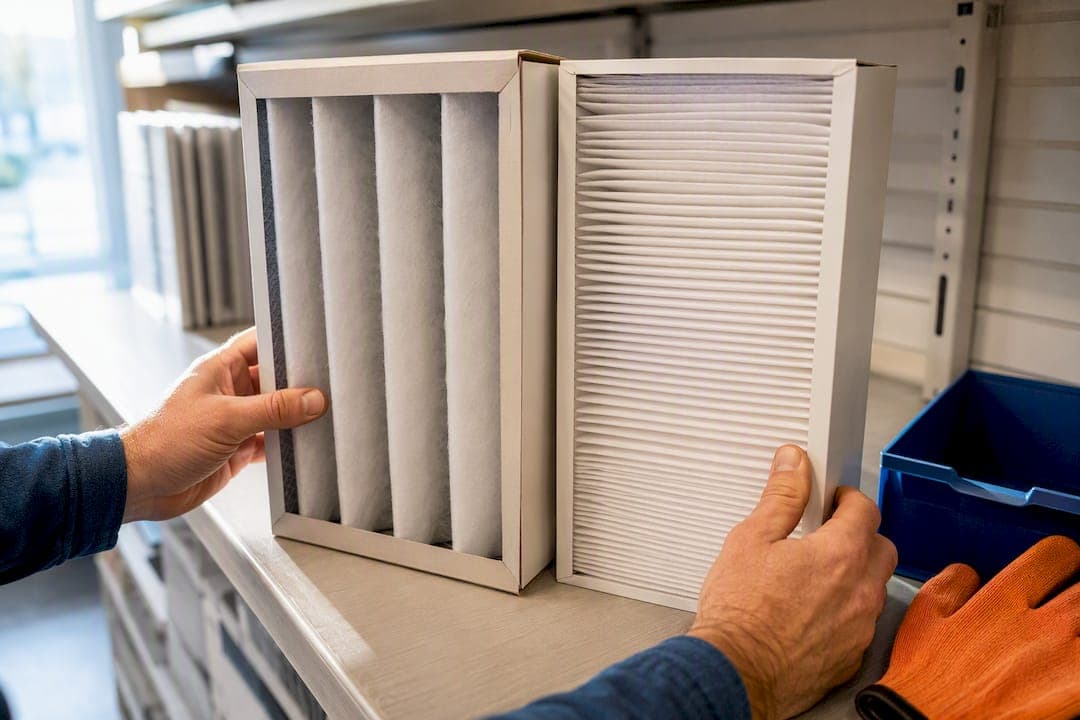
MERV, short for Minimum Efficiency Reporting Value, is the ASHRAE standard that scores how well an air filter captures particles between 0.3 and 10 microns. The scale runs from 1 to 16 for residential and light commercial use, and higher numbers mean finer filtration. Most homes do best with a filter in the MERV 8 to 13 range, though the right pick depends on your HVAC system's airflow tolerance.
TL;DR:
- MERV ratings are based on the worst performance during testing, meaning a MERV 11 filter guarantees at least that level of filtration in the toughest conditions.
- Filters rated MERV 8 to 13 are generally suitable for most homes, but exceeding this range requires confirmation that the HVAC system can manage increased airflow resistance.
- Higher MERV filters, especially above 13, can cause pressure drops that reduce airflow, strain equipment, and lead to weaker ventilation if not properly matched to the system.
- MPR and FPR ratings are proprietary and less reliable indicators; prioritize MERV because it is based on standardized third-party testing.
- Professional duct cleaning and air quality testing are recommended if airflow drops after filter upgrades or if existing ductwork is dusty or moldy, as filters alone cannot resolve these issues.
Table of Contents
- How MERV Ratings Work and What the Number Actually Measures
- MERV Scale Breakdown: What Each Range Actually Captures
- Choosing the Right MERV Rating for Your Home
- MPR and FPR Ratings vs. MERV: Which Number Should You Trust?
- Airflow, Pressure Drop, and Keeping Your System Healthy
- Where Professional Duct and Filter Service Fits In
- Sources
- FAQ
How MERV Ratings Work and What the Number Actually Measures
A MERV score isn't a marketing gimmick. It comes from a controlled lab test defined by ASHRAE Standard 52.2, and the EPA treats it as the benchmark for comparing filter performance. Technicians feed a synthetic aerosol through the filter, then count particles both before and after it passes through, across twelve different size ranges, over six loading cycles that simulate a filter aging in real use.
Here's the part most people miss: the filter's MERV rating isn't based on its average performance. It's based on its worst performance.
- Particles get grouped into three size ranges (often called E1, E2, and E3), covering roughly 0.3 to 10 microns.
- Across all six test cycles, the testing method records the lowest efficiency observed in each particle group, not the average.
- That worst-case number in each group is what actually determines the final MERV score.
This conservative approach matters because it means a MERV 11 filter really does perform at least that well under the toughest conditions the test throws at it. The National Air Filtration Association built its user guide around this exact point: the test exists to compress a mountain of particle-count data into one number you can trust without a lab coat.
MERV Scale Breakdown: What Each Range Actually Captures
The gap between a MERV 4 filter and a MERV 13 filter is enormous, both in what it captures and where it belongs. A cheap fiberglass filter rated MERV 2 mostly protects your equipment from lint and large dust. A MERV 13 filter, by contrast, gets into bacteria and most tobacco smoke particles.
| MERV range | Particle size focus | Typical contaminants captured | Common applications |
|---|---|---|---|
| 1–4 | Larger than 10 microns | Pollen, dust mites, carpet fibers | Window air conditioners, minimal filtration systems |
| 5–8 | 3–10 microns | Mold spores, hair spray, dust | Standard residential furnaces and light commercial systems |
| 9 | 1–3 microns | Lead dust, auto emissions, fine dust | Better residential systems, hospital laboratories |
| 13–16 | 0.3–1 micron | Bacteria, most smoke, sneeze droplets | Superior residential systems, hospital inpatient care |
HEPA filters sit outside this chart entirely. True HEPA media captures 99.97% of particles at 0.3 microns, which puts its performance above MERV 16 on the underlying efficiency curve, but HEPA is a separate certification standard, not a point on the MERV scale itself. That's why you'll never see a "MERV 17" filter for sale, and why comparing HEPA vs. MERV filters is really comparing two different measurement systems, not two points on the same ruler.
Choosing the Right MERV Rating for Your Home
For most houses, MERV 8 to 13 is the sweet spot. The EPA specifically calls out MERV 13 as a reasonable upgrade for homeowners chasing better indoor air quality, provided the HVAC system can handle it. That last condition is the one people skip, and it's the one that causes service calls.
Here's how to work through the decision:
- Start with MERV 8 to 9 if your household has no specific air quality concerns. This range handles everyday dust, pollen, and pet dander without stressing an average residential blower.
- Move to MERV 11 to 13 if you're dealing with allergies, asthma, wildfire smoke season, or multiple pets. This band picks up finer particles, including much of what triggers respiratory flare-ups, but it also creates more resistance to airflow.
- Check your system's specs before buying anything above MERV 13. Look at the owner's manual or the sticker inside the blower compartment for a maximum recommended MERV or static pressure rating.
- Call an HVAC technician if you're unsure. A tech can measure static pressure directly and tell you whether your ductwork and blower motor can handle a higher-efficiency filter without overworking the system.
- Replace on a schedule, not by memory. Disposable pleated filters generally need changing every few months, with more frequent changes recommended during pollen season, wildfire smoke events, or with multiple pets in the house.
Pro Tip: A higher MERV number isn't automatically better for your air quality if it chokes your airflow. A MERV 13 filter in a system built for MERV 8 can force the blower to work harder, shorten its lifespan, and sometimes leave rooms under-heated or under-cooled because less air is actually moving.
Our HVAC filter guide for Avondale homes walks through specific filter examples if you want to see what these ranges look like on a store shelf.
MPR and FPR Ratings vs. MERV: Which Number Should You Trust?
Walk down a filter aisle and you'll spot two other numbers competing for attention: MPR and FPR. Both are proprietary retail scales, not independent lab standards, and neither converts cleanly to MERV.
- MPR (Microparticle Performance Rating) measures capture efficiency specifically for particles between 0.3 and 1 micron, ignoring larger particles entirely.
- FPR (Filter Performance Rating) weighs a broader mix, including large-particle capture and how efficiency holds up as the filter loads with debris over its lifetime.
- Because each system measures something different, equivalency charts that translate MPR or FPR into MERV are approximations, not exact conversions.
When a filter box lists all three numbers, treat MERV as the one worth trusting. Building-science analysts consistently recommend prioritizing MERV since it's the only one built on a standardized, third-party test method rather than a manufacturer's internal scale.
Airflow, Pressure Drop, and Keeping Your System Healthy
Every filter resists airflow to some degree, and that resistance is called pressure drop. Bump the MERV rating up, and pressure drop climbs with it. Your blower motor has to work harder to pull the same volume of air through denser media, and if it can't keep up, your whole system suffers.
Watch for these warning signs after a filter upgrade:
- Noticeably weaker airflow from vents throughout the house.
- A jump in your energy bill without a change in usage or weather.
- New whistling, straining, or rattling noises from the air handler.
- Rooms that take longer to reach the thermostat setting.
A short maintenance checklist keeps both your air quality and your equipment protected: confirm the filter's exact size and fit so there's no gap for unfiltered air to bypass it, seal any obvious leaks around the filter slot, and replace filters more frequently during smoke events, high pollen weeks, or after any home renovation that kicks up dust.
Pro Tip: If you switched filters and noticed weaker airflow within days, don't wait out the season. A quick static pressure check can confirm whether the system is straining before it causes real damage.
Where Professional Duct and Filter Service Fits In
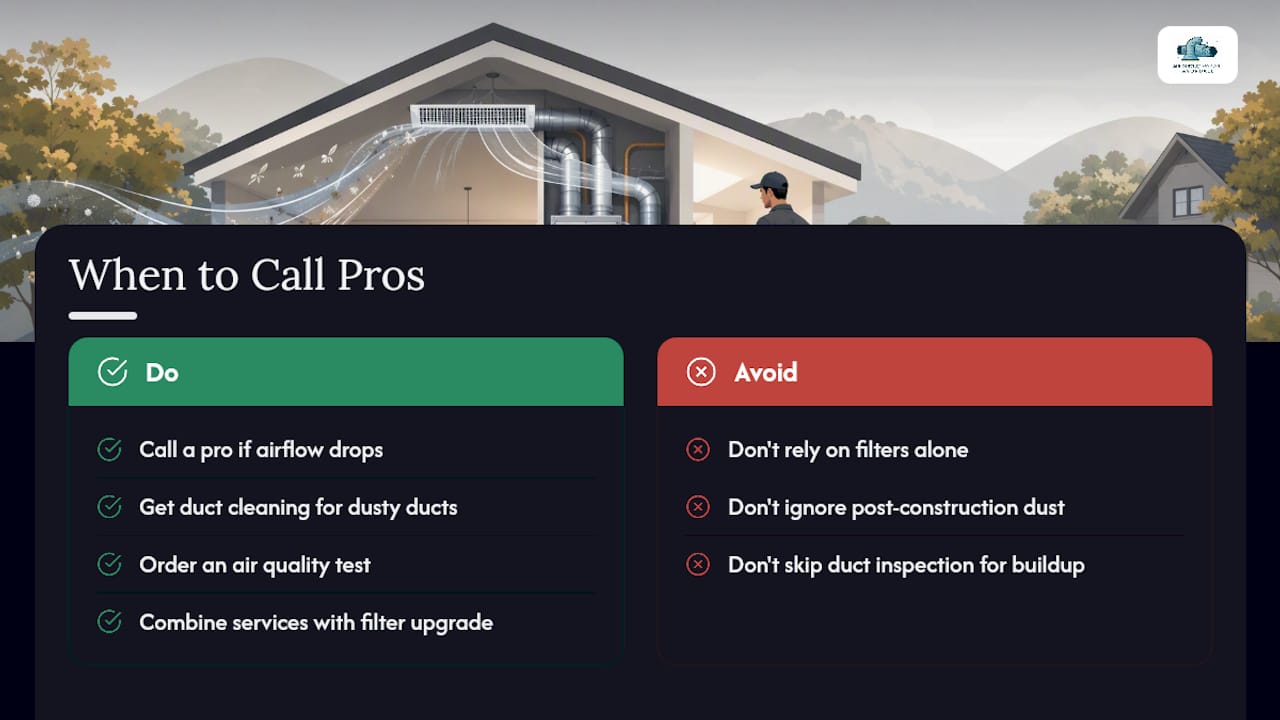
A better filter only solves part of the air quality equation. If ductwork is coated in dust from a renovation, or you suspect mold hiding somewhere in the system, upgrading the filter won't fix what's already circulating. Specialized local companies handle duct cleaning, filter replacement, and air quality testing for homes and businesses, and those services work together with the right filter choice rather than replacing the need for one.
If airflow drops noticeably after installing a higher-MERV filter, or you're dealing with post-construction dust, that's a signal worth a professional look rather than another trip to the filter aisle. An air quality test can confirm whether what's floating through your vents matches what your new filter is supposed to be catching, and a duct inspection can rule out the buildup a filter alone can never reach.
— Shaun
Sources
- What is a MERV rating? | US EPA
- Minimum efficiency reporting values (MERV) | ASHRAE Terminology
- ANSI/ASHRAE Standard 52.2 user guide (NAFA)
- Understanding filter ratings: MERV, FPR, and MPR - EnergyVanguard
FAQ
What MERV rating is best for asthma?
Many HVAC professionals suggest MERV 11 to 13 for asthma and severe allergy sufferers, since this range captures finer particles like bacteria and most smoke. Always verify your system's blower can handle the added airflow resistance before installing it.
Is a higher MERV rating always better?
No. A MERV rating beyond what your HVAC system is designed to handle can restrict airflow, strain the blower motor, and reduce overall comfort even as it filters more particles.
How often should I replace a MERV 8 or MERV 13 filter?
Most disposable pleated filters need replacing every 1 to 3 months, though higher-MERV filters in dusty or high-pollen environments may need changing closer to the 1 month mark.
Can I use a MERV 13 filter in any home furnace?
Not necessarily. Check your system's manufacturer specifications or static pressure rating first, and consult an HVAC technician if you're unsure whether your equipment can handle the added resistance.