
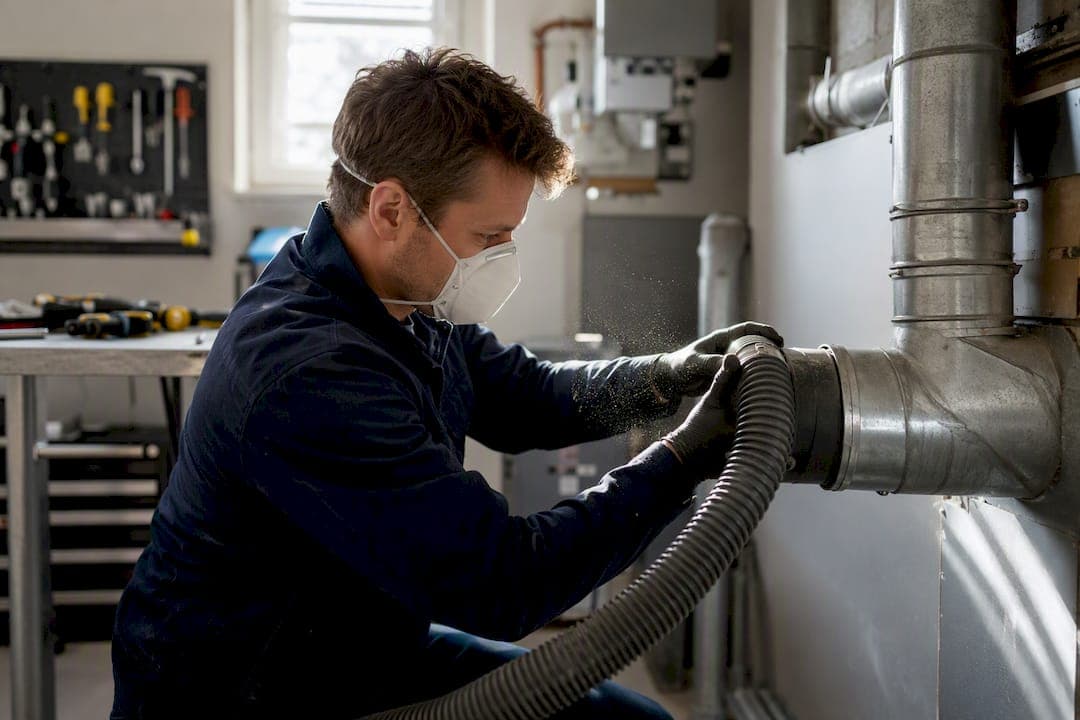
Negative pressure duct cleaning is a containment-based method that pulls contaminated air out of your ductwork through a sealed vacuum connection while technicians dislodge debris inside the system, so nothing escapes into your living space. It's the right call when the EPA triggers show up in your home: visible mold on duct surfaces, rodent or insect infestation, heavy dust deposits restricting airflow, or leftover construction debris after a remodel.
- Don't hire anyone who skips containment. "Blow-and-go" outfits that agitate dust without a sealed vacuum connection often leave more debris in your air than they remove.
- Ask specifically about NADCA ACR compliance and negative-pressure verification before signing anything.
TL;DR:
- Proper negative pressure duct cleaning requires continuous suction and vacuum collection verified through pressure monitoring, not just separate steps.
- Sealed containment and NADCA ACR compliance are essential to avoid scattering debris and ensure thorough removal of contaminants.
- Flex duct should be inspected for fragility before cleaning, as high negative pressure can cause collapse or damage if not managed properly.
- Equipment must deliver sustained high CFM and include true HEPA filtration for effective removal of mold and heavy contamination.
- Costly quotes with minimal documentation may indicate incomplete procedures, so ask for verification proof and a documented scope of work before hiring.
Table of Contents
- How Negative Pressure Duct Cleaning Actually Works
- What Duct Cleaning Can and Can't Fix for Your Home
- What Equipment Specs Actually Tell You About Quality
- Why Flex Duct Needs a Different Approach
- What a Proper Professional Duct Cleaning Service Includes
- Questions to Ask Before You Hire a Duct Cleaner
- How Much Duct Cleaning Costs and How Long It Takes
- Key Takeaways
- Sources
- FAQ
How Negative Pressure Duct Cleaning Actually Works
The process depends on continuous suction paired with mechanical agitation happening at the same time, not one after the other. Here's the sequence a properly run job follows:
- Isolation and sealing — Technicians seal registers, grilles, and the supply/return openings throughout the house so air can only move where they want it to.
- Negative air machine connection — The machine hooks into the trunk line, sometimes at multiple access points on larger homes, so every branch of the system stays under consistent suction. Zoning matters because a single connection point can leave distant branches under-pressurized.
- Agitation — Whips, brushes, or air compressor tools knock loose dust, pet hair, and debris stuck to duct walls.
- Simultaneous collection — The negative air machine pulls that dislodged material straight into its filtration system before it can settle back down or drift into your rooms.
- Monitoring — A manometer or magnehelic gauge tracks pressure differential throughout the job, confirming the system stays under negative pressure the entire time.
That last step is what separates a real duct cleaning job from a shop-vac with extra steps. The NADCA ACR standard requires exactly this combination: agitation plus simultaneous vacuum collection under continuous negative pressure, verified rather than assumed.
What Duct Cleaning Can and Can't Fix for Your Home
Duct cleaning earns its keep in specific situations, and it disappoints homeowners who expect it to solve everything. When contamination is heavy, source removal genuinely helps: mold colonies get physically extracted, post-construction dust and drywall debris get cleared out, and remediation-adjacent jobs (after a rodent problem, say) get the reset they need.
Where it falls short matters just as much. The EPA is blunt that routine duct cleaning isn't necessary on a schedule the way changing your furnace filter is, and cleaning ducts alone rarely resolves broader air quality complaints if the coil, blower, or humidity source is the real culprit.
- Cleaning coils and fans can improve efficiency; duct cleaning by itself has thinner evidence for energy savings.
- If your only complaint is "the house feels dusty," a duct cleaning won't necessarily fix it unless visible contamination is present.
- Insist on NADCA verification documentation. It's your proof the job matched the claim.
What Equipment Specs Actually Tell You About Quality
Not all negative air machines are built the same, and the differences show up in results you can't see with the naked eye. The core spec is CFM, cubic feet per minute of airflow, which needs to outpace your duct system's leakage rate to maintain transport velocity strong enough to carry debris to the collection point instead of dropping it mid-duct.
Statistic Callout: Remediation-grade work typically demands sustained high CFM verified under actual working loads, not just a manufacturer's peak rating on the spec sheet, according to remediation industry guidance. A machine that looks powerful on paper but chokes under real ductwork resistance risks scattering contaminants instead of capturing them.
- Multi-stage filtration matters: a coarse pre-filter catches bulk debris before it can clog the finer stages downstream.
- A true HEPA final stage is non-negotiable for mold or heavy-contamination jobs, since ordinary filters let fine particulates pass straight through.
- Portable pod units trade raw CFM for mobility, useful in tight residential crawlspaces; truck-mounted systems deliver more power but need clear exterior access.
Modern portable units like the BlowBeast II show how far portable equipment has come, offering variable-speed control and HEPA options in a footprint that still fits through a standard doorway.
Why Flex Duct Needs a Different Approach
Flexible ductwork is more fragile than sheet metal, and it doesn't always tolerate the same suction levels. Manufacturers commonly rate flex duct at or below 1 inch of water column negative pressure tolerance. Push past that and the thin inner liner can collapse, kink, or tear, sometimes permanently restricting airflow in a section you just paid to clean.
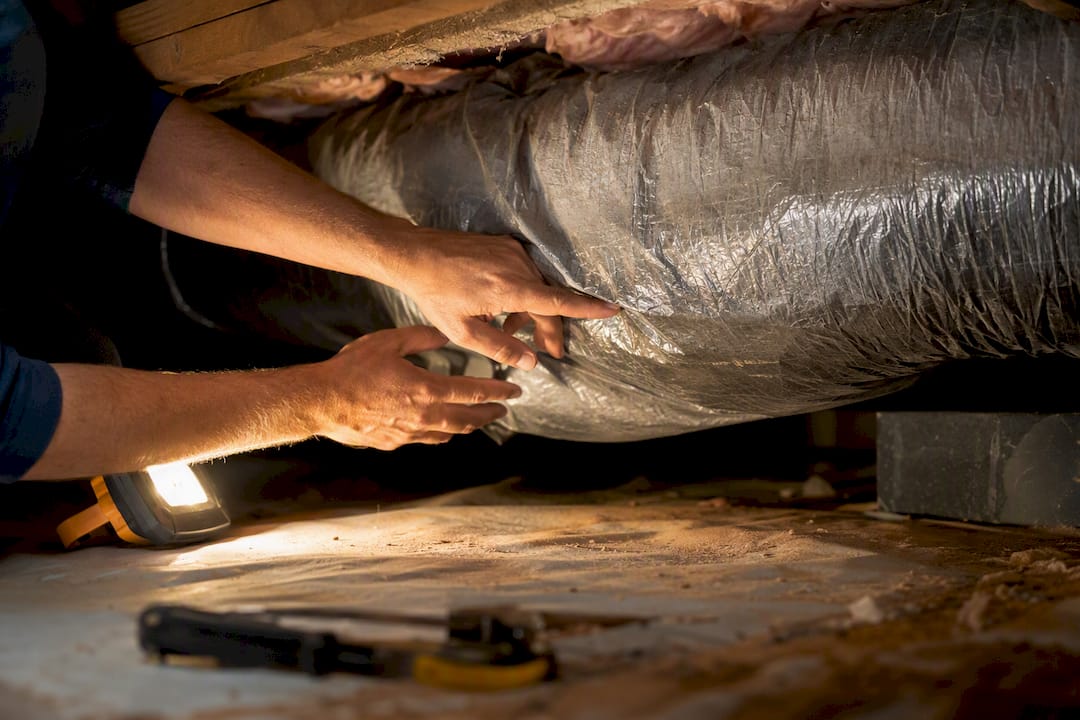
NADCA's position isn't to ban negative pressure near flex duct. It's to assess the material first and adjust the protocol, whether that means lowering suction, adding physical support along vulnerable runs, or replacing a compromised section before the vacuum ever connects.
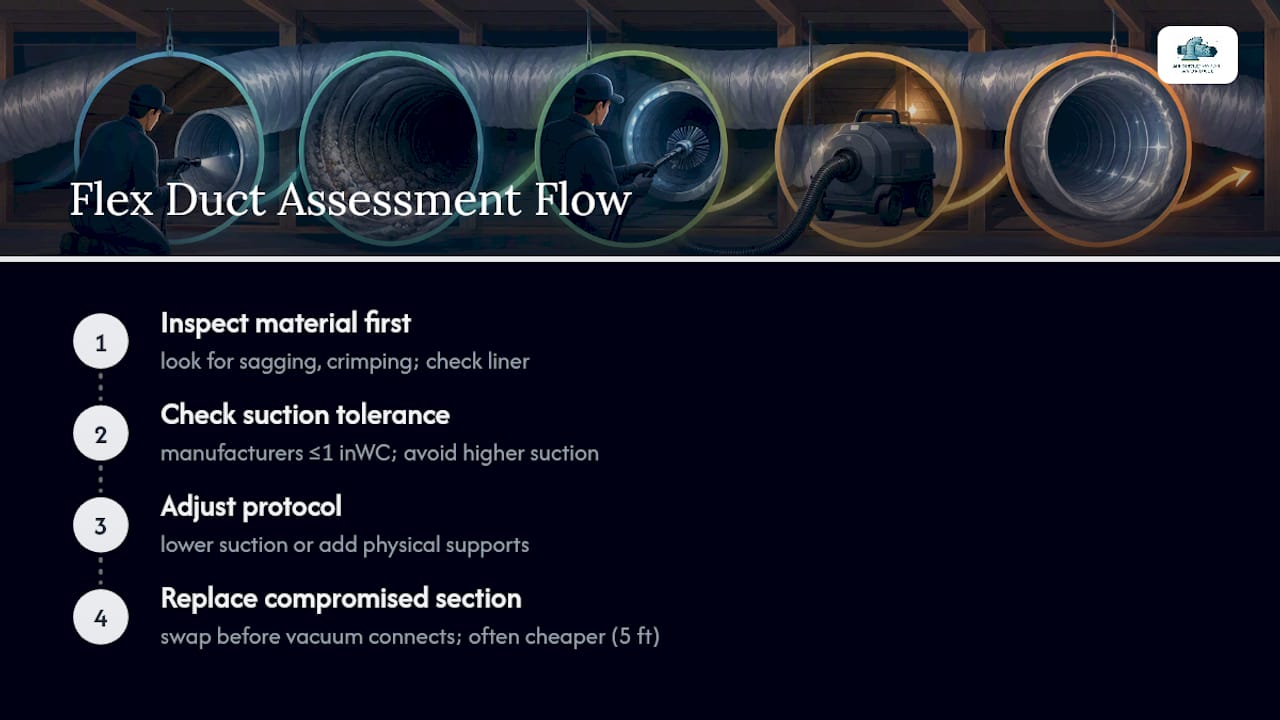
Pro Tip: If your home has older flex duct that's already sagging or crimped, ask your technician to inspect it before the job starts. Replacing a bad five-foot section often costs less than the water damage or airflow loss caused by a collapsed run.
What a Proper Professional Duct Cleaning Service Includes
A real job follows a sequence, and skipping steps is how homeowners end up with dustier air than before. Here's what should happen, in order:
- Assessment — Technicians inspect the air handler, coils, returns, and duct material condition before touching anything.
- Containment setup — Registers get sealed, and the negative air machine connects to establish pressure across the whole system.
- Continuous monitoring — Pressure differential is tracked throughout, with backup equipment on-site in case the primary unit fails mid-job.
- Agitation and collection working together — Debris gets dislodged and vacuumed simultaneously, never in separate passes.
- Filtration or exhaust — Collected air runs through staged filtration, ending in a true HEPA stage, or gets exhausted outdoors depending on the job.
- Verification — A visual inspection at access points, and ideally photo or video documentation, confirms the ducts are actually clean.
Statistic Callout: NADCA guidance also recommends HEPA-filtered air scrubbers as a supplemental control, running alongside the main negative air machine to catch any ambient particulates that slip past containment. Redundancy isn't overkill here. It's what keeps one equipment hiccup from turning into a contamination event.
Questions to Ask Before You Hire a Duct Cleaner
A few pointed questions separate a legitimate contractor from one hoping you won't ask. Before you sign a contract, get answers on paper for these:
- Can you show proof of NADCA ACR compliance and negative-pressure monitoring during the job?
- What's the CFM and HEPA rating on the equipment you'll actually use, not just what's listed on your website?
- How will you handle exhaust, indoors through filtration or vented outdoors?
- If you find flex duct or wet insulated liners, will you recommend repair or replacement rather than pushing ahead?
- What's your written scope of work, verification method, and warranty on repairs?
Get every answer in writing. A contractor confident in their process won't hesitate to document it.
How Much Duct Cleaning Costs and How Long It Takes
Most residential jobs run 1.5 to 3 hours depending on system size and how much contamination technicians find once they open things up. Cost swings on a few predictable factors.
- Remediation-grade HEPA filtration and higher-CFM machines cost more to operate than standard residential equipment.
- Duct repairs, flex duct replacement, or difficult access points (crawlspaces, tight attics) add labor time.
- Severity of contamination changes how long agitation and collection take.
A quote dramatically lower than competitors is worth a second look. It often means the containment step, and the equipment that makes it possible, isn't part of the job at all.
A Homeowner's Take on Where the Corners Get Cut
The gap between a real duct cleaning and a "blow-and-go" job rarely shows up in the sales pitch. It shows up in whether they replace fragile flex duct instead of blasting it, and whether they hand you documented verification instead of just an invoice. Warranty-backed work with proof beats a cheaper quote every time.
— Shaun
How Airanddryerventcleaningavondale Handles Negative Pressure Duct Cleaning
Homeowners in Avondale who want the containment and verification standards described above, without having to police every step themselves, get exactly that from Airanddryerventcleaningavondale. Every job runs on NADCA-aware protocols: sealed containment, HEPA collection, and continuous negative-pressure monitoring from start to finish, not a shortcut version.
The team assesses flex duct and fragile liners before applying suction, and recommends repair or replacement when a section can't safely handle the job rather than forcing it through. Services cover residential and commercial air duct cleaning, duct repair, and air quality testing for homes dealing with mold, pest contamination, or post-construction dust. Work comes with warranty backing and flexible scheduling, including after-hours slots for busy households. If your ducts show any of the EPA's warning signs, schedule an assessment and get a documented, standards-based plan instead of guesswork.
Key Takeaways
Negative pressure duct cleaning works only when continuous suction, simultaneous vacuum collection, and NADCA-standard verification happen together, not as separate or skipped steps.
| Point | Details |
|---|---|
| Confirm EPA triggers first | Visible mold, pests, heavy debris, or post-construction dust justify cleaning; routine cleaning on a schedule usually doesn't. |
| Demand containment proof | Insist on sealed registers, continuous negative pressure, and manometer monitoring throughout the job. |
| Check flex duct condition | Flex duct tolerates roughly 1 inch w.c. negative pressure; fragile sections need repair or replacement first. |
| Match equipment to the job | Ask for CFM specs and a true HEPA final filtration stage, especially for mold or heavy-contamination work. |
| Verify before you pay | Airanddryerventcleaningavondale documents post-job inspection and follows NADCA-aware containment and HEPA collection protocols for Avondale homes. |
Sources
- Should You Have the Air Ducts in Your Home Cleaned? | US EPA
- ACR: The NADCA Standard (2021 edition)
- Effects of Negative Air Duct Cleaning on Flex Ducting | ACHR News
- Negative Air Machine Duct Cleaning | Remediation Standards Guide
- The BlowBeast II negative air machine | Rotobrush
FAQ
Does Negative Pressure Duct Cleaning Actually Work?
Yes, when done correctly with sealed containment and simultaneous vacuum collection, it physically removes mold, debris, and heavy contamination from ducts rather than just stirring it up. The EPA warns that poorly executed cleaning without proper collection can actually increase indoor dust.
What Is the Average Cost to Clean Air Ducts?
Cost varies by home size, contamination severity, and equipment class, with jobs typically taking 1.5 to 3 hours to complete. Unusually cheap quotes often signal missing containment or HEPA filtration rather than genuine savings.
How Can I Fix Negative Air Pressure Issues in My House?
House-wide negative pressure problems (different from a controlled cleaning job) usually trace back to exhaust fans, dryer vents, or a furnace pulling more air out than the house can replace. A qualified HVAC technician or air quality test can pinpoint the source and recommend a fix like added return air or a fresh-air intake.
What Makes a Good Negative Air Machine for Duct Cleaning?
A good machine sustains high CFM under real working loads, not just its rated peak, and includes staged filtration ending in a true HEPA final stage. Portable units like the BlowBeast II balance that power with the mobility residential jobs require.