
The most effective way to stop mold in commercial duct systems is to control moisture at the source and run a structured inspection program before contamination spreads. Three actions matter most: keep indoor relative humidity low in all occupied zones, inspect and clear condensate drain pans quarterly, and replace filters regularly according to manufacturer recommendations while maintaining access panel logs.
- Keep relative humidity below 50% in all occupied zones
- Inspect condensate drain pans and lines every quarter
- Replace filters per manufacturer schedule and log every service visit
- Seal duct penetrations and repair insulation gaps within 30 days of discovery
- Schedule a professional duct inspection annually, or immediately after any water event
Pro Tip: The EPA and NADCA both emphasize that moisture control prevents recurrence. Cleaning without fixing the moisture source is a temporary fix at best.
Table of Contents
- Why does mold grow in commercial duct systems?
- How do you spot mold in ducts before it becomes a crisis?
- What does a prioritized prevention checklist look like?
- How do duct materials affect your mold risk?
- When does routine cleaning cross the line into full mold remediation?
- What should your inspection and maintenance schedule look like?
- How do you hire the right HVAC remediation contractor?
- What does a professional commercial remediation job actually look like?
- Key Takeaways
- The part most facility teams skip
- What to expect from a commercial duct cleaning engagement in Avondale
- Authoritative sources and further reading
- FAQ
Why does mold grow in commercial duct systems?
Mold in commercial HVAC ductwork needs three things: moisture, organic material (dust, debris, insulation fibers), and limited airflow. Commercial systems create all three conditions naturally, which is why mold growth in ventilation systems is a recurring problem rather than a one-time event.
Large commercial systems run continuously across multiple pressure zones, which creates temperature differentials that generate condensation on coil faces, inside plenums, and along uninsulated duct runs. The scale of these systems also means that a single contaminated air handler can distribute spores building-wide within minutes, according to ADRI's commercial HVAC mold guide. That speed of spread is what separates a localized problem from a building-wide remediation project.
The specific moisture sources to monitor:
- Evaporator coils: Condensation collects on coil faces during every cooling cycle. Dirty coils hold more moisture and create a nutrient-rich surface.
- Clogged condensate drain pans: Standing water in a drain pan is the single most common mold trigger in commercial systems. Even a partial clog allows water to pool for days.
- Leaking duct penetrations: Gaps where ducts pass through exterior walls or rooftop units allow humid outside air to enter and condense on cooler interior surfaces.
- Sweating ducts: Uninsulated or under-insulated supply ducts in humid mechanical rooms sweat continuously during cooling season.
- Negative building pressure: When exhaust exceeds supply, humid outdoor air infiltrates through gaps and raises interior humidity levels.
Indoor relative humidity consistently above 50–60% create conditions where mold can establish on virtually any organic surface inside the duct system. In Arizona's climate, that threshold is most at risk during monsoon season, when outdoor humidity spikes sharply.
How do you spot mold in ducts before it becomes a crisis?
Early detection is the difference between a targeted cleaning job and a full remediation shutdown. The earliest reliable signs appear at the system's edges, not its core.
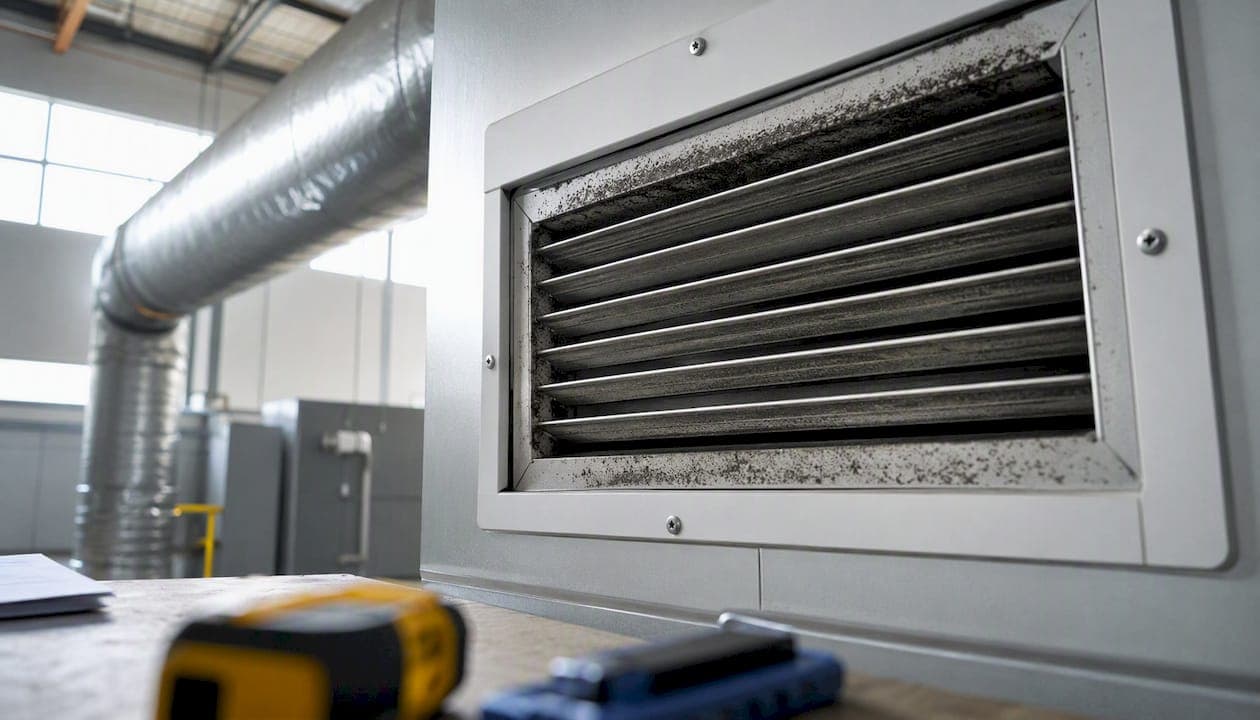
At supply registers and grilles, look for dark gray or black discoloration around the louvers, often in a ring or halo pattern. That pattern indicates spores are being deposited as air exits. A musty odor that appears only when the system runs, then fades when it shuts off, is a strong indicator of contamination inside the duct rather than in the occupied space.
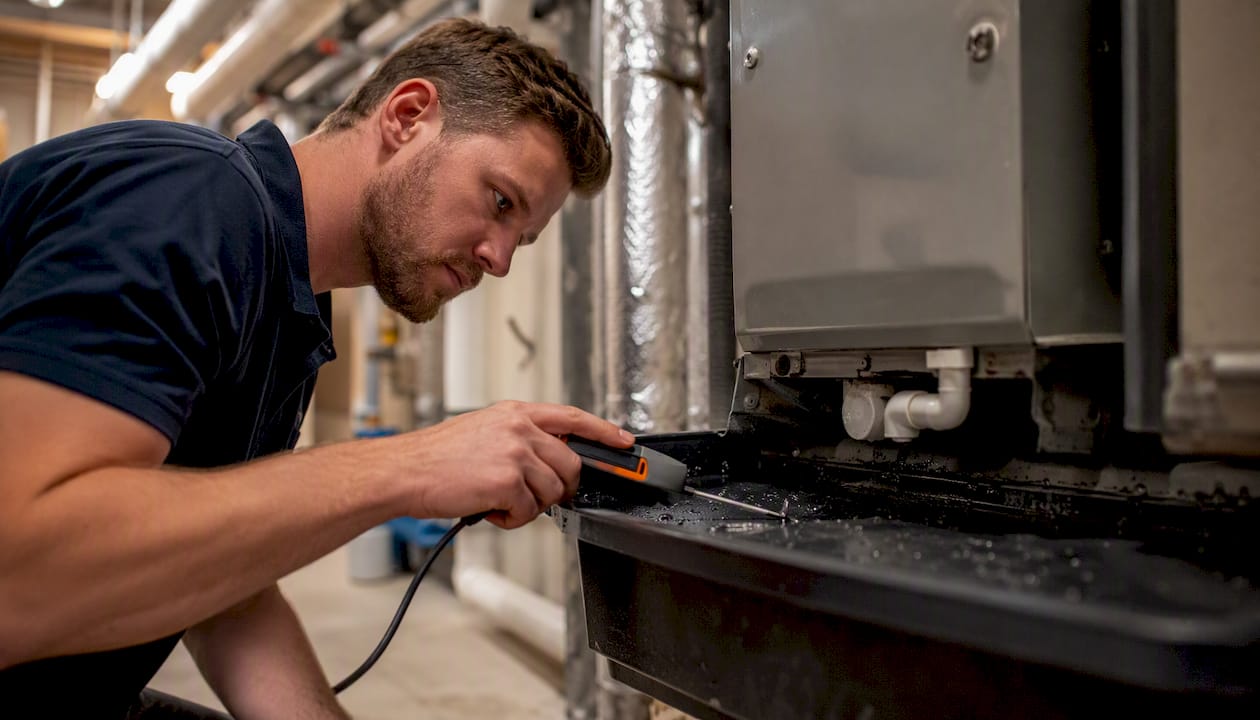
On coil faces and drain pans, look for visible growth (typically black, green, or white fuzzy deposits), slime in the drain pan, or water staining on the pan walls above the drain outlet. Insulation inside air handlers that appears dark, compressed, or wet-smelling should be treated as contaminated until proven otherwise.
Occupant-level signals that demand escalation:
- Persistent respiratory complaints (coughing, congestion, headaches) concentrated in specific zones or floors
- Musty odors reported by multiple occupants in different areas simultaneously
- Visible mold at more than one register in the same air handler zone
- Humidity readings elevated in occupied spaces despite normal system operation
- Declining workplace productivity or increased absenteeism correlated with HVAC operation
When visible mold appears at multiple registers, the contamination is almost certainly deeper than the register face. That pattern warrants a professional inspection, not a surface wipe-down.
What does a prioritized prevention checklist look like?
Moisture control comes first. Cleaning a duct system without addressing the moisture source guarantees the problem returns within one to two seasons.
Immediate actions (complete within 30 days):
- Clear all condensate drain lines and confirm positive drainage
- Patch any visible duct penetrations with mastic sealant or foil tape rated for HVAC use
- Install or calibrate humidity sensors in each major air handler zone
- Pull and inspect the current filter set; replace if loading exceeds 50% or if filters show moisture staining
- Walk all accessible drain pans and photograph standing water or biological growth
Quarterly tasks:
- Inspect and flush condensate drain pans and lines
- Replace filters per manufacturer schedule, with MERV 13 filters commonly used for commercial air quality improvements
- Check condensate pump alarms and float switches for proper operation
- Review humidity sensor logs for any zone exceeding 55% for more than 48 consecutive hours
Annual controls:
- Schedule a professional duct inspection with access panel entry and photographic documentation
- Inspect and re-seal all duct penetrations through exterior walls and rooftop units
- Evaluate insulation condition on supply ducts in unconditioned spaces; replace any wet or compressed sections
- Review maintenance logs for recurring moisture events and address root causes
Pro Tip: Add condensate-pump failure alarms to your building management system if they are not already monitored. A failed pump can flood a drain pan in under an hour, and most facilities do not discover it until the next scheduled inspection.
Thermal imaging and moisture meters let teams find hidden wet spots behind insulation and inside plenums before mold becomes visible, which cuts remediation costs significantly compared to reactive discovery.
How do duct materials affect your mold risk?
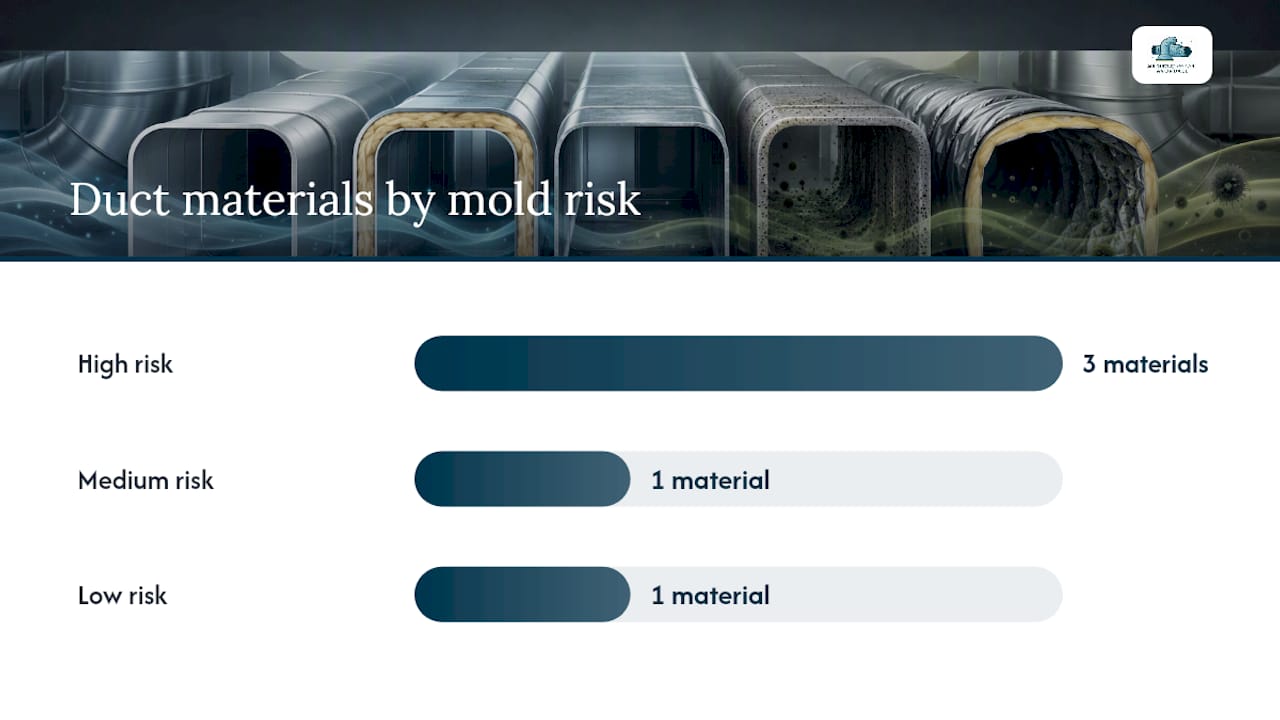
Not all duct materials carry the same risk, and that difference matters when you are deciding whether to clean, repair, or replace a section.
| Material | Mold Risk Level | Cleanable? | Recommendation |
|---|---|---|---|
| Galvanized sheet metal (unlined) | Low | Yes | Standard cleaning protocol; inspect seams and joints |
| Sheet metal with internal liner (fiberglass) | High | Partial | Replace liner if wet or visibly contaminated |
| Flexible duct (insulated) | High | No | Replace if contaminated; cannot be effectively cleaned |
| Rigid fiberglass duct board | High | No | Replace sections with visible growth or moisture damage |
| Sheet metal with external insulation | Medium | Yes (metal only) | Remove and replace external insulation if wet |
Flexible duct is the highest-risk material in commercial systems. Its corrugated interior surface traps debris and moisture, and the insulation jacket holds water against the inner liner. Once contaminated, flexible duct cannot be cleaned to a standard that eliminates mold risk. Replacement is the only reliable fix.
Internally lined sheet metal presents a similar problem. The fiberglass liner absorbs moisture and provides an ideal growth surface. EPA guidance is clear that porous materials with heavy contamination should be discarded rather than cleaned. For retrofit decisions, unlined galvanized sheet metal with external insulation is the lowest-risk configuration because the metal surface can be cleaned and the insulation can be replaced independently.
Access panel placement also changes risk. Systems without adequate access points force technicians to skip sections during inspection, which means contamination goes undetected. Retrofitting access panels at coil faces, drain pans, and major duct junctions is a one-time cost that reduces long-term remediation exposure considerably.
When does routine cleaning cross the line into full mold remediation?
Routine duct cleaning is appropriate when contamination is limited to non-porous surfaces, the moisture source has been corrected, and there is no evidence of systemic spread. Full mold remediation is required when any of the following are true:
- Visible mold growth is present inside plenums or on coil faces
- Insulation is saturated or shows biological growth
- Occupant health complaints span multiple zones or floors
- Humidity readings indicate an unresolved moisture source
- Mold is visible at registers in more than one air handler zone
The decision flow runs: inspect → identify moisture source → isolate affected zones → clean or remediate → verify with post-work testing.
Professional remediation follows a defined protocol. EPA guidance requires polyethylene containment barriers, negative air pressure in the work area, decontamination chambers at zone entries, and appropriate respirators for workers. Contaminated porous materials are bagged and removed. Non-porous surfaces are HEPA-vacuumed, then treated with EPA-registered disinfectants. Some mold inhibitor treatments applied to coil and duct surfaces may protect components for up to two years after remediation.
Cleaning without zone isolation redistributes spores rather than removing them. Effective commercial cleaning requires inflatable plugs or blocking plates to isolate cleaned sections, maintaining directional airflow so HEPA vacuums capture dislodged material rather than pushing it downstream.
Red flags that mandate remediation rather than cleaning:
- Visible mold inside air handler cabinets or plenums
- Saturated duct insulation in any section
- Occupant health complaints that correlate with system operation
- Post-cleaning air sampling that shows elevated spore counts
What should your inspection and maintenance schedule look like?
Quarterly drain-pan inspections and annual professional duct inspections are the minimum standard for commercial systems. After any water intrusion event, affected materials must be dried or removed within 24–48 hours to prevent mold establishment.
| Activity | Frequency | Responsible Party | Time to Complete | Document |
|---|---|---|---|---|
| Filter inspection and replacement | Per manufacturer (typically monthly–quarterly) | In-house | 30–60 min per AHU | Log date, MERV rating, condition |
| Condensate drain pan inspection | Quarterly | In-house | — | Photo + moisture reading |
| Humidity sensor log review | Monthly | In-house | 30 min | Flag any zone >55% for >48 hrs |
| Condensate pump alarm test | Quarterly | In-house | 10 min per unit | Pass/fail log |
| Professional duct inspection | Annually | Licensed contractor | 4–8 hrs per system | Written report + photos |
| Thermal imaging survey | Annually or post-water event | Licensed contractor | 2–4 hrs | Annotated thermal images |
| Post-water event dryness check | Within 24–48 hrs of event | In-house + contractor | Immediate | Moisture meter readings |
For recordkeeping, photograph every drain pan at each quarterly visit and log moisture meter readings at key points (coil face, drain pan outlet, duct near penetrations). A simple spreadsheet with date, location, reading, and technician initials is sufficient for most facilities and provides documentation if an insurance or compliance question arises later.
When a water event affects ductwork, shut the system down in the affected zone and do not restart until moisture readings confirm the materials are dry. The 24–48 hour window is not a guideline; it is the threshold after which mold colonization becomes significantly more likely.
How do you hire the right HVAC remediation contractor?
Hire a professional when the scope exceeds in-house capacity, when remediation thresholds are met, or when post-cleaning air testing shows elevated spore counts. The contractor evaluation process should be as structured as the remediation itself.
Questions to ask every candidate:
- What NADCA or IICRC certifications does your team hold, and can you provide documentation?
- Describe your containment setup for a commercial air handler remediation. What negative-air equipment do you use?
- What PPE do your technicians wear inside contaminated zones?
- Can you provide a written scope of work, containment diagram, and remediation acceptance criteria before work begins?
- What EPA-registered disinfectants do you use, and can you provide the product data sheets?
- Do you carry general liability and workers' compensation insurance? Can you provide current certificates?
- Can you provide references from at least two commercial HVAC remediation jobs of similar scope?
Contract clauses to require:
- Written containment protocol with zone boundaries and negative-air specifications
- Post-remediation verification testing (air sampling or visual plus moisture readings) with pass/fail criteria defined in advance
- Warranty or guarantee language specifying what triggers a callback and at whose cost
- Photo documentation deliverable as part of the final report
Red flags that should end the conversation:
- Refuses to provide a written containment plan before starting work
- Cannot name the EPA-registered disinfectants they use
- No insurance certificates available on request
- Vague scope ("we'll clean everything") with no defined acceptance criteria
- No references from commercial jobs
Rooftop unit access and weatherproofing are worth discussing with any contractor working on multi-story buildings, since penetrations around rooftop units are a common re-entry point for moisture after remediation.
What does a professional commercial remediation job actually look like?
A well-executed commercial remediation job on a mid-size office building typically restores air handler zones to clean, dry, verifiable condition within two to five days, depending on system size and contamination extent.
Here is the step-by-step sequence used on a standard commercial job:
- EPA-registered disinfectant application: — Non-porous surfaces receive an EPA-registered disinfectant treatment. Application follows label instructions for dwell time and ventilation.
Pro Tip: Request that the contractor provide before-and-after moisture meter readings at a minimum of five fixed points per zone, documented in the final report. Those readings are your acceptance test and your insurance documentation if a dispute arises later.
Deliverables you should receive from every qualified contractor: photographic evidence of containment setup and post-work conditions, pre/post moisture readings at documented locations, a containment diagram showing zone boundaries, and a follow-up monitoring plan with recommended re-inspection dates.
Key Takeaways
Preventing mold in commercial ducts requires fixing moisture sources first, running a defined quarterly and annual maintenance schedule, and knowing when cleaning alone is not enough.
| Point | Details |
|---|---|
| Moisture control is the priority | Keep indoor humidity below 50% and inspect condensate drain pans regularly throughout the year. |
| Know when to escalate | Visible mold in plenums, saturated insulation, or multi-zone occupant complaints require formal remediation, not routine cleaning. |
| Material risk varies | Flexible duct and internally lined sheet metal cannot be effectively cleaned; replace contaminated sections. |
| Post-water event response | Dry or remove affected materials within 24–48 hours to prevent mold establishment. |
| Airanddryerventcleaningavondale | Provides commercial duct cleaning, IAQ testing, and duct repair and replacement services in Avondale, AZ. |
The part most facility teams skip
Most commercial mold problems are not cleaning failures. They are maintenance planning failures. A facility team that cleans ducts every three years but never inspects a drain pan in between is doing the expensive work while skipping the cheap work that actually prevents the problem.
The 24–48 hour dryness window after a water event is the clearest example. Every hour past that window raises the probability of mold colonization, yet most facilities do not have a documented response protocol for water events in mechanical spaces. The system gets restarted, the wet insulation stays wet, and six months later someone is calling a remediation contractor.
The other thing teams underestimate is material selection. Flexible duct is cheap to install and expensive to remediate. In a humid climate or a building with a history of condensation issues, the cost difference between flex duct and unlined sheet metal at installation is trivial compared to a single remediation job. That calculation rarely makes it into the initial construction budget conversation, but it should.
Contractor selection is also where facilities get burned. The red flags listed in this article are not hypothetical. A contractor who cannot produce a written containment plan before starting work is not equipped to do commercial remediation. The containment plan is not paperwork; it is the technical specification for the job.
What to expect from a commercial duct cleaning engagement in Avondale
If you are managing a commercial property in Avondale, AZ and any of the red-flag criteria in this article apply, the right next step is a professional assessment before conditions worsen.
Airanddryerventcleaningavondale provides commercial air duct cleaning, duct repair and replacement, access panel installation, and indoor air quality testing for commercial clients in Avondale. Every commercial engagement starts with a scope evaluation and written service plan. You get photo documentation before and after work, a clear explanation of what was found and what was done, and follow-up monitoring recommendations. Flexible scheduling, including after-hours options, means work can be completed without disrupting building operations.
For facilities where duct sections need replacement rather than cleaning, Airanddryerventcleaningavondale handles the full scope from removal through installation. Contact the team to schedule a commercial assessment and get a written scope before any work begins.
Authoritative sources and further reading
- EPA Mold Course Chapter 5: Covers containment protocols, PPE requirements, and porous material disposal standards used as the basis for remediation guidance in this article.
- EPA: Should You Have the Air Ducts in Your Home Cleaned?: EPA's vendor-neutral guidance on when duct cleaning is warranted and what it does not fix.
- NADCA Advanced Duct Cleaning Techniques: NADCA's guidance on commercial cleaning methods, zone isolation, and thermal imaging applications.
- ADRI Commercial HVAC Mold Guide: Inspection frequencies, maintenance protocols, and remediation documentation standards referenced throughout this article.
- The Mold Facts: HVAC Mold and Condensation Management: Source for humidity thresholds and the 24–48 hour dryness standard after water events.
FAQ
How do you prevent mold in HVAC ducts?
Control moisture at the source by keeping indoor humidity below 50%, inspecting condensate drain pans quarterly, and replacing filters on schedule. Fix any leaks or drainage problems before scheduling cleaning, since cleaning without addressing moisture causes recurrence.
How common is mold in commercial HVAC ducts?
Mold growth in commercial duct systems is a frequent problem because continuous operation, large coil surfaces, and multi-zone pressure differentials create persistent condensation opportunities. Any system with clogged drain pans, aging insulation, or unresolved humidity issues is at elevated risk.
Can mold be removed from HVAC ducts?
Mold can be removed from non-porous surfaces like sheet metal using HEPA vacuuming and EPA-registered disinfectants under proper containment. Porous materials such as wet insulation or contaminated flexible duct cannot be effectively cleaned and must be replaced.
Can mold in air ducts make you sick?
Yes. Mold spores distributed through a commercial HVAC system can cause respiratory symptoms, headaches, and allergic reactions in occupants. Multi-zone occupant complaints that correlate with system operation are a strong indicator of system-wide contamination and warrant immediate professional inspection.