

The most effective questions for HVAC maintenance vendors cut straight to what actually protects you: licensing proof, itemized service scopes, emergency response protocols, and warranty terms. Before you sign anything or schedule a first visit, get clear answers to these:
- Are you licensed and insured? Can you provide certificates?
- What specific tasks are included in a standard maintenance visit, and what costs extra?
- How do you handle after-hours emergencies, and do contract holders get priority?
- How long have you been servicing systems like mine, and what refrigerants do you work with?
- Will I receive a written, itemized estimate before any work begins?
- How often do you recommend preventive visits, and can the schedule flex?
- Are your technicians direct employees or subcontractors?
- What warranties cover equipment you install, and do you guarantee your labor?
- Do you perform Manual J load calculations or equivalent system sizing checks?
- What are your contract cancellation terms?
That list is your starting point. The sections below explain why each question matters and what a strong answer actually looks like.
Table of Contents
- Why does verifying licensing and insurance matter for HVAC vendors?
- How do you evaluate vendor experience and HVAC system specialization?
- Do you get written estimates and a clear maintenance scope?
- What should you ask vendors about energy efficiency?
- What questions cover maintenance plans, emergency service, and responsiveness?
- How do you check references and validate vendor reliability?
- What technical questions should you ask about system evaluation and warranties?
- How do you build a proactive HVAC maintenance partnership?
- Airanddryerventcleaningavondale serves Avondale homeowners and businesses
- FAQ
- Key Takeaways
Why does verifying licensing and insurance matter for HVAC vendors?
A licensed vendor has cleared the regulatory bar your state sets for HVAC work. Most states require contractors to hold active licenses tied to specific trade categories, and you can verify those licenses through your state's contractor licensing board. In Arizona, for example, the Registrar of Contractors maintains a public lookup tool. An unlicensed technician working on your system can void equipment warranties and leave you holding liability for any resulting damage.
Insurance is the other half of that protection. Request proof of both general liability and workers' compensation coverage before anyone sets foot on your property. General liability covers property damage the technician causes; workers' comp covers injuries they sustain while on your site. Without it, a slip-and-fall on your roof during a condenser inspection becomes your problem.
Pro Tip: Don't just accept a certificate of insurance at face value. Call the issuing carrier directly to confirm the policy is active and the coverage limits are adequate for the scope of work.
Ask for proof of licensing and insurance upfront, not after you've already agreed to terms. Vendors who hesitate or offer vague reassurances instead of documents are telling you something.
How do you evaluate vendor experience and HVAC system specialization?
Years in business matter, but they're not the whole picture. A vendor with 15 years servicing light commercial rooftop units may be the wrong choice for a residential geothermal system. Ask specifically about their experience with your equipment type, brand, and the refrigerants it uses. R-410A and R-32 systems require different handling than older R-22 equipment, and not every technician is certified for all of them.
Here's what to ask and look for:
- Track record: How long have you been in business, and can you provide references from clients with similar systems?
- Technician credentials: Are your techs EPA 608 certified? Do they hold NATE certification or manufacturer-specific training?
- Employee vs. subcontractor: Confirm whether technicians are direct employees or third-party subcontractors. Employees go through the vendor's vetting and training; subcontractors may not.
- Ongoing training: HVAC technology evolves fast. Ask whether technicians receive regular training on new equipment and updated refrigerant regulations.
- References: Request contacts from at least two or three recent clients, and actually call them. Ask about communication, punctuality, and how the vendor handled problems.
A vendor who can't answer the subcontractor question clearly or who deflects on references is worth scrutinizing further before you commit.
Do you get written estimates and a clear maintenance scope?
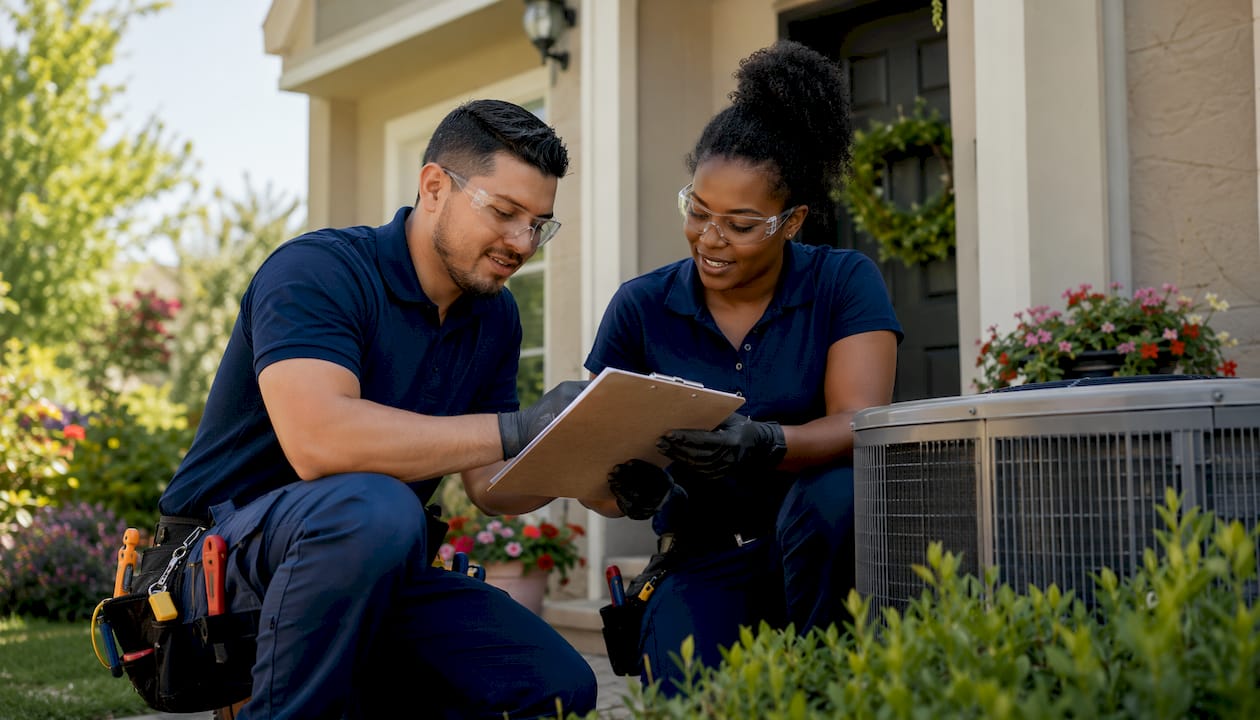
Maintenance is not a standardized term in the HVAC industry. One vendor's "full tune-up" might include coil cleaning, refrigerant check, and electrical inspection. Another's might mean a filter swap and a visual walkthrough. Insist on a written, itemized list of every task included in a standard visit so you can compare vendors on equal footing.
Questions to ask before signing:
- What exactly is included in a standard maintenance visit, line by line?
- Which services trigger additional charges, and what are those rates?
- Is pricing per visit, per system, or based on tonnage?
- Are replacement parts included, or billed separately at what markup?
- Will I receive a written estimate before any non-standard work begins?
Failing to document scope clearly is a leading cause of service disputes and budget surprises. Experienced vendors provide written estimates without being asked because it protects both parties. If a vendor resists putting the scope in writing, that's a red flag worth taking seriously.
Pro Tip: Ask for a residential HVAC maintenance checklist so you can cross-reference what the vendor proposes against industry-standard tasks.

What should you ask vendors about energy efficiency?
A good HVAC vendor doesn't just keep your system running. They help it run better. The U.S. Department of Energy identifies duct leakage and improper system sizing as two of the biggest drivers of residential energy waste, so ask directly whether your vendor addresses both.
- Does your maintenance process include a whole-home evaluation covering ductwork, airflow, and electrical components?
- What steps do you take during a visit to optimize airflow and humidity control?
- How often do you recommend preventive visits for peak efficiency in Arizona's climate?
- Do you recommend energy-saving upgrades, and how do you document those recommendations?
- Will I receive a pre- and post-maintenance system assessment?
According to Energy Star, sealing and insulating ducts can improve system efficiency by as much as 20%. A vendor who never mentions ductwork during a maintenance visit is leaving real savings on the table. Understanding vent maintenance and its impact on energy costs is worth discussing with any vendor you're evaluating.
What questions cover maintenance plans, emergency service, and responsiveness?
Reliability is the whole point of a maintenance contract. A vendor who takes three days to respond to a failed system in July isn't a partner; they're a liability. These questions separate vendors who have real infrastructure from those who are just selling you a piece of paper.
- How frequently are preventive visits scheduled, and can that cadence adjust based on my system's age or usage?
- What is your guaranteed response time for emergency calls?
- Do you offer after-hours service, and is that included in the contract or billed at a premium?
- Do contract holders receive priority scheduling over non-contract customers?
- Are emergency labor and parts covered under the plan, or are they extra?
- What are the contract cancellation terms, and does it auto-renew?
Clarifying emergency protocols upfront is one of the most important steps a facility manager or homeowner can take. A vendor with a documented escalation process and a clear SLA for response time is a fundamentally different proposition than one who says "we'll get there as soon as we can." Get the response time commitment in writing.
How do you check references and validate vendor reliability?
References and reviews are where vendor claims meet reality. Most vendors will hand you a short list of happy clients, which is useful but limited. Push a little further.
- Can you provide references from clients who have systems similar to mine?
- How long have those clients been with you?
- What is your average response time for non-emergency service calls?
- How do you handle disputes or situations where a client is dissatisfied?
- Do you hold any industry certifications, such as NATE or ACCA membership?
Professional vendors value clients who ask detailed questions because it signals a collaborative mindset rather than a purely transactional one. Beyond the reference list, check Google reviews, the Better Business Bureau, and your state's contractor licensing board for any complaints or disciplinary actions. A pattern of unresolved complaints in online reviews tells you more than a curated reference list ever will.
For additional vetting questions, a guide to questions for HVAC installers covers overlapping ground that applies equally well to maintenance vendor selection.
What technical questions should you ask about system evaluation and warranties?
This is where you separate vendors who understand HVAC engineering from those who are running through a checklist. These questions require real answers, not sales talk.
- Do your technicians perform Manual J load calculations, or an equivalent assessment, to confirm the system is properly sized for the space?
- What does your inspection cover beyond the air handler and condenser: ductwork, condensate drain, float switches, electrical connections?
- What warranty do you provide on equipment you install, and is it the manufacturer's warranty or an additional labor guarantee?
- Do you use OEM parts, or do you substitute aftermarket components? If aftermarket, how do you verify quality?
- Will I receive a written post-maintenance report with findings and recommendations?
HVAC warranties can be voided by improper installation or the use of non-approved parts, so the OEM vs. aftermarket question has real financial stakes. A vendor who uses aftermarket parts without disclosing it upfront is making a decision that affects your equipment warranty without your knowledge. Post-maintenance reports are equally telling: a vendor who documents findings and recommendations is building a service history that helps you make smarter decisions over time.
How do you build a proactive HVAC maintenance partnership?
Asking the right questions isn't just about vetting a vendor once. It's about establishing the foundation for a relationship that keeps your system out of crisis mode. Well-defined maintenance contracts focused on proactive system management reduce downtime and deliver measurable return on investment over time.
The shift from reactive to proactive maintenance starts with documentation. Every visit should produce a written record: what was inspected, what was found, what was adjusted, and what needs attention next. That paper trail lets you spot trends before they become failures. A compressor that's drawing slightly high amperage in March is a warning sign; catching it then costs far less than an emergency replacement in August.
Clear written agreements are the backbone of any good partnership. The contract should spell out scope, pricing, emergency protocols, and technician assignment. Consistent technician assignments matter more than most property managers realize. A technician who has serviced your system for two years knows its quirks in a way a rotating crew never will.
Pro Tip: Schedule an annual review of your maintenance plan with your vendor. As your building's occupancy, equipment age, or local regulations change, the plan should change with them.
Understanding why preventive maintenance pays off in lower operational costs and longer equipment life makes the case for treating your vendor relationship as a long-term investment rather than a recurring expense.
Airanddryerventcleaningavondale serves Avondale homeowners and businesses
If you're in Avondale, Arizona and the questions above have you thinking about what your current HVAC maintenance setup is actually covering, Airanddryerventcleaningavondale is worth a direct conversation. The company specializes in the cleaning and maintenance work that most general HVAC contractors treat as an afterthought: air duct cleaning, dryer vent cleaning, vent replacement, duct repairs, air filter replacement, and indoor air quality testing. For commercial properties, the commercial air duct cleaning service covers the ductwork and ventilation systems that affect both air quality and energy costs across your entire facility.
Scheduling is flexible, including after-hours options, and the work comes with warranties. If you want to know exactly what's inside your ducts before you commit to a long-term maintenance contract with any vendor, getting a professional cleaning and assessment first gives you a clear baseline. Contact Airanddryerventcleaningavondale to schedule a service visit and get a written estimate before any work begins.
FAQ
What are the most important questions to ask an HVAC vendor?
Ask for proof of licensing and insurance, a written itemized maintenance scope, emergency response times, technician qualifications, and warranty terms on both parts and labor. These questions reveal whether a vendor is qualified, transparent, and built for a long-term relationship.
What is the $5,000 rule for HVAC?
A common rough decision guide involves comparing the system's age and repair cost to a threshold value, with replacement generally worth considering if repairs become disproportionately expensive. It's a starting point, not a hard standard, and a qualified technician's assessment should drive the final call.
What does a standard HVAC maintenance checklist cover?
A thorough checklist typically includes inspecting and cleaning coils, checking refrigerant levels, testing electrical connections, inspecting the condensate drain, replacing or inspecting filters, and verifying airflow. Because maintenance definitions vary widely across vendors, always request a written task list before agreeing to a plan.
How do I know if an HVAC contractor is legitimate?
Verify their license through your state's contractor licensing board, confirm active general liability and workers' compensation insurance with the issuing carrier, and check for unresolved complaints with the Better Business Bureau. NATE certification or ACCA membership adds another layer of credibility.
How often should HVAC maintenance visits happen?
Many residential systems benefit from preventive maintenance visits before cooling and heating seasons. Commercial systems or older equipment may need more frequent attention depending on usage and local climate conditions.
Key Takeaways
Asking the right questions before signing with an HVAC maintenance vendor protects your budget, your equipment warranty, and your system's long-term reliability.
| Point | Details |
|---|---|
| Verify licensing and insurance | Request certificates and confirm coverage with the issuing carrier before any work begins. |
| Demand a written scope | Maintenance definitions vary widely; an itemized task list is the only way to compare vendors fairly. |
| Clarify emergency protocols | Get guaranteed response times and after-hours terms in writing, not just a verbal assurance. |
| Ask about technician status | Direct employees go through vendor vetting and training; subcontractors may not. |
| Airanddryerventcleaningavondale | Serves Avondale, AZ homeowners and commercial properties with air duct cleaning, vent maintenance, and air quality testing, with flexible scheduling and written estimates. |