
TL;DR:
- A structured vent cleaning workflow is essential to manage high dust levels and prevent HVAC failure in Avondale.
- Proper documentation, tenant communication, and condition-based inspections are key to effective ventilation maintenance.
- External specialists are necessary for asbestos, heavy mold, pests, or post-fire and flood duct systems.
Managing rental properties in Avondale, Arizona means juggling dozens of competing priorities every single week. Vent cleaning rarely feels urgent until a tenant files a complaint, an HVAC system fails mid-summer, or an inspector flags a safety issue. Avondale's notorious dust storms and dry desert air push particulate matter into ductwork far faster than in most U.S. cities, which means the stakes for property managers here are genuinely higher. This guide lays out a structured, repeatable vent cleaning workflow that protects your tenants, your equipment, and your bottom line, without adding chaos to your already packed schedule.
Table of Contents
- Why a structured vent cleaning workflow matters in Avondale
- Essential tools, resources, and prep steps
- Step-by-step vent cleaning workflow for managed properties
- Adapting the workflow for Avondale: Key troubleshooting and best practices
- Post-cleaning verification and documentation
- A property manager's perspective: The real mistake is skipping the workflow, not the cleaning
- Vent cleaning solutions made easy for Avondale property managers
- Frequently asked questions
Key Takeaways
| Point | Details |
|---|---|
| Avondale needs frequent checks | High dust means property managers should inspect vents yearly and clean as conditions require. |
| Structured workflow prevents issues | A documented, stepwise approach minimizes tenant complaints and avoids costly surprises. |
| Coordination and communication | Proactive tenant notifications and staging in multi-family units reduce disruption and complaints. |
| Special situations require pros | Bring in specialists for asbestos, heavy mold, or inaccessible vent systems to ensure safety and compliance. |
Why a structured vent cleaning workflow matters in Avondale
Avondale sits in the heart of the Sonoran Desert, where haboobs and persistent dry winds dump enormous amounts of dust into the air year-round. That dust does not stay outside. It finds its way into HVAC intakes, settles in ductwork, and builds up on vent covers within weeks. Without a structured cleaning workflow, that buildup compounds season after season.
The consequences are not just cosmetic. Clogged vents restrict airflow, which forces HVAC units to work harder to maintain set temperatures. In Phoenix metro summers, where temperatures routinely exceed 110°F, an overworked HVAC system can fail at the worst possible moment. Repair calls spike, tenant comfort drops, and your maintenance budget takes a hit you did not plan for. The EPA's guidance on duct cleaning notes that while cleaning may not always be necessary everywhere, Arizona's dust levels justify more frequent inspections than the national average suggests.
Beyond energy and equipment costs, neglected vents create real health risks for tenants:
- Accumulated dust and allergens trigger respiratory issues, especially in tenants with asthma or allergies
- Moisture trapped in ductwork creates conditions where mold colonies can form and spread spores through the air supply
- Pest debris and droppings in vents introduce bacteria and contaminants into living spaces
- Carbon monoxide risks increase when dryer vents or exhaust vents are blocked by debris
A well-designed workflow eliminates these risks proactively. According to data from the HVAC industry, systems with clean ducts and vents run 15 to 25 percent more efficiently than systems clogged with debris. Over a portfolio of 20 or 30 units, that efficiency gain is real money, and it shows up directly in lower utility costs or in more competitive utility-inclusive lease rates.
Pro Tip: Start tracking HVAC runtime data for each unit. When one unit runs notably longer than comparable units in the same building, clogged ductwork is often the first thing to check. This kind of data-driven trigger is far more reliable than a fixed calendar schedule.
One of the most practical things you can do is understand the root causes. If you know why dust accumulates faster in certain units, you can adjust your inspection frequency accordingly. Read more on reducing ductwork dust in Avondale to identify whether your properties have design or location factors that accelerate buildup.
A reactive approach, meaning you clean only when a problem becomes obvious, consistently costs more than a structured, condition-based workflow. Proactive workflows catch issues before they become emergencies, reduce unscheduled downtime, extend HVAC system life, and protect you from tenant complaints and liability.
Essential tools, resources, and prep steps
Before a single vent cover comes off, you need the right materials, the right people, and the right documentation framework in place. Trying to improvise during a cleaning day wastes time and introduces safety risks.
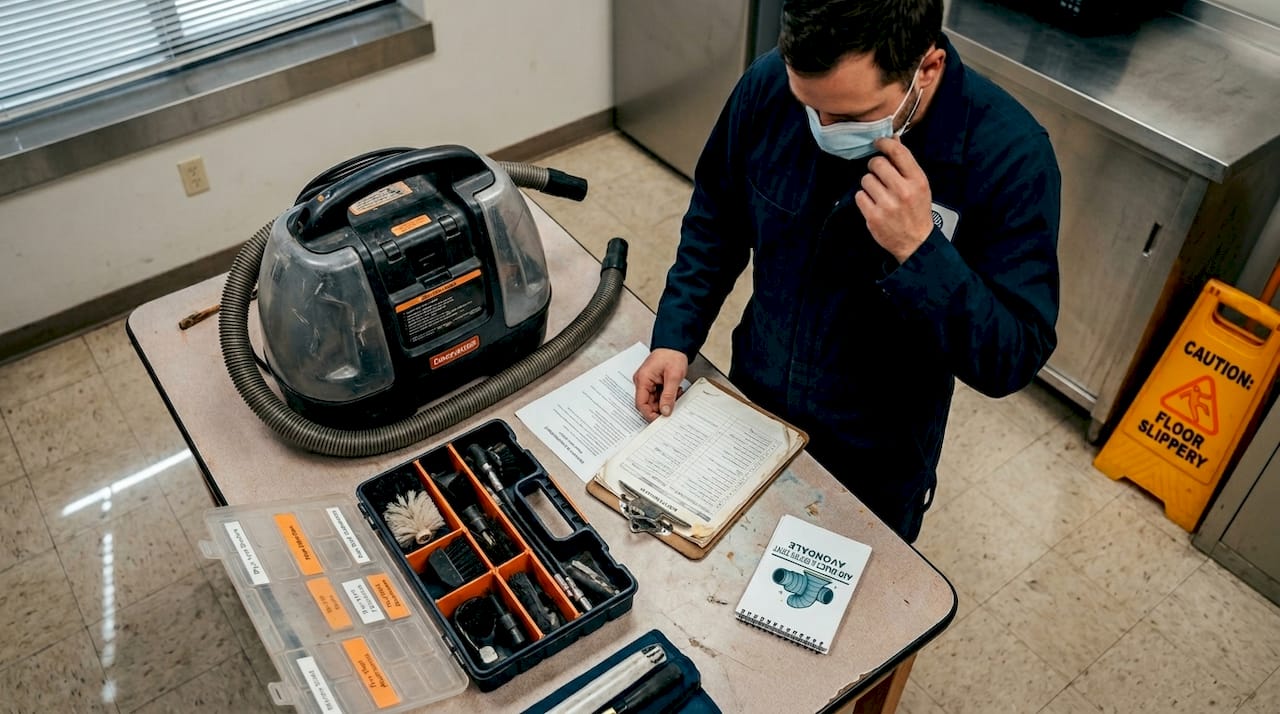
Here is a complete reference table of what every managed property vent cleaning operation needs:
| Category | Item | Purpose |
|---|---|---|
| Equipment | High-powered portable vacuum | Remove debris from duct interiors |
| Equipment | Rotating brush kit | Dislodge stuck-on dust and debris |
| Equipment | Air pressure tools | Blow out hard-to-reach sections |
| Safety | N95 or P100 respirators | Protect workers from dust and mold spores |
| Safety | Safety glasses and gloves | Eye and skin protection during cleaning |
| Materials | Duct sealant and tape | Seal gaps or minor damage discovered during cleaning |
| Materials | Replacement vent covers | Swap out cracked or corroded covers |
| Documentation | Pre-cleaning inspection form | Record baseline condition with photos |
| Documentation | Vendor work order template | Track what was done, by whom, and when |
| Communication | Tenant notice template | Notify occupants at least 48 hours in advance |
| Technology | Property management software | Automate reminders and track cleaning history |
The technology column in that table deserves special attention. Property management platforms like Buildium and Visitt allow you to automate maintenance reminders, coordinate vendor scheduling, and maintain a searchable history for every unit. For a portfolio of any meaningful size, manual tracking in spreadsheets will inevitably develop gaps that cause missed inspections or duplicated work.
Preparation steps before any cleaning begins should follow this sequence:
- Notify tenants in writing at least 48 hours in advance, specifying the date, time window, and what access is needed
- Identify and flag any units with recent water damage, visible mold, signs of pests, or materials that may contain asbestos
- Confirm vendor certifications and insurance before granting duct system access
- Verify that the correct air filter replacement materials are available so filters can be swapped out immediately after cleaning
- Block off service areas in multi-family buildings to prevent foot traffic during cleaning operations
- Brief your maintenance staff on the sequence of units and who is responsible for each task
One often-overlooked prep step is a pre-cleaning air quality baseline. Taking a simple indoor air quality reading before cleaning and then after gives you objective data to share with tenants and document for your records. This is especially valuable if a tenant later raises concerns about air quality. For a detailed look at what a thorough process looks like step by step, the guide to mastering the cleaning process provides useful context for what good looks like at every phase.
Pro Tip: Create a laminated quick-reference card for your maintenance staff with the core steps, safety requirements, and documentation checklist. Field teams under time pressure make fewer errors when the steps are physically in front of them, not buried in a digital file.
Step-by-step vent cleaning workflow for managed properties
With your materials staged, staff briefed, and tenants notified, here is the sequential workflow that keeps everything moving efficiently and creates a defensible record of your process.
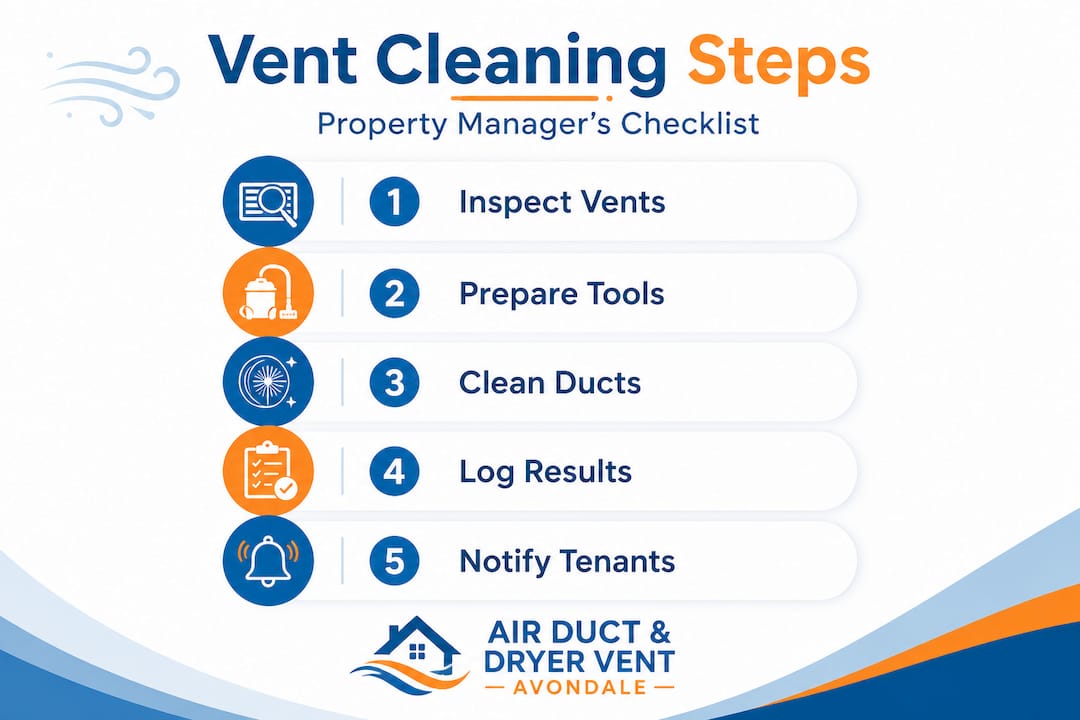
- Send formal tenant communications. Issue written notice to all affected tenants at least 48 hours before cleaning. Specify the access window, what areas will be affected, and any noise or inconvenience to expect. Keep a copy of every notice sent.
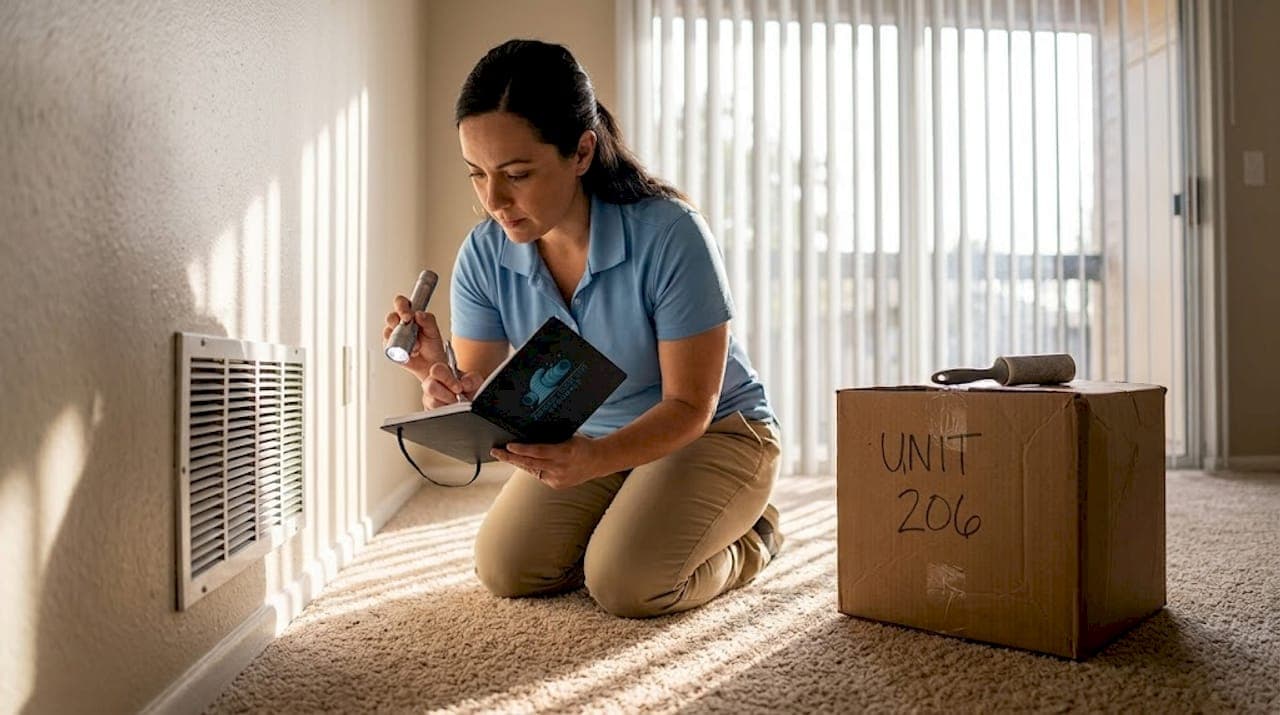
- Conduct a pre-cleaning inspection. Walk each unit and photograph every vent cover, return air grille, and accessible duct section. Note any visible damage, mold, pest signs, or unusual debris. Flag any units that need specialist attention before cleaning proceeds.
- Schedule and stage the work. For multi-family or commercial properties, coordinate by zone or floor to minimize how many tenants are affected at once. Group units with similar duct layouts to maximize efficiency.
- Perform the cleaning. Follow the vent cleaning workflow precisely: remove vent covers, vacuum duct interiors, brush debris loose from walls, blow out remaining particulate, clean or replace covers, and replace air filters.
- Post-cleaning verification. Restore airflow, run the HVAC system for 10 to 15 minutes, and check that every vent is delivering air properly. Verify that covers are sealed correctly and no debris is visible at the vent face.
- Document everything. Log completion in your property management system, attach photos, and note any anomalies found. Generate a work order summary for each unit.
For properties that experienced recent construction or renovation, ductwork should be treated as a high-priority target. Construction dust is far denser and more abrasive than ordinary household dust, and it saturates duct interiors quickly. The benefits of cleaning vents after renovation are well-documented and extend well beyond just air quality.
Here is a quick comparison of two common approaches for larger properties:
| Factor | Zone-by-zone cleaning | Whole-building cleaning |
|---|---|---|
| Tenant disruption | Minimal per session | High, but single event |
| Scheduling complexity | Higher, requires staging | Simpler to coordinate |
| Best for | Occupied multi-family buildings | Vacant or between-lease periods |
| Cost per session | Lower | Higher upfront |
| Documentation | Rolling records per zone | Single comprehensive record |
Safety note: If your property contains ductwork installed before 1980, there is a meaningful possibility it includes asbestos-containing materials. Per EPA guidance on duct safety, do not proceed with standard cleaning in these systems. Disturbing asbestos-containing materials without proper abatement protocols creates serious health and legal liability. Always bring in a licensed asbestos specialist for assessment before any work begins.
Pro Tip: For multi-family properties with shared air handling systems, create a master diagram of the duct layout before your first cleaning cycle. Shared systems mean one contaminated section can affect multiple units. Having a visual map helps you confirm that every zone is actually reached and cleaned.
Adapting the workflow for Avondale: Key troubleshooting and best practices
Even the best workflow runs into real-world complications. Avondale's environment and the variety of property types in the area create some specific challenges that your workflow needs to address head-on.
Prioritize these situations for immediate cleaning attention:
- Any unit where renovation, remodeling, or construction work has occurred, even partial work like tile replacement or drywall patching
- Units following smoke or fire events, even small contained fires, since smoke particles penetrate deeply into ductwork
- Properties showing visible mold at vent covers or return air grilles
- Units where tenants report unusual odors from vents, which often indicates organic debris or pest activity
- Buildings that recently experienced significant water intrusion or flooding
Common Avondale-specific workflow pitfalls that property managers consistently overlook include:
- Underestimating dust accumulation rates. Avondale's dust storms can load a ductwork system with several months' worth of debris in a single event. Inspections should follow any major haboob, not just the calendar.
- Missing shared system zones. In commercial strip properties or older multi-family buildings, shared air handlers serve multiple units. Missing one zone means the cleaned units get recontaminated within days from the uncleaned shared section.
- Non-compliance on asbestos protocols. Older Avondale commercial properties and some residential buildings built before 1980 require asbestos assessment before duct work. Skipping this step exposes you to significant legal and financial risk.
- Delaying cleaning after tenant turnover. The gap between tenants is the best window for thorough duct cleaning, but it is frequently skipped due to schedule pressure.
The EPA notes that while condition-based cleaning rather than fixed-interval cleaning is the standard approach, the Arizona environment creates conditions where inspections should happen more frequently than in lower-dust regions. This is not a reason to clean obsessively, but it is a clear signal that annual inspections at minimum are non-negotiable in this climate.
When should you bring in an external specialist instead of your in-house team?
- Confirmed or suspected asbestos in ductwork materials
- Heavy mold colonization inside duct interiors, not just surface mold on covers
- Active pest infestations that require full remediation before cleaning can proceed
- Physically inaccessible duct sections that require cutting access panels
- Post-fire or post-flood situations where the entire air system may be compromised
For scheduling HVAC cleaning across your Avondale portfolio, the most effective pattern for most managed properties is a visual inspection every six months, with full cleaning triggered by condition rather than fixed intervals. This approach is more efficient than annual blanket cleaning and catches problems before they escalate. Pairing this with regular air quality assessments gives you objective data to justify your schedule and satisfy tenant concerns.
Post-cleaning verification and documentation
Cleaning without verification is half a job. A vent cleaning workflow is only as good as the final confirmation that work was done correctly and the records that prove it.
Every post-cleaning verification should include:
- Visual inspection of all vent covers and return grilles. Look for residual debris, proper seating of covers, and any damage to surrounding surfaces.
- Airflow check at each vent. Run the HVAC system and confirm that air is flowing from every supply vent and that return grilles are pulling air correctly. A simple handheld anemometer gives you a measurable baseline for future comparisons.
- Filter confirmation. Verify that new filters are properly installed and seated. A correctly sized filter installed crooked defeats the purpose of the cleaning.
- Tenant sign-off. Walk through completed units with tenants when possible, or leave a written summary of what was done and an easy way for them to report concerns within 48 hours.
- Photo archive. Photograph every vent location before and after cleaning, label images with unit number and date, and attach them to the work order in your management system.
- Vendor confirmation. If third-party vendors performed the work, collect their signed completion report and retain it alongside your own internal records.
Well-documented vent cleaning records protect you in multiple ways. They demonstrate due diligence if a tenant disputes air quality conditions. They provide evidence of regular maintenance if an HVAC warranty claim requires proof of upkeep. And they give you a year-over-year baseline to identify which units consistently accumulate debris faster than others, which often points to structural issues worth addressing.
For commercial properties, the documentation standard is even higher. Commercial air duct maintenance records may be required for insurance purposes, lease compliance, or local code inspections. Building these records into your standard workflow from the start is far easier than reconstructing them after the fact.
Studies indicate that buildings with thorough post-cleaning verification processes identify workmanship problems roughly 30 percent of the time, meaning missing this step regularly means accepting incomplete work as complete. That is a significant gap in a workflow designed to protect tenant health and property condition.
A property manager's perspective: The real mistake is skipping the workflow, not the cleaning
Here is something that most vent cleaning guides will not tell you directly: the cleaning itself is rarely where property managers fail. The failure almost always happens in the workflow surrounding it.
Most property managers who have dealt with vent-related tenant complaints or HVAC breakdowns can trace the root cause back to one of these three things: they had no documented pre-cleaning inspection, they had no tenant communication protocol, or they had no post-cleaning verification process. The actual cleaning was done, or at least mostly done, but the surrounding structure was missing.
"Set it and forget it" scheduling is probably the most expensive habit in property maintenance. A calendar that says "clean vents in October" sounds organized, but it misses the unit that had a dust storm blow through in August, the building that had a bathroom renovation in September, and the shared air handler that serves three units but is only accessible from one of them. Static calendars create a false sense of control.
What actually drives value in vent maintenance is not the frequency of cleaning but the quality of the system around it. A property management platform that logs every inspection, flags overdue units, and tracks vendor history is worth far more than an extra cleaning cycle you do not actually need. Technology and documentation, not just elbow grease, are what separate well-run portfolios from reactive ones.
The other thing most managers get wrong is treating tenant communication as an afterthought. Tenants who get clear, advance notice about maintenance work almost always respond positively. Tenants who are surprised by technicians showing up or who notice their vents were accessed without explanation generate complaints and distrust, even when the work was done perfectly. The communication and scheduling piece is not a soft skill. It is a core workflow component with measurable impact on tenant satisfaction and retention.
The managers who have the fewest vent-related problems are not the ones who clean the most. They are the ones who inspect consistently, document carefully, communicate proactively, and adapt their schedule based on actual property conditions rather than habit.
Vent cleaning solutions made easy for Avondale property managers
Running a structured vent cleaning workflow across multiple properties takes time, coordination, and the right service partner who understands Avondale's specific environment.
At Air Duct and Dryer Vent Cleaning Avondale, we work directly with property managers to make this process as simple and reliable as possible. Whether you manage a single commercial building or a portfolio of multi-family properties, our team handles commercial air duct cleaning, full vent and air duct cleaning, and dryer vent cleaning with documentation that fits directly into your management records. We offer flexible scheduling including after-hours options, coordinate directly with tenants on your behalf, and provide written verification reports after every job. Contact us today to schedule a free inspection and build a cleaning plan that matches your actual property needs.
Frequently asked questions
How often should Avondale property managers schedule vent cleaning?
Because of high dust levels, inspections should happen at least every six months, with full cleaning triggered by condition rather than a fixed calendar. Annual minimum inspections are non-negotiable in Arizona's desert environment.
What are the biggest mistakes to avoid in a vent cleaning workflow?
Skipping pre-cleaning inspections, failing to document completed work, and not giving tenants advance notice are the three most consistent causes of complaints and workflow breakdowns.
Can property managers clean vents during occupancy in multi-family or commercial properties?
Yes, but staging work by zone or floor is critical to minimizing disruption, and tenants must receive clear written communication well in advance of any access to their units.
When should a specialist be brought in for vent cleaning?
Bring in licensed specialists for any situation involving asbestos duct materials, confirmed heavy mold inside ducts, active pest infestations, or systems that were compromised by fire or flooding.