
TL;DR:
- Contaminated vents significantly reduce indoor air quality, impairing cognitive function and workplace productivity. Regular duct maintenance, appropriate filtration, and IAQ monitoring are essential to ensure healthy air and optimize performance. Future-proof approaches like demand-controlled ventilation and smart IAQ systems help sustain efficient, healthy work environments in 2026.
Your office might look spotless, but if your vents are pushing contaminated air through the building, you have a problem that no amount of surface cleaning will fix. The role of clean vents in workplace productivity is more direct than most office managers realize. Indoor air pollution runs 2 to 5 times worse than outdoor air, and the cognitive effects compound every hour your team sits inside. This article breaks down exactly how vent cleanliness connects to focus, health, and output, plus what you can do about it in 2026.
Table of Contents
- Key takeaways
- How dirty vents degrade air quality and drain productivity
- Ventilation standards for office air quality in 2026
- Practical benefits of clean vents and duct maintenance
- How to assess and maintain clean ventilation systems
- Advanced strategies for future-proofing your workplace air quality
- My take on the productivity lever most offices ignore
- Take the next step for your workplace air quality
- FAQ
Key takeaways
| Point | Details |
|---|---|
| Dirty vents hurt cognition | CO2 buildup from poor ventilation measurably reduces decision-making ability in office workers. |
| Standards exist for a reason | ASHRAE 62.1 sets minimum ventilation rates that directly affect employee health and performance. |
| Clean when it counts | Duct cleaning delivers real results when contamination is visible. Pre-clean surveys prevent unnecessary work. |
| Monitoring is your early warning | CO2 sensors and IAQ monitors let you catch air quality problems before they affect your team. |
| Future-proofing pays off | Smart ventilation and mixed-mode systems can cut energy costs while maintaining peak air quality. |
How dirty vents degrade air quality and drain productivity
Most office managers think about air quality in terms of smell. If it smells fine, it probably is fine. That assumption is wrong, and it costs businesses more than they think.
Dust, mold spores, volatile organic compounds (VOCs), and biological debris accumulate inside ductwork over time. Every time your HVAC system kicks on, it redistributes those contaminants throughout your workspace. Your team breathes that air for eight or more hours a day, five days a week.
The consequences are not subtle. Research shows that cognitive performance drops 15% at 1,000 ppm CO2 and falls by 50% at 2,500 ppm compared to a clean-air baseline. In a poorly ventilated office where windows stay closed and occupancy is high, hitting 1,000 ppm before noon is not unusual. You are not dealing with a comfort issue. You are dealing with a measurable reduction in your team's ability to think.
Here is what commonly builds up inside workplace ductwork:
- Dust and particulate matter from construction, foot traffic, and equipment wear
- Mold spores that thrive in humid ductwork, especially in climates like Avondale, Arizona
- VOCs from furniture, cleaning products, and office equipment that get trapped and recirculated
- Pollen and biological allergens that enter through outdoor air intakes and settle in ducts
- CO2 that accumulates when fresh air exchange rates fall below what the occupancy load demands
Employees experiencing sick building syndrome symptoms often report headaches, chronic fatigue, eye irritation, and difficulty concentrating. Those are the same symptoms you might attribute to stress, dehydration, or a rough night of sleep. The real cause is frequently the air they are breathing.
The difference between a visually clean office and one with genuinely healthy air often comes down to what is happening inside the ventilation system, not on the desks or floors.
Pro Tip: Install a CO2 monitor in your highest-occupancy workspace. If readings consistently exceed 800 ppm during the workday, you have a ventilation problem worth investigating immediately.
Ventilation standards for office air quality in 2026
The good news is that there are clear benchmarks to aim for. The bad news is that most offices have never verified they actually meet them.
ASHRAE 62.1 sets the minimum outdoor air ventilation rate at 5 CFM (cubic feet per minute) per person plus 0.06 CFM per square foot for office spaces. Those numbers are not arbitrary. They represent the minimum airflow needed to dilute CO2 and contaminants generated by occupants and the building itself.
What filtration actually means for your team
Meeting ventilation rates is only part of the equation. ASHRAE 62.1 compliance also requires filtration minimums. The standard calls for MERV 6 to 8 filters at minimum, with MERV 13 or higher recommended for offices where occupant health is a priority. MERV ratings measure how effectively a filter captures airborne particles. A MERV 8 filter catches most visible dust. A MERV 13 filter captures fine particles including many mold spores and bacteria.
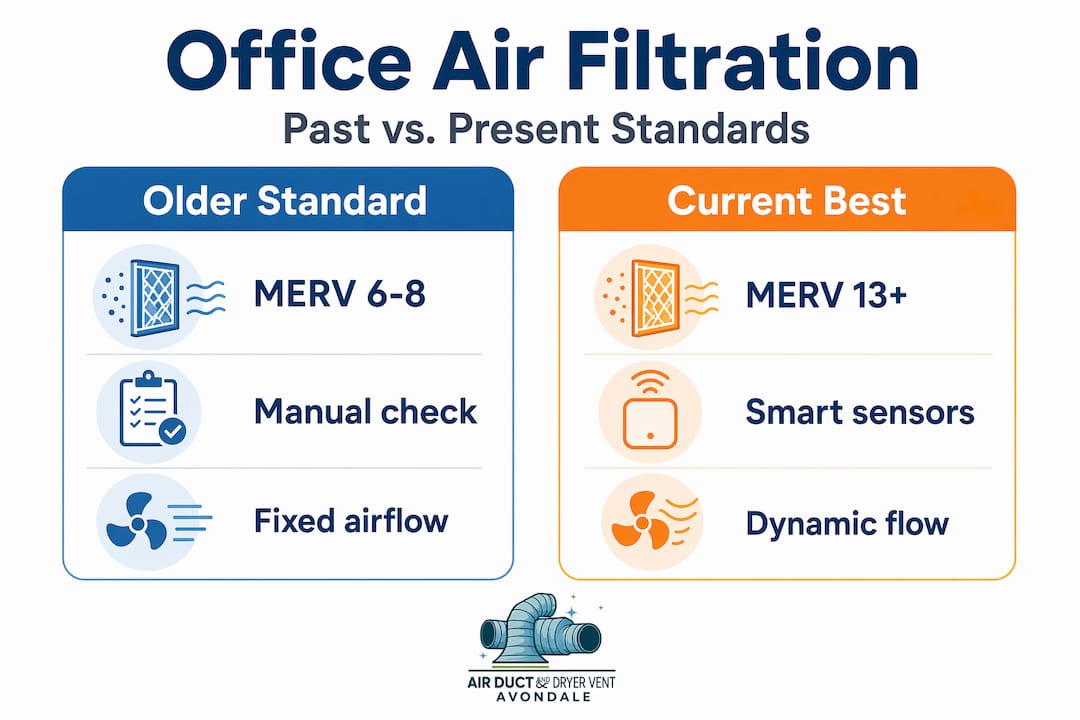
Many offices are still running MERV 6 filters installed years ago and never upgraded. That is a significant gap between what the building appears to be doing and what it actually delivers.
The following comparison shows how ventilation practice has evolved and why the newer approach matters:
| Factor | Older practice | Current best practice (2026) |
|---|---|---|
| Ventilation rate | Fixed airflow regardless of occupancy | Demand-controlled ventilation (DCV) |
| Filtration | MERV 6 minimum | MERV 13+ recommended |
| IAQ monitoring | Annual inspections | Continuous CO2 and particulate sensors |
| Energy approach | Maximum fresh air at all times | Adjust intake based on real-time occupancy |
| Duct maintenance | Reactive (clean when there is a complaint) | Proactive (scheduled inspection and survey) |
Understanding demand-controlled ventilation
Demand-controlled ventilation, commonly called DCV, is one of the more impactful tools available to office managers right now. Instead of pumping a fixed volume of outdoor air into the building regardless of how many people are present, DCV systems use CO2 sensors to adjust airflow in real time. DCV can reduce ventilation energy costs by 20 to 40% by matching outdoor air intake to actual occupancy rather than design-load assumptions.
For offices with hybrid schedules, that is a significant operational advantage. You avoid over-ventilating an empty floor on Tuesday and under-ventilating a packed all-hands meeting on Thursday.
Pro Tip: When reviewing your HVAC specifications, ask your contractor for the design ventilation rate versus the verified delivered rate. These numbers often differ significantly in older commercial buildings.
Practical benefits of clean vents and duct maintenance
Vent and duct cleaning is not something you should do on a fixed schedule regardless of conditions. The EPA recommends cleaning air ducts only when there is a specific reason, such as visible mold growth, pest infestations, or heavy debris accumulation. Cleaning systems that are in reasonable condition can actually disturb settled particles and temporarily worsen air quality.
That said, when conditions warrant cleaning, the benefits to a workplace are real and measurable. Here is when duct cleaning delivers genuine value for commercial spaces:
- After construction or renovation. Drywall dust and construction debris enter duct systems during building work and do not self-clear. A thorough cleaning after any major renovation is not optional.
- When mold is confirmed. If moisture has entered the duct system, mold spreads rapidly and recirculates spores constantly. Cleaning and addressing the moisture source are both required.
- After pest activity. Rodent droppings and nesting material inside ducts create serious biological contamination.
- When employees report persistent allergy symptoms. This is not a definitive trigger on its own, but combined with visual inspection it often reveals a contamination problem. Allergen removal through duct cleaning can make a meaningful difference for staff wellness.
- When the system has never been cleaned after many years of operation. Long-term accumulation of debris restricts airflow and reduces HVAC efficiency.
What clean ducts do for your HVAC system and your bottom line
Beyond the health benefits, clean air vents reduce the load on your HVAC system. Restricted ductwork forces the system to work harder to move the same volume of air, which increases energy consumption and accelerates equipment wear. Offices that address duct contamination often see measurable drops in their utility bills alongside the performance improvements.
The broader picture on workforce health and absenteeism makes a strong business case. Poor indoor air quality contributes directly to sick building syndrome, which increases unplanned absences, reduces engagement, and raises healthcare costs over time.
Pro Tip: Before scheduling a duct cleaning, request a pre-clean survey. A qualified technician should inspect the system and identify specific contamination sources. Pre-clean surveys are essential to confirm that cleaning is actually warranted and to target the intervention correctly.
How to assess and maintain clean ventilation systems
You do not need to wait for complaints before taking your workplace air quality seriously. There are practical steps you can take right now to build an ongoing assessment and maintenance program.
Monitoring continuously rather than reactively
The most effective office managers treat IAQ like they treat network uptime. They monitor it constantly and act on anomalies before they become visible problems. CO2 sensors are inexpensive relative to their value. Place them in conference rooms, open-plan floors, and any space with limited natural ventilation. Track readings over time and correlate spikes with occupancy patterns.
Signs that your vents need attention
Watch for these indicators across your workspace:
- Visible dust accumulation on or around vent covers, especially on return air registers
- A stale or musty odor that intensifies when the HVAC system runs
- Employees reporting seasonal allergy symptoms that persist indoors year-round
- Uneven temperature distribution suggesting restricted airflow in certain zones
- An unexplained increase in HVAC energy consumption over the previous year
Selecting qualified technicians
Not all duct cleaning services deliver the same results. Look for technicians who use negative-pressure equipment to contain loosened debris during cleaning, conduct a full system inspection before and after the job, and provide documentation of findings. In Avondale and across Arizona, reputable providers like Airanddryerventcleaningavondale offer commercial duct cleaning with transparent pre-clean assessments and verifiable outcomes.
Building cleaning frequency around reality, not marketing
The right cleaning interval depends on your specific building conditions. A medical office in a high-traffic building needs more frequent attention than a small law firm in a newer space. Base your schedule on inspections rather than a fixed calendar.
Pro Tip: Integrate duct inspection into your annual HVAC preventive maintenance contract. Having your HVAC technician look inside the system once a year costs very little and catches developing problems before they require expensive intervention.
Advanced strategies for future-proofing your workplace air quality
The organizations that will perform best over the next decade are the ones that treat air quality as an infrastructure investment rather than a maintenance line item. Several newer approaches are worth knowing about.
Mixed-mode ventilation
Mixed-mode ventilation (MMV) combines mechanical and natural ventilation, using sensors and automated controls to switch between or blend both modes depending on outdoor conditions, occupancy, and air quality readings. Research shows MMV delivers energy savings without a measurable drop in employee satisfaction or performance. For office buildings in a climate like Avondale, where outdoor air quality is often excellent outside the peak summer months, mixed-mode systems can significantly reduce cooling loads while maintaining indoor air quality.
Smart IAQ management
Building automation systems can now integrate IAQ sensor data with HVAC controls to manage ventilation, filtration, and air cleaning in real time. Instead of running at fixed settings, smart systems respond to actual CO2 levels, particulate counts, and humidity readings. The result is a workspace that consistently stays within optimal air quality ranges without wasting energy during low-occupancy periods.
What this means for your workforce planning
Forward-thinking office managers are starting to include IAQ benchmarks in their facility performance standards. This matters for talent retention too. Employees increasingly notice and report on their physical workspace conditions. A building that consistently maintains clean, well-ventilated air sends a signal about how the organization values the people who work in it.
Pro Tip: Ask your HVAC provider whether your current system supports DCV controls or smart thermostat integration. Many commercial systems installed after 2015 have the hardware for it but were never configured to use those features.
My take on the productivity lever most offices ignore
I have talked with a lot of office managers and operations leaders over the years, and the pattern I keep seeing is the same. They invest heavily in ergonomic furniture, standing desks, and productivity software, and then they wonder why their teams still report fatigue and difficulty concentrating. When I start asking about ventilation and duct maintenance, the conversation usually goes quiet.
The honest reality is that air quality is one of the last things to get budget attention because its effects are invisible and gradual. Nobody calls in sick and says the CO2 level in conference room B made them unproductive. They just feel off, make slower decisions, and go home tired. The connection never gets made.
What I have learned from watching buildings improve after serious IAQ work is that the results show up in ways management did not expect. Meeting output improves. Sick days drop. People start commenting that the office feels different, without being able to say exactly why.
The compounding cost of neglect here is real. A team running at 85% cognitive capacity because their ventilation is borderline inadequate is a permanent hidden tax on your operating results. It is not dramatic enough to trigger a crisis response, but it adds up every single day.
If you are serious about workforce performance, clean vents and verified air quality belong on your leadership agenda. Not in the facilities backlog. On the agenda.
— Shaun
Take the next step for your workplace air quality
Your team deserves an environment where the air they breathe supports their best work, not works against it.
Airanddryerventcleaningavondale provides professional commercial duct and vent cleaning services specifically designed for businesses in Avondale, Arizona. From pre-clean surveys that identify whether cleaning is actually needed, to thorough negative-pressure cleaning that removes mold, debris, and allergens from your ductwork, every service is built around verified results. Need to know where you actually stand? Their indoor air quality testing service gives you a clear, data-backed picture of your current conditions so you can make decisions based on facts. Flexible scheduling, including after-hours options, means zero disruption to your operations.
FAQ
What is the role of clean vents in workplace productivity?
Clean vents support productivity by maintaining indoor air quality at levels that allow full cognitive function. When vents circulate clean air, CO2 and contaminants stay low, and employees can focus, decide, and perform consistently throughout the workday.
How often should commercial air ducts be cleaned?
The EPA recommends cleaning air ducts when there is visible contamination such as mold, heavy debris, or pest activity, rather than on a fixed schedule. Annual inspections help determine when cleaning is actually warranted based on your specific building conditions.
What CO2 level signals a ventilation problem in an office?
CO2 readings above 1,000 ppm indicate inadequate ventilation and are associated with measurable drops in decision-making performance. Monitoring your workspace with CO2 sensors is the most reliable way to catch ventilation problems early.
What MERV rating filter should a commercial office use?
ASHRAE 62.1 sets a minimum of MERV 6 to 8, but MERV 13 or higher is recommended for office environments where air quality and occupant health are priorities. Higher-rated filters capture finer particles including mold spores and many biological contaminants.
Does clean ductwork actually save energy?
Yes. Restricted or contaminated ducts force the HVAC system to work harder to move air, increasing energy consumption. Cleaning systems that have genuine debris buildup reduces that resistance and can lower utility costs alongside the health and productivity benefits.