

TL;DR:
- Proper ventilation exchanges stale indoor air with fresh outdoor air to ensure a healthy workplace. Meeting standards like ASHRAE 62.1 improves employee health, boosts productivity, and reduces operating costs. Regular maintenance and advanced systems like DOAS, ERVs, and CO2 sensors optimize indoor air quality effectively.
Ventilation in businesses is defined as the controlled exchange of stale indoor air with fresh outdoor air to maintain a healthy, productive, and energy-efficient workplace. The industry standard governing this process is ASHRAE 62.1, which sets minimum outdoor air requirements for commercial spaces including offices, retail stores, and restaurants. Poor air circulation does more than make a room feel stuffy. It directly reduces worker output, triggers health complaints, and raises operating costs. The role of ventilation in businesses has moved from a background compliance issue to a front-line operational priority for facility managers and business owners who want measurable results.
How does ventilation affect employee health and productivity?
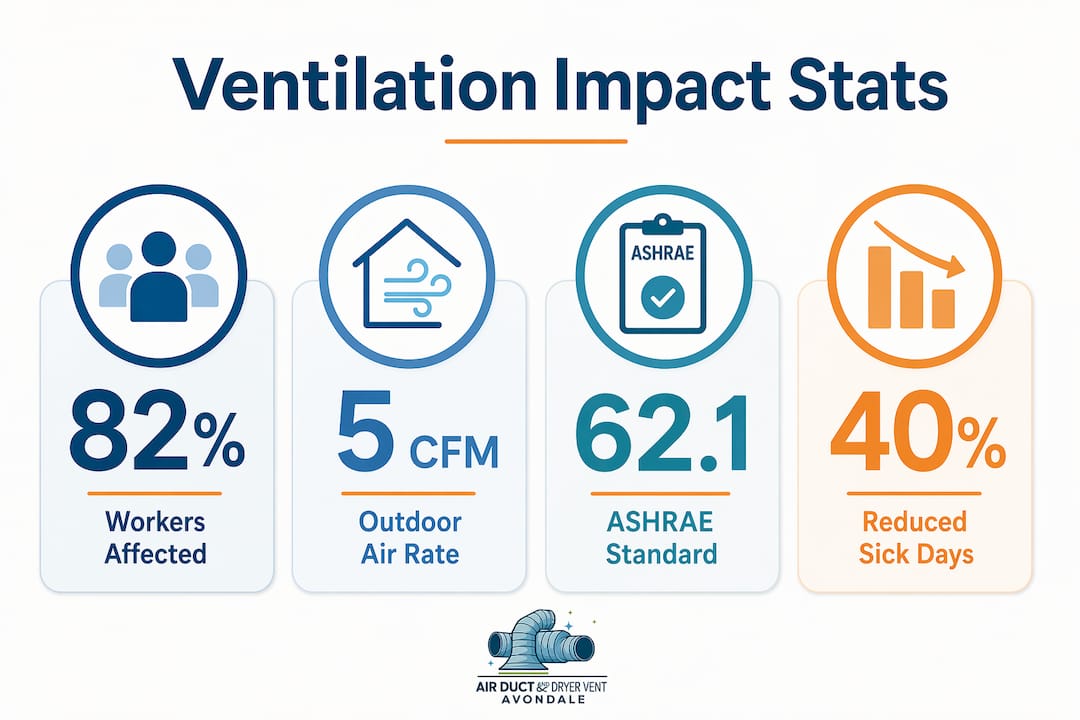
Poor ventilation is the leading environmental cause of Sick Building Syndrome in commercial workplaces. 82% of workers in poorly ventilated buildings report symptoms including headaches, fatigue, and eye or throat irritation. That figure means most of your workforce is likely affected before you even notice a drop in output.
The air quality problems behind these symptoms fall into three categories: elevated carbon dioxide (CO2) from occupant breathing, fine particulate matter known as PM2.5, and volatile organic compounds (VOCs) released by furniture, cleaning products, and building materials. Each of these pollutants accumulates when fresh air exchange is insufficient. CO2 above 1,000 parts per million impairs concentration. PM2.5 at elevated levels increases cardiovascular and respiratory risk over time.
Meeting or exceeding ASHRAE 62.1 ventilation standards improves cognitive performance by 61% and raises productivity by 10%. Those are not marginal gains. A 10% productivity increase across a 20-person office is the equivalent of adding two full-time workers without hiring anyone.
The symptoms your workers experience from poor air quality include:
- Persistent headaches during work hours that resolve after leaving the building
- Unexplained fatigue and difficulty concentrating, especially in the afternoon
- Eye, nose, and throat irritation with no identified allergy trigger
- Increased frequency of respiratory infections across the team
- Dizziness or nausea in enclosed meeting rooms or server areas
Pro Tip: Install low-cost CO2 sensors in high-occupancy areas like conference rooms and open-plan floors. When readings exceed 1,000 ppm, increase outdoor air intake immediately. Real-time data removes the guesswork from ventilation decisions.
The importance of air quality in workplaces goes beyond comfort. Businesses that ignore it pay the price through absenteeism, reduced output, and higher staff turnover.
What standards and regulations define proper commercial ventilation?
ASHRAE 62.1 is the primary standard for ventilation in commercial buildings across the United States. It specifies minimum outdoor air delivery rates by space type, calculated using a combination of occupancy density and floor area. The Environmental Protection Agency (EPA) and the Occupational Safety and Health Administration (OSHA) both reference indoor air quality guidance that aligns with ASHRAE 62.1 as the baseline for safe commercial environments.
The rates vary significantly depending on how a space is used. A restaurant dining area has far higher ventilation demands than a standard office because of cooking odors, higher occupancy density, and moisture. Retail spaces require 0.12 CFM per square foot, while restaurant dining areas require 7.5 CFM per person plus 0.18 CFM per square foot. These numbers reflect the actual pollutant load each space type generates.
| Space type | Outdoor air rate | Basis |
|---|---|---|
| Office | 5 CFM/person + 0.06 CFM/sq ft | Occupancy and area |
| Retail | 0.12 CFM/sq ft | Area-based |
| Restaurant dining | 7.5 CFM/person + 0.18 CFM/sq ft | Occupancy and area |
| Conference room | 5 CFM/person + 0.06 CFM/sq ft | Occupancy and area |
CFM stands for cubic feet per minute, the standard unit for measuring airflow volume. Falling below these rates is not just a health risk. It exposes your business to OSHA citations and potential liability if workers develop documented health conditions tied to poor air quality.
Compliance with ASHRAE 62.1 is the legal floor, not the ceiling. Businesses that exceed minimum rates consistently report fewer sick days, lower turnover, and better performance reviews from employees. Treating the standard as a target rather than a ceiling is a practical decision, not just a regulatory one.
What ventilation technologies work best for commercial spaces?
The most common misconception in commercial facility management is that air conditioning equals ventilation. Air conditioning regulates temperature but does not necessarily improve ventilation or reduce CO2 levels. True ventilation requires active fresh air exchange, which standard HVAC systems often fail to deliver because they primarily recirculate existing indoor air.

Three technologies address this gap effectively.
Dedicated Outdoor Air Systems (DOAS) supply 100% outdoor air to a space, pre-conditioned to avoid temperature and humidity extremes. They decouple ventilation from heating and cooling, which gives facility managers precise control over fresh air delivery independent of thermal comfort settings.
Energy Recovery Ventilators (ERVs) transfer heat and moisture between outgoing stale air and incoming fresh air. DOAS and ERVs provide fresh air efficiently without the energy penalty of conditioning 100% outdoor air from scratch. In a hot climate like Avondale, Arizona, this matters significantly because the temperature differential between outdoor and conditioned indoor air is large for most of the year.
Demand-Controlled Ventilation (DCV) uses CO2 sensors as an occupancy proxy. CO2 sensors enable dynamic ventilation control, throttling outdoor air intake up or down based on actual occupancy rather than a fixed schedule. A conference room that holds 20 people at 9 a.m. and zero people at 3 p.m. does not need the same airflow at both times. DCV eliminates that waste automatically.
Maintenance is the part most businesses underestimate. Neglected ductwork and dirty filters reduce ventilation effectiveness and increase equipment wear and utility bills. A system that was properly designed and installed will still underperform if filters are not changed on schedule and ductwork is not inspected for leaks, blockages, or accumulated debris.
Key maintenance actions that sustain ventilation performance include:
- Replace air filters on the manufacturer's recommended schedule, or more frequently in high-dust environments
- Inspect and clean ductwork annually to remove debris, mold spores, and allergen buildup
- Test damper operation and outdoor air intakes to confirm they open and close correctly
- Calibrate CO2 sensors at least once per year to maintain accurate demand-controlled ventilation
- Check ERV cores and heat exchanger surfaces for fouling that reduces heat transfer efficiency
Pro Tip: Track three IAQ indicators monthly: PM2.5 concentration, CO2 levels, and relative humidity. Humidity above 60% promotes mold growth. Keeping all three within target ranges tells you your ventilation system is working before symptoms appear.
How does proper ventilation improve operational efficiency and cut costs?
Ventilation directly affects your operating budget in ways that are easy to measure once you know where to look. Proper maintenance of ventilation components including ductwork and filters sustains system efficiency and prevents the energy waste that comes from a system working harder than it should. A clogged filter forces your HVAC unit to draw more power to move the same volume of air. That extra load shows up on your utility bill every month.
Demand-Controlled Ventilation reduces energy consumption by supplying outdoor air only when occupancy demands it. In buildings with variable occupancy, such as retail stores, event spaces, or shared offices, this can produce meaningful reductions in conditioning costs without sacrificing air quality. The energy saved on conditioning unnecessary outdoor air often offsets the cost of the sensor hardware within the first year of operation.
The workforce cost of poor ventilation is less visible but larger in total. Absenteeism from Sick Building Syndrome symptoms, reduced output from cognitive impairment, and staff turnover driven by an uncomfortable work environment all carry direct financial costs. Improving air quality addresses all three simultaneously.
| Ventilation investment | Operational benefit |
|---|---|
| ERV installation | Lower conditioning costs for outdoor air year-round |
| DCV with CO2 sensors | Energy savings during low-occupancy periods |
| Regular duct and filter maintenance | Reduced equipment wear and lower utility bills |
| ASHRAE 62.1 compliance | Fewer sick days and lower absenteeism costs |
| Air quality monitoring | Early detection of problems before they affect output |
Pro Tip: Connect your ventilation controls to a building energy management system (BEMS). A BEMS logs airflow, temperature, and energy consumption together, so you can see exactly when and where ventilation is costing or saving money.
Mold growth inside ductwork is a hidden cost multiplier. When moisture and poor airflow combine, mold affects air quality and forces expensive remediation that could have been prevented with routine maintenance. Catching it early through regular inspections is far cheaper than addressing it after symptoms appear.
Key Takeaways
Proper ventilation is the single most cost-effective investment a business can make to protect worker health, meet ASHRAE 62.1 compliance requirements, and reduce long-term operating costs.
| Point | Details |
|---|---|
| ASHRAE 62.1 compliance pays off | Meeting ventilation standards boosts cognitive performance by 61% and productivity by 10%. |
| AC is not ventilation | Air conditioning regulates temperature but does not deliver the fresh air exchange workers need. |
| DCV cuts energy waste | CO2 sensors adjust outdoor air intake to actual occupancy, reducing conditioning costs. |
| Maintenance sustains performance | Dirty filters and neglected ductwork raise utility bills and reduce air quality simultaneously. |
| Monitoring enables prevention | Tracking PM2.5, CO2, and humidity monthly catches problems before they affect worker health. |
Ventilation is a business asset, not a building feature
I have spent years working with facility managers who treat ventilation as something to fix when someone complains. That approach costs more than it saves. By the time workers are reporting headaches or fatigue, the air quality problem has already been affecting their output for weeks.
The most useful shift I have seen is when a facility manager starts treating ventilation data the same way they treat financial data. You would not wait for a budget crisis to check your accounts. Waiting for symptoms to check your CO2 levels is the same mistake. The businesses that get this right install sensors, set alert thresholds, and respond to data rather than complaints.
The misconception that air conditioning handles ventilation is genuinely widespread, and it causes real damage. I have walked into offices where the AC was running perfectly and the CO2 was above 1,400 ppm. The workers were sluggish, the manager thought they were just tired, and the fix was simply opening the outdoor air damper. That is a free solution to a problem that was costing the business in lost output every single day.
Ventilation as a strategic asset means measuring it, maintaining it, and investing in it the same way you invest in your team. The return is real, it is measurable, and it shows up in your workforce before it shows up in your financials. Facility managers who understand this are the ones whose buildings consistently outperform on retention and productivity metrics.
The other thing I would stress is that technology alone does not solve the problem. A DOAS or ERV installed in a building with dirty, leaking ductwork will underperform. The system is only as good as its weakest component. Regular professional cleaning and inspection of air vent systems is what keeps the technology working as designed. Skipping that step is like buying a high-performance engine and never changing the oil.
— Shaun
How Airanddryerventcleaningavondale supports your commercial ventilation system
Airanddryerventcleaningavondale provides professional cleaning and maintenance services for commercial air ducts, vents, and related systems across Avondale, Arizona. Keeping your ventilation system clean is what makes every other investment in air quality actually work.
Dirty ductwork and clogged vents undermine even the best-designed ventilation system. Airanddryerventcleaningavondale's commercial air duct cleaning service removes accumulated dust, allergens, mold spores, and debris that block airflow and reduce system efficiency. The team also offers indoor air quality testing to give you a clear baseline reading of PM2.5, CO2, and other key indicators before and after service. Flexible scheduling, including after-hours options, means the work gets done without disrupting your operations. Contact Airanddryerventcleaningavondale to schedule a commercial assessment and see what your ventilation system is actually delivering.
FAQ
What is the role of ventilation in a business?
Ventilation in a business delivers fresh outdoor air and removes stale indoor air, controlling CO2, PM2.5, and VOC levels that directly affect worker health and cognitive performance. ASHRAE 62.1 sets the minimum outdoor air rates required for commercial spaces.
How does poor ventilation affect employees?
82% of workers in poorly ventilated buildings report symptoms including headaches, fatigue, and eye or throat irritation. These symptoms are the defining signs of Sick Building Syndrome and directly reduce productivity.
Does air conditioning count as ventilation?
Air conditioning regulates temperature but does not deliver fresh outdoor air or reduce CO2 levels. True ventilation requires a dedicated fresh air exchange system such as a DOAS or ERV.
What are the ASHRAE 62.1 ventilation requirements for offices?
ASHRAE 62.1 requires offices to receive 5 CFM per person plus 0.06 CFM per square foot of outdoor air. Retail spaces require 0.12 CFM per square foot, and restaurant dining areas require 7.5 CFM per person plus 0.18 CFM per square foot.
How often should commercial ductwork be cleaned?
Commercial ductwork should be inspected annually and cleaned whenever inspection reveals debris buildup, mold growth, or airflow restriction. Neglected ductwork reduces ventilation effectiveness and increases utility costs.