
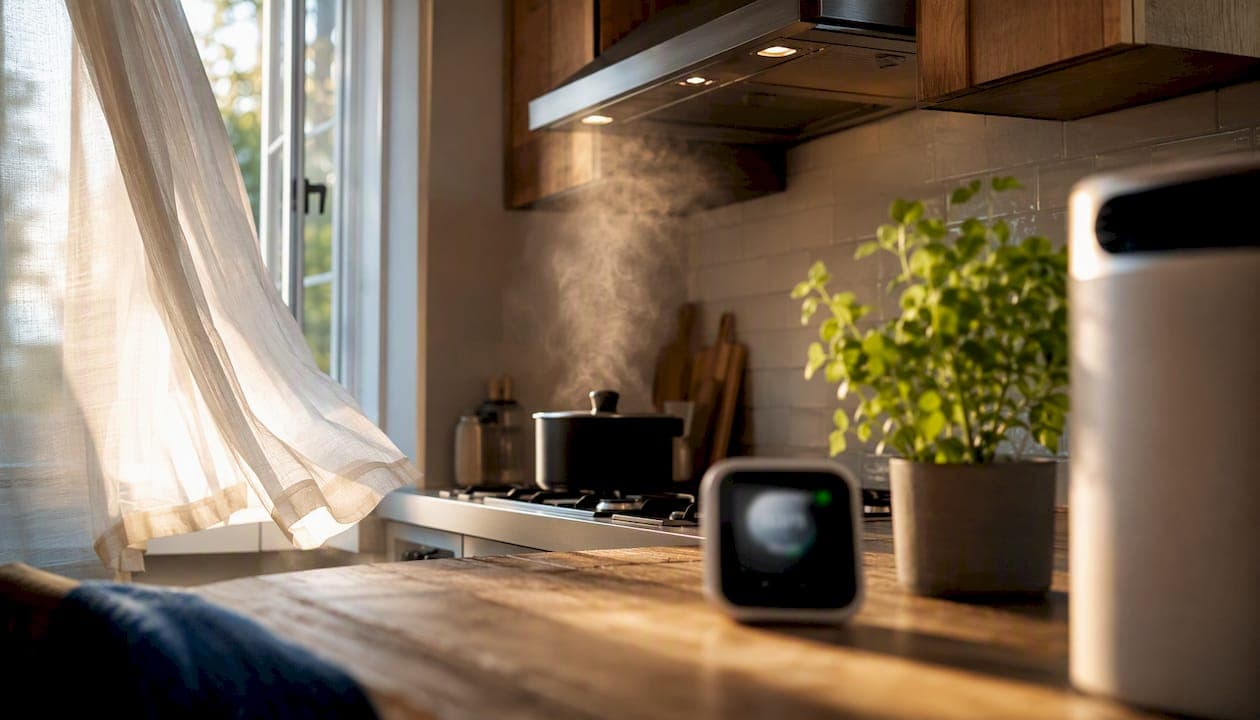
The single highest-priority move for 2026 is a three-step sequence: increase measured outdoor-air ventilation wherever outdoor conditions allow, add HEPA filtration sized correctly for the room, then verify both with a CO2 or particle sensor instead of guessing. Skip the verification step and you're flying blind on whether any of it worked.
Here's the checklist to run today, before you plan anything bigger.
- Open windows on opposite sides of a room for cross-ventilation, but only when outdoor air quality is good.
- Run kitchen and bathroom exhaust fans during and after cooking or showering.
- Place a properly sized portable HEPA unit in bedrooms, classrooms, or high-occupancy offices.
- Set a CO2 monitor in the room you use most and watch how it responds to occupancy.
Quick numeric targets: Aim for the equivalent of 4 to 6 air changes per hour in higher-risk indoor settings, and treat sustained CO2 readings well above outdoor baseline (roughly 400 to 420 ppm) as a signal that a room needs more fresh-air delivery.
Pro Tip: If a room's CO2 climbs past 1,000 ppm within the first hour of occupancy and stays there, that's your cue to schedule a professional HVAC assessment rather than adding another box fan.
Table of Contents
- Which Metrics Actually Tell You Ventilation Is Working?
- What Can You Do Today at Little or No Cost?
- How Should You Adjust and Maintain Your HVAC System?
- How Do You Size and Place a Portable Air Cleaner?
- When Does It Make Sense to Upgrade to Mechanical Ventilation?
- How Do You Verify Ventilation Is Actually Working?
- How Should You Prioritize Ventilation Fixes by Setting?
- What Do These Upgrades Cost and How Long Do They Take?
- What Does the Latest Research Say About Ventilation in 2026?
- Sources
- FAQ
Which Metrics Actually Tell You Ventilation Is Working?
Three numbers matter, and most people only track one. Air changes per hour (ACH) measures how many times the total volume of air in a room gets replaced with outdoor or filtered air in sixty minutes. CO2, measured in parts per million (ppm), works as a practical stand in for how much exhaled breath is accumulating, which makes it a solid proxy for how well fresh air is diluting what people breathe out. PM2.5 particle counts measure fine particulate matter, the stuff from smoke, dust, and combustion that penetrates deep into lungs.
Calculating ACH isn't complicated. Divide your fan or HVAC fresh-air flow rate (in cubic feet per minute) by the room volume, then multiply by 60. A 1,500 cubic foot classroom pulling 150 CFM of outdoor air gets roughly 6 ACH. That's within the range referenced by CDC guidance for higher-risk settings (CDC guidance references for higher-risk settings).
For CADR to room sizing, a portable air cleaner rated at 200 CADR handles a room up to roughly 400 square feet at a reasonable air exchange rate, per typical manufacturer sizing charts.
Target ranges by setting:
- Homes: 0.35 to 1 ACH from mechanical ventilation, supplemented by natural ventilation when possible.
- Classrooms: 4 to 6 equivalent ACH during occupied hours.
- Offices: 4+ equivalent ACH in shared spaces, higher in conference rooms with dense occupancy.
Pro Tip: A CO2 spike that drops back to baseline within 15 minutes of a room emptying out is normal. A reading that stays elevated for hours, even overnight, points to a ventilation shortfall worth fixing.
What Can You Do Today at Little or No Cost?
Rapid, cheap fixes buy you time while bigger upgrades get planned. During the COVID era, CDC's national school survey found that relocating activities outdoors and opening windows were the most commonly reported ventilation improvements among K to 12 public schools. That's strong evidence these low-cost steps are both practical and widely adopted, not theoretical.
Same-day actions:
- Open windows on two sides of a room to create cross-ventilation, provided outdoor air quality is acceptable.
- Turn on box or window fans pointed to exhaust air outward, not just circulate it in place.
- Run bathroom and kitchen exhaust fans every time you cook, shower, or clean with strong-smelling products.
- Move gatherings, exercise classes, or lunch periods outdoors when weather permits.
Within one to two weeks:
- Stagger occupancy schedules in shared spaces to reduce peak density.
- Install a CO2 monitor in each frequently used room to track baseline performance.
- Check that exhaust fans are actually venting outside, not into an attic or crawlspace.
- Inventory portable HEPA units and reposition them for better room coverage.
None of this works everywhere, though. Wildfire smoke, high outdoor pollution days, or extreme heat and cold all make open windows a bad idea. In those conditions, close up the building, run HVAC and portable filtration instead, and rely on filtered indoor air rather than fresh outdoor air. Opening windows can also drag in humidity or pollen you didn't want, which is one reason professional ventilation design accounts for pressure balance, not just fresh air volume.
Pro Tip: Check your local air quality index before deciding whether today is an open-windows day or a seal-it-up-and-filter day. The strategy should flip with conditions, not stay fixed year-round.
How Should You Adjust and Maintain Your HVAC System?
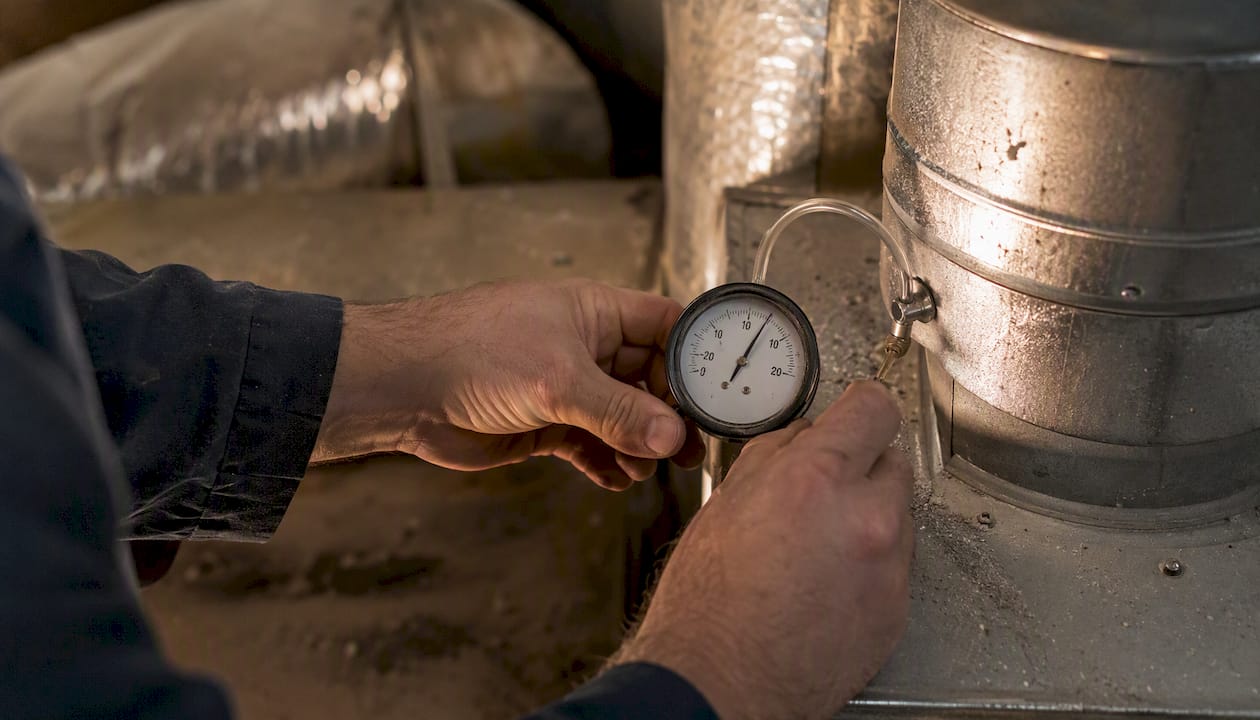
Filter selection is the fastest lever most people underuse. Harvard's Healthy Buildings researchers recommend MERV-13 filters for HVAC systems that can handle them, since that rating captures a meaningfully higher share of fine particles than the MERV 8 filters many systems ship with. Not every system can take the upgrade without strain, though. A denser filter increases static pressure, and older or undersized blowers may struggle to push air through it, which shows up as reduced airflow or a system running longer to hit the same temperature.
Operational adjustments that don't require new equipment:
- Extend fan runtime settings so air circulates and filters continuously, not just when heating or cooling cycles on.
- Verify outdoor-air dampers are actually opening on schedule. Many get stuck closed for years without anyone noticing.
- Avoid economizer settings that prioritize energy savings over fresh-air intake during moderate weather.
- Replace filters on the manufacturer's schedule, not whenever you remember.
- Schedule duct inspection when you notice inconsistent airflow between rooms or visible dust buildup at vents.
A MERV-13 upgrade paired with sealed ductwork can outperform several portable HEPA units combined, because it treats the whole building's air rather than one room at a time. That's the case for spending on the central system before buying a fleet of portables. Our guide on HVAC systems and air quality walks through routine maintenance steps that keep this working year-round. Our step-by-step filter change guide covers the mechanics of doing it correctly.
Pro Tip: Before ordering a case of MERV-13 filters, have a technician check your system's static pressure rating. If the blower can't handle the resistance, you'll lose airflow and stress the equipment instead of gaining cleaner air.
How Do You Size and Place a Portable Air Cleaner?
CADR, or Clean Air Delivery Rate, tells you how many cubic feet of filtered air a unit produces per minute for smoke, dust, and pollen specifically. A unit with a 300 smoke CADR handles a room up to roughly 600 square feet at a solid air exchange rate, though manufacturers vary in how they calculate this, so check the specific unit's rating rather than assuming a universal formula.
Sizing and placement steps:
- Measure the room's square footage and match it against the unit's CADR rating for smoke or dust, whichever matters more for your situation.
- Place the unit a few feet from a wall, away from corners where airflow gets restricted.
- Run it continuously in occupied rooms rather than switching it on and off, since particle levels rebuild quickly once it stops.
What portable filtration won't do: it doesn't touch CO2 levels. A HEPA unit can scrub particles all day while CO2 keeps climbing in a poorly ventilated room, because CO2 removal requires fresh outdoor air exchange, not filtration. Treat the two as separate problems needing separate solutions.
- Look for true HEPA certification, not "HEPA-type" or "HEPA-like" marketing language.
- Multiple smaller units often outperform one large unit in irregularly shaped spaces.
- Check filter replacement intervals before buying. Some units need new filters every three months under heavy use, which adds up in operating cost.
- Noise matters for bedrooms and classrooms; check the decibel rating at the speed you'll actually run it.
Our breakdown of HVAC filter types covers compatibility questions that apply to both central systems and portable units.
When Does It Make Sense to Upgrade to Mechanical Ventilation?
Temporary fixes have a ceiling. When CO2 stays elevated despite fans and open windows, or when a building's HVAC can't take a MERV-13 filter without choking airflow, that's the signal to move from stopgaps to mechanical upgrades.
Energy recovery ventilators (ERVs) and heat recovery ventilators (HRVs) bring in fresh outdoor air while capturing most of the energy from the air being exhausted, so you're not paying to heat or cool a constant stream of untreated outside air. Most residential forced-air systems don't mechanically introduce outdoor air at all; they just recirculate what's already inside. That's exactly the gap an ERV or HRV closes. HRVs suit colder, drier climates where moisture retention matters less. ERVs work better in humid climates because they also transfer moisture, preventing a swing toward overly damp or overly dry conditions.
A simple decision flow:
- Monitor CO2 and particle levels for at least a week to establish a real baseline, not a guess.
- If levels exceed target ranges consistently, check whether HVAC adjustments alone (filter upgrade, longer runtime) close the gap.
- If they don't, or if the ductwork can't support a denser filter, evaluate an ERV/HRV or a dedicated outdoor-air system.
Red flags that point straight to a mechanical upgrade: persistent high CO2 despite behavioral fixes, an HVAC system that can't tolerate MERV-13 due to pressure limits, or recurring moisture and mold that suggest inadequate air exchange rather than a one-off leak.
A licensed mechanical engineer or certified HVAC contractor should run the load and ventilation calculations before any retrofit gets ordered. Guessing at ERV sizing wastes money in both directions, undersized units underperform and oversized ones waste energy.
Pro Tip: Don't buy an ERV or HRV based on square footage alone. Occupancy density changes the calculation more than floor area does, and a contractor needs both numbers.
How Do You Verify Ventilation Is Actually Working?
Buying equipment without measuring results is the most common mistake in this whole process. A 2026 systematic review found that indoor air quality monitoring remains underdeveloped in practice, with many studies relying on comfort proxies like "does it feel stuffy" instead of standardized sensor data. Don't repeat that mistake at the building level.
A basic testing protocol:
- Take a baseline CO2 and PM2.5 reading in an empty room before making any changes.
- Re-test during normal occupied hours to see how much levels climb.
- If readings exceed your target range, adjust one variable (fan runtime, window position, filter) and re-test rather than changing everything at once.
- Log every result with date, occupancy count, and outdoor conditions so patterns show up over weeks, not just one snapshot.
Buy a CO2 monitor with logging capability and a stated accuracy within about 50 ppm, since cheap sensors drift significantly over months. Place it at breathing height, away from doors, windows, and direct sunlight, which all skew readings.
Classrooms warrant daily spot checks during the first month of any new intervention. Homes can get by with weekly checks once a baseline is established.
Pro Tip: A brief CO2 spike during a packed meeting isn't a problem if it drops fast once people leave. A reading that stays high overnight in an empty room means something's wrong with the baseline ventilation, not just occupancy.
How Should You Prioritize Ventilation Fixes by Setting?
Budget and urgency don't distribute evenly across a home, a school, and an office, so the priority order shifts too.
Homes: Start with kitchen and bathroom exhaust fans, then a portable HEPA unit in bedrooms, then a CO2 monitor. HVAC filter upgrades come next if the system supports MERV-13.
K to 12 schools: Classrooms need CO2 monitors first, since occupancy density is high and stays constant for hours. Add one portable HEPA unit per roughly 20 to 25 students in rooms without strong mechanical ventilation, then push HVAC runtime and filter upgrades district-wide where budgets allow.
Small offices: Shared spaces and conference rooms get priority over private offices, since density and dwell time drive most of the risk.
- Rank interventions by cost, speed of impact, and how well they scale across multiple rooms or buildings.
- Put the cheapest, fastest wins first (exhaust fans, portable units, sensors).
- Reserve capital-intensive fixes (ERV/HRV, duct redesign) for spaces where monitoring data shows a persistent gap.
Vulnerable spaces deserve to jump the queue regardless of cost ranking. Nursing stations, special-needs classrooms, and eldercare common areas house people with less physiological reserve to handle poor air quality, so those rooms should get monitors and filtration before a lower-risk conference room does, even if the conference room is cheaper to fix.
When contractor capacity or budget is limited, phase it: monitors and portables this month, HVAC filter and runtime changes next quarter, mechanical retrofits on a longer capital cycle. Facility managers juggling multiple buildings will find our commercial vent maintenance guide useful for sequencing that kind of rollout.
What Do These Upgrades Cost and How Long Do They Take?
Costs and timelines split into three tiers, and mixing them up is how projects stall.
- Same-day, low-cost: A portable HEPA unit or CO2 monitor is available and installable the day you buy it.
- One to four weeks: Filter upgrades, fan runtime adjustments, and exhaust fan repairs typically fall in this window, limited mostly by contractor scheduling rather than the work itself.
- One to six months: ERV/HRV installation, dedicated outdoor-air systems, or duct redesign require design, permitting in some jurisdictions, and equipment lead times.
Sealing gaps around doors and windows also factors into pressure balance during a retrofit. Our partner resource on how new interior doors affect energy efficiency in older homes is a useful companion read if sealing and airflow trade-offs come up during planning.
Seasonal timing matters more than most people expect. Scheduling a major HVAC retrofit in peak summer or winter often means longer contractor lead times and temporary discomfort while the system is down. Late spring or early fall tends to give more scheduling flexibility.
On energy trade-offs: ERVs and HRVs are built specifically to limit the energy penalty of fresh-air intake by recovering heat or coolness from exhaust air before it leaves the building. That's the whole point of choosing recovery ventilation over simply cranking up a standard exhaust fan, which just dumps conditioned air outside with nothing recovered.
What Does the Latest Research Say About Ventilation in 2026?
The evidence base shifted in a meaningful way this year. A 2026 scoping review of 62 studies found mechanical and hybrid ventilation systems, especially those with high-efficiency filtration, consistently delivered lower CO2 and particle levels than natural ventilation alone, along with measurable reductions in infection incidence in school settings. Natural ventilation still has a role, but it's not a substitute for mechanical systems in buildings with high or sustained occupancy.
Building owners can't wait for regulation to catch up. There's no comprehensive federal standard governing indoor air the way there is for outdoor air, which means the responsibility to upgrade filtration and verify ventilation performance falls on whoever manages the building.
That gap, described by Harvard's Healthy Buildings program, is the practical takeaway for 2026.
- Indoor air standards still lag well behind outdoor air regulation.
- Mechanical and hybrid systems outperform natural ventilation alone in most real-world conditions studied.
- Monitoring remains the weakest link industry-wide, and sensor-validated data should guide every major spending decision.
A Real-World Note on Making This Stick
The biggest pitfall I see isn't picking the wrong filter or the wrong fan. It's treating ventilation as a one-time project instead of something you check monthly. A CO2 monitor that never gets glanced at is worthless. Build a recheck into your calendar, or the upgrade you paid for quietly stops working and nobody notices for a year.
Where Airanddryerventcleaningavondale Fits Into Your Plan
If you're in Avondale and the checklist above pointed you toward a duct inspection, a filter upgrade, or an actual sensor-based air quality test rather than a guess, that's precisely where a local specialist earns their keep over a DIY approach or a generic national chain. Airanddryerventcleaningavondale handles the parts of this process that require hands-on diagnosis: air duct cleaning, dryer vent cleaning, filter replacement, duct repair and replacement, and full HVAC inspections, all sized to your actual system rather than a one-size-fits-all recommendation.
For homeowners and small business owners who want to confirm what's really happening in their ducts before spending on a bigger retrofit, our indoor air quality testing service gives you the sensor-based data this article recommends, rather than a guess. Property managers weighing a commercial-scale cleaning can start with our commercial air duct cleaning page to see what a full-building service includes. If your priority is simpler, a straightforward vent cleaning, book through our air vent cleaning service and get a technician out on a schedule that works for you, including after-hours slots.
The most effective 2026 ventilation strategy combines increased outdoor-air exchange, correctly sized HEPA filtration, and sensor-based verification rather than any single fix alone.
| Point | Details |
|---|---|
| Start with low-cost actions | Open windows when air quality allows, run exhaust fans, and use portable HEPA units before planning capital upgrades. |
| Target 4 to 6 ACH in high-risk rooms | Classrooms and dense offices should aim for this equivalent air-change rate during occupied hours. |
| Filtration alone won't fix CO2 | Portable HEPA units remove particles but do not reduce CO2; fresh-air exchange handles that separately. |
| Verify with sensors, not guesswork | Log CO2 and PM2.5 readings before and after changes since monitoring remains the weakest link industry-wide. |
| Call in professional assessment when needed | Airanddryerventcleaningavondale offers duct cleaning, filter replacement, and air quality testing for Avondale properties needing verified results. |
Sources
- Improving Indoor Air Quality | US EPA
- Simple steps for improving indoor air quality | Harvard T.H. Chan School of Public Health
- Ventilation and filtration strategies to reduce respiratory infections in schools: a scoping review
- Systematic review on indoor air quality monitoring
FAQ
What Are the Main Types of Ventilation Systems?
Buildings typically rely on natural ventilation (windows, vents), mechanical exhaust systems (bathroom and kitchen fans), mechanical supply systems, balanced systems, energy recovery ventilators (ERVs), heat recovery ventilators (HRVs), and hybrid systems combining natural and mechanical approaches.
How Can You Improve Ventilation Right Now?
Increase outdoor-air exchange by opening windows when air quality permits, run exhaust fans during cooking and showering, and add a properly sized portable HEPA unit, then verify results with a CO2 monitor.
How Do You Fix Poor Ventilation in a Building?
Start by measuring the problem with a CO2 monitor, then address the gap with increased outdoor-air intake, upgraded HVAC filtration such as MERV 13, and, if those aren't enough, a mechanical retrofit like an ERV or HRV.
How Do You Fix Poor Indoor Air Quality Overall?
Combine source control (removing pollutants at the origin), improved ventilation, and air cleaner filtration, which EPA identifies as the three core strategies for addressing indoor air problems.
When Should You Call a Professional Instead of Doing It Yourself?
Call a professional when CO2 stays elevated despite fans and open windows, when ductwork can't handle a MERV-13 filter without losing airflow, or when you need diagnostic testing; Airanddryerventcleaningavondale offers air quality testing and duct inspection for exactly this situation.