
TL;DR:
- A professional home air audit uses calibrated diagnostic tools to identify air leaks, duct losses, and ventilation issues that basic monitors cannot detect. It provides quantified data, actionable recommendations, and can qualify for tax credits, unlike DIY air quality monitors that only detect pollutants superficially. The process involves blower door testing, thermographic scanning, and detailed reports to guide targeted improvements for energy efficiency and healthier indoor air quality.
Most homeowners have heard the phrase "home air audit" but assume it means plugging in a cheap monitor from Amazon and checking a few readings. That assumption costs real money. A home air audit is a professional diagnostic process that measures how air moves through your entire house, where it leaks, and whether your ventilation is helping or hurting your indoor air quality. Understanding what this process actually involves is the first step toward fixing the hidden problems that drive up energy bills and quietly affect your family's health.
Table of Contents
- Key takeaways
- What is a home air audit and how it actually works
- Professional audits versus DIY air quality monitors
- Audit levels, pricing, and certifications
- How audit findings translate into real home improvements
- Preparing for your air audit and using the report well
- My take on why audits are worth the investment
- Improve your air quality with local professional services
- FAQ
Key takeaways
| Point | Details |
|---|---|
| Audits go far beyond monitors | Professional audits measure leakage, duct losses, and ventilation rates that consumer devices simply cannot detect. |
| Blower door testing is the core diagnostic | This pressurization test produces ACH50 data that drives every air sealing and ventilation recommendation. |
| Certified auditors unlock tax credits | Only audits performed by a certified home energy auditor qualify for the federal 25C tax credit. |
| Typical cost is $250 to $650 | Level 2 audits are the standard recommendation and include duct leakage testing and blower door results. |
| Audit findings guide real improvements | Recommendations typically cover air sealing, insulation upgrades, duct repairs, and HVAC adjustments. |
What is a home air audit and how it actually works
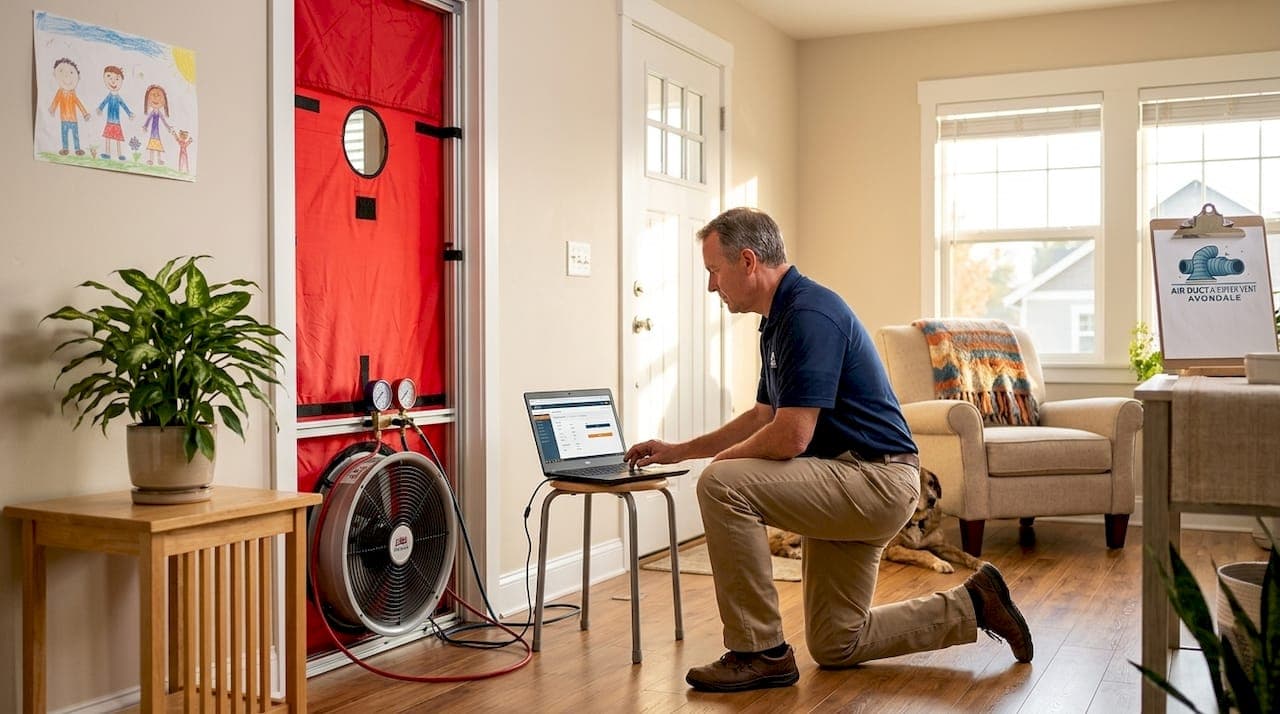
A home air audit, also called a home energy assessment or home ventilation assessment, is a structured professional inspection that identifies exactly where your home loses conditioned air, where pollutants enter the living space, and whether your ventilation system is functioning as designed. It is not a visual walkthrough. It is a data-collection process that uses calibrated diagnostic equipment to measure what you cannot see.
Professional home energy assessments combine a room-by-room walkthrough with a review of your utility bills to identify patterns before any testing begins. Auditors look at insulation levels, window and door conditions, HVAC equipment age, and any obvious moisture or air quality concerns. That context sets up the diagnostic phase.
The core diagnostic tools
The tools used in a professional audit are what separate it from any home air quality check you can do on your own.
- Blower door test. A calibrated fan mounts in an exterior doorway and depressurizes the entire house. Blower door results are reported as air changes per hour at 50 Pascals (ACH50), giving the auditor a precise measurement of how tight or leaky the building envelope is. This number informs every air sealing and ventilation decision that follows.
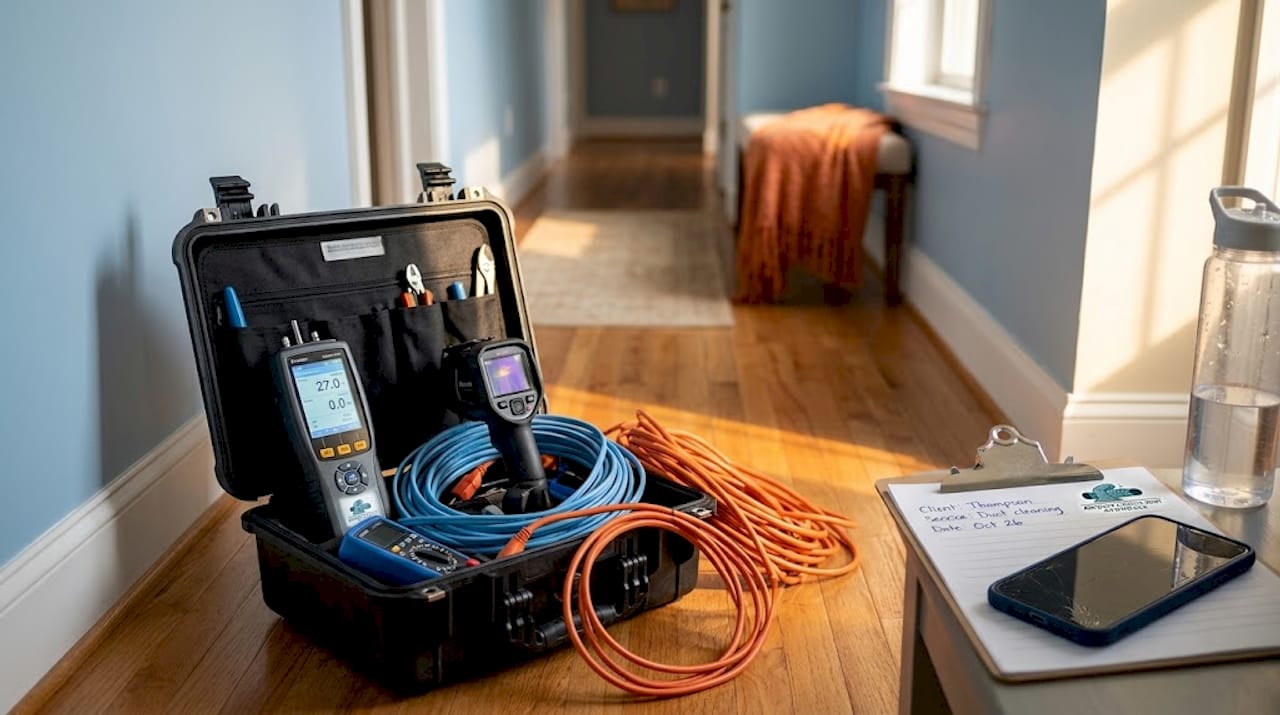
- Thermographic scanning. Infrared cameras reveal temperature differences in walls, ceilings, and floors, showing exactly where insulation is missing or where air is infiltrating.
- Duct leakage testing. The duct system is tested separately from the home envelope. Separating duct leakage from whole-house leakage is critical because treating them as the same problem leads to ineffective fixes.
- Combustion safety testing. Auditors check gas appliances and water heaters for backdrafting, which can push carbon monoxide into living areas.
- Ventilation assessment. The auditor measures actual airflow rates and compares them to ASHRAE standards for your home's size and occupancy.
The full picture these tools create is what makes a professional air quality assessment at home genuinely useful. You get quantified data, not opinions.
Pro Tip: Ask your auditor for the raw blower door number (ACH50) before they give you recommendations. If they cannot or will not share that number, you are not getting a complete audit.
Professional audits versus DIY air quality monitors
This is where a lot of homeowners get genuinely surprised. Consumer-grade air quality monitors are real products with real value, but their purpose is monitoring, not diagnosing. Understanding the difference saves you from making expensive home improvement decisions based on incomplete data.
What monitors actually measure
Consumer monitors typically track a subset of indoor pollutants: particulate matter (PM2.5), carbon dioxide, volatile organic compounds (VOCs), temperature, and humidity. Some higher-end models add radon or carbon monoxide detection. That coverage sounds thorough until you understand what it leaves out.
Consumer-level monitors vary widely in accuracy, pollutant detection, and real-time responsiveness. Comparative testing shows that some models fail to detect unhealthy particulate levels quickly, or at all. You might be breathing air that exceeds safe PM2.5 thresholds while your monitor shows a green light.
More importantly, a monitor tells you that a problem exists. It does not tell you where the problem originates, why it is happening, or what to do about it. That gap is where professional audits do their work.
| Feature | DIY air quality monitor | Professional home air audit |
|---|---|---|
| Detects PM2.5 and CO2 | Yes | Yes |
| Measures home envelope leakage | No | Yes (blower door) |
| Identifies duct losses | No | Yes (duct leakage test) |
| Provides ventilation rate data | No | Yes (airflow measurement) |
| Combustion safety assessment | No | Yes |
| Produces a repair roadmap | No | Yes (written report) |
Many homeowners mistakenly believe monitors are sufficient to diagnose air quality issues. A monitor is a useful tool for ongoing awareness. It is not a substitute for a diagnostic audit that measures the actual mechanics of how air moves through your home.
Audit levels, pricing, and certifications
Not all home air audits are created equal, and the level you choose determines both what you learn and what you pay. Knowing the structure beforehand helps you ask the right questions and avoid paying for an audit that does not cover what you actually need.
The three audit levels
Level 1 is a basic walkthrough and utility bill analysis. An auditor identifies obvious areas of concern and provides general recommendations without diagnostic testing. It is useful as a starting point but does not produce the quantified data needed for serious improvements.
Level 2 is the standard recommendation for most homeowners. It includes everything in Level 1 plus blower door testing, duct leakage testing, thermographic scanning, and a detailed written report with prioritized recommendations. Level 2 audits are also required for qualification under federal tax incentive programs. This is what most people mean when they talk about a professional home energy efficiency audit.
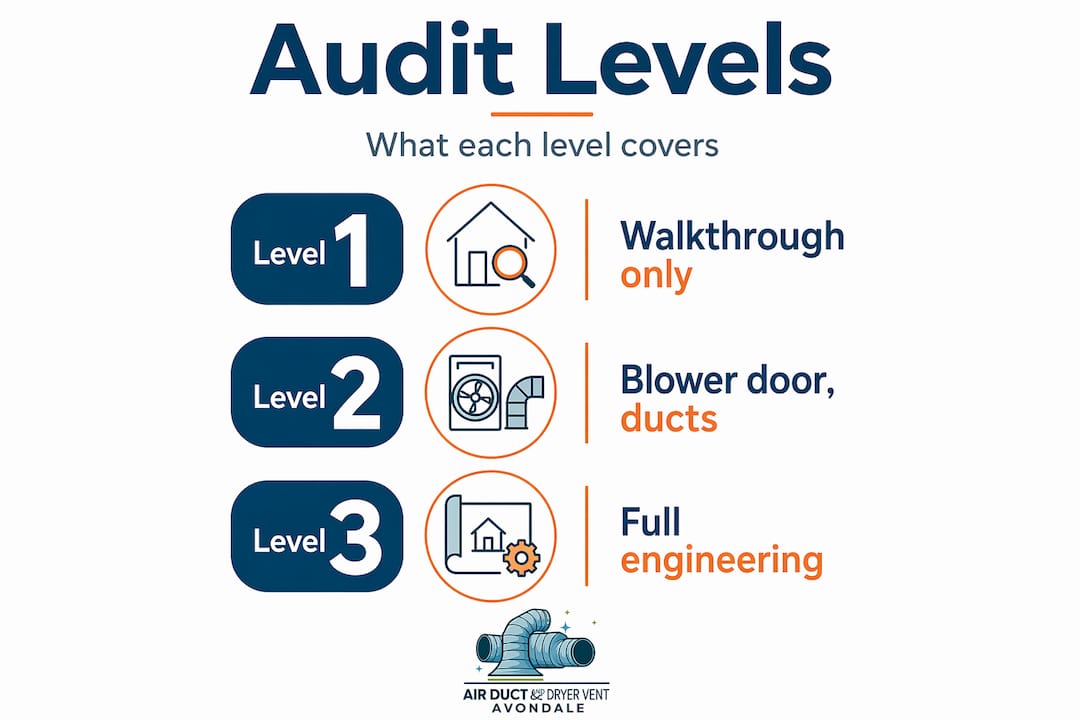
Level 3 adds invasive inspection, detailed engineering analysis, and advanced equipment testing. It is primarily used for commercial properties or large residential projects with complex HVAC systems.
What you should expect to pay
Typical home energy audits cost between $250 and $650 in 2026, with the national average sitting around $437. The price varies based on your home's square footage, the audit level you choose, and the scope of testing your contractor includes. Larger homes and older construction typically fall at the higher end.
| Audit level | What is included | Typical cost range |
|---|---|---|
| Level 1 | Walkthrough, utility bill review, general recommendations | $100 to $200 |
| Level 2 | Blower door, duct leakage testing, thermographic scan, full report | $250 to $650 |
| Level 3 | Advanced engineering analysis, invasive inspection, full HVAC diagnostics | $700 and above |
Why certification matters
Certification is not just a credential. Only certified home energy auditors qualify for federal 25C tax credit eligibility, which can offset a significant portion of your audit cost. Look for auditors certified through RESNET (Rater Energy Services Network), BPI (Building Performance Institute), or the HERS rating system. Hiring an uncertified contractor may save you fifty dollars upfront and cost you hundreds in lost tax credits.
Pro Tip: Before scheduling any audit, ask the contractor which certification they hold and whether they can document your audit results in a format accepted for the federal 25C credit. A qualified auditor will answer both questions immediately.
How audit findings translate into real home improvements
The audit report you receive is not a document to file away. It is a prioritized action plan. Understanding how the findings connect to specific improvements helps you make smarter decisions about which projects to tackle first and which upgrades actually address the problems your home has.
Here is how a typical audit's recommendations break down, from highest-impact to maintenance-level fixes:
- Whole-home air sealing. Gaps around pipes, electrical boxes, and attic hatches are the most common leakage sources. Sealing these before adding insulation is the highest-leverage improvement most homes can make.
- Insulation upgrades. Once air sealing is complete, adding or improving insulation retains the gains. Attics are the most common priority, especially in older homes where original insulation has settled or degraded.
- Duct sealing and insulation. Even with a tight building envelope, leaky ducts waste 20 to 30% of conditioned air, undermining your HVAC's performance no matter how new the equipment is.
- Moisture and mold remediation. Auditors frequently uncover moisture intrusion in crawl spaces, basements, and around HVAC equipment. Addressing these sources directly improves both air quality and structural integrity.
- HVAC efficiency adjustments. The audit may reveal that your system is oversized, undersized, or operating outside its designed parameters. Recalibration or targeted repairs often deliver significant gains without equipment replacement.
- Mechanical ventilation decisions. Air leakage and ventilation are interconnected. Tightening a home without balancing its ventilation can trap pollutants and moisture indoors. The audit tells you exactly whether your home needs added mechanical ventilation, such as an energy recovery ventilator, and at what airflow rate.
"Professional home energy assessments provide a data-driven roadmap for comfort and savings, emphasizing measured building performance over guesswork." — U.S. Department of Energy
The best use of an audit report is to share it with any contractor you hire for improvements. The quantified data gives contractors specific targets to meet, making it far easier to verify whether the work actually solved the problem.
Learning how HVAC systems improve air quality and efficiency alongside your audit findings helps you connect the diagnostic results to the mechanical systems that move air through your home every day.
Preparing for your air audit and using the report well
Getting the most from a home air audit starts before the auditor arrives. A few hours of preparation can make the process faster, more accurate, and significantly more useful.
Before the auditor arrives
- Gather 12 to 24 months of utility bills. Auditors use consumption patterns to identify seasonal loss trends that on-site testing alone may not reveal.
- Make sure all areas of your home are accessible: attic hatches, crawl space entries, utility rooms, and any storage areas adjacent to exterior walls.
- Note any comfort complaints you have noticed, such as rooms that stay too hot or too cold, drafts near windows, or recurring condensation on walls. These observations help the auditor focus diagnostic time where it matters most.
- If you have had any water intrusion, mold remediation, or HVAC work done recently, have the paperwork available.
During the audit
Stay present if you can. Auditors can explain what they are seeing in real time, and your input about how the home actually performs is genuinely useful data. Ask questions when you do not understand a reading or a recommendation. A good auditor will explain ACH50 numbers, duct pressure results, and ventilation calculations in plain terms.
Pro Tip: Take photos of the thermographic scan images if your auditor shares them on-site. These visuals make it much easier to explain the problem areas to insulation or sealing contractors later.
Reading and acting on your report
When the written report arrives, focus first on the items flagged as high-priority. These are typically the measures with the shortest payback period given your current energy costs. Review best practices in air quality testing to understand what benchmarks you are working toward after improvements are made.
One common mistake is acting on the most expensive recommendation first because it sounds most significant. Start with air sealing. It is almost always the cheapest improvement, the one with the fastest payback, and the prerequisite that makes every other improvement work better.
My take on why audits are worth the investment
I have seen homeowners spend $8,000 on new HVAC equipment when a $400 audit would have shown them that their real problem was duct leakage. The equipment runs better, sure, but it is still conditioning air that escapes into the attic before reaching the living room. That is a frustrating outcome that a blower door test and duct leakage measurement would have prevented.
What surprises most people is how complex their home's air systems actually are. You have the building envelope, the duct network, combustion appliances, exhaust fans, and natural infiltration all interacting at once. An HVAC tune-up checks the equipment. An audit checks the whole system. Those are very different evaluations.
In my experience, the audits that pay for themselves fastest are not in the most inefficient homes. They are in homes that have already had some upgrades but still show high energy use. That disconnect almost always points to duct losses or ventilation imbalance that no amount of new insulation can fix. The audit finds it. The targeted fix solves it. And the energy bills show the difference within one billing cycle.
The other thing I have come to believe strongly: indoor air quality and energy efficiency are not separate goals. They are the same goal. A tight, well-ventilated, properly ducted home uses less energy and has better air. An audit is the only diagnostic tool that addresses both at the same time. That is genuinely useful. Not just reassuring. Genuinely useful.
— Shaun
Improve your air quality with local professional services
If your audit report points to dirty ductwork, debris buildup, or ventilation gaps as contributing factors, professional cleaning is the logical next step. At Airanddryerventcleaningavondale, our team works directly alongside audit findings to target the specific problem areas your report identifies.
Our air duct and vent cleaning service removes the accumulated dust, allergens, and debris that restrict airflow and degrade the air quality your audit was designed to improve. We also offer professional air quality testing for homeowners who want verified baseline data before or after any cleaning or sealing work. If your audit flagged dryer vent conditions as a safety concern, our dryer vent cleaning service in Avondale, AZ addresses that directly. Flexible scheduling, after-hours availability, and service warranties mean you can act on your audit findings without disrupting your week. Reach out to Airanddryerventcleaningavondale to connect your audit roadmap to professional results.
FAQ
What is included in a home air audit?
A professional home air audit typically includes a room-by-room walkthrough, blower door testing, duct leakage testing, thermographic scanning, combustion safety checks, and a written report with prioritized recommendations. Level 2 audits are the standard for homeowners seeking comprehensive diagnostics.
How long does a home air audit take?
Most Level 2 home air audits take between two and four hours depending on the size of the home and the scope of testing included. Larger homes or those with complex HVAC systems may require additional time.
Can a home air audit lower my energy bills?
Yes. Audit findings typically lead to air sealing and duct repairs that directly reduce energy losses. The DOE notes that audit-driven improvements such as air sealing and insulation upgrades consistently lower utility bills and improve comfort.
Is a home air audit worth it for a newer home?
Newer homes can still have significant duct leakage, ventilation imbalances, and construction-related air gaps. An audit provides quantified data regardless of home age, and the federal 25C tax credit helps offset the cost for qualifying homeowners.
What is the difference between a home air audit and a regular HVAC inspection?
An HVAC inspection checks the mechanical performance of your heating and cooling equipment. A home air audit measures the entire building system, including the envelope, ducts, ventilation rates, and combustion safety. The two assessments address different problems and are most effective when used together.