
TL;DR:
- A dryer vent booster fan is installed inside the duct to improve airflow on long or complex runs. Only UL-705 listed DEDPV units with safety features should be used to prevent fire hazards. Proper installation and regular maintenance are essential to ensure safety and effectiveness.
A dryer vent booster fan is an inline exhaust fan installed inside your dryer ductwork to maintain airflow through runs that are too long or too complex for the dryer alone to push air through effectively. The industry-standard version is called a Dryer Exhaust Duct Power Ventilator, or DEDPV, and the safety benchmark to know is DEDPV-705 — a UL-705 supplemental listing that separates genuinely safe units from generic duct fans.
For Avondale homeowners and business owners, the short version is this:
- A booster fan can be necessary and safe, but only on a clean duct with a properly listed DEDPV unit.
- If drying times are long or your duct run is complex, the first call is a professional inspection and cleaning, not a fan purchase.
- Airanddryerventcleaningavondale performs camera inspections, airflow testing, and professional duct cleaning in Avondale before any booster recommendation is made.
Safety note: A booster fan installed on a clogged or damaged duct is a fire hazard, not a fix. Clean the duct first, every time.
Table of Contents
- How does a dryer vent booster fan work?
- Who typically needs a booster fan, and what are the signs?
- What types of booster fans exist, and which safety standards matter?
- What does installation involve, and how often should you maintain it?
- Common misconceptions and the real risks of booster fans
- When should you call a pro in Avondale, and what does the inspection include?
- Key Takeaways
- The part most homeowners skip until something goes wrong
- Ready to get your dryer vent inspected in Avondale?
- Useful sources
- FAQ
How does a dryer vent booster fan work?
Think of the booster as a relay station. Your dryer's internal blower pushes hot, moist, lint-laden air down the duct. Over a long run, that push loses momentum, and airflow velocity drops below what's needed to carry lint all the way to the exterior termination. The booster fan picks up the slack mid-run, maintaining velocity so lint and moisture keep moving outward instead of settling in the duct walls.
The fan doesn't run manually. DEDPV units use either a pressure switch or a current-sensing relay to detect when the dryer starts, energize automatically, and then run a short purge cycle after the dryer shuts off to clear residual moisture.
Why duct length and bends matter:
- Standard residential dryers are sized for roughly 25 feet of straight rigid duct.
- Each 90-degree elbow adds approximately 5 equivalent feet of resistance to that total.
- A run with three elbows and 20 feet of straight duct already exceeds the dryer's design limit.
- Some dryer installation instructions and local building codes require a booster when equivalent length exceeds 25–35 feet depending on the number of bends.
Physical placement rules:
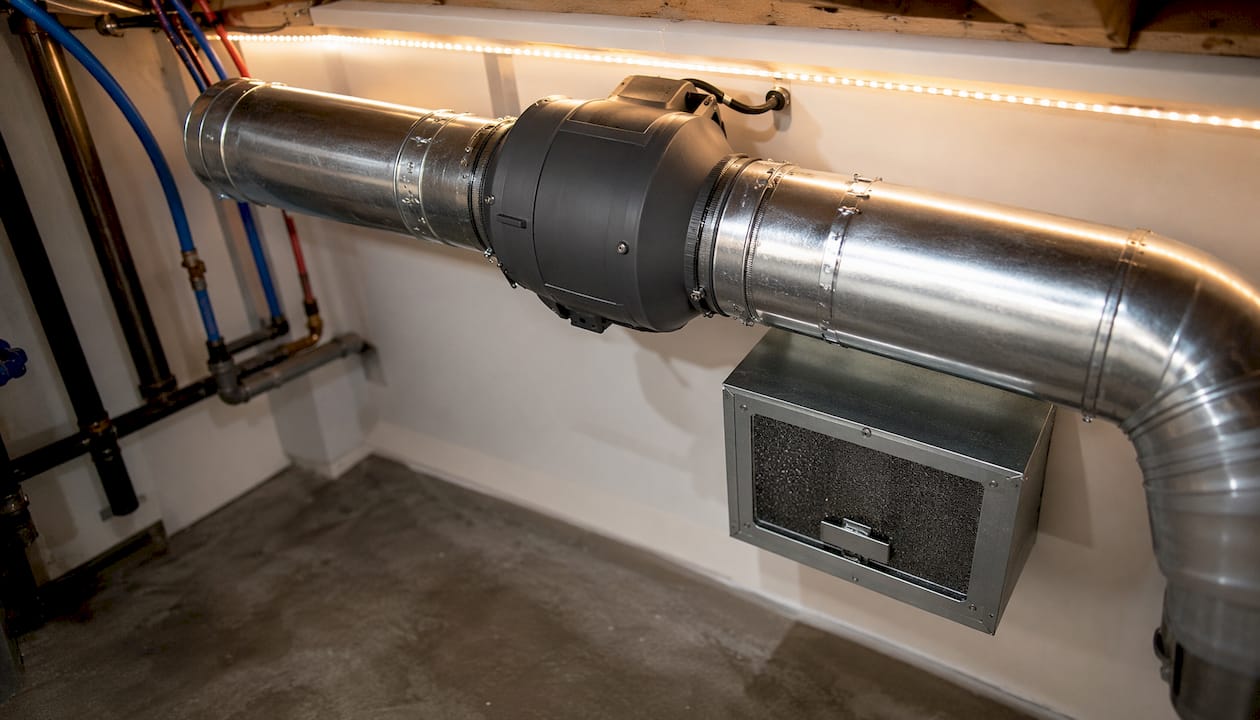
- Install only in rigid metal ductwork, never in flexible foil or plastic.
- Position the booster 5–15 feet from the dryer outlet so wet lint doesn't get pulled directly into the impeller.
- Seal all duct connections at the booster to prevent exhaust leaking into attic or wall cavities.
- Confirm the booster's rated run length covers your total equivalent footage before purchasing.
Who typically needs a booster fan, and what are the signs?
Not every dryer needs one. A short, straight run to an exterior wall doesn't benefit much from a booster. But certain setups almost always do.
Common situations that call for a booster:
- Second-floor laundry rooms with long vertical duct runs
- Homes where the laundry room sits far from an exterior wall
- Duct runs with multiple elbows or sharp turns
- Commercial laundries, laundromats, and multifamily buildings with shared or extended duct paths
Signs your current run may be underperforming:
- Drying cycles consistently run longer than your dryer manual's estimated times
- Lint visible around the exterior vent termination cap
- Condensation or moisture staining inside the attic or on duct surfaces
- The dryer exterior feels unusually hot during a cycle
- You're scheduling duct cleanouts more frequently than once a year
Pro Tip: Never add a booster fan before a professional duct cleaning. Installing a booster on a clogged run pushes lint into the fan housing, shortens the fan's life, and raises fire risk. Clean the duct first, then evaluate whether a booster is actually needed.
What types of booster fans exist, and which safety standards matter?
There are two categories, and the difference between them is significant.
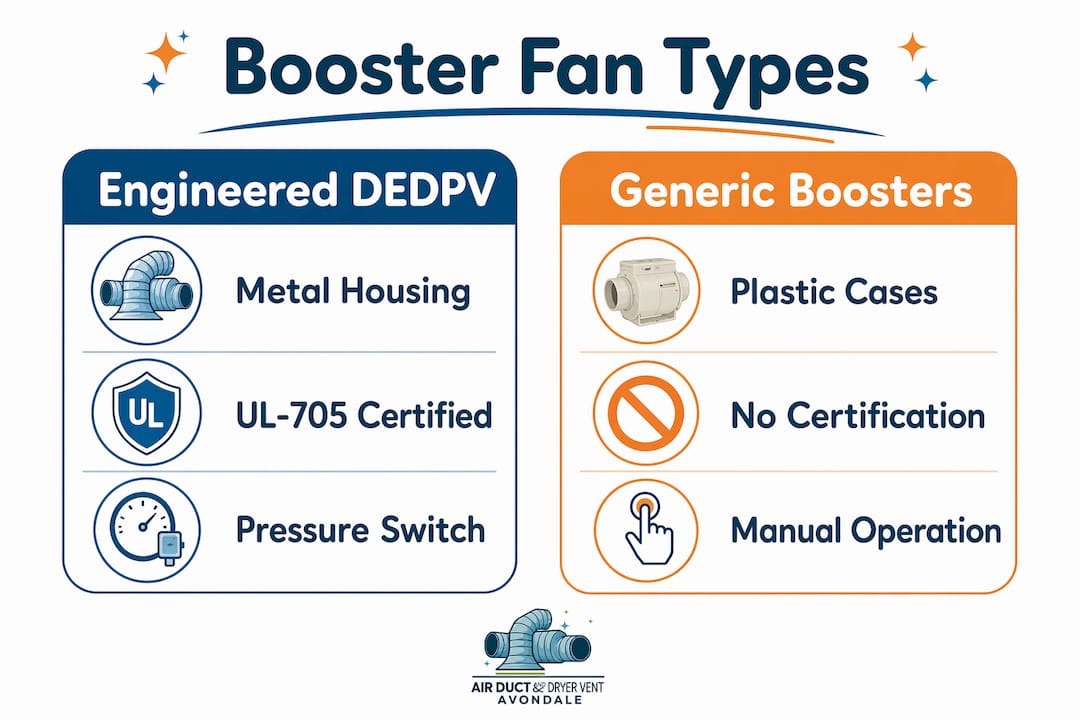
Engineered DEDPVs (DEDPV-705 / UL-705 supplement) are purpose-built for dryer exhaust. They feature metal housings, pressure or current-sensing interlocks, automatic shutoff on overtemperature or locked-rotor events, and indicator panels or fault lights that show homeowners whether the fan is operating correctly. Fantech, a leading HVAC specialist in this space, cites DEDPV units rated effective up to 125 linear feet of 4-inch rigid duct.
Generic duct booster fans are designed for simple air movement, not for lint and moisture. They lack safety shutoffs, use plastic or lightweight housings, and can clog, overheat, or fail without any alert. The industry has been moving away from these for dryer applications precisely because of the fire risk they carry.
Safety features to insist on:
- UL/ETL listing to the DEDPV-705 standard
- Metal housing rated for dryer exhaust temperatures
- Pressure-sensing or current-sensing interlock (automatic on/off with the dryer)
- Automatic shutoff on overtemp or locked-rotor conditions
- Wall-mount indicator panel or LED fault light
Safety callout: Some dryer manufacturers specify in their installation instructions that only listed booster units may be used on extended runs. Using an unlisted fan can void the dryer warranty and violate local code. Always check the dryer manual and confirm with your local building department before purchasing.
What does installation involve, and how often should you maintain it?
Installation is more involved than plugging in a fan. A proper DEDPV installation requires electrical work, duct modifications, and in some jurisdictions, a permit.
Installation essentials a pro will verify:
- Confirm the full equivalent-length calculation and select a DEDPV model rated for that footage.
- Mount the unit in rigid metal duct, 5–15 feet from the dryer outlet, secured to a joist or stud.
- Wire the interlock correctly (pressure switch calibration or current-sensing relay connection).
- Seal all duct joints with foil tape to prevent leaks into the attic or wall cavity.
- Install a wall-mount indicator panel near the dryer so you can verify operation at a glance.
- Run a post-install airflow (CFM) test to confirm the system meets design specs.
Check your local building codes and dryer manufacturer limits before finalizing the model. Some municipalities require a permit for the electrical work involved.
Maintenance schedule:
- Inspect the fan impeller every 6 months under normal use; heavy-use households or commercial operations may need quarterly checks.
- Verify the interlock triggers correctly at each inspection.
- Test airflow and temperature cutouts annually.
- Clear any lint accumulation from the impeller housing at each visit.
Pro Tip: Label the booster fan's location and set a calendar reminder for annual maintenance. A fan that fails silently on a long run leaves the dryer exhausting into a restricted duct, which is exactly the condition you installed the booster to prevent.
Common misconceptions and the real risks of booster fans
The biggest misconception is that a booster fan is part of the dryer. It isn't. It's a permanently installed ventilation component that needs its own maintenance and electrical safety checks, just like any other exhaust fan in your home.
Other myths and real hazards:
- "Any duct fan will work." Non-listed fans lack safety shutoffs and can clog or overheat without warning.
- "A booster fixes a clogged vent." It doesn't. It accelerates lint buildup in the fan housing and can spread a fire if it lacks an overtemp shutoff.
- "Installing one won't affect my dryer warranty." Using an unapproved fan can void the manufacturer warranty.
A failing booster produces the same symptoms as a restricted duct: extended drying times, elevated dryer temperatures, and sudden performance drops. Many homeowners blame the dryer itself and call an appliance repair tech, when the real problem is a seized or lint-clogged booster impeller. If drying times return after a period of normal operation, inspect the booster before anything else.
When should you call a pro in Avondale, and what does the inspection include?
If your run exceeds manufacturer limits, drying times are long, or you're considering a booster installation, a professional evaluation is the right starting point. A full professional evaluation covers more ground than a visual check.
What Airanddryerventcleaningavondale's inspection includes:
- Camera inspection of the full duct run to identify blockages, damage, or improper materials
- Equivalent-length calculation to determine whether a booster is actually needed
- CFM/airflow testing to measure current performance against design specs
- Visual check for lint accumulation, moisture staining, and termination condition
- Evaluation of duct material (rigid metal vs. flexible foil or plastic)
- Professional cleaning before any booster recommendation is finalized
- Written report with findings and a clear recommendation
Pro Tip: Ask for a wall-mount indicator panel and a written maintenance plan with any booster installation. Get permits if local code requires them. A written plan protects you if a warranty question arises later.
Key Takeaways
A dryer vent booster fan is only safe and effective when the duct is clean and the unit meets DEDPV-705/UL-705 standards with proper interlocks and failure indicators.
| Point | Details |
|---|---|
| Clean the duct first | Installing a booster on a clogged run accelerates lint buildup and raises fire risk. |
| Use a listed DEDPV unit | Only DEDPV-705/UL-705 listed fans include the metal housing, interlocks, and shutoffs dryer exhaust requires. |
| Know your run limits | Standard dryers are sized for roughly 25 feet of straight duct; each 90-degree elbow adds about 5 equivalent feet. |
| Inspect every 6 months | Inspect the impeller every 6 months; heavy-use properties may need quarterly checks. |
| Airanddryerventcleaningavondale | Provides camera inspection, airflow testing, professional cleaning, and booster-ready evaluations for Avondale properties. |
The part most homeowners skip until something goes wrong
The industry conversation has shifted clearly toward DEDPV-705 units, and for good reason. Generic duct boosters are cheap and widely available, but they were never designed for dryer exhaust. Lint is not dust. The temperatures involved are not trivial. A fan that lacks an overtemp shutoff in a lint-laden duct is a combination that has caused house fires.
What I see repeatedly in Avondale is a specific pattern: a homeowner installs a generic booster to solve long drying times, the fan works for a season, then quietly fails. Because there's no indicator panel, nobody notices. The dryer keeps running against a restricted duct for months, running hot, wearing out faster, and accumulating lint at the fan housing. By the time someone calls for service, the duct needs a full cleaning and the fan needs replacement.
The fix is straightforward: clean first, use a listed DEDPV with an indicator panel, and schedule maintenance on a calendar. The indicator panel is the detail most people skip because it adds a small cost. It's also the detail that tells you, without any guesswork, whether the fan protecting your home is actually running.
Ready to get your dryer vent inspected in Avondale?
Airanddryerventcleaningavondale handles the full process for residential and commercial properties in Avondale: professional dryer vent cleaning, camera inspections, CFM airflow testing, and booster-ready evaluations that tell you exactly whether your run needs a DEDPV and which model fits your footage. For business owners managing laundromats or multifamily properties, the team also covers commercial duct cleaning and ongoing maintenance plans.
Scheduling is flexible, including after-hours appointments, and every job comes with a written report and warranty. Call or book online to get a cleaning and a booster-ready assessment for your Avondale property.
Useful sources
- DEDPVs vs. Duct Boosters: What Builders Need to Know — Fantech: DEDPV-705 safety features, pressure-sensing logic, and failure alerts.
- Clothes Dryer Exhaust Vent Draft Booster Fans — Inspectapedia: Placement rules, maintenance intervals, and code references.
- Dryer Vent Cleaning Guide for Safe and Efficient Homes — MDTech Services: Professional inspection workflow and cleaning-first protocols.
- Check your dryer's installation manual for the manufacturer's maximum equivalent-length limit and any booster-fan requirements specific to your model.
- Contact your local Avondale building department to confirm permit requirements for booster fan electrical work.
FAQ
What is a dryer vent booster fan?
A dryer vent booster fan is an inline exhaust fan installed in the dryer ductwork to maintain airflow through long or complex duct runs. The safety-rated version is called a DEDPV (Dryer Exhaust Duct Power Ventilator), listed to the DEDPV-705/UL-705 standard.
How does a dryer vent booster fan work?
The fan uses a pressure switch or current-sensing relay to detect when the dryer starts, then runs automatically to maintain exhaust velocity through the duct, and purges briefly after the dryer cycle ends.
Do I need a booster fan for my dryer?
You likely need one if your duct run exceeds roughly 25 equivalent feet of straight duct, includes multiple elbows, or runs vertically for a significant distance. Long drying times and lint at the exterior termination are the clearest signs.
Can I install a dryer vent booster fan myself?
Installation involves electrical wiring, duct modifications, and in some areas a permit. Most manufacturers and HVAC professionals recommend hiring a qualified technician to handle placement, interlock wiring, and post-install airflow verification.
How often should a dryer vent booster fan be inspected?
Inspect the impeller and interlock every 6 months. Heavy-use households or commercial properties may need quarterly checks. Airanddryerventcleaningavondale includes booster inspection as part of its maintenance plans for Avondale properties.