

TL;DR:
- Flexible ductwork is a cost-effective solution for HVAC air distribution in tight or retrofit spaces, made from layers including a plastic liner, wire coil, insulation, and vapor barrier. Proper installation, support, and insulation are essential for optimal performance, while poor practices significantly reduce efficiency and durability. Using the correct R-value and sealing connections ensure energy savings and reliability, especially in hot climates where insulation and vapor barriers are critical.
Flexible ductwork is a type of HVAC ducting made from a helically wound wire coil covered with a flexible plastic liner, insulation, and a vapor barrier jacket, designed to distribute conditioned air through spaces where rigid metal duct would be impractical. The industry term is "flexible air duct" or simply "flex duct," and it appears in the vast majority of residential HVAC systems built in the last three decades. Understanding what is flexible ductwork, how it works, and where it performs best gives you a real advantage when planning, installing, or maintaining any forced-air system. Get the construction and installation details right, and flex duct performs on par with rigid alternatives at a fraction of the cost.
What is flexible ductwork made of?
Flexible ductwork is a layered product, and each layer has a specific job. Strip one away and the whole system suffers. Here is what you are actually looking at when you unroll a section of flex duct:
- Inner plastic liner. This is the air and vapor barrier. It is the only layer that actually contains the airflow. According to HVAC School, damage to the inner liner leads directly to air leakage and mold risk because the insulation layer does not block air or moisture on its own.
- Helically wound metal wire frame. A spring-like coil of galvanized steel wire wraps around the inner liner. This coil is what gives flex duct its shape and allows it to bend without collapsing. Without it, the liner would flatten under negative pressure from the blower.
- Insulation layer. Fiberglass batting or mineral wool wraps around the wire frame. This layer controls heat transfer between the conditioned air inside and the unconditioned space outside, such as an attic or crawl space. R-value ratings of R-4.2, R-6, and R-8 are the most common options.
- Outer vapor barrier jacket. A metalized film or reinforced plastic jacket wraps the insulation. This layer prevents ambient moisture from soaking into the fiberglass, which would destroy its insulating value over time.
The jacket color is not cosmetic. Silver vapor barrier jackets reflect solar heat and reduce heat gain, while black jackets absorb heat, which can reduce condensation risk by warming the duct surface. Contractors in hot, dry climates like Avondale, Arizona typically favor silver jackets to limit heat gain in unconditioned attics. Contractors in humid climates sometimes choose black jackets to keep duct surfaces warmer and reduce sweating.
Pro Tip: Always inspect the inner liner before installation. A single puncture or tear compromises the entire air seal, and you will not find it again once the duct is tucked into a ceiling cavity.
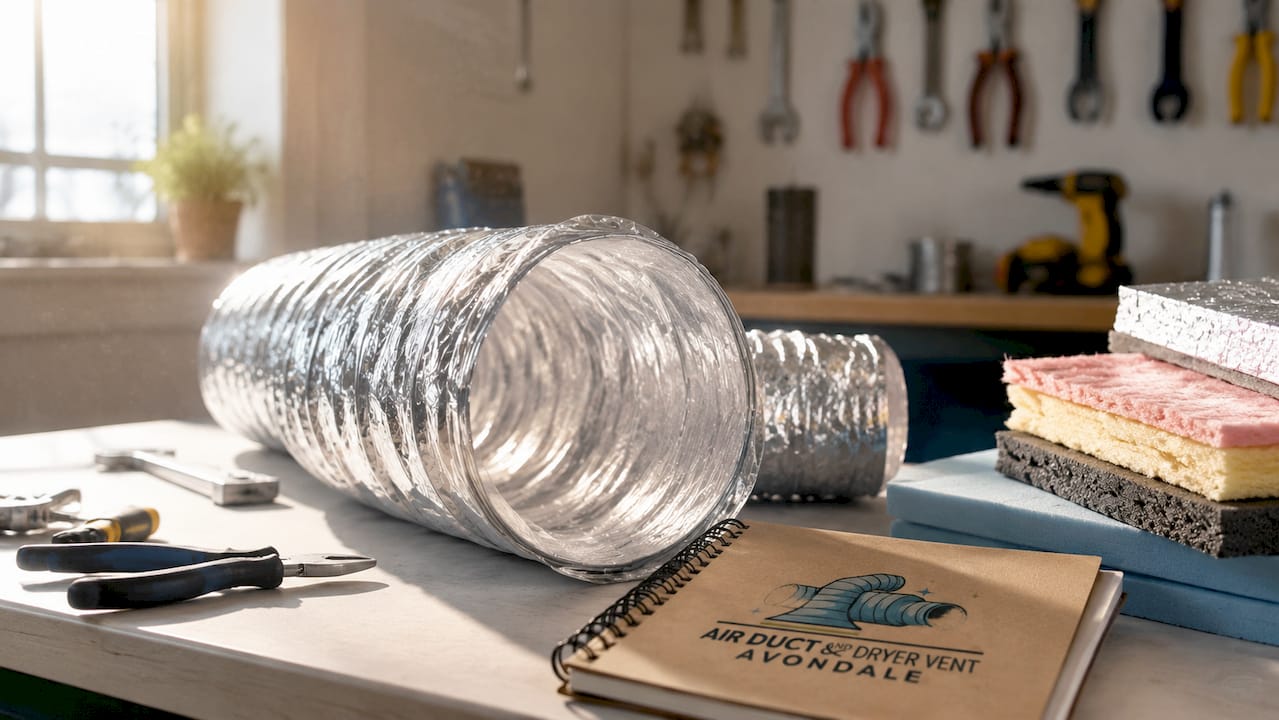
The outer jacket must also remain intact after installation. Contractors select jacket color based on environmental moisture challenges to minimize condensation on duct surfaces. This is a detail most homeowners never consider, but it directly affects long-term durability and indoor air quality.
Flexible vs. rigid ductwork: cost, installation, and performance
Choosing between flex duct and rigid sheet metal is one of the first decisions in any HVAC duct design. The right answer depends on your budget, your space, and how much you care about long-term airflow efficiency.
Cost comparison
Flexible ductwork costs between $1 and $4 per linear foot, compared to $7 to $13 per linear foot for rigid metal ductwork. That is a 60–80% cost difference per linear foot. For a typical residential system with 200 linear feet of duct, the material savings alone can reach $1,200 to $1,800.
Installation advantages
Flex duct installs faster in tight spaces, attics, and around structural obstacles. A contractor can route a flex duct run around a ceiling joist in seconds. The same path in rigid sheet metal requires custom fabrication, additional fittings, and significantly more labor time. Flexible ducts are often used for short drops near air diffusers and in retrofits where rigid ducts are impractical, which highlights versatility as a core advantage.
Performance trade-offs
Rigid metal duct has lower friction resistance and maintains a perfectly round cross-section, which maximizes airflow. Flex duct, by contrast, has a corrugated inner surface that creates more friction. Any compression or sag increases that friction further. This is the trade-off you accept for the cost and installation savings.
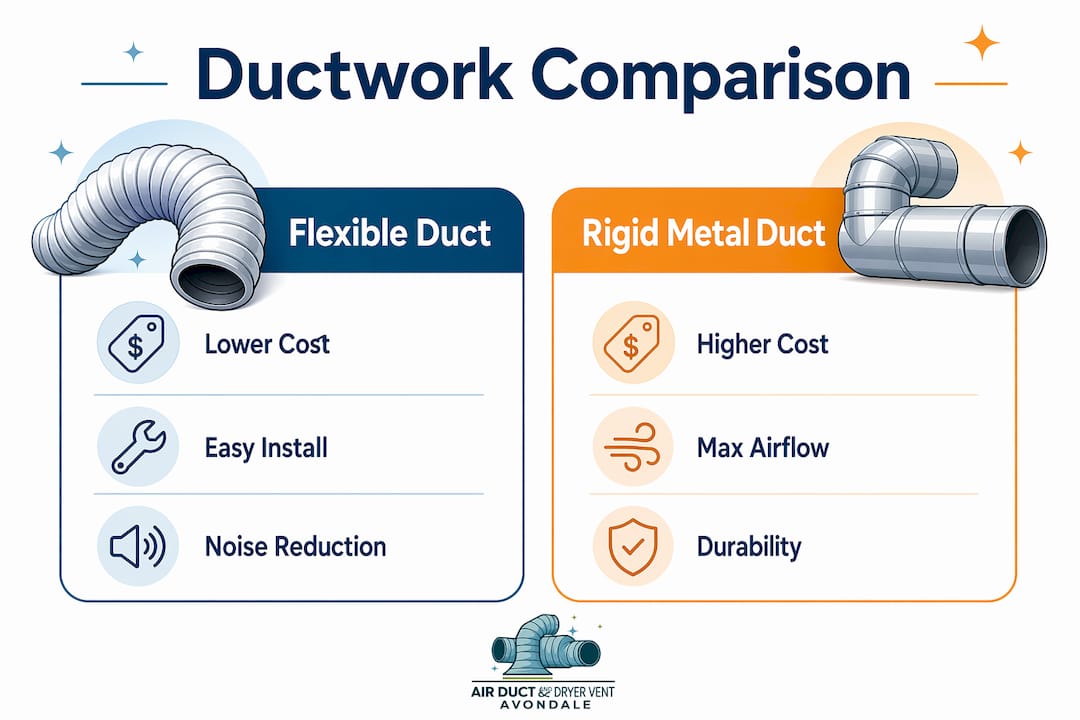
Flexible ductwork reduces noise transmission because its soft, pliable material absorbs vibrations that rigid metal ducts transmit directly into living spaces. This is a genuine advantage in bedrooms and home offices where HVAC noise is a comfort issue.
| Factor | Flexible ductwork | Rigid metal ductwork |
|---|---|---|
| Material cost per linear foot | $1–$4 | $7–$13 |
| Installation speed | Fast, minimal fabrication | Slower, custom cuts required |
| Airflow resistance | Higher (corrugated surface) | Lower (smooth interior) |
| Noise transmission | Low (absorbs vibration) | Higher (transmits vibration) |
| Best application | Short runs, retrofits, tight spaces | Long main trunk lines |
| Durability | Moderate (liner can be damaged) | High (sheet metal lasts decades) |
Pro Tip: Use rigid metal for main trunk lines and flex duct for the final 6–8 feet to each register. This hybrid approach captures the cost and noise benefits of flex duct while keeping main-line airflow resistance low.
Understanding how air ducts impact energy savings helps you make this hybrid decision with confidence rather than guesswork.
What are the best practices for installing flexible ductwork?
Installation quality is the single biggest factor in flex duct performance. A well-installed flex duct system outperforms a poorly installed rigid system every time. The following practices are not optional. They are the difference between a system that works and one that wastes energy and money.
1. Extend ducts to full length
Compressed flex duct is the most common and most damaging installation error. Compressing flexible ducts by 15% can increase friction-related pressure drop by up to 30%, which directly restricts airflow and forces the blower to work harder. Always extend flex duct to at least 90% of its rated length before securing it. A duct that looks "close enough" when bunched up is costing you real efficiency every hour the system runs.
2. Support ducts every 4–5 feet
Sagging flex duct creates low spots where air slows, turbulence builds, and pressure drops. Supporting flexible ducts every 4–5 feet and avoiding bends tighter than the duct diameter minimizes turbulence and pressure drops. Use proper saddle-style hangers, not wire or zip ties that cut into the jacket and compress the duct.
3. Avoid sharp bends
The bend radius of any flex duct run should be at least equal to the duct diameter. A 6-inch duct should never bend tighter than a 6-inch radius. Sharp bends kink the inner liner, reduce the effective cross-section, and create turbulence that compounds the pressure drop from the corrugated surface.
4. Seal all connections with mastic or UL 181 tape
Failures in flexible duct performance typically stem from installation errors including connections not properly sealed with mastic or UL 181 approved tapes. Standard gray cloth duct tape fails within a few years when exposed to temperature cycling. Mastic sealant or UL 181B-FX rated tape holds for the life of the system.
5. Choose the right R-value for your climate
Upgrading to R-8 insulated flexible ducts can reduce air distribution energy losses by 15–20%, lowering annual HVAC energy consumption by 8–12%. In Avondale, Arizona, where attic temperatures regularly exceed 140°F in summer, R-8 flex duct is not a luxury. It is the correct specification. Homes using R-4.2 duct in unconditioned attics in hot climates are losing a measurable portion of every cooling dollar before the air even reaches the living space.
Pro Tip: Before finalizing any flex duct run, do a quick visual check from the air handler to the register. The duct should look like a gently curved tube, not a folded accordion. If it looks compressed or kinked, pull it taut and re-support it before closing up the ceiling.
Knowing why duct size matters for HVAC efficiency is equally important. An undersized flex duct run creates the same pressure drop problems as a compressed one, regardless of how well it is installed.
Improper installation of flexible ductwork, such as compressing ducts or allowing sagging, can reduce HVAC efficiency by 20–40%. That range represents the gap between a system that delivers on its design specs and one that runs constantly without ever reaching setpoint.
What types of flexible ducting are available?
Not all flex duct is the same product. The right type depends on your climate, application, and performance goals. Here is a breakdown of the main categories:
- Non-insulated flex duct. A bare inner liner with the wire coil and no insulation layer. This type is only appropriate for conditioned spaces where the duct runs entirely within the thermal envelope of the building. Using it in an attic or crawl space causes significant heat transfer and condensation.
- R-4.2 insulated flex duct. The minimum insulation level for most residential applications. Suitable for short runs in mildly unconditioned spaces. Not recommended for hot attics or long branch runs.
- R-6 insulated flex duct. A mid-range option that meets most residential energy codes. Appropriate for moderate climates and standard attic installations.
- R-8 insulated flex duct. The high-performance option. Required by energy codes in many hot-climate states and strongly recommended for any duct run in an unconditioned attic. The R-8 specification is the most effective way to reduce distribution losses in hot climates.
- Silver jacket flex duct. The standard choice for most residential applications. The metalized outer jacket reflects radiant heat and is the default in hot, dry climates like Arizona.
- Black jacket flex duct. Used in humid climates where condensation on duct surfaces is a concern. The black jacket absorbs ambient heat, keeping the duct surface warmer and reducing the temperature differential that causes sweating.
For residential applications, the most common scenario is R-6 or R-8 insulated flex duct with a silver jacket for branch runs from a rigid metal trunk line to individual registers. Light commercial applications follow the same logic but often specify R-8 as a baseline due to longer run lengths and higher occupancy loads.
Industry experts note that flexible ductwork's reputation as cheap and low quality is misleading. Proper sizing, support, and sealing yield high performance comparable to rigid ducts. The material is not the limiting factor. The installation is.
Maintenance differences across types are real but manageable. Non-insulated flex duct is easier to inspect visually but offers no protection against heat transfer. Insulated types require periodic inspection of the outer jacket for tears or compression, especially in attics where foot traffic during other maintenance can damage the jacket without anyone noticing.
Key takeaways
Flexible ductwork delivers cost, installation, and noise advantages over rigid metal duct, but only when installed correctly with full extension, proper support, sealed connections, and the right R-value for the climate.
| Point | Details |
|---|---|
| Cost advantage is significant | Flex duct costs $1–$4 per linear foot versus $7–$13 for rigid metal, a 60–80% savings. |
| Installation quality determines performance | Compressed or sagging ducts can cut HVAC efficiency by 20–40%, wiping out all cost savings. |
| R-8 insulation pays for itself | Upgrading to R-8 flex duct reduces distribution energy losses by 15–20% in unconditioned spaces. |
| Inner liner integrity is non-negotiable | A pierced inner liner causes air leakage and mold risk regardless of how intact the insulation is. |
| Jacket color is a climate decision | Silver jackets reduce heat gain in hot climates; black jackets reduce condensation risk in humid ones. |
Why I think flex duct gets an unfair reputation
I have seen flex duct blamed for everything from high energy bills to poor air quality, and in almost every case the real culprit was the installation, not the material. A sagging, kinked, compressed run of flex duct is a genuine problem. But that is a labor and oversight issue, not a product defect.
The contractors I respect most use flex duct deliberately. They run rigid metal for the main trunk, then drop flex duct for the last few feet to each register. That approach captures the noise reduction and cost benefits of flex without the long-run airflow penalties. It is also faster to install and easier to adjust during a renovation.
The R-8 specification is where I see the most resistance from cost-conscious contractors, and it is the wrong place to cut corners. In an Arizona attic that hits 140°F in July, the difference between R-4.2 and R-8 is not academic. You can feel it in the rooms farthest from the air handler. Spending a few extra dollars per linear foot on insulation is one of the highest-return decisions in residential HVAC.
My honest advice: do not judge flex duct by the worst installations you have seen. Judge it by what it does when it is sized correctly, fully extended, properly supported, and sealed with mastic. That system will run quietly, efficiently, and reliably for 20 years.
— Shaun
Keep your flex duct system running at its best
Even a perfectly installed flex duct system accumulates dust, debris, and contaminants over time. Dirty ducts restrict airflow, reduce system efficiency, and circulate allergens through every room in the building. Airanddryerventcleaningavondale provides professional air duct cleaning in Avondale for both residential and commercial properties, including inspection for compressed sections, damaged liners, and failed duct connections. If your system is not delivering the airflow or efficiency it should, a professional inspection often reveals the exact installation issue causing the problem. Schedule a cleaning or air vent cleaning service with Airanddryerventcleaningavondale and get your HVAC system performing the way it was designed to.
FAQ
What is flexible ductwork used for in HVAC systems?
Flexible ductwork is used to connect rigid trunk lines to individual air registers and diffusers, especially in tight spaces or retrofits where rigid metal duct cannot be routed easily. It is standard in residential forced-air systems for branch runs of 6–15 feet.
Is flexible ductwork as efficient as rigid metal duct?
Properly installed flex duct with R-8 insulation performs close to rigid metal in most residential applications. The efficiency gap comes from installation errors like compression and sagging, not from the material itself.
How often should flexible ductwork be inspected?
Flex duct should be inspected every 3–5 years for signs of sagging, compression, jacket damage, or failed connections. Attic installations warrant more frequent checks because foot traffic and temperature extremes accelerate wear.
What R-value should flexible ductwork have in a hot climate?
R-8 is the recommended specification for flex duct runs in unconditioned attics in hot climates like Arizona. R-8 insulated flex duct reduces air distribution energy losses by 15–20% compared to lower-rated alternatives.
Can flexible ductwork be repaired, or does it need full replacement?
Minor tears in the outer jacket or insulation layer can be repaired with UL 181 approved tape or mastic sealant. Damage to the inner liner typically requires duct replacement because a compromised air barrier cannot be reliably patched for long-term performance.