
TL;DR:
- Indoor air quality reporting measures pollutants and airflow inside buildings and delivers a verified report with fixes. Most issues stem from dust, mold, or vent problems, with source control being the most effective solution. Professional assessments provide detailed, verifiable data and prioritized actions tailored to local conditions.
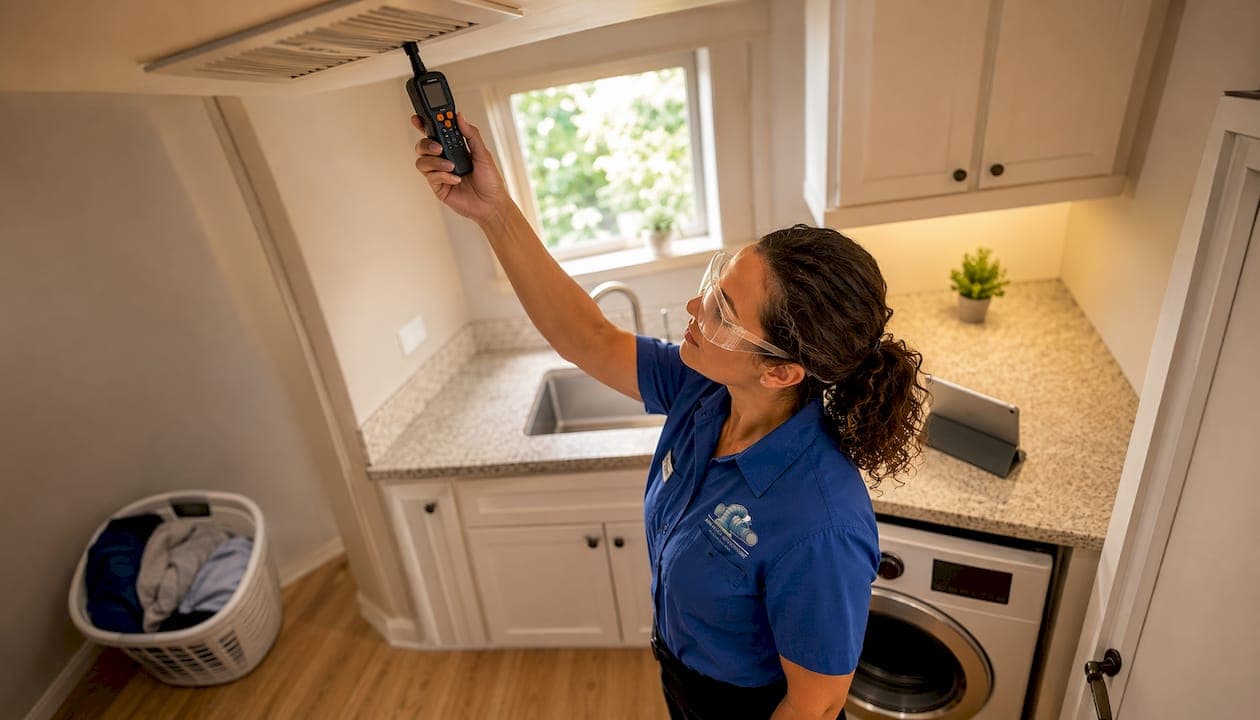
HVAC indoor air quality reporting is a professional assessment that measures pollutants, airflow, and comfort conditions inside your home or building, then delivers a documented report with prioritized fixes. For Avondale homeowners and business owners, it matters because Arizona dust, post-construction debris, and dryer vent backpressure are real, local contributors to poor air. The EPA and ASHRAE both recognize that identifying and controlling pollution sources is the most effective first step. If you want a straight answer on what to do next: schedule a local IAQ test with Air Duct and Dryer Vent Cleaning Avondale, or read the deliverables checklist below before you call anyone.
Table of Contents
- What does a professional IAQ report actually contain?
- How do ASHRAE and EPA standards shape IAQ reporting?
- How do professionals actually collect IAQ data?
- What do IAQ reports typically find, and what fixes do they recommend?
- How often should you get IAQ reporting?
- What does IAQ reporting cost, and how long does it take?
- What to ask before you hire an IAQ reporting provider
- Air Duct and Dryer Vent Cleaning Avondale: local IAQ services
- Key Takeaways
- A straight take on what IAQ reports actually change
- Ready to schedule your Avondale IAQ assessment?
- Useful sources and further reading
- FAQ
What does a professional IAQ report actually contain?
A credible report is not a one-page summary. It is a documented package that gives you verifiable evidence, not just a technician's verbal opinion.
Standard deliverables to expect:
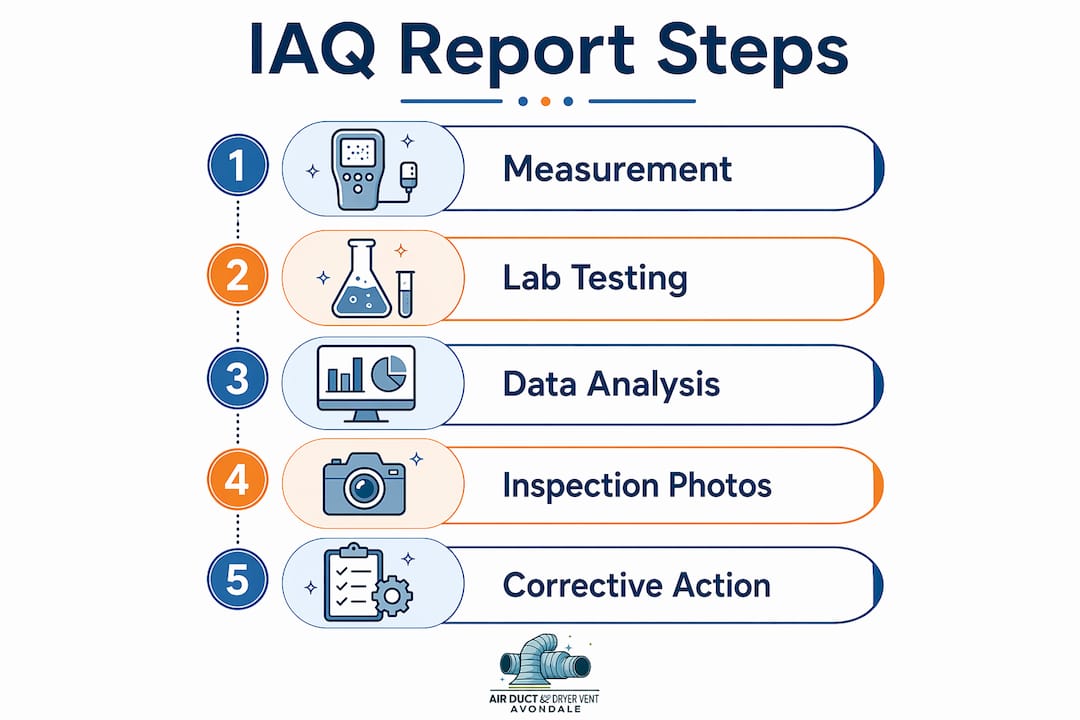
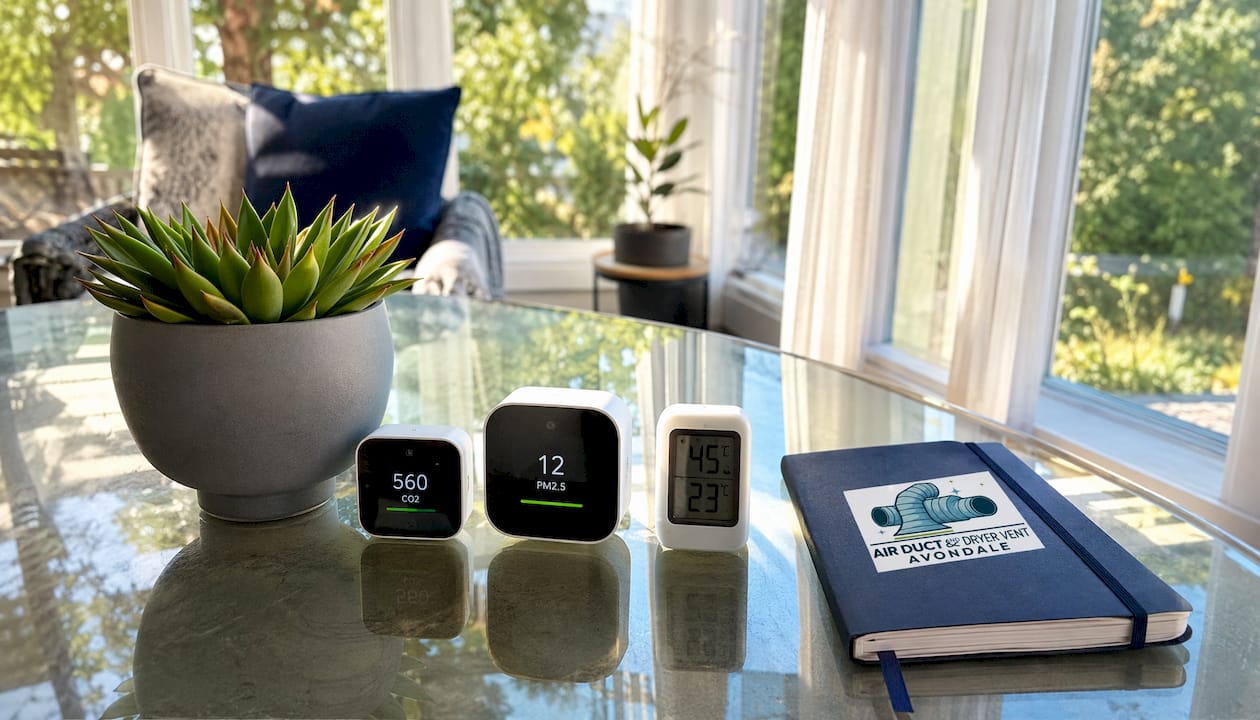
- Measurements: CO2, PM2.5/PM10, humidity, and temperature readings from calibrated sensors, time-stamped so you can see trends across the day
- Airflow readings: supply and return static-pressure measurements that reveal whether your HVAC system is moving enough air
- Inspection notes: written observations on duct condition, visible dust, mold evidence, and filter status
- Photographic evidence: before/after photos of duct interiors, vents, and any problem areas
- Lab reports: chain-of-custody microbiology or mold-species results when surface or bulk sampling is performed
- Prioritized recommendations: corrective actions ranked by urgency, with estimated costs and verification steps
| Report section | What it contains |
|---|---|
| Measurements | Time-stamped sensor logs for CO2, PM2.5/PM10, humidity, temperature |
| Airflow data | Static-pressure readings, supply/return balance, CFM estimates |
| Inspection notes | Written findings, visual mold evidence, filter condition |
| Photos | Before/after duct and vent images |
| Lab results | Chain-of-custody microbiology or mold-species identification |
| Recommendations | Prioritized corrective actions with cost estimates and timelines |
Pro Tip: Require time-stamped sensor logs and before/after photos as a condition of hiring. A provider who cannot supply them is not running a verifiable assessment.
How do ASHRAE and EPA standards shape IAQ reporting?
Two bodies set the framework that professional IAQ reports are built around: ASHRAE and the EPA.
ASHRAE Standard 62.1 governs commercial and non-residential spaces. It defines "acceptable indoor air quality" as conditions that at least 80% of occupants find satisfactory and offers three compliance paths. ASHRAE Standard 62.2 is the residential counterpart, covering dwelling-unit ventilation, local exhaust, and source control, with recent editions raising baseline filtration expectations.
The two main evaluation approaches under 62.1:
- Ventilation Rate Procedure (VRP): A prescriptive, design-based approach. You meet minimum outdoor-air rates per person and per square foot. It is straightforward for new construction but does not verify actual occupant experience.
- Indoor Air Quality Procedure (IAQP): A performance-based path. Instead of fixed ventilation rates, you demonstrate that pollutant concentrations stay below limits and that occupants report acceptable air quality. IAQP requires post-construction verification, including occupant surveys showing majority satisfaction, and root-cause analysis if limits are exceeded. It is an ongoing commitment, not a one-time calculation.
The EPA's guidance focuses on the same three levers: source control, ventilation, and filtration. For most residential situations, the EPA puts source control first because it eliminates the problem rather than diluting or filtering it after the fact.
How do professionals actually collect IAQ data?
The method a technician uses determines what the data can and cannot tell you.
- Continuous sensor monitoring (CO2, PM2.5, humidity, temperature): Runs for hours or days. Shows trends and peak events, not just a snapshot. Best for identifying patterns tied to occupancy or HVAC cycles.
- Handheld particle counters: Spot readings for PM2.5 and PM10 during a walkthrough. Fast and useful for locating problem zones, but they miss time-based spikes.
- VOC and gas meters: Spot readings for volatile organic compounds, carbon monoxide, or formaldehyde. Useful after renovations or when occupants report chemical odors.
- HVAC airflow and static-pressure tests: Measures whether the system is delivering the designed airflow to each zone. A common root cause of stuffy rooms and humidity imbalances.
- Surface or bulk sampling sent to a lab: Required when mold or microbiology is suspected. Identifies species and concentration levels. Chain-of-custody documentation is standard for any results used in dispute resolution or warranty claims.
| Problem symptom | Best method | What it reveals |
|---|---|---|
| Stuffy rooms, occupant complaints | CO2 trend + airflow test | Ventilation deficit or HVAC imbalance |
| Musty or mold smell | Visual inspection + bulk/surface lab sample | Mold species and concentration |
| Post-renovation odors | VOC spot meter | Elevated formaldehyde or other VOCs |
| Elevated dust, allergy symptoms | Particle counter + duct inspection | PM source and duct debris load |
Sensors show trends. Lab tests confirm species and levels. Neither replaces the other for a complete picture.
What do IAQ reports typically find, and what fixes do they recommend?
Most Avondale properties share a short list of recurring problems. Here is what reports surface and what actually fixes them:
- High indoor PM2.5: Source control first (seal off construction areas, address dryer venting), then duct cleaning and filter upgrades. Arizona dust loads are heavier than national averages.
- Elevated CO2: Increase fresh-air intake or adjust demand-control ventilation settings. A stuffy conference room is almost always a ventilation problem, not a filtration problem.
- High humidity: Fix plumbing leaks, add dehumidification. Keeping relative humidity in a moderate range reduces mold risk and often improves perceived air quality more than a filter upgrade alone.
- Dryer vent backpressure: Dryer vent cleaning resolves this quickly. Blocked dryer vents push lint particles and moisture back into living spaces.
- Dust-laden ducts: Duct cleaning plus a higher-MERV filter. Post-construction dust is a frequent culprit in newer Avondale builds.
Pro Tip: The EPA backs source control as the highest-leverage fix for most residential IAQ problems. Removing the source of VOCs, lint, or dust beats filtering around it. Common Avondale sources: fresh paint, new cabinetry, improperly vented dryers, and construction debris in ducts.
Dryer vent cleaning and filter replacement are same-day fixes. Duct replacement or HVAC repairs take longer and require a licensed trades contractor.
How often should you get IAQ reporting?
Frequency depends on your situation, not a universal calendar.
- One-off investigative test: After complaints, a renovation, a new tenant move-in, or a mold scare. This is the most common entry point for homeowners.
- Annual or biannual checks: Appropriate for households with asthma or allergy sufferers, older duct systems, or high-traffic commercial spaces.
- Continuous monitoring: Busy commercial zones, schools, or multi-tenant buildings where a single bad reading can affect dozens of people. Tenant-facing scorecards that map sensor feeds to zones and overlay occupant complaints are more useful in practice than monthly static PDFs for these properties.
For most Avondale homeowners, a professional one-off test after a renovation or after persistent complaints is the right starting point. Low-cost consumer sensors (for CO2 and PM2.5) are useful for ongoing awareness between professional assessments, but they do not replace calibrated equipment or lab analysis.
What does IAQ reporting cost, and how long does it take?
Costs vary by scope. Here is a realistic breakdown of what drives the price:
- Single-zone spot check: Fastest and least expensive. Same-day results. Useful for a targeted complaint but limited in scope.
- Short-term monitoring (24–72 hours): Covers a full occupancy cycle and captures peak events. More informative for recurring problems.
- Multi-zone or multi-week campaigns: Appropriate for commercial properties or IAQP-style verification. Lab turnaround for microbiology adds days to the timeline.
Factors that push costs up: chain-of-custody lab analysis, large commercial floor area, urgent service requests, and multiple re-tests for verification. Factors that keep costs down: focusing on source control and maintenance tasks rather than extensive sensor deployments, which EPA guidance supports as the higher-value approach for most residential situations.
What to ask before you hire an IAQ reporting provider
Use this checklist during any call or bid review:
- What certifications do your technicians hold, and are your methods aligned with ASHRAE or EPA guidance?
- Which pollutants do you measure, and what equipment do you use?
- Are sensors factory-calibrated? Do you provide chain-of-custody documentation for any lab samples?
- What is the timeline from assessment to written report delivery?
- Do you offer a follow-up verification visit after corrective work is completed?
- Can you provide a sample report or references from similar Avondale properties?
Require in writing: time-stamped sensor logs, inspection photos, a prioritized corrective-action list with estimated costs, verification steps, and any applicable service warranty. A provider who hesitates on any of these is worth reconsidering.
Air Duct and Dryer Vent Cleaning Avondale: local IAQ services
Air Duct and Dryer Vent Cleaning Avondale delivers professional IAQ testing alongside the cleaning and repair work that actually fixes what a report finds. Services include air duct cleaning, dryer vent cleaning, vent replacement, duct repairs, filter replacement, and HVAC system testing. For commercial properties, commercial duct cleaning is available with zone-level reporting suited to property managers and business owners. The local advantage is real: faster response times, direct knowledge of Arizona dust conditions and seasonal air quality patterns, and familiarity with the building types common across Avondale. Warranties and flexible scheduling, including after-hours options, are part of the standard offering. Book an IAQ assessment or request a sample report at airanddryerventcleaningavondale.com.
Key Takeaways
HVAC indoor air quality reporting gives you documented, verifiable evidence of what is in your air and a prioritized plan to fix it, which is more useful than a verbal opinion or a single sensor reading.
| Point | Details |
|---|---|
| What reporting delivers | Measurements, photos, lab results, and prioritized corrective actions in one documented package. |
| Source control first | EPA guidance puts source control above filtration as the highest-leverage fix for most homes. |
| Humidity target | Keeping indoor relative humidity between 30–50% reduces mold risk, often more than a filter upgrade. |
| When to hire a pro | After renovations, persistent complaints, new occupancy, or any suspected mold or dryer vent issue. |
| Local option | Air Duct and Dryer Vent Cleaning Avondale provides on-site IAQ testing, duct cleaning, and follow-up verification for Avondale properties. |
A straight take on what IAQ reports actually change
Most homeowners assume an IAQ report is a formality. It rarely is. The reports that produce real change are the ones that connect a specific measurement to a specific source, then hand the owner a ranked list of fixes with realistic costs. The problem with generic air quality advice is that it treats every home the same. Avondale properties deal with heavy dust loads, post-construction debris in new builds, and dryer vents that run longer distances than older housing stock was designed for. A report that does not account for those local conditions is not wrong, exactly. It just misses the things most likely to matter here.
The other thing worth saying: source control is consistently underused. Homeowners spend money on high-MERV filters and air purifiers while the actual source, whether it is a partially blocked dryer vent, new flooring off-gassing VOCs, or construction dust packed into duct returns, keeps producing the problem. A good report names the source. A good provider fixes it.
Ready to schedule your Avondale IAQ assessment?
Contact Air Duct and Dryer Vent Cleaning Avondale to book an on-site IAQ test, request a sample report, or combine a duct cleaning with a full air quality assessment. Before your appointment, note any occupancy patterns, recent renovation dates, and specific complaints (odors, allergy flare-ups, stuffy rooms). Deliverable turnaround and follow-up verification visit availability can be confirmed when you book. Start at the IAQ testing page or call to discuss your property's specific situation.
Useful sources and further reading
- Introduction to Indoor Air Quality — US EPA: The EPA's foundational overview of what IAQ is, why it matters, and how pollution sources and ventilation interact. A reliable starting point for any homeowner.
- Improving Indoor Air Quality — US EPA: Practical EPA guidance on source control, ventilation, and filtration. Directly supports the fix priorities discussed in this article.
- ASHRAE Standard 62.1 Fact Sheet: One-page summary of the commercial ventilation standard, including VRP and IAQP compliance paths.
- ASHRAE Standards 62.1 and 62.2 — Bookstore: Full standard references for both commercial (62.1) and residential (62.2) ventilation and IAQ requirements.
- Demystifying IAQP — CASPRtech: Clear explanation of how the Indoor Air Quality Procedure works in practice, including verification requirements and occupant survey thresholds.
- IAQ Scorecards for Tenant Reporting — Oxmaint: Explains how zone-level scorecards translate sensor data into tenant-readable reports. Useful for commercial property managers.
- Indoor Air Quality Services — LC Heating & Air: Partner resource with a residential overview of IAQ reporting and service options.
- Indoor Environmental Services Guide — Foundation ResQ: Covers household VOC sources and allergen management, useful context for source-control decisions.
FAQ
What is HVAC indoor air quality reporting?
It is a professional assessment that measures pollutants, airflow, and comfort conditions inside a building, then delivers a documented report with prioritized corrective actions. It goes beyond a verbal inspection to provide verifiable, time-stamped data.
How often should Avondale homeowners get an IAQ test?
A one-off test after a renovation, persistent complaints, or a suspected mold issue is the most common starting point. Households with allergy or asthma sufferers benefit from annual checks.
What is the difference between VRP and IAQP?
The Ventilation Rate Procedure (VRP) is a prescriptive design approach based on minimum outdoor-air rates. The Indoor Air Quality Procedure (IAQP) is performance-based and requires post-construction verification that occupants experience acceptable air quality, including at least 80% occupant satisfaction in surveys.
Does Air Duct and Dryer Vent Cleaning Avondale provide IAQ reports?
Yes. Air Duct and Dryer Vent Cleaning Avondale offers on-site IAQ testing with documented deliverables, alongside duct cleaning, dryer vent cleaning, and follow-up verification for residential and commercial properties in Avondale.
What humidity level should I maintain indoors?
Keep relative humidity between 30–50%. That range reduces mold risk and often improves perceived air quality more than a filter upgrade alone.