

An HVAC service agreement is a written contract between you and a licensed contractor that defines exactly what maintenance work gets done, when, at what price, and under what conditions. Before you sign anything, check for these core terms:
- Scope of services — which tasks are included and which are explicitly excluded
- Visit schedule — how many tune-ups per year and when they occur
- Price model — flat annual fee, per-visit rate, or subscription with discounted labor
- Term, renewal, and cancellation — contract length, auto-renewal windows, and exit fees
- Warranties and workmanship guarantees — written labor warranty duration and coverage
- Priority/emergency response — guaranteed response times during peak demand
- Contractor responsibilities — who pulls permits, who carries insurance
- Customer obligations — access requirements and system-prep expectations
The sections below break each clause down in plain English, give you pricing benchmarks, and include sample language you can copy or request from any contractor.
Table of Contents
- What is an HVAC service agreement and why do contractors offer them?
- Common scope-of-services clauses: what's included and what isn't
- How HVAC service agreements are priced and what drives the cost
- Are HVAC service agreements worth it? The benefits and tradeoffs
- Plain-English breakdown of the contract clauses you must understand
- Quick checklist and sample contract phrases you can copy or request
- How HVAC service agreements differ from home warranties and insurance
- Local example: how a trusted Avondale provider writes fair HVAC service agreement terms
- Key Takeaways
- Why the fine print matters more than the price tag
- Airanddryerventcleaningavondale offers clear, scope-specific service agreements in Avondale
- Useful sources, templates, and where to find sample contracts
- FAQ
What is an HVAC service agreement and why do contractors offer them?
An HVAC service agreement (also called a maintenance agreement, comfort plan, or service contract) is a pre-paid or subscription arrangement where a contractor commits to scheduled preventive maintenance on your heating and cooling equipment in exchange for a fixed fee.

From your side, the appeal is straightforward: predictable costs, priority scheduling, and the peace of mind that someone is checking your system before it fails in July. From the contractor's side, the math is equally clear. Agreements spread maintenance visits across the calendar year, preventing the overload that hits every HVAC company when temperatures spike and every phone rings at once. It is a capacity-management tool as much as a customer benefit.
Pay-per-visit vs. service agreement at a glance:
- Pay-per-visit: No upfront cost, full flexibility, but no priority status and no rate lock
- Service agreement: Predictable annual cost, priority response during peak demand, often includes discounted parts and labor on repairs
- Emergency-only service: Highest per-call cost, no preventive maintenance, no warranty preservation
Most residential agreements include biannual tune-ups — one before cooling season and one before heating season — which aligns with manufacturer maintenance requirements and helps preserve equipment warranties.

Common scope-of-services clauses: what's included and what isn't
The scope section is where most billing disputes start. A vague scope lets a contractor charge for work you assumed was covered. A precise scope protects both parties.
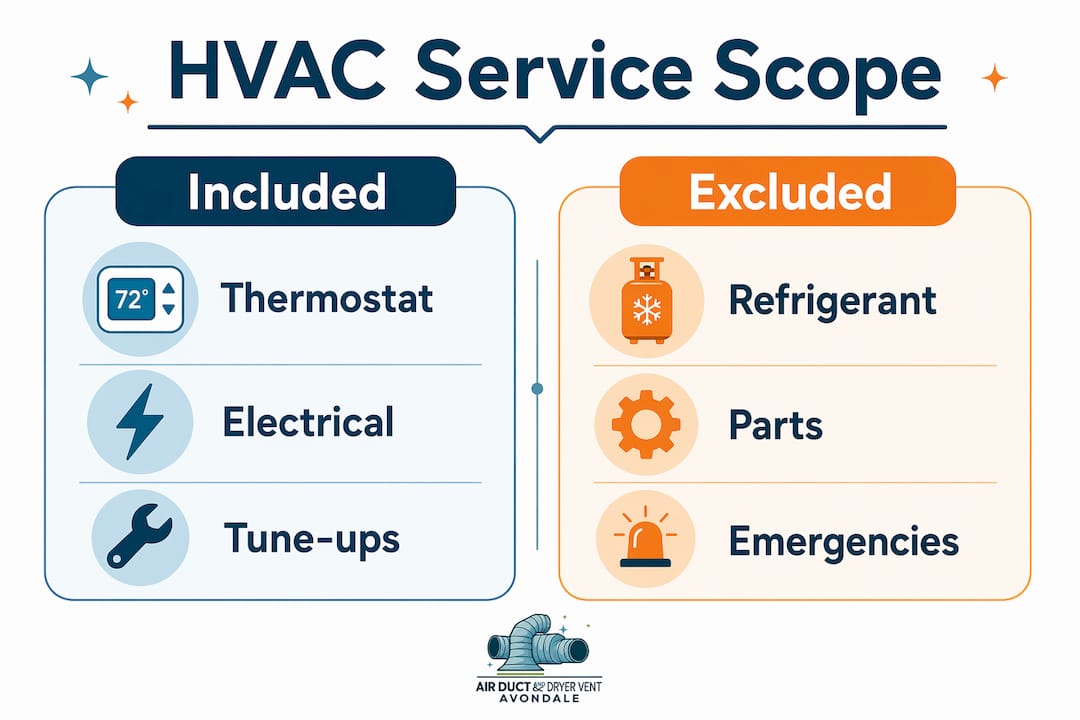
Standard inclusions in a residential maintenance visit:
- Thermostat calibration and operation check
- Electrical connection inspection and tightening
- Evaporator and condenser coil inspection (cleaning may be extra)
- Condensate drain check and flush
- Filter inspection (replacement may be billed separately)
- Blower motor and belt inspection
- Safety controls and gas-pressure checks on furnaces
- Refrigerant pressure check (recharge is almost always excluded)
Common exclusions to watch for:
- Refrigerant leak repair or reclamation fees
- Compressor or heat exchanger replacement
- Ductwork repair or sealing
- Structural work, asbestos remediation, or mold remediation
- Electrical panel upgrades
| Typically Included | Typically Excluded |
|---|---|
| Thermostat check | Refrigerant recharge |
| Electrical inspection | Compressor replacement |
| Coil inspection | Ductwork repair |
| Condensate drain flush | Asbestos or mold remediation |
| Filter check | Refrigerant leak repair |
| Safety controls check | Structural modifications |
A clear statement of work with an attached checklist reduces disputes and creates a paper trail for both parties. Ask for the inspection checklist before you sign, not after the first visit. The contract should also list each covered unit by model number and serial number — a detail that matters the moment you add a second system or replace aging equipment.
Pro Tip: If the scope says "as needed" for coil cleaning or drain flushing, push back. Request specific language: "Contractor will flush condensate drain at each scheduled visit." Vague verbs cost money.
How HVAC service agreements are priced and what drives the cost
Basic residential plans typically fall in the $150–$300 per year range for a standard two-visit maintenance plan on a single system. That range covers labor for the visits and basic inspections; parts, refrigerant, and repairs are usually billed separately.
Common pricing models:
- Flat annual fee — one payment covers all scheduled visits; simplest to budget
- Per-visit pricing — pay each time a technician comes out; no commitment but no discount
- Subscription with discounted labor/parts — monthly billing, often 10–20% off repair labor
- Prepaid multi-year plan — lower per-year cost in exchange for a longer commitment
- Tiered plans (basic vs. premium) — basic covers inspections only; premium adds parts, priority response, or filter replacements
What pushes the price up:
- Multiple systems or zones (each unit typically adds cost)
- Older equipment requiring more inspection time
- High local labor rates or remote access
- R-410A or R-22 refrigerant handling requirements
- Guaranteed same-day or after-hours emergency response
Billing mechanics to read carefully:
- Deposit at signing (standard for installation contracts; less common for maintenance plans)
- Auto-renewal clauses that roll the contract forward unless you cancel within a defined window
- Late-payment fees and interest rates
- Cancellation fees, especially on prepaid multi-year plans
Regular preventive maintenance consistently reduces emergency repair costs and extends equipment life, which is the core financial argument for paying the annual fee upfront.
Pricing benchmark: Basic residential two-visit plans typically run $150–$300/year. Premium plans with parts coverage and priority response can run higher depending on equipment type and local labor rates.
Are HVAC service agreements worth it? The benefits and tradeoffs
The honest answer is: it depends on your equipment age, your risk tolerance, and how much you value priority access during a heat wave.
Reasons a plan makes sense:
- Equipment older than 8–10 years benefits most from regular inspection
- Priority scheduling during high-demand periods — when every HVAC company is booked out three days, plan members often get same-day or next-day service
- Predictable maintenance costs help with annual budgeting
- Regular maintenance can reduce energy consumption, as dirty coils and clogged filters force systems to work harder
- Some manufacturer warranties require documented annual maintenance to remain valid
- Multi-unit properties and small commercial buildings get the most value per dollar
Reasons to skip it:
- New equipment under full manufacturer warranty may not need extra coverage
- If you already have a home warranty that covers HVAC repairs, you may be paying twice
- Coverage quality varies widely between providers — a cheap plan with vague scope is worse than no plan
- Auto-renewal traps can lock you in for another year if you miss the cancellation window
For most homeowners with systems over five years old, the regular HVAC service benefits outweigh the $150–$300/year annual fee for basic plans, particularly in climates where systems run hard for six or more months a year. For brand-new equipment under warranty, a single annual inspection visit may be all you need.
Plain-English breakdown of the contract clauses you must understand
Every HVAC service agreement contains standard legal language. Here is what the key clauses actually mean and what you should do about each one.
| Clause | Plain-Language Meaning | Your Action |
|---|---|---|
| Term and auto-renewal | Contract runs for a fixed period; renews automatically unless you cancel within the notice window | Note the cancellation deadline in your calendar the day you sign |
| Termination and cancellation fees | Early exit triggers a fee, often a percentage of the remaining contract value | Negotiate a pro-rated refund for prepaid plans |
| Liability and indemnification | Limits what the contractor owes if something goes wrong; may cap damages | Ask for a minimum liability equal to the contract value |
| Labor warranty | Contractor guarantees their workmanship for a stated period | Require at least one year in writing |
| Change-order provision | Any extra work beyond the agreed scope requires written approval before it is done | Never authorize verbal extras |
| Permit responsibility | States who pulls municipal permits for installation or repair work | Contractor must pull all permits — never accept this burden yourself |
| Dispute resolution | Defines whether disputes go to arbitration or court, and which state's law applies | Confirm the venue is your state |
Red flags to negotiate before signing:
- No written labor warranty or a warranty shorter than 90 days
- Permit responsibility placed on the homeowner
- Auto-renewal with a cancellation window shorter than 30 days
- No change-order requirement — extras can be added without your written approval
- Liability cap set at zero or "contractor is not responsible for consequential damages" with no floor
A solid HVAC contract identifies both parties clearly, defines the full scope, details payment terms, and includes enforceable termination and indemnification language. If any of those four elements is missing or vague, ask for a revised draft before you sign.
Pro Tip: Never accept verbal promises about what is covered. If a salesperson says "we'll take care of the coil cleaning at no extra charge," get that sentence added to the scope of work in writing before the contract is executed. Verbal assurances are unenforceable.
Regarding written labor warranties and permit responsibility, insisting on both in writing is one of the most practical protections a homeowner has. A contractor who resists either of those requests is telling you something important.
Quick checklist and sample contract phrases you can copy or request
Run through this list before you sign any HVAC maintenance or repair contract:
- Scope lists every covered unit by model number and serial number
- Number of annual visits and their timing are stated explicitly
- Price, billing cycle, and any auto-renewal terms are written out
- Cancellation process and any exit fees are defined
- Written labor warranty of at least one year is included
- Contractor carries general liability and workers' compensation insurance (request the certificate)
- Contractor pulls all required municipal permits
- Change-order provision requires your written approval before extras are billed
- Priority or emergency response time is defined (e.g., "within 24 hours for plan members")
- Exclusions list is specific, not a catch-all "all other repairs excluded" clause
Sample phrases to insert or request:
- Scope line: "Contractor shall perform the tasks listed in Exhibit A at each scheduled visit. No additional charges will be assessed for tasks listed in Exhibit A."
- Change-order clause: "Any work beyond the agreed scope requires written authorization from the homeowner before commencement. Verbal authorizations are not binding." This aligns with standard change-order provisions that protect against surprise invoices.
- Labor warranty: "Contractor warrants all labor performed under this agreement against defects in workmanship for a period of [12] months from the date of service."
- Priority response: "Plan members will receive scheduling priority during high-demand periods. Contractor will respond to emergency service requests within [24] hours."
- Termination notice: "Either party may terminate this agreement with [30] days written notice. Prepaid amounts for unperformed visits will be refunded pro-rata."
That single paragraph covers scope, change orders, permits, and labor warranty in four sentences. If a contractor's draft is missing any of those four elements, this is the language to request.
How HVAC service agreements differ from home warranties and insurance
These two products are often confused, and the confusion can be expensive.
Key differences:
- Coverage focus: A service agreement covers scheduled preventive maintenance on specific equipment. A home warranty covers repair or replacement costs when covered systems fail unexpectedly.
- Contractor selection: With a service agreement, you choose your contractor and build a direct relationship. With a home warranty, the warranty company assigns a contractor from its network — you have little or no say in who shows up.
- Maintenance vs. repair: Service agreements create a direct relationship with a local provider focused on maintenance schedules. Home warranties focus on repair cost coverage after a failure, and they typically exclude pre-existing conditions and lack-of-maintenance failures.
- Manufacturer warranty interaction: Regular documented maintenance under a service agreement can preserve your manufacturer warranty. Home warranties generally do not satisfy manufacturer maintenance requirements.
When both make sense: A home warranty on an older home with multiple aging systems, combined with a service agreement for preventive maintenance, can make sense. The service agreement keeps systems running and documented; the home warranty backstops catastrophic repair costs.
When they overlap redundantly: If your equipment is new and under full manufacturer warranty, adding both a service agreement and a home warranty is likely overkill. Start with a single annual inspection visit and reassess as the equipment ages.
Understanding how HVAC warranties work for your specific equipment is the first step toward knowing which product actually fills a gap in your coverage.
Local example: how a trusted Avondale provider writes fair HVAC service agreement terms
In Arizona's climate, the stakes on a service agreement are higher than in most states. Cooling systems run hard from April through October, and a system that skips its spring tune-up is a system that fails in a 115-degree week. That context shapes how a responsible local contractor structures their agreements.
Airanddryerventcleaningavondale, serving residential and commercial clients in Avondale, AZ, builds its service agreements around a few practices that reflect both fair contracting and local conditions:
- Scope tied to a written inspection checklist — every visit produces a documented report covering air ducts, vents, filters, and system components, so clients have a paper trail for warranty purposes
- Scheduling aligned with Arizona seasons — pre-cooling-season visits in March or April and a post-summer check in October, timed to the actual demand curve rather than a generic biannual calendar
- Permit and insurance transparency — the contractor carries general liability and workers' compensation, and clients can request the certificate of insurance before work begins; the contractor pulls all required municipal permits
For HVAC cleaning services specifically, the scope should call out air duct cleaning, dryer vent cleaning, and air quality testing as distinct line items — not bundled under a vague "system inspection" heading. That specificity protects you and holds the contractor accountable.
Key Takeaways
A well-written HVAC service agreement protects you with a clear scope, a written labor warranty of at least one year, contractor permit responsibility, and explicit cancellation terms before you commit.
| Point | Details |
|---|---|
| Scope must be specific | List every covered unit by model and serial number; attach an inspection checklist. |
| Pricing benchmark | Basic two-visit residential plans typically cost $150–$300/year; premium plans with parts and priority response generally cost more. |
| Written labor warranty | Require at least one year in writing; never accept verbal assurances or warranties under 90 days. |
| Contractor pulls permits | Never sign a contract that places permit responsibility on the homeowner. |
| Airanddryerventcleaningavondale | Provides documented inspection reports, proof of insurance on request, and scope-specific agreements for Avondale, AZ clients. |
Why the fine print matters more than the price tag
Most homeowners compare HVAC service agreements on price alone. That is the wrong filter. A $199/year plan with a vague scope, no written labor warranty, and a 60-day auto-renewal notice window can cost you far more than a $299 plan that spells out every covered task, guarantees a 24-hour emergency response, and lets you cancel with 30 days' notice.
The clause that catches most people off guard is the auto-renewal window. Contractors set these windows at 30, 60, or even 90 days before the renewal date. Miss the window by a week and you are locked in for another year. Write the cancellation deadline in your calendar the day you sign — not the renewal date, the deadline to cancel before renewal.
The second underrated clause is the change-order provision. During a maintenance visit, a technician may find something that needs repair. Without a written change-order requirement, that repair can be started and billed before you have agreed to the cost. A single sentence requiring written homeowner approval before any extra work begins eliminates that risk entirely.
Permit responsibility is the third clause most homeowners never read. If a contractor installs or replaces equipment without pulling a municipal permit, the liability for that unpermitted work can follow the property. The contractor should always pull permits. If the contract says otherwise, that is a red flag worth walking away from.
Airanddryerventcleaningavondale offers clear, scope-specific service agreements in Avondale
If you are a homeowner or small business owner in Avondale, AZ who wants a maintenance plan with no vague language and no surprise invoices, Airanddryerventcleaningavondale is the local alternative to a one-size-fits-all service contract.
The services covered include air duct and vent cleaning, dryer vent cleaning, air filter replacement, duct repairs, and air quality testing — each listed as a specific line item in the scope, not buried in a generic "system inspection" clause. Proof of insurance is available on request before any work begins. Flexible scheduling includes after-hours options for commercial clients who cannot afford downtime during business hours.
To request a sample service agreement, schedule a seasonal inspection, or get a local quote, contact Airanddryerventcleaningavondale directly through the main services page.
Useful sources, templates, and where to find sample contracts
These resources help you verify contract language, check contractor credentials, and compare sample agreements:
- ContractsCounsel — HVAC Contract Guide: Explains mandatory contract elements (parties, scope, payment, termination, indemnification) and what makes an HVAC contract legally enforceable in the U.S.
- HVACDatabase — 7 Must-Check Items Before Signing: Practical checklist covering labor warranties, permit responsibility, and red-flag clauses; one of the most homeowner-focused guides available.
- ServiceTitan — HVAC Service Contracts Guide: Explains how modern agreements integrate with CRM and digital tracking tools; useful for understanding what inspection records and service histories should look like.
- ACHR News — Service and Maintenance Agreements: Industry perspective on how contractors use agreements for capacity management — helpful context for understanding why contractors push these plans.
- LegalClarity — Commercial HVAC Proposal Template: Covers commercial proposal structure including payment milestones, retainage clauses, and bid bond requirements for larger projects.
- Seasonal HVAC maintenance tips: Practical guidance on why biannual visits matter and what each seasonal check should cover.
- License and insurance verification: In Arizona, verify contractor licensing through the Arizona Registrar of Contractors. Always request a current certificate of insurance before work begins.
FAQ
Are HVAC service agreements worth it?
For most homeowners with equipment older than five years, yes. The combination of priority scheduling during peak demand and documented preventive maintenance typically outweighs a moderate annual cost, particularly in high-use climates like Arizona.
How much do HVAC service contracts cost?
Basic residential two-visit plans typically run $150–$300/year for a single system. Premium plans that include parts coverage, priority emergency response, or additional units will cost more depending on equipment type and local labor rates.
What is the $5,000 HVAC rule?
The 'rule' is an informal homeowner guideline: multiplying your system's age by estimated repair costs can help decide if replacement is more cost-effective than repair. It is a rough heuristic, not an industry standard, and should be weighed against your specific equipment condition and replacement quotes.
What should an HVAC service agreement always include?
Every agreement should identify the covered equipment by model and serial number, state the number and timing of annual visits, include a written labor warranty of at least one year, require the contractor to pull all permits, and define cancellation terms and any exit fees.
How is an HVAC service agreement different from a home warranty?
A service agreement covers scheduled preventive maintenance on specific equipment through a contractor you choose. A home warranty covers repair or replacement costs for system failures and assigns its own contractor network — it does not satisfy manufacturer maintenance requirements the way a documented service agreement does.