TL;DR:
- Industrial dryers exhaust high volumes that require engineered duct systems and dedicated make-up air for safety. Improper venting increases fire risk, causes equipment failure, and can lead to carbon monoxide back-drafting. Regular inspections and rigid metal ductwork are essential for compliance and operational safety.
Industrial dryers cannot safely use standard residential venting. The core reason is volume: a commercial dryer routinely exhausts 800 CFM or more, roughly four to eight times what a household unit produces. That volume demands engineered ductwork, dedicated make-up air, and lint management systems that residential venting simply cannot provide. Get it wrong, and you are looking at fire risk, equipment failure, code violations, and carbon monoxide hazards in the same building where your staff works.
Here is what drives the requirement for specialized venting in industrial laundry settings:
- High exhaust volume (often exceeding 800 CFM) requires dedicated, engineered duct systems and make-up air per the International Mechanical Code (IMC)
- Intense lint production demands rigid, smooth ductwork with no traps or flexible sections
- Elevated heat loads create fire conditions when airflow is restricted
- Pressure imbalances cause back-drafting of combustion gases from nearby appliances
- Regulatory compliance under the IMC, NFPA 54, and manufacturer specifications requires purpose-built installations
Why improper venting puts your facility at serious risk
Lint buildup accounts for a significant proportion of dryer fires, and that figure reflects residential and light commercial settings. In a high-volume industrial facility running multiple dryers simultaneously, the accumulation rate is far faster and the consequences far worse.
The fire risk is not just about lint sitting in a duct. Restricted airflow forces the dryer to run hotter than its design temperature, which creates a feedback loop: more heat drives more lint off fabric, that lint accumulates faster, and the elevated temperature makes ignition more likely. The U.S. Consumer Product Safety Commission identifies this overheating cycle as the primary mechanism behind dryer fires, not just the lint itself.
Beyond fire, improper venting causes equipment damage that shows up on your maintenance budget. When a dryer cannot exhaust properly, its heating element and motor run under sustained thermal stress. Bearings wear faster, thermostats cycle erratically, and drum seals degrade ahead of schedule. A dryer that should last a decade may need major repairs within three or four years.
There is also a building-level hazard that facility managers sometimes overlook. When high-volume exhaust pulls air out of a laundry room faster than make-up air can replace it, the room goes negative pressure. That pressure differential can pull combustion gases, including carbon monoxide, backward through water heaters, boilers, or gas dryers sharing the same space. Smoke tests at exterior doors are a fast, low-cost way to confirm whether back-drafting is occurring.
Key dangers of improper industrial dryer venting:
- Lint ignition from restricted airflow and elevated internal temperatures
- Premature failure of heating elements, motors, and drum components
- Increased energy consumption as dryers compensate for poor exhaust
- Negative building pressure causing combustion gas back-drafting
- Carbon monoxide accumulation from back-drafted appliances
- Mold and moisture damage when exhaust is not fully directed outdoors
What a properly designed industrial dryer vent system looks like
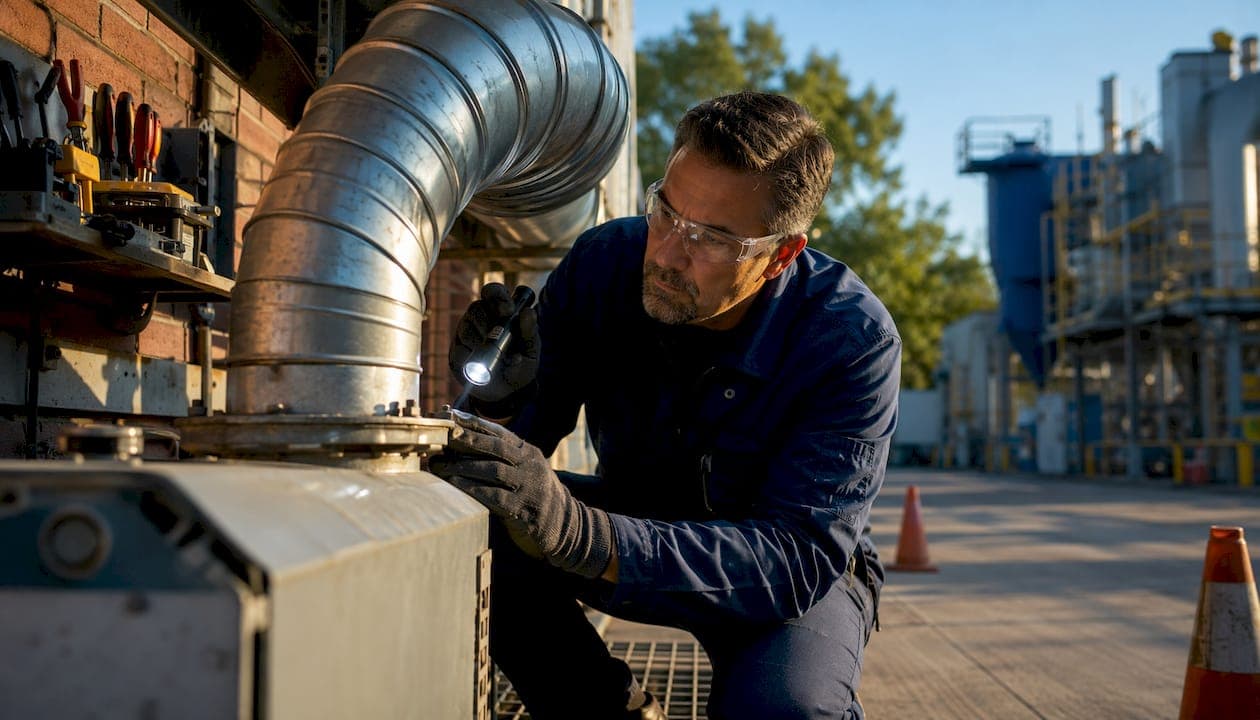
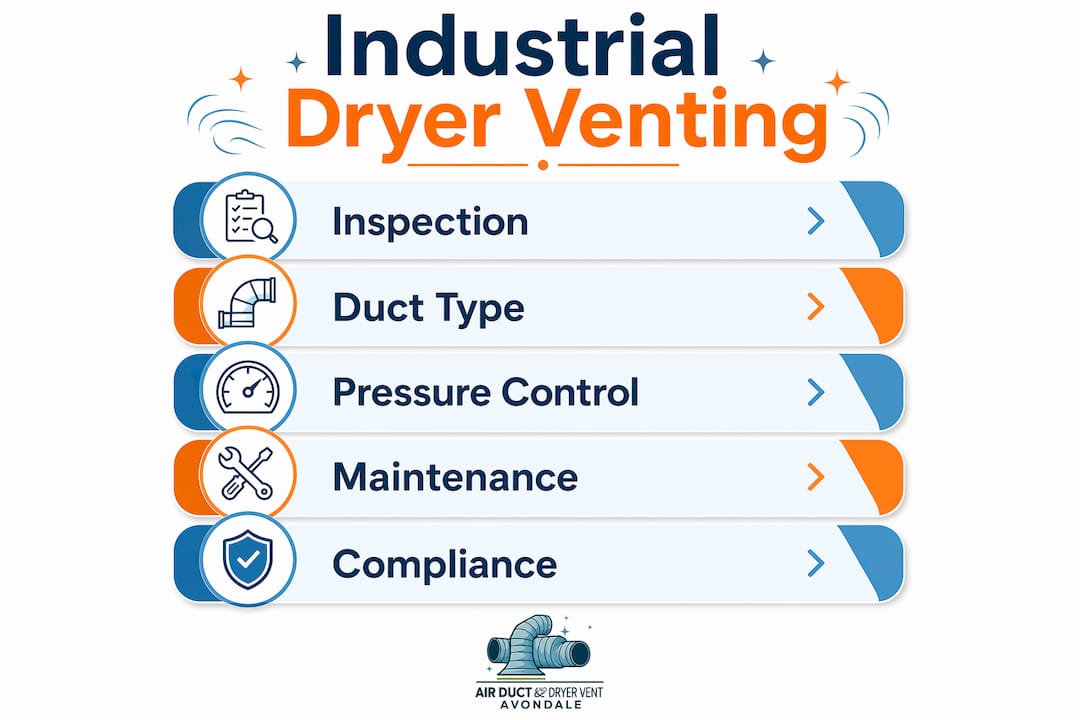
The single most important material decision is duct type. Flexible foil, plastic, or vinyl ducting is not approved for commercial or industrial dryer venting. Only rigid galvanized steel or stainless steel meets code. Flexible materials trap lint at every corrugation, reduce airflow, and create the exact conditions that lead to fires. If your facility has any flexible sections beyond the short transition duct at the dryer connection, that is a code violation worth addressing immediately.
Each dryer should have its own dedicated exhaust duct. Shared or manifolded systems are sometimes used in multi-unit facilities, but they require professional engineering with cleanouts, high-capacity fans, and pressure balancing. For individual runs, keep equivalent duct length under 15 feet for natural draft systems. Every 90-degree elbow adds roughly 5 equivalent feet to that calculation, so duct routing matters as much as raw distance.
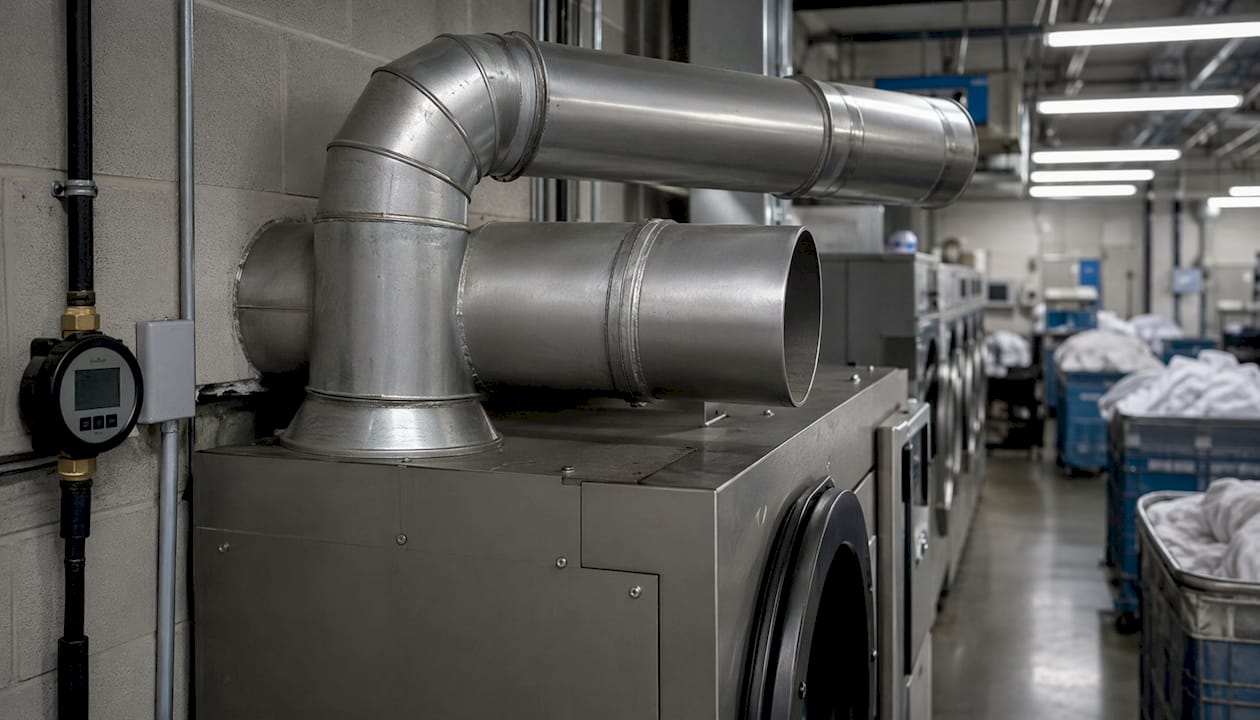
Pressure control is where many facilities fall short. Manufacturer specifications call for maintaining outlet duct pressure between +0.10 and +0.30 inches water column. Variable-speed exhaust fans paired with duct pressure sensors hold that range automatically, preventing both the under-pressure that starves airflow and the over-pressure that strains the dryer blower. In high-rise buildings, shaft design and variable-speed fans are particularly critical because stack effect and wind pressure can swing duct pressure well outside that range.
Exterior vent terminations deserve attention too. Mesh screens at the cap catch lint and block airflow within weeks of installation. The correct termination is a louvered, animal-proof damper that closes when the dryer is off and opens fully under exhaust pressure.
| Design parameter | Requirement |
|---|---|
| Duct material | Rigid galvanized steel or stainless steel only |
| Individual duct run (natural draft) | 15 equivalent feet maximum |
| Outlet duct pressure | +0.10 to +0.30 in. w.c. |
| Make-up air threshold (IMC) | Required when exhaust exceeds 200 CFM |
| Duct terminus | Louvered damper, no mesh screen |
| Multi-unit systems | Engineered manifold with cleanouts and high-capacity fans |
Key design elements for compliant industrial venting:
- Rigid metal ductwork throughout, no flexible sections except the listed transition duct
- Individual exhaust per dryer with runs kept as short and straight as possible
- Dedicated make-up air supply (louvers or mechanical fans) for any exhaust over 200 CFM
- Duct pressure sensors and variable-speed fans for manifold systems
- Louvered, animal-proof exterior vent caps with no mesh screens
- Cleanout ports at every change of direction in multi-dryer manifold systems
How often should you inspect and clean industrial dryer vents?
Industrial dryer vents require monthly inspections and professional duct cleaning on a schedule tied to usage volume. A facility running dryers eight or more hours a day accumulates lint far faster than a lightly used commercial laundry. Monthly is the floor, not the ceiling, for high-throughput operations.
The signs of a developing blockage are usually visible before a full restriction occurs. Clothes taking longer to dry, the dryer exterior running unusually hot, or a burning smell during operation all point to restricted exhaust. Any one of those symptoms warrants an immediate inspection, not a wait until the next scheduled cleaning.
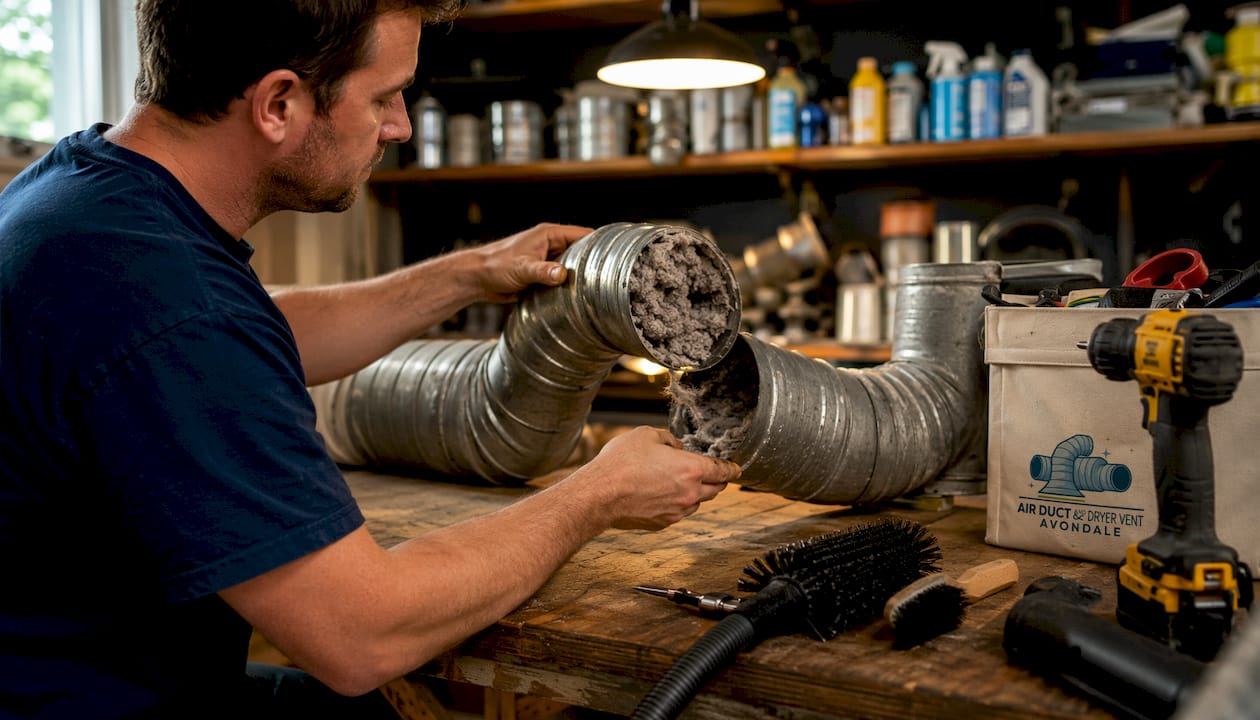
Pro Tip: Install inline lint traps and inspection ports at key points in your duct runs. They let maintenance staff check lint accumulation without disassembling the duct, and they catch debris before it reaches the exterior cap or the fan housing in manifold systems.
Professional cleaning matters for more than just safety. Documented cleaning records protect your warranty, satisfy insurance requirements, and provide evidence of due diligence if a fire investigation ever occurs. Keep a log with dates, technician credentials, and any findings from each service visit. For dryer vent cleaning in commercial settings, working with a certified technician who can also test airflow and pressure after cleaning is worth the added cost.
Maintenance best practices for facility managers:
- Schedule monthly lint removal and duct inspections for high-use industrial dryers
- Use smoke pens or lit matches at exterior doors to test for negative room pressure
- Document every cleaning and inspection with date, technician, and findings
- Replace any flexible duct sections found during inspection with rigid metal
- Check exterior vent caps for lint accumulation and damper function at each visit
- Verify make-up air supply is unobstructed and delivering adequate volume
Which codes govern industrial dryer venting, and what do they require?
The International Mechanical Code is the primary regulatory framework for commercial dryer venting in most U.S. jurisdictions. Its make-up air mandate is the provision facility managers most often miss: any exhaust system moving more than 200 CFM requires a dedicated make-up air source. Given that a single industrial dryer can exceed 800 CFM, a four-dryer laundry room may need to supply over 3,000 CFM of replacement air. Louvers, transfer grilles, or mechanical fans all qualify, but they must be sized to match the exhaust volume.
NFPA 54, the National Fuel Gas Code, governs combustion air requirements for gas-fired appliances. Its relevance to dryer venting is indirect but real: when a laundry room goes negative pressure because exhaust exceeds make-up air supply, gas-fired dryers and water heaters in that space cannot draw adequate combustion air. The result is incomplete combustion, elevated carbon monoxide production, and potential back-drafting into occupied areas. Coordinating dryer venting with combustion appliance requirements under NFPA 54 is not optional in a mixed-appliance laundry room.
Manufacturer installation instructions carry their own compliance weight. Following them is required to maintain warranty coverage, and deviating from them can constitute a code violation if the authority having jurisdiction treats manufacturer specs as part of the installation standard. Unity Laundry Systems, for example, publishes detailed venting specifications for its commercial dryer lines that specify duct diameter, maximum equivalent length, and pressure requirements. Ignoring those specs voids the warranty and creates liability exposure if a fire occurs.
Multi-unit duct systems in high-rise buildings add a layer of complexity. Fire-rated shaft requirements, damper specifications, and fan sizing for stack-effect compensation all come into play. The IMC addresses these configurations directly, and most jurisdictions require a mechanical engineer to stamp the design before a permit is issued.
Key codes and compliance requirements for industrial dryer venting:
- IMC: make-up air required for any exhaust exceeding 200 CFM
- IMC: rigid metal ductwork required, flexible materials prohibited
- IMC: duct length, diameter, and fan requirements for individual and manifold systems
- NFPA 54: combustion air coordination for gas appliances sharing laundry spaces
- Manufacturer specs: duct pressure, diameter, and length limits that affect warranty validity
- Fire-rated shaft and damper requirements for multi-story installations
FAQ
How do you vent a commercial dryer?
Commercial dryers must vent directly to the outdoors through rigid galvanized or stainless steel ductwork, with each unit on its own dedicated exhaust run kept under 15 equivalent feet for natural draft systems. Any installation exhausting more than 200 CFM also requires a dedicated make-up air source per the International Mechanical Code.
Why are commercial dryers different from residential dryers?
Commercial dryers operate at much higher airflow volumes, often exceeding 800 CFM per unit, and produce far more lint per cycle than residential machines. Those differences require engineered duct systems, dedicated make-up air, and monthly inspections rather than the basic flexible-duct setups that residential installations allow.
How many CFM does a commercial dryer exhaust?
A single commercial or industrial dryer typically exhausts 800 CFM or more, roughly four to eight times what a household unit produces. That volume is why the IMC mandates dedicated make-up air and why standard residential venting components cannot handle the load.
Why are vented dryers being phased out in some applications?
Ventless condensing dryers are gaining traction in high-rise and retrofit settings where running exhaust ductwork is impractical or cost-prohibitive. However, they are not a direct replacement for high-throughput industrial dryers, which still require vented designs to handle the moisture and lint volumes that commercial laundry operations generate.
What happens if an industrial dryer is not vented correctly?
Improper venting leads to lint accumulation, elevated internal temperatures, and fire risk, with lint buildup involved in 33% of dryer fires. Beyond fire, inadequate exhaust causes premature equipment failure, higher energy costs, and potential carbon monoxide back-drafting into occupied spaces.
Key Takeaways
Industrial dryers require purpose-built venting systems because their exhaust volumes, lint loads, and heat output exceed what standard residential or light commercial ductwork can safely handle.
| Point | Details |
|---|---|
| High exhaust volume | Industrial dryers often have very high exhaust air volumes, requiring dedicated make-up air under the IMC. |
| Lint fire risk | Lint buildup is a factor in 33% of dryer fires, making routine cleaning a safety requirement. |
| Rigid ductwork only | Flexible foil or vinyl ducting is prohibited; only rigid galvanized or stainless steel meets code. |
| Pressure control | Outlet duct pressure must stay between +0.10 and +0.30 in. w.c. per manufacturer specifications. |
| Monthly inspections | High-use industrial dryer vents require monthly inspections and documented professional cleaning. |
Airanddryerventcleaningavondale provides professional commercial dryer vent cleaning for facilities in Avondale, Arizona, including inspection, lint removal, pressure testing, and documentation for compliance records. If your facility runs industrial dryers and has not had a professional vent inspection recently, that is the right place to start.