

TL;DR:
- Proper air duct sizing is crucial for optimal HVAC performance, efficiency, and indoor comfort. Incorrectly sized ducts lead to increased static pressure, poor airflow, and higher energy costs, while well-designed systems ensure balanced distribution and longevity. Accurate load calculations, Native Manual D design, and regular maintenance are essential for achieving the best results.
Air duct size is the single most influential factor in how well your HVAC system delivers conditioned air throughout your home or building. Get the sizing wrong in either direction and you pay for it in higher utility bills, uneven temperatures, and equipment that wears out years ahead of schedule. The industry standard for duct design, ACCA Manual D, exists precisely because sizing decisions are too consequential to leave to guesswork. Understanding why duct dimensions matter gives homeowners and property managers the knowledge to protect a major investment and keep indoor air quality where it needs to be.
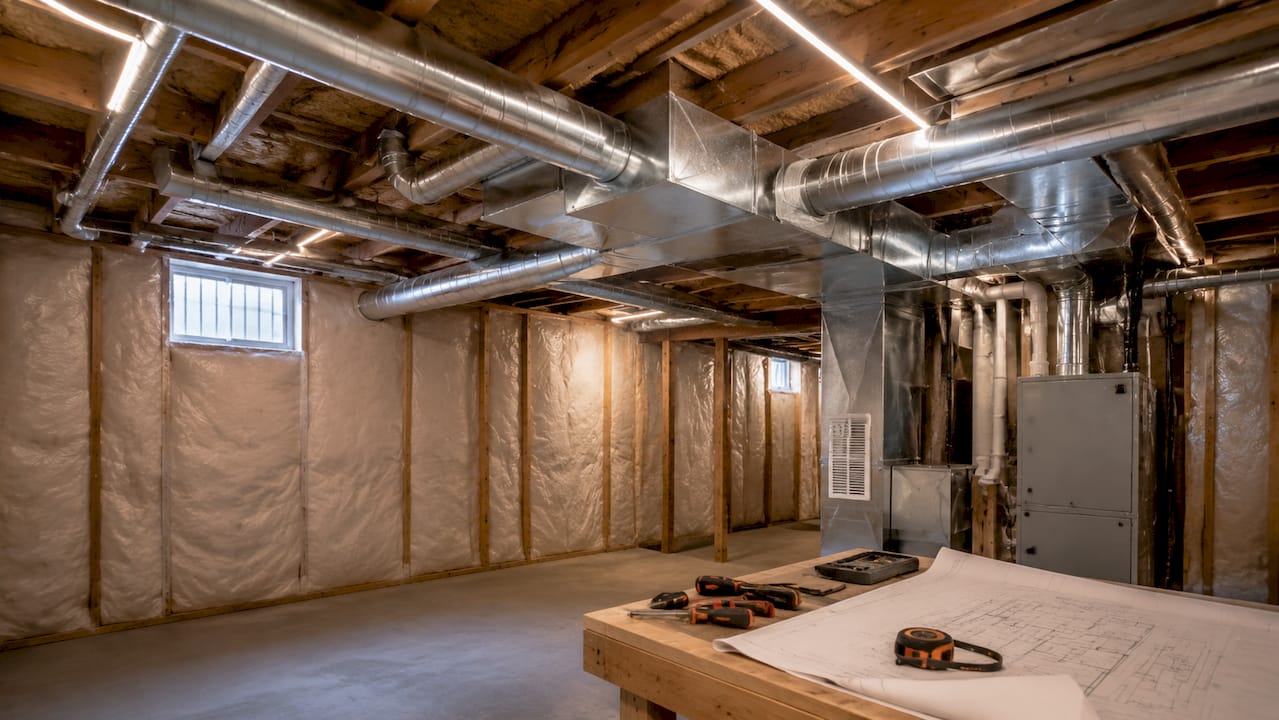
Why is air duct size important for your HVAC system?
Air duct size controls two things that determine whether your HVAC system performs or struggles: airflow volume and air velocity. A duct that is too narrow restricts how much air can move per minute. A duct that is too wide lets air slow down so much that it never properly mixes with the room air. Both failures produce the same result: a system that runs longer, works harder, and costs more to operate.
The ACCA Manual D methodology is the recognized industry standard for residential duct design. It calculates the correct duct dimensions based on the airflow requirements from a Manual J load calculation, which accounts for your home's square footage, insulation levels, window placement, and local climate. In Avondale, Arizona, where summer cooling loads are extreme, skipping this step is especially costly. A duct system sized for a mild climate will choke an HVAC unit trying to push conditioned air through 110-degree heat.
Understanding HVAC airflow is the foundation of every sizing decision. When ducts are correctly sized, the blower motor operates within its designed range, static pressure stays in check, and every room receives the airflow it needs. When they are not, the entire system compensates in ways that accelerate wear and inflate your energy bill.
Pro Tip: Before any duct replacement or HVAC upgrade, request a Manual J load calculation from your contractor. Without it, new equipment is often paired with old, incorrectly sized ductwork, and you get none of the efficiency gains you paid for.
What happens when air ducts are too small or too large?
Sizing errors fall into two categories, and both cause real damage to your system and your comfort.
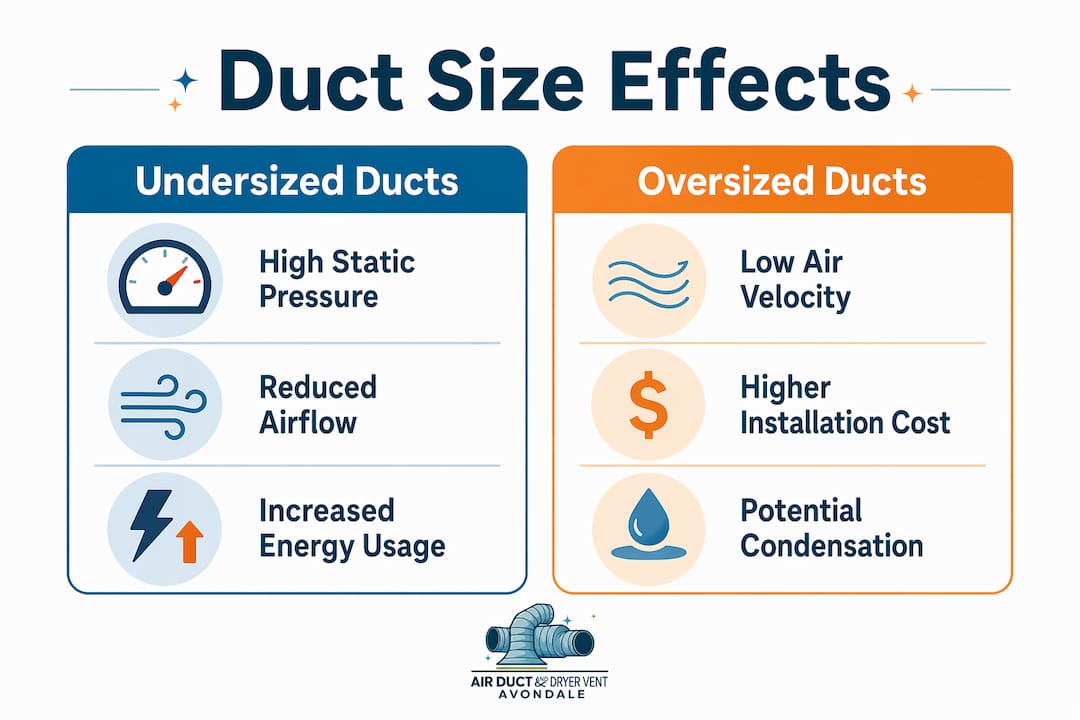
Undersized ducts: the pressure problem
When ducts are too small for the airflow the system needs to move, static pressure rises. Static pressure is the resistance the blower motor fights against to push air through the duct network. The ideal static pressure for most residential systems sits around 0.5 inches of water column (WC). When ducts are undersized, static pressure above 0.8 in WC causes airflow to drop by 20 to 40 percent. That is not a minor inconvenience. A 30 percent airflow reduction means rooms at the end of the duct run receive almost no conditioned air, while the blower motor strains continuously against resistance it was never designed to handle.
The consequences compound quickly:
- Blower motors overheat and fail prematurely
- Evaporator coils freeze because insufficient airflow prevents heat exchange
- Hot or cold spots appear in rooms farthest from the air handler
- The system short-cycles, turning on and off more frequently than designed
- Noise increases as air forces itself through undersized passages at high velocity
Oversized ducts: the velocity problem
Counterintuitively, bigger is not better when it comes to duct sizing. Oversized ducts reduce air velocity, which causes thermal stratification. Thermal stratification means warm air pools near the ceiling while cool air settles near the floor, and the two layers never mix properly. You end up with a room that feels uncomfortable regardless of what the thermostat reads.
Oversized ducts also cost more to install and require more insulation to prevent condensation. The system delivers air so slowly that it loses temperature before reaching the register, particularly in longer duct runs. Both undersizing and oversizing increase energy consumption and shorten equipment lifespan. The goal is a duct system sized precisely for the airflow volume the equipment produces and the rooms require.
How duct size affects HVAC efficiency and energy bills
The financial case for correct duct sizing is straightforward. Poorly sized and leaky duct systems can result in a loss of 20 to 30 percent of conditioned air, while proper design and sealing reduce energy bills by 15 to 25 percent. For a household spending $200 per month on cooling in an Arizona summer, that represents $30 to $50 in monthly savings from duct sizing alone.
Air velocity is the measurable indicator of whether a duct is correctly sized. The table below shows the recommended velocity ranges for different parts of a residential duct system:
| Duct section | Recommended air velocity | Effect of deviation |
|---|---|---|
| Main trunk ducts | 700 to 900 FPM | Below 700 FPM causes stratification; above 900 FPM causes noise |
| Branch runs | 400 to 600 FPM | Below 400 FPM reduces room mixing; above 600 FPM increases static pressure |
| Return air ducts | 400 to 600 FPM | Undersized returns restrict system airflow and cause coil damage |
These velocity ranges for main trunks are not arbitrary. They represent the balance point where air moves fast enough to mix properly in rooms but slow enough to avoid turbulence, noise, and excessive friction losses in the duct walls.
Equipment capacity does not guarantee comfort on its own. Duct bottlenecks create high static pressure that shortens equipment lifespan regardless of how efficient the unit is rated. A 20 SEER heat pump paired with undersized ductwork will perform worse in practice than a 14 SEER unit with correctly sized ducts. This is the most expensive mistake homeowners make when upgrading HVAC equipment.
Pro Tip: Ask your HVAC technician to measure static pressure at the air handler during your next service visit. A reading above 0.8 inches WC is a clear signal that your duct system needs evaluation, even if the equipment itself is in good condition.
The impact on energy savings and indoor air quality extends beyond the equipment itself. Correctly sized ducts distribute filtered air evenly, which means your filtration system works as designed across every room rather than just near the air handler.
Why duct design considers more than just size
Size is the starting point, but duct performance depends on several other design factors that most homeowners never hear about until something goes wrong.
Aspect ratio and friction loss
Rectangular ducts are common in residential construction because they fit between floor joists and wall cavities. The problem is that a flat, wide duct creates far more surface area in contact with moving air than a round duct carrying the same volume. Aspect ratio affects friction loss, and designers aim for a ratio close to 1:1 to minimize pressure drop. A duct that is 24 inches wide and 6 inches tall has a 4:1 aspect ratio, which generates significantly more friction than a 12 by 12 inch duct moving the same airflow. That friction forces the blower to work harder and consumes more energy.
Round ducts are the most efficient shape for any given cross-sectional area. Flexible duct, common in residential attic installations, performs reasonably well when fully extended but loses significant efficiency when compressed or kinked. A compressed flex duct section can increase friction loss by 50 percent or more over a short run.
Return duct sizing: the most neglected factor
Return ducts carry air back to the air handler to be conditioned again. Most homeowners focus entirely on supply ducts and ignore the return side. Undersized return ducts cause pressure imbalance, coil freezing, and heat exchanger overheating. These are not minor performance issues. A cracked heat exchanger is a safety hazard and a repair bill that often exceeds the cost of a new furnace.
The comparison below shows how supply and return duct sizing errors differ in their effects:
| Sizing error | Supply duct impact | Return duct impact |
|---|---|---|
| Too small | High static pressure, noise, reduced airflow to rooms | Negative pressure, coil freeze, heat exchanger stress |
| Too large | Low velocity, thermal stratification, poor room mixing | Reduced return velocity, poor filtration efficiency |
| Correct sizing | Balanced airflow, proper velocity, even temperatures | Stable system pressure, full equipment lifespan |
Return air sizing is as important as supply duct sizing, yet it is routinely undersized in homes built before the widespread adoption of Manual D calculations. If your home has a single return grille for a multi-room system, that is almost certainly a design deficiency worth addressing.
Pro Tip: Check whether your home has return air pathways in every bedroom. Closed bedroom doors with no return grille or door undercut create pressure imbalances that force conditioned air out through wall gaps and attic bypasses, wasting energy and pulling in unconditioned outside air.
Practical steps to get duct sizing right
Getting duct sizing right is not a DIY project, but understanding the process helps you ask the right questions and avoid being sold solutions that do not address the actual problem.
-
Start with a Manual J load calculation. This is the industry-standard method for determining how much heating and cooling each room in your home requires. Every duct sizing decision flows from this number. Without it, any duct sizing is a guess. Insist that your contractor provide documentation of this calculation before any duct work begins.
-
Require Manual D duct design. Once the Manual J load is established, Manual D uses that data to calculate the correct duct sizes, lengths, and configurations. HVAC contractors certified through ACCA or NATE are trained in this methodology. Ask specifically whether the contractor uses Manual D, not just rule-of-thumb sizing.
-
Use a duct sizing calculator as a verification tool. Online tools like the HVAC duct sizing calculators available through ACCA and various engineering resources let you cross-check contractor proposals. Target a friction rate near 0.08 in. w.c. per 100 feet for residential systems. This balances duct diameter, velocity, noise, and efficiency in a single design parameter.
-
Seal and insulate ducts alongside resizing. Correct sizing alone does not capture all available efficiency gains. Sealing and insulating ducts improve system efficiency by up to 20 percent. In an attic installation in Avondale where summer temperatures exceed 150 degrees Fahrenheit in the attic space, uninsulated ducts lose a significant portion of their cooling capacity before air ever reaches the living space. Mastic sealant applied at all joints, combined with R-8 duct insulation, is the minimum standard for Arizona climates.
-
Balance airflow with dampers after installation. Even a correctly sized duct system benefits from balancing. Manual dampers installed at branch takeoffs allow a technician to fine-tune airflow to each room. This step is often skipped because it requires time and measurement equipment, but it is the difference between a system that performs on paper and one that performs in every room.
-
Inspect ducts every three to five years. Duct systems degrade over time. Joints separate, insulation deteriorates, and air duct leaks develop at connection points. Regular inspection catches these problems before they compound into major efficiency losses. Property managers overseeing multiple units should treat duct inspection as a standard line item in their maintenance schedule.
Common mistakes to avoid: never add supply registers without recalculating the duct system, never block return grilles with furniture, and never assume that a new HVAC unit will fix comfort problems caused by undersized ductwork.
Key takeaways
Air duct size directly controls static pressure, air velocity, and system efficiency, making it the most consequential design decision in any HVAC installation.
| Point | Details |
|---|---|
| Undersized ducts raise static pressure | Static pressure above 0.8 in WC cuts airflow by 20 to 40 percent and strains the blower motor. |
| Oversized ducts cause stratification | Low air velocity prevents proper room mixing, leaving occupants uncomfortable despite the system running. |
| Correct sizing cuts energy costs | Proper duct design and sealing reduce energy bills by 15 to 25 percent compared to poorly sized systems. |
| Return ducts matter as much as supply | Undersized return ducts cause coil freezing and heat exchanger damage, not just comfort issues. |
| Manual D is the design standard | ACCA Manual D calculations, combined with Manual J load data, are the only reliable basis for duct sizing. |
What I've learned from watching homeowners get duct sizing wrong
Most homeowners I talk to have never heard of Manual D. They know their HVAC brand, they know their unit's tonnage, and they assume that a bigger or newer unit will fix whatever comfort problem they have. What they do not know is that equipment capacity alone does not deliver comfort. The ductwork is the delivery system, and a high-efficiency unit pushing air through undersized ducts is like a high-performance engine bolted to a car with a clogged fuel line.
The pattern I see repeatedly is this: a homeowner upgrades from a 3-ton to a 4-ton unit because rooms feel hot in summer. The contractor installs the new unit without touching the ductwork. Six months later, the homeowner calls back because the system is louder, the energy bill is higher, and the hot rooms are still hot. The new unit is pushing more air through the same undersized ducts, which raises static pressure further and makes everything worse.
The uncomfortable truth is that duct sizing is unglamorous work. It does not sell itself the way a high-SEER rating does. But in my experience, a properly designed duct system on a mid-efficiency unit outperforms a high-efficiency unit on a poorly designed duct system every single time. If you are planning any HVAC upgrade, get the duct system evaluated first. The types of air ducts in your home, their condition, and their sizing should be the first conversation, not an afterthought.
— Shaun
Get your Avondale duct system professionally evaluated
If your home has uneven temperatures, rising energy bills, or an HVAC system that runs constantly without satisfying the thermostat, the duct system is the first place to look.
Airanddryerventcleaningavondale provides professional air duct cleaning and inspection for residential and commercial properties throughout Avondale, Arizona. The team identifies airflow restrictions, duct leaks, and sizing issues that undermine system performance and indoor air quality. For properties with damaged or incorrectly sized ductwork, duct repair and replacement services restore proper airflow and help your HVAC system perform the way it was designed to. Schedule an inspection and start recovering the energy efficiency your system should already be delivering.
FAQ
Why is air duct size important for home comfort?
Air duct size controls the volume and velocity of conditioned air reaching each room. Incorrect sizing causes uneven temperatures, excessive noise, and an HVAC system that runs longer without meeting the thermostat setpoint.
What is the ideal static pressure for a residential duct system?
The ideal static pressure for most residential HVAC systems is around 0.5 inches of water column. Static pressure above 0.8 inches WC indicates undersized or restricted ductwork and causes airflow to drop by 20 to 40 percent.
Can oversized ducts cause problems?
Yes. Oversized ducts reduce air velocity below the 400 to 600 FPM range needed for proper room mixing, causing thermal stratification where warm and cool air layers separate instead of blending evenly throughout the space.
How much energy can proper duct sizing save?
Properly designed and sealed duct systems reduce energy bills by 15 to 25 percent compared to poorly sized systems. Sealing and insulating existing ducts alone can improve system efficiency by up to 20 percent.
How do I know if my ducts are the wrong size?
Common signs include hot or cold spots in specific rooms, unusually high energy bills, excessive noise from the vents, and a system that runs continuously without reaching the set temperature. A static pressure measurement by a certified HVAC technician confirms whether duct sizing is the cause.