
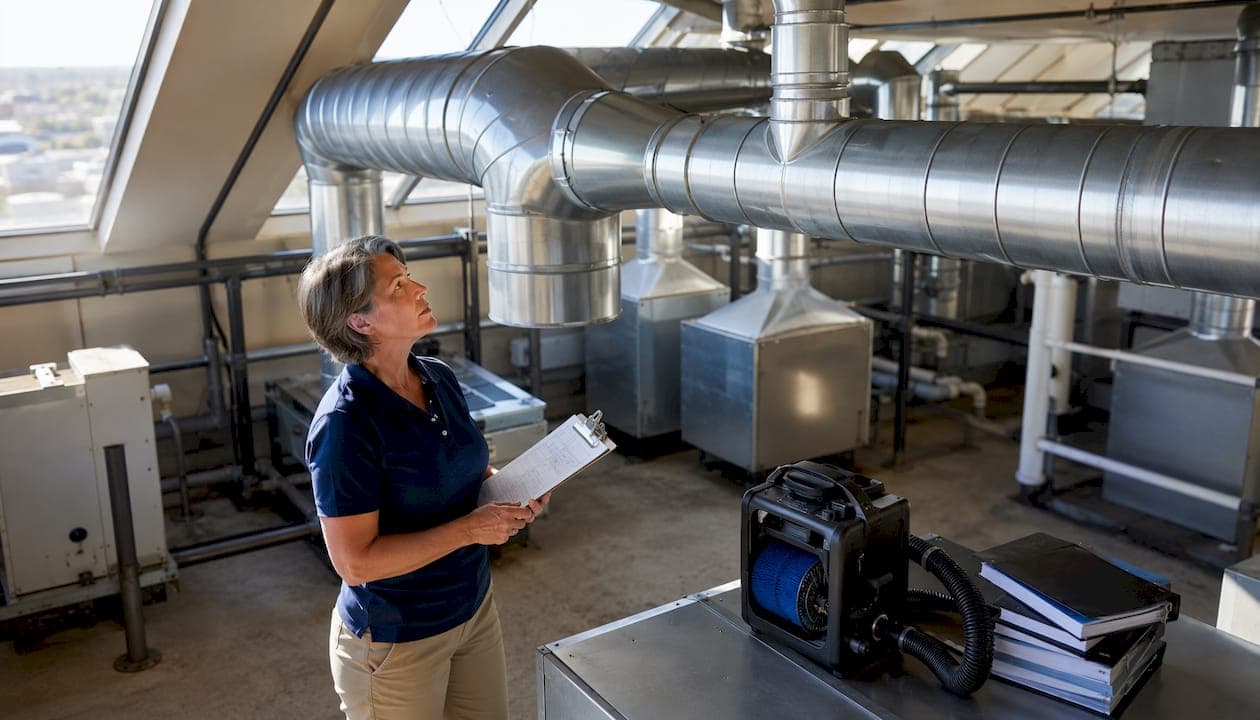
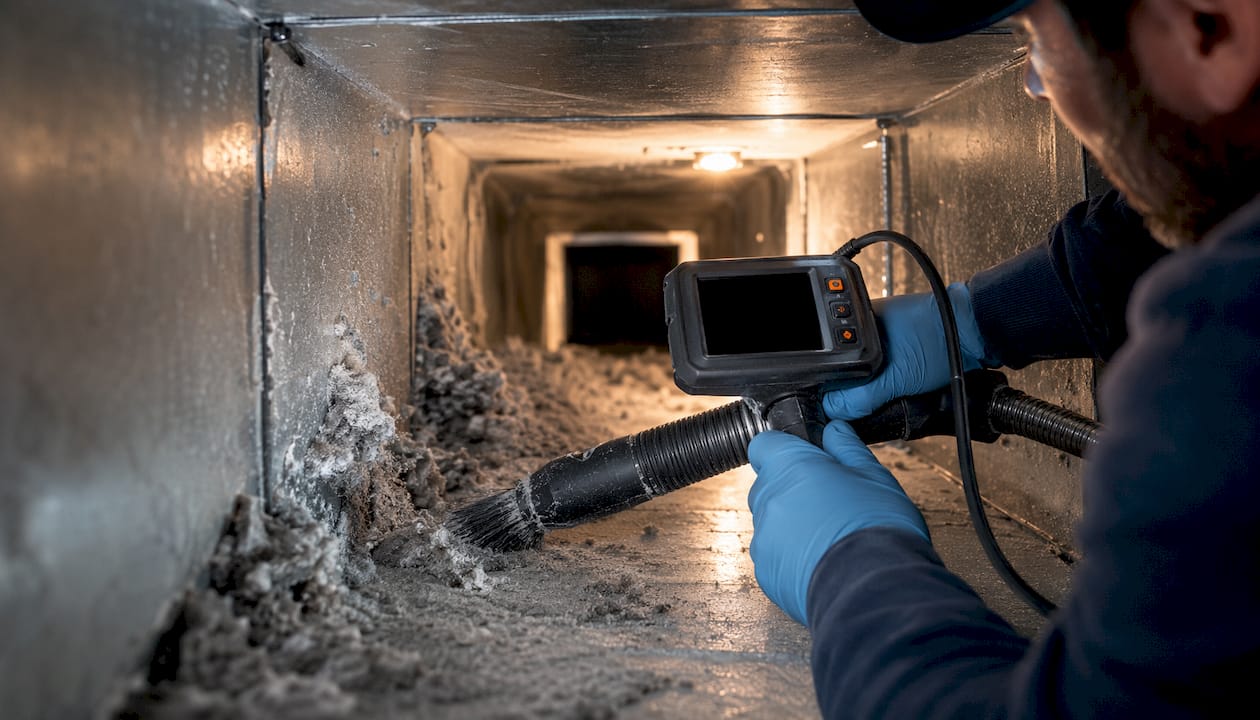
Multi-unit residential buildings need duct cleaning when specific contamination is present: visible mold or slime inside duct runs, persistent musty odors traced to the HVAC system, large dust discharge from supply registers, water or flood damage to ductwork, or evidence of pests in the system. The three highest-priority triggers for multifamily properties are mold or moisture in shared shafts, lint accumulation in shared dryer exhausts (a direct fire hazard), and visible dust discharge or restricted airflow stressing blower equipment across multiple units.
Your immediate next step: schedule a visual inspection with photographic documentation of common-area systems and shared dryer exhausts before anything else. Isolate affected shafts pending remediation. The U.S. EPA and industrial hygienists are clear that cleaning should follow identified contamination, not a calendar. The DOHS fact sheet reinforces this: clean when you have a reason, not as blanket preventive maintenance.
- Mold or moisture in ducts or insulation: Act immediately; wet porous liner must be replaced, not treated.
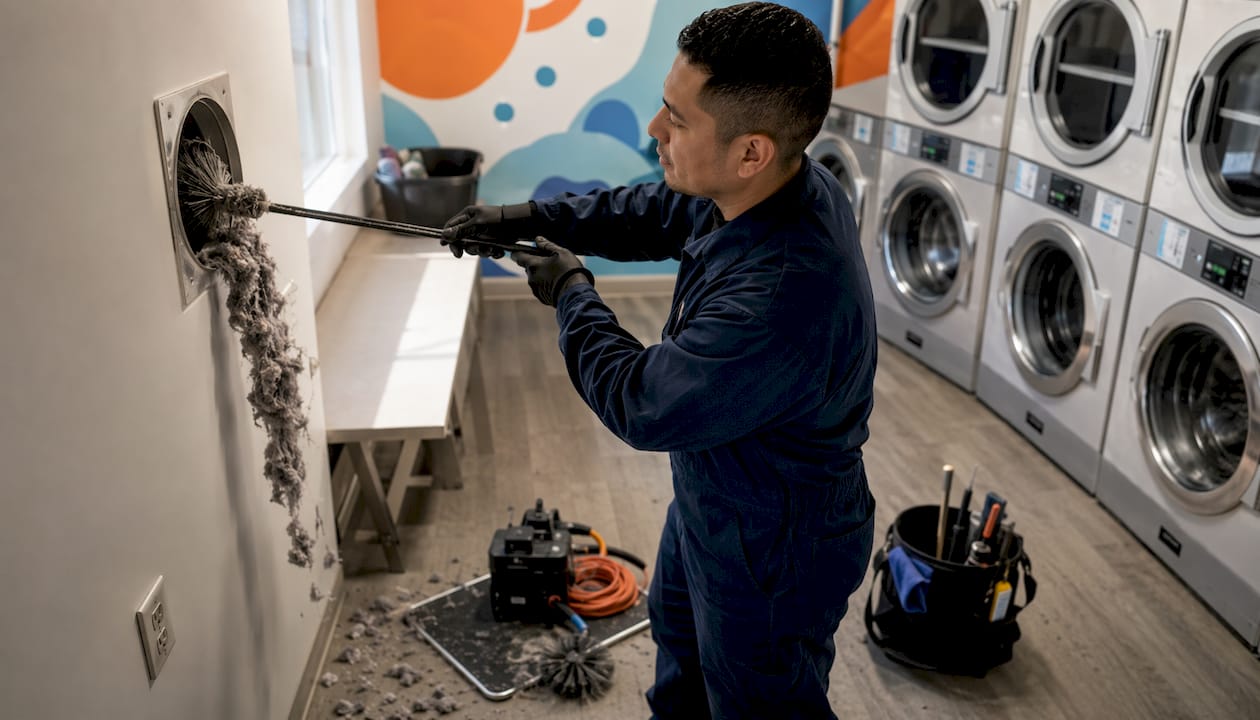
- Shared dryer exhaust lint: Schedule annual cleaning; lint buildup in common exhausts is a leading preventable fire risk in multifamily buildings.
- Visible dust discharge or restricted airflow: Commission a diagnostic inspection to assess static pressure and blower stress before equipment fails.
Pro Tip: Combine dryer-vent cleaning and common-area duct cleaning into a single building-wide project. You cut disruption in half, often get better pricing, and produce one consolidated compliance record.
For Avondale properties, Airanddryerventcleaningavondale (Air Duct & Dryer Vent Avondale) is the local resource for building-scale inspections, documented cleaning, and NADCA-aligned procedures.
Table of Contents
- Why shared systems make multi-unit properties uniquely vulnerable
- Concrete benefits property owners can actually count on
- Signs that should trigger a duct-cleaning work order now
- What a professional multi-unit duct cleaning should include
- Who pays, who coordinates, and how to document it
- How often to budget for cleaning and what it costs
- How to pick a contractor for a multi-unit building
- What a typical multifamily job looks like with Air Duct & Dryer Vent Avondale
- Key Takeaways
- The part most property managers get wrong
- Air Duct & Dryer Vent Avondale serves multifamily properties across Avondale
- Useful sources and further reading
- FAQ
Why shared systems make multi-unit properties uniquely vulnerable
Single-family homes have one household's worth of contaminants moving through one set of ducts. A 40-unit apartment building is a different problem entirely.
Shared vertical shafts and common-area mechanical rooms let contaminants travel between units. A smoker on the third floor, a pet owner on the second, and a tenant who cooks heavily on the fourth all contribute to a shared airstream. Cleaning only one unit's registers rarely solves a building-level odor or allergen problem because contaminants migrate through transfer vents and interconnected shafts.
- Higher turnover and mixed behaviors: Smoking, pets, and heavy cooking accelerate debris buildup faster than in owner-occupied homes.
- Concentrated lint loads: Multiple dryers exhausting into a shared stack build lint far faster than a single-family dryer, and that lint is a fire-inspection failure point.
- Static pressure and equipment stress: Clogged ducts raise static pressure on blower fans, driving premature motor failure and uneven temperature distribution across floors — a direct tenant-satisfaction and energy-cost problem.
- Access and containment complexity: Occupied units, limited shaft access, and the risk of cross-contamination require coordinated scheduling and physical containment that single-family jobs simply don't need.
The structural reality is that a problem in one part of the system can show up as a complaint in a completely different unit. That's what makes multi-unit HVAC cleaning a building-scale project, not a unit-by-unit task.
Concrete benefits property owners can actually count on
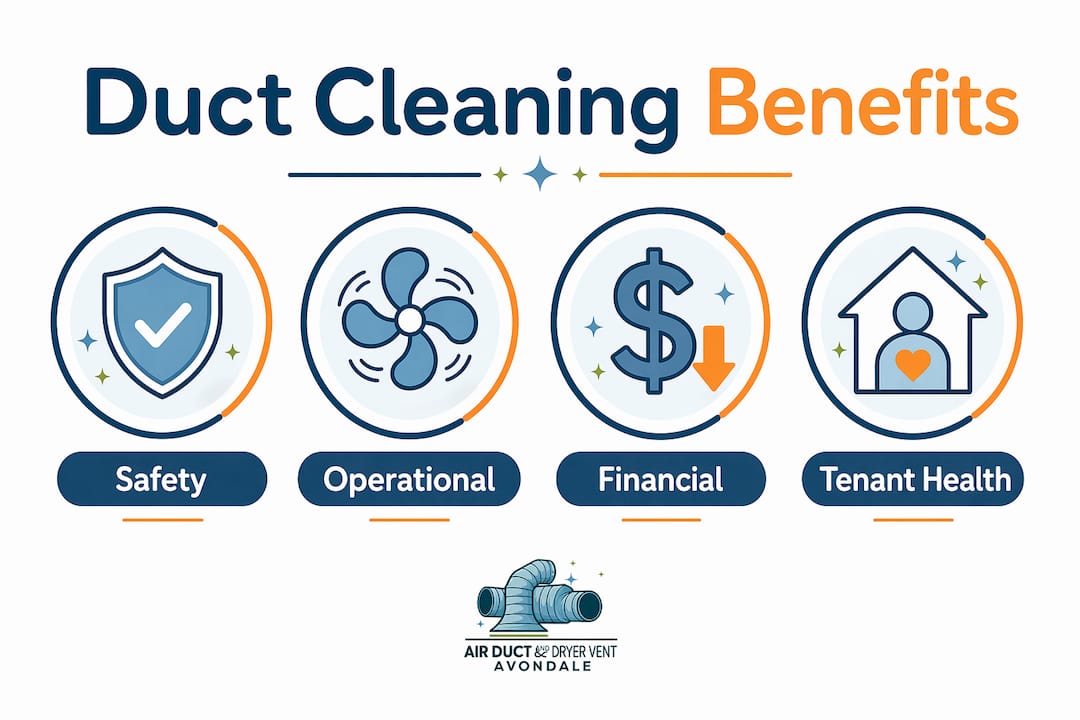
The benefits of duct cleaning in multifamily buildings fall into four categories: safety, operational, financial, and tenant relations. Being honest about what cleaning does and doesn't deliver matters here.
Fire risk reduction is the most defensible benefit. Dryer vent lint accumulation in shared exhausts is a leading preventable fire risk in multi-unit properties, and local fire codes often expect regular inspection and cleaning. Regular dryer-vent cleaning is generally recommended in occupied multifamily buildings as a liability management practice.
Odor removal and airflow restoration are real and measurable. When debris physically blocks registers or coats coil surfaces, cleaning restores flow. Tenant complaints about uneven heating or cooling often trace directly to restricted ducts, and resolving that reduces turnover.
Equipment lifespan improves when static pressure drops. Blower motors running against restricted ducts wear out faster. Cleaning that resolves a flow restriction can defer a costly motor or coil replacement.
The EPA is explicit: there is little evidence that routine duct cleaning prevents health problems in the general population. Clean when contamination is identified and the source is controlled — not on a fixed schedule for its own sake.
Risk management value is often underestimated. Documented cleaning creates a paper trail for insurance purposes, demonstrates due diligence in tenant-safety communications, and supports fire-code compliance. That documentation is worth as much as the cleaning itself in a liability context.
Signs that should trigger a duct-cleaning work order now
Use this as a prioritized checklist. If you check any high-priority item, commission an inspection this week.
High-priority triggers (act immediately):
- Visible mold or slime inside duct runs or on registers
- Water or flood damage to ductwork or duct insulation
- Persistent musty or foul odors traced to the HVAC system
- Large visible dust discharge from supply registers into occupied units
- Evidence of rodent or pest infestation inside duct runs
Performance triggers (schedule within 30 days):
- Uneven airflow or temperature complaints across multiple units on the same system
- Sudden rise in energy usage without an obvious cause
- Repeated blower motor failures suggesting elevated static pressure
Regulatory triggers (address before next inspection):
- Failed fire-safety inspection related to dryer vents or shared exhausts
- Local code citations for HVAC or ventilation maintenance
Operational triggers (include in next scheduled project):
- Post-construction or renovation dust contamination in duct runs
- Heavy debris after a tenant move-out with known smoking or pet history
"Duct cleaning is appropriate when specific contamination is present — and the contamination source must be identified and controlled before or during cleaning, or the problem will return." — DOHS/NIH Fact Sheet on HVAC Duct Cleaning
After large renovation or flood events, professional duct cleaning is often necessary because dust, oil residues, and debris introduced during those events can be significant and accessible.
What a professional multi-unit duct cleaning should include
A scope of work that doesn't specify deliverables is an invitation for a partial cleaning. Here's what to insist on.
Core inclusions:
- Full vacuuming of accessible supply and return runs using negative-air equipment
- Mechanical agitation of debris (rotary brush or equivalent)
- Cleaning of registers and grilles
- Cleaning of air handler components: coils, fan housing, and drip pans when warranted
- Physical containment to prevent cross-contamination between units during service
- Photographic before/after documentation of all cleaned sections
What to insist on in the written scope of work:
- NADCA-aligned cleaning procedures or equivalent documented standard
- Written pre-inspection report identifying contamination type and location
- Documented containment plan for occupied units
- Negative-air vacuuming with HEPA-filtered equipment
- Warranty terms and itemized repair recommendations identified during cleaning
Common red flags and exclusions:
- Biocide application on porous fiberglass-lined duct without replacement. NADCA and EPA both caution against relying on biocides for porous materials; wet or moldy liner should be replaced.
- Inaccessible sections inside walls cleaned without a specific access plan
- No photographic evidence offered
Cleaning large interconnected HVAC systems requires specialized equipment and containment to prevent cross-contamination in occupied units. A contractor who shows up with a shop vac is not equipped for this work.
Dryer-vent cleaning is a separate but often simultaneous project for buildings with shared exhausts. Scope it as a distinct line item with its own before/after documentation and annual scheduling.
Who pays, who coordinates, and how to document it
Responsibility splits in multifamily properties follow a consistent pattern, but the details depend on your CC&Rs, lease agreements, and local code.
Typical responsibility split:
- Owner or HOA: Common-area duct systems, vertical shafts, shared dryer exhausts, mechanical room equipment, and any system that serves more than one unit.
- Individual unit owners or tenants: In-suite filters, interior diffusers, and unit-level maintenance specified in the lease.
Always verify against your CC&Rs and leases before assigning costs. Ambiguity here creates disputes.
Coordination steps for occupied buildings:
- Issue written tenant notices at least 72 hours before access
- Schedule by floor or zone to clean all units in one pass rather than returning repeatedly
- Use after-hours scheduling where possible to reduce disruption
- Document every unit accessed with date, technician name, and scope performed
Governance and liability: NFPA standards and local fire codes assign responsibility for dryer-vent maintenance to the building owner or HOA in most jurisdictions. HOAs commonly adopt annual dryer-vent schedules to reduce fire risk and liability. Governance clarity in CC&Rs is the single most effective way to prevent disputes about who pays.
Documents to maintain in the property file:
- Pre- and post-cleaning inspection reports with photographs
- Written scope of work and itemized invoices
- Contractor's certificate of insurance and worker's comp documentation
- NADCA membership or certification documentation if applicable
- Fire-safety inspection records for dryer vents
How often to budget for cleaning and what it costs
Follow EPA and NADCA guidance: clean based on triggers, not a fixed calendar. That said, most multifamily properties operate on a practical cycle.
Practical frequency rules:
- Shared dryer exhausts: Annual cleaning, minimum. Lint builds faster in shared stacks than in single-family homes, and fire marshals treat this as a standard inspection point.
- Common-area HVAC ducts: Inspect annually; clean on a 3–5 year rotation or when triggers appear.
- In-suite systems: Inspect at tenant turnover; clean when contamination is identified.
| Building size | Typical scope | Suggested frequency | Ballpark cost range (estimate) |
|---|---|---|---|
| Small (10–30 units) | Common-area ducts + dryer vents | Annual dryer vents; ducts every 3–5 years | — |
| Mid size | Full common-area system + shared exhausts | Annual dryer vents; ducts every 3–4 years | — |
| Large | Phased by zone; AHU cleaning included | Annual dryer vents; ducts on 3-year zone rotation | — |
Cost ranges are estimates for planning purposes only. Actual quotes depend on system complexity, access, contamination level, and local market rates.
Budgeting tips:
- Rotate unit-level duct inspections on a 3-year cycle so you're not cleaning the entire building at once.
- Budget dryer-vent cleaning as an annual line item in fire-safety or maintenance reserves.
- Factor in potential repair costs identified during cleaning: damaged insulation, disconnected runs, or failed dampers often surface during a thorough inspection.
- Air filter replacement on a regular schedule reduces debris load and extends the interval between full duct cleanings.
How to pick a contractor for a multi-unit building
Vetting a contractor for a multifamily job is different from hiring someone for a single-family home. The stakes are higher, the logistics are more complex, and the documentation requirements are real.
Credentials to request before signing anything:
- Proof of commercial general liability insurance and worker's compensation
- NADCA membership or certification, or documented equivalent procedural standards
- References from comparable multifamily projects (ask for property manager contacts, not just names)
- Experience with occupied buildings and shared dryer exhaust systems specifically
Sample RFP questions:
- What containment method do you use to prevent cross-contamination between units?
- What vacuuming equipment do you use, and is it HEPA-filtered?
- How do you handle inaccessible runs or contaminated porous insulation?
- What photographic documentation do you provide, and in what format?
- What are your warranty terms, and what triggers a callback?
- How do you coordinate tenant access and scheduling in occupied buildings?
Red flags:
- Low-ball pricing with no written scope of work
- Reliance on biocides as the primary solution without pre-testing
- No before/after photos offered or inability to produce references
- No certificate of insurance or unwillingness to name the property as additionally insured
- Vague answers about containment or equipment
Contractor selection checklist (paste into your RFP):
- Itemized written estimate with line-item pricing
- Written scope of work with defined deliverables and acceptance criteria
- Timeline for access, including unit-by-unit or zone scheduling
- Required safety practices for occupied buildings documented
- Certificate of insurance naming the property
- Photographic documentation plan
- Warranty terms in writing
What a typical multifamily job looks like with Air Duct & Dryer Vent Avondale
A representative project for a mid-size Avondale multifamily property might start with a complaint pattern: tenants on upper floors reporting musty odors and uneven airflow, combined with a shared laundry room that hasn't had dryer-vent service in over two years.
The scope for a job like this typically covers shared dryer exhausts from the laundry room through the roof termination, common-area supply and return runs, and AHU coil cleaning where coil fouling is contributing to restricted airflow. Technicians work zone by zone, with containment barriers in place and negative-air equipment running to prevent debris from migrating into occupied units during service.
What documented outcomes look like:
- Before/after photographs of each duct section and dryer exhaust
- Airflow measurements at registers before and after cleaning
- Written inspection report identifying any damaged insulation, disconnected runs, or dampers needing repair
- Itemized invoice with warranty terms for the work performed
- IAQ testing results if requested as part of the scope
Airanddryerventcleaningavondale provides commercial air duct cleaning with documented, warrantied service for Avondale properties. The combination of local code familiarity and experience coordinating access in occupied buildings is what separates a building-scale job from a residential call.
Key Takeaways
Multi-unit buildings need duct cleaning when specific contamination is identified, not on a routine calendar, with shared dryer exhausts needing regular attention as a fire-safety baseline.
| Point | Details |
|---|---|
| Clean on triggers, not a schedule | EPA guidance: clean when mold, water damage, pest infestation, or visible dust discharge is confirmed. |
| Dryer vents need annual service | Shared exhausts build lint faster than single-family systems and are a common fire-marshal inspection failure point. |
| Scope of work protects you | Insist on NADCA-aligned procedures, negative-air vacuuming, containment, and before/after photos in every contract. |
| Budget on a 3–5 year cycle | Rotate common-area duct inspections every 3–5 years; budget dryer-vent cleaning as an annual line item. |
| Airanddryerventcleaningavondale | Offers documented, warrantied commercial duct and dryer-vent cleaning for multifamily properties in Avondale, AZ. |
The part most property managers get wrong
The conventional wisdom on duct cleaning in multifamily buildings tends to fall into one of two traps: either "clean everything every year" or "never bother unless a tenant complains." Both are wrong, and both cost money.
The annual blanket-cleaning approach ignores what the EPA and a systematic review of field studies have both found: routine cleaning rarely produces measurable health improvements. You're spending real money on a service that may not address the actual problem, and you're not necessarily reducing liability by doing it.
The "wait for complaints" approach is worse. By the time tenants are complaining about odors or uneven airflow, static pressure has already been stressing your blower motors for months. Shared dryer exhausts that haven't been serviced in three years are a fire inspection problem waiting to happen, not a tenant-relations problem.
The right frame is risk-based maintenance. Inspect annually. Clean when triggers appear. Treat dryer-vent cleaning as a fire-safety obligation, not a comfort upgrade. Document everything. That approach costs less over a five-year horizon than either extreme, and it's the one that holds up when an insurer or fire marshal asks what you did and when.
Air Duct & Dryer Vent Avondale serves multifamily properties across Avondale
Property managers who need a single contractor for both duct cleaning and dryer-vent service in occupied multifamily buildings have a specific problem: most residential cleaners aren't equipped for it, and most large commercial contractors aren't interested in a 30-unit building.
Airanddryerventcleaningavondale fills that gap for Avondale properties. The services most relevant to multifamily work include commercial duct cleaning, dryer vent cleaning with annual scheduling for shared exhausts, air quality testing for pre/post documentation, and duct repair or replacement when cleaning reveals damaged insulation or disconnected runs. Local familiarity with Avondale codes and HOA coordination logistics means fewer surprises on access and scheduling. Every job comes with written documentation and warranty terms. To get a building-specific inspection or a proposal for your property, contact Airanddryerventcleaningavondale directly and ask for a multi-unit assessment.
Useful sources and further reading
- U.S. EPA: Should You Have the Air Ducts in Your Home Cleaned? The primary regulatory guidance on when duct cleaning is and isn't warranted. Read this before commissioning any cleaning project.
- DOHS/NIH Fact Sheet on HVAC Duct Cleaning Covers contamination triggers, preventive maintenance, and the limits of biocide use on porous materials.
- Is Ventilation Duct Cleaning Useful? A Systematic Review Academic review of field evidence on IAQ and energy benefits; useful for understanding why trigger-based cleaning is the defensible standard.
- NADCA (National Air Duct Cleaners Association): The industry body that sets procedural standards for duct cleaning. Request NADCA membership or equivalent documented procedures from any contractor you hire. NADCA's standards cover equipment, containment, and documentation requirements.
- Airanddryerventcleaningavondale: Local resource for multi-unit duct and dryer-vent cleaning in Avondale, AZ, with documented service and warranty terms.
FAQ
Is HVAC duct cleaning really necessary for apartment buildings?
Not on a routine schedule, but yes when specific triggers are present. The EPA recommends cleaning when there is confirmed mold, pest infestation, water damage, or visible dust discharge from registers — not as blanket annual maintenance.
Are apartments supposed to clean air ducts, and who is responsible?
Building owners or HOAs are typically responsible for common-area systems and shared dryer exhausts; individual tenants are usually responsible for in-suite filters. Check your CC&Rs and lease agreements to confirm the split for your property.
How often should ducts be cleaned in a multi-unit building?
Shared dryer exhausts should be cleaned annually as a fire-safety baseline. Common-area HVAC ducts are typically inspected annually and cleaned on a 3–5 year rotation, or sooner when contamination triggers appear.
What are the signs your ducts need cleaning in a multifamily property?
The clearest signs are visible mold inside duct runs, persistent musty odors traced to the HVAC system, large dust discharge from supply registers, water damage to ductwork, or evidence of pests in the system. Uneven airflow across multiple units and repeated blower motor failures are also strong indicators.