
TL;DR:
- Proper vent maintenance includes controlling components, distribution paths, and exhaust systems to ensure indoor air quality and energy efficiency. Routine actions like filter changes, coil cleaning, and vent inspections are more effective long-term than annual duct cleaning. Neglecting dryer vents poses fire risks, making regular cleaning essential for safety and appliance longevity.
Duct cleaning gets most of the attention when homeowners and business owners in Avondale, Arizona think about their HVAC systems, but fixating on duct cleaning alone misses the bigger picture. Ventilation is a key driver for indoor air quality, and preventive maintenance across your entire vent system is what actually protects your health and your utility budget. This guide cuts through the noise and shows you exactly what vent maintenance means, why it matters more than most people realize, and what you should be doing right now to protect your Avondale home or business.
Table of Contents
- What does vent maintenance really mean?
- How vent maintenance boosts indoor air quality
- Energy efficiency: Savings hidden in your vents
- Dryer vent maintenance: Safety and efficiency essentials
- How often and what should you really service?
- Why the duct cleaning myth persists—and what really works in Avondale
- Get expert vent maintenance for peace of mind in Avondale
- Frequently asked questions
Key Takeaways
| Point | Details |
|---|---|
| More than duct cleaning | Effective vent maintenance includes the whole system, not just ductwork. |
| Boosts air quality | Well-maintained vents keep Avondale homes and businesses safer and healthier. |
| Improves efficiency | Routine vent service reduces energy waste and lowers monthly bills. |
| Safety for dryer vents | Dryer vent cleaning is critical for reducing fire risk and appliance wear. |
| Follow expert guidance | Authoritative sources recommend preventive checks and as-needed cleaning above annual duct service. |
What does vent maintenance really mean?
With the common misconception clear, let's break down what vent maintenance actually involves.
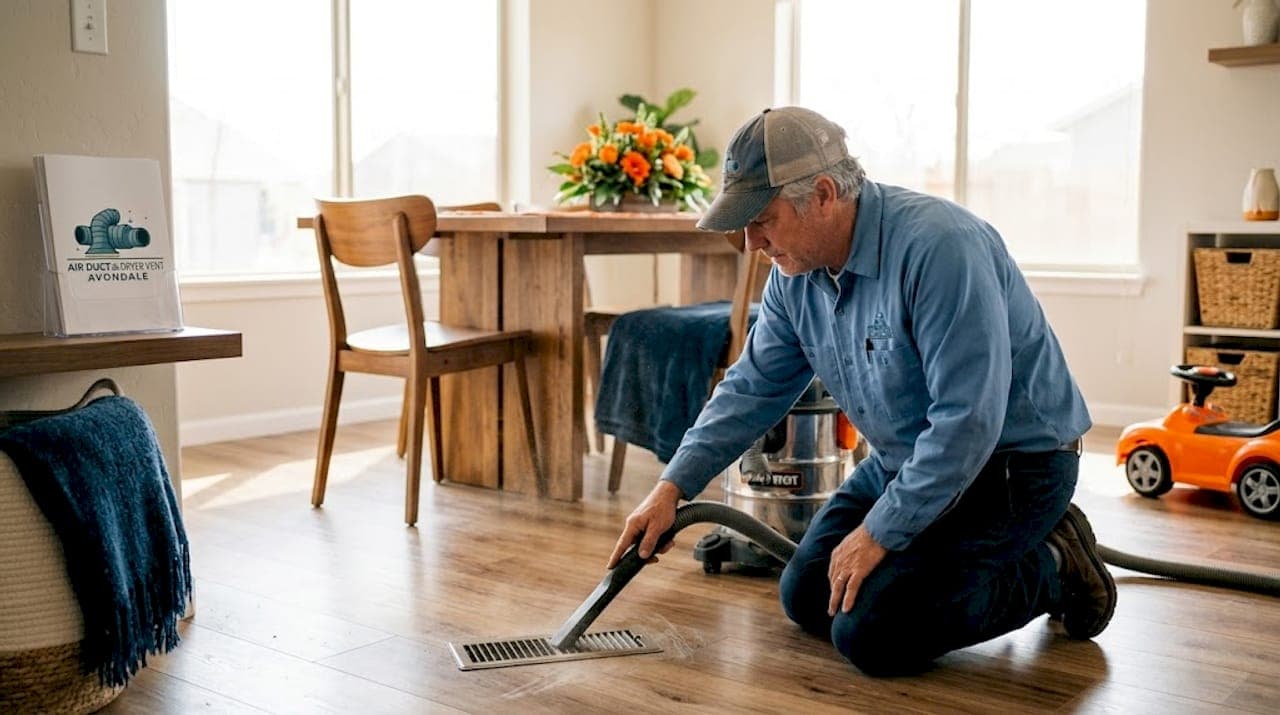
Most people hear "vent maintenance" and picture a technician vacuuming the inside of a duct. That's only a small slice of what a healthy vent system actually needs. Real vent maintenance covers three distinct categories, and each one has its own failure points, its own maintenance schedule, and its own consequences when ignored.
Ventilation maintenance includes controlling components such as dampers, actuators, and drain pans; distribution paths like ducts and registers; and exhaust systems including dryer vents. Each category has different roles and needs. A damper stuck in the wrong position can flood a room with unconditioned air no matter how clean your ducts are. A drain pan full of standing water becomes a mold incubator that pumps spores into every room your system serves.
The three main categories of vent maintenance:
- Ventilation controls: Dampers, actuators, thermostats, and sensors that regulate how air moves through the system. These wear out, stick, and drift out of calibration over time.
- Distribution paths: The ductwork, registers, grilles, and air handlers that carry conditioned air from your system to your living or working spaces. These accumulate dust, debris, and sometimes moisture.
- Exhaust systems: Dryer vents, bathroom exhausts, and kitchen range hoods that remove stale or contaminated air from the building. Blockages here cause moisture buildup, odors, and in the case of dryer vents, real fire risk.
Here's a quick comparison of what happens when each category is neglected:
| Category | Neglected outcome | Maintenance action |
|---|---|---|
| Ventilation controls | Poor airflow, hot/cold spots, high energy use | Inspect dampers, clean actuators, calibrate sensors |
| Distribution paths | Dust, allergens, uneven temperatures | Filter changes, register cleaning, duct inspection |
| Exhaust systems | Moisture, mold, fire risk, appliance damage | Clean dryer vents, clear bathroom/kitchen exhausts |
When choosing the right setup for your property, understanding the differences in choosing your vent system is a smart first step before scheduling any service.
Pro Tip: If you're not sure which category your biggest problem falls into, start by checking your air filter. A filter clogged with gray, matted dust tells you that your distribution path is overdue for attention and that your controls may be working overtime to compensate.
How vent maintenance boosts indoor air quality
Now that you know what vent maintenance entails, let's look at why it plays such a critical role in your indoor air quality.
Indoor air quality is not a vague, abstract concept. It directly affects how often your family gets sick, how well your employees concentrate at work, and whether allergy or asthma symptoms flare up inside your own building. The frustrating reality is that many people spend money on one-time duct cleanings expecting a permanent fix, only to see no lasting improvement. The reason is simple: duct cleaning alone does not address the sources of contamination.
Ventilation is primary for removing contaminants, and routine preventive actions are the foundation of healthy indoor environments. When you change filters on schedule, clean coils, inspect drain pans, and keep exhaust paths clear, you stop pollutants from cycling through your system in the first place.
"EPA recommends focusing on preventive maintenance rather than routine duct cleaning and notes it does not reliably improve indoor air quality without these other foundational actions."
This is the part that surprises most homeowners. The EPA, which has studied indoor air quality for decades, does not recommend annual duct cleaning as a standard practice. Instead, it points to filter changes, coil cleaning, and moisture control as the actions that actually move the needle on air quality. Duct cleaning has its place, but it's a targeted response to a specific problem, not a routine habit.
What routine vent maintenance actually removes from your air:
- Fine dust particles and construction debris, especially common in newer Avondale neighborhoods
- Pet dander and hair that settle in registers and ductwork
- Mold spores that grow in moisture-prone drain pans and near cooling coils
- Pollen that enters through fresh air intakes during Arizona's desert bloom seasons
- Volatile organic compounds (VOCs) absorbed by dust and recirculated through dirty systems
Learning the basics of air vent cleaning helps you understand what a professional inspection should cover and what questions to ask. If your home or business has recently gone through remodeling, you'll find that understanding the benefits of post-renovation vent care is especially important, since construction stirs up dust and debris that settles directly into your duct system.
One practical example: a family in a three-bedroom Avondale home with two dogs and a new baby was experiencing near-constant allergy symptoms. The ducts looked clean on a visual inspection, but the filter was running well past its recommended replacement date and the drain pan showed early mold growth. Replacing the filter and sanitizing the drain pan resolved the symptoms within two weeks. No full duct cleaning was necessary.
Energy efficiency: Savings hidden in your vents
Cleaner air is only half the story. For most Avondale property owners, energy costs matter too.
Arizona summers are brutal on HVAC systems. When your system runs nearly nonstop from May through September, even small inefficiencies add up fast. A clogged filter makes your system work harder to pull air through. A stuck damper forces your air handler to push against unnecessary resistance. A dryer vent blocked with lint makes your dryer run two or even three cycles to dry a single load. All of these translate directly into higher utility bills.
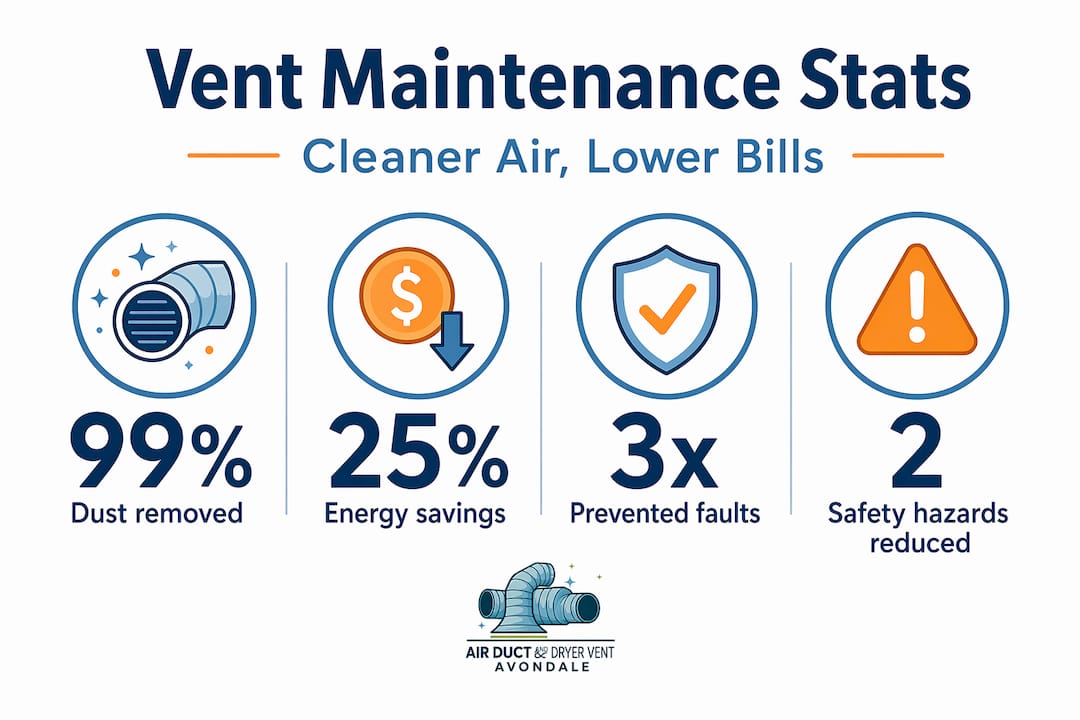
📊 Efficiency fact: Routine HVAC preventive maintenance improves energy efficiency by preventing faults and reducing unnecessary energy use. Addressing ventilation issues can produce measurable savings on your monthly energy costs.
Compare the results of proactive versus reactive maintenance:
| Approach | Filter status | Energy impact | Cost trend |
|---|---|---|---|
| Proactive quarterly checks | Changed on schedule | System runs at rated efficiency | Stable or decreasing bills |
| Reactive (wait for problems) | Changed when dirty or broken | System overworks, efficiency drops | Rising bills, surprise repairs |
| No maintenance | Severely clogged | Significant efficiency loss | Highest costs, shortened system life |
Here's a numbered action plan to start capturing energy savings through your vent system:
- Change your air filter on a set schedule. For most Avondale homes with pets or dust, every 30 to 60 days is realistic. For businesses with high foot traffic, monthly changes are smart.
- Inspect dampers and actuators annually. A damper stuck open in an unused room wastes conditioned air all summer long.
- Clear all supply and return registers. Furniture pushed against registers blocks airflow and forces your system to compensate.
- Check that all exhaust vents have clear exterior exits. Blocked kitchen or bathroom exhausts trap humidity and make your cooling system work harder.
- Schedule a professional airflow check every year or two. A technician with proper tools can identify airflow imbalances you'd never notice on your own.
For a deeper look at how your HVAC system and vent maintenance work together, the connection between HVAC efficiency and air quality is worth understanding before your next service call.
Small business owners in Avondale often overlook the commercial side of this equation. A restaurant kitchen with a partially blocked exhaust system runs its makeup air unit harder, which shows up directly in the electricity bill. A dental office with a dirty cooling coil struggles to maintain comfortable temperatures for patients, which often leads to thermostat wars and wasted energy. The math is the same whether you own a house or a storefront.
Dryer vent maintenance: Safety and efficiency essentials
Energy and air quality help your bottom line, but neglecting certain vents could even risk lives.
Dryer vents are in a category of their own. Every other vent system in your home primarily affects comfort and air quality. Your dryer vent can start a fire. That's not an exaggeration or a scare tactic. It's a documented, measurable risk that affects thousands of households every year.
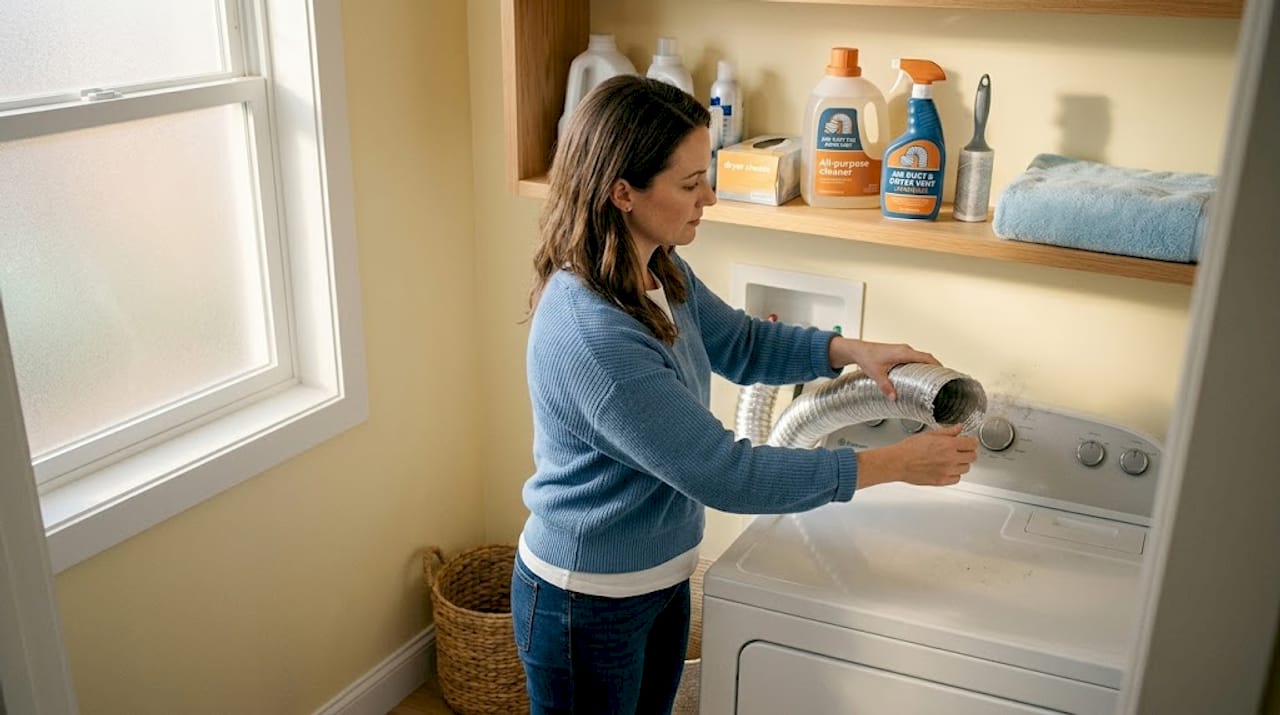
Lint clogs restrict airflow, cause overheating, and are a leading fire risk in residential settings. Cleaning dryer vents regularly improves both safety and appliance efficiency. Lint is extremely flammable. It accumulates with every load of laundry, and it builds up not just in the lint trap but deep inside the vent line that runs from your dryer to the exterior of your home. That line can stretch ten, twenty, or even thirty feet in some Avondale homes, and every bend in the duct is a place where lint gathers.
Key signs your dryer vent needs immediate attention:
- Clothes take more than one cycle to dry completely
- The outside of your dryer feels very hot to the touch during operation
- You notice a burning smell when the dryer is running
- The exterior vent flap does not open fully when the dryer is on
- It has been more than 12 months since the vent was professionally cleaned
Pro Tip: The length and routing of your dryer vent line matters enormously. A straight, short run is far easier to keep clean than a long line with multiple 90-degree bends. If your vent line runs more than 15 feet or has more than two bends, plan on professional cleaning every 6 to 12 months rather than waiting for the annual mark.
The efficiency angle matters too. A dryer running against a partially blocked vent uses significantly more electricity or gas per load. Over the course of a year, that waste adds up to real money. Getting a dryer vent cleaning done properly also extends the life of your appliance by reducing the stress of excess heat on its mechanical components.
Understanding why dryer vent lint is a serious concern gives you the full picture of both the safety and efficiency stakes involved with this often-overlooked maintenance task.
How often and what should you really service?
So how often do you actually need to work on your vents, and what should get top priority?
This is where a lot of homeowners and business owners get misled. Some service companies suggest annual full duct cleanings as a standard practice. That sounds reasonable, but it's not what the research or federal guidance actually supports. What the evidence does support is a regular, structured approach focused on the tasks that produce consistent results.
Quarterly preventive maintenance actions are recommended for ventilation system components. At the same time, EPA advises regular filter changes, coil cleaning, and drain pan maintenance, with duct cleaning reserved for specific triggers rather than used as a routine service.
Here is a practical, evidence-based maintenance schedule for Avondale homeowners and small business owners:
- Every 30 to 60 days: Check and replace air filters. In Avondale, desert dust and heat mean filters fill faster than they would in cooler, less dusty climates.
- Every 3 months (quarterly): Inspect registers and grilles for visible dust buildup. Wipe them down. Check that all vents are unobstructed. Visually inspect drain pans for standing water or discoloration.
- Every 6 months: Have a professional inspect cooling coils and heating elements. Clean dryer vents if the vent line is long or has multiple bends. Check dampers and actuators for proper operation.
- Annually: Schedule a full system inspection including airflow testing. Evaluate whether duct cleaning is needed based on visible buildup, pest evidence, or air quality symptoms.
- As needed (trigger-based): After home renovation, after a rodent or pest intrusion, when you notice musty odors or visible mold near registers, or after purchasing a home with unknown maintenance history.
Pro Tip: Keep a simple log of your maintenance tasks with dates. A $2 notebook or a note on your phone is enough. When you call a service company, having that history helps them give you accurate, targeted recommendations instead of defaulting to a full cleaning package you may not need.
To understand what a proper service visit looks like from start to finish, reading through a vent cleaning process guide gives you the context to evaluate any technician's work. And when a cleaning is warranted, knowing what to expect from recommended vent cleaning services helps you make a confident, informed decision.
Why the duct cleaning myth persists—and what really works in Avondale
You've seen the science. Now here's what most people, and some service companies, still get wrong.
The duct cleaning industry is not a bad one. Legitimate duct cleaning serves a real purpose in the right situations. The problem is that aggressive marketing has convinced many Avondale homeowners that annual duct cleaning is as routine as an oil change. It's not. And when you spend money on a service you don't actually need, you're not spending it on the filter changes, coil cleanings, and quarterly inspections that would genuinely protect your air and your wallet.
EPA guidance contrasts sharply with common duct-cleaning marketing, stressing an as-needed basis and a focus on preventive maintenance as the foundation of a healthy system. That guidance hasn't changed despite decades of industry pressure.
Here's why the myth sticks around: duct cleaning is visible and dramatic. A technician arrives with large equipment, photographs dark debris inside your ducts, and emerges with a bag of dust. It feels like something significant happened. Compare that to a filter change and a coil wipe-down, which look modest but actually deliver more consistent long-term results. Humans are naturally drawn to the dramatic intervention, even when the quiet, routine action is what the evidence supports.
Our perspective, built from years of serving Avondale homes and businesses, is this: the best thing you can do for your vent system is to stop treating maintenance as a one-time event and start treating it as an ongoing relationship with your property. Quarterly filter checks cost almost nothing. A coil inspection every six months is fast and affordable. These small, consistent actions prevent the kind of neglect that eventually does require a major cleaning or, worse, a system replacement.
When a company pushes you toward a full duct cleaning without asking about your filter history, recent renovations, or air quality symptoms, that's a signal to slow down and ask questions. Request an air vent cleaning workflow explanation before agreeing to any service. A trustworthy technician will always explain what they found and why a specific service is warranted, not just sell you a package.
The right approach saves you money. It also means the air you breathe every day in your Avondale home or office is actually getting cleaner, not just getting a one-time scrub that loses its benefit within a few months.
Get expert vent maintenance for peace of mind in Avondale
Ready to take clear, meaningful action? Here's how our Avondale team can help.
Knowing what good vent maintenance looks like is one thing. Having a trusted local team execute it correctly is another. At Air Duct and Dryer Vent Cleaning Avondale, we base every service recommendation on what the evidence actually supports, not on upselling. Whether you need a thorough air vent cleaning or a complete assessment of your system's health, we tailor every visit to your specific home or business.
Our team handles everything from routine filter and coil inspections to full dryer vent solutions and air duct repair options when your system needs more than cleaning. We offer flexible scheduling, including after-hours appointments for busy families and business owners. Contact us today to schedule an inspection and start breathing easier in Avondale.
Frequently asked questions
How often should vents be cleaned or serviced for best air quality?
Quarterly preventive maintenance is recommended for ventilation system components, with duct cleaning reserved for specific situations like visible mold, pest intrusion, or significant debris buildup rather than on a fixed annual schedule.
Does routine duct cleaning improve energy efficiency?
Little evidence supports the idea that cleaning ducts alone improves efficiency. The real gains come from maintaining coils, fans, filters, and controls, which reduce strain on your system and lower energy use consistently over time.
Is vent maintenance different from air duct cleaning?
Yes, vent maintenance is more comprehensive than duct cleaning alone. It covers air filters, heating and cooling equipment, drain pans, dampers, and exhaust systems, giving your entire ventilation system the ongoing care it needs to perform well.
Why is dryer vent cleaning especially important?
Dryer vent lint buildup poses a serious fire risk and forces your dryer to work harder, using more energy per load and shortening the appliance's life. Regular professional cleaning addresses both the safety and efficiency concerns at once.
What maintenance tasks should I prioritize for my vents?
Focus first on regular filter changes and coil inspections, then add quarterly system checks. Reserve full duct cleaning for situations involving mold, pests, visible contamination, or a property with no documented maintenance history.