
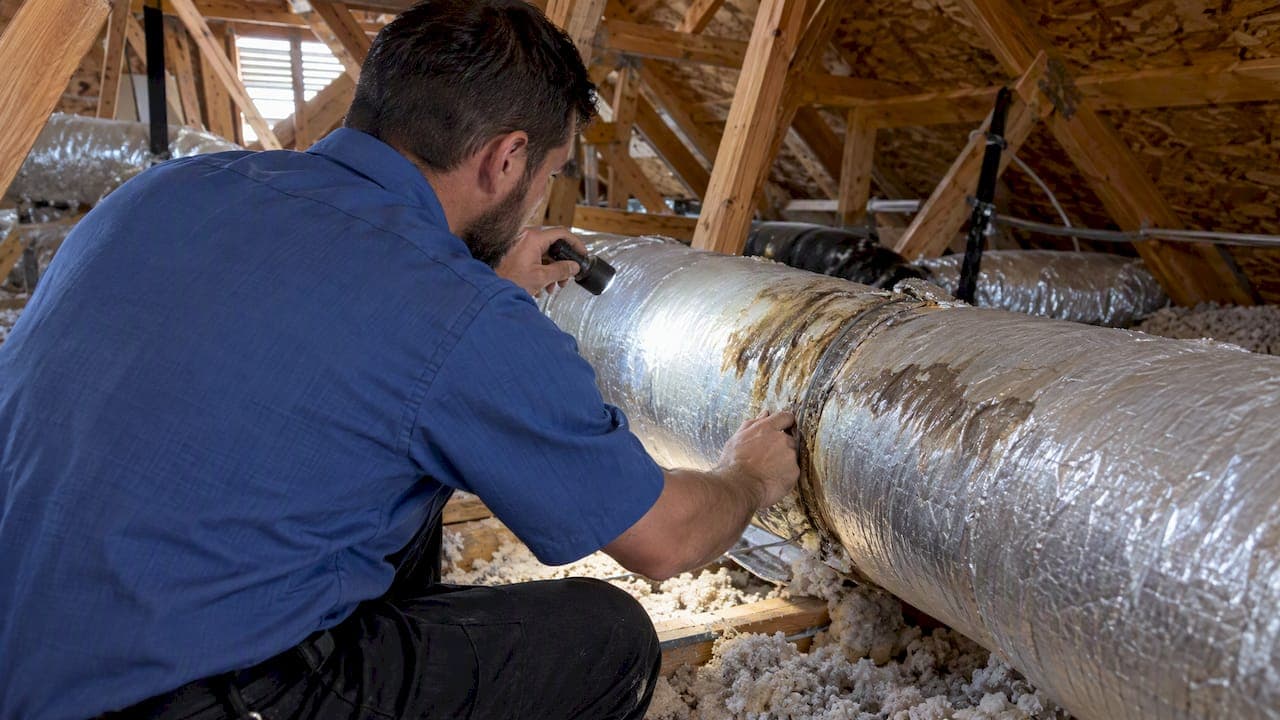
Attic duct cleaning is not something you need on a fixed schedule for its own sake. The EPA advises against routine cleaning under ordinary conditions, reserving the job for homes with visible mold, pest infestation, or debris that chokes airflow. A reasonable baseline is every 3 to 5 years, but mold, odors, pests, or post-construction dust means you should act sooner, following NADCA-recommended methods.
TL;DR:
- Attic duct cleaning should be considered more urgently if there are pets, respiratory issues, recent renovations, or visible dust discharge, rather than on a fixed schedule.
- Signs requiring immediate attention include visible dust blowing from registers, persistent odors, uneven airflow, pest evidence, or heavy post-renovation dust.
- Moisture problems, mold, or wet/damaged liners require replacing duct sections rather than cleaning, especially in attic environments prone to humidity and insulation disturbance.
- Professional cleaning must follow NADCA standards with containment, negative-pressure vacuuming, and thorough inspection, as DIY methods cannot reliably reach attic duct sections.
- Fixing underlying moisture issues and replacing porous liners are critical, since cleaning alone offers only temporary relief and does not prevent mold or pest recurrence.
Table of Contents
- Baseline frequency and how to adjust it for attic conditions
- Signs your attic ducts need cleaning now
- Attic-specific risks and constraints: moisture, insulation, and duct materials
- Cleaning methods compared: mechanical removal, fogging, and DIY limits
- When to hire a professional for attic duct cleaning
- How a professional handles attic duct work safely
- A quick, prioritized checklist for homeowners
- How our attic duct services help with inspection, cleaning, and repair
- Authoritative resources and standards
- Sources
- FAQ
Baseline frequency and how to adjust it for attic conditions
The 3 to 5 year baseline assumes a fairly ordinary household: filters changed on schedule, no major renovations, no pets shedding into the return air, and no occupants with severe allergies or asthma. Change any of those assumptions and the clock should move up.
Attics add their own wrinkle. They run hotter and more humid than living spaces, insulation shifts over time, and pests find their way in through gaps around vents and soffits. All of that settles into ductwork faster than in a climate-controlled basement system.
A few conditions should push you to inspect sooner than the standard interval:
- Pets in the home, especially multiple animals shedding into return vents
- Occupants with asthma, allergies, or other respiratory sensitivities
- Smokers living in the house
- Recent or frequent renovation work, including drywall sanding or flooring replacement
- Visible dust discharge from supply registers when the system starts
- An attic that already runs dusty due to poor sealing or an unfinished floor
If two or more of these apply, treat the 3 to 5 year window as an outer limit, not a target. An inspection costs far less than letting contamination build behind a wall.
Signs your attic ducts need cleaning now
Some signals are loud enough that you do not need to wait for an inspection to know something is wrong. These are the ones worth checking for directly.
- Dust visibly blowing from registers or a small dust cloud when the blower first kicks on.
- Musty or persistent odors from vents that do not clear up after a fresh filter.
- Reduced or uneven airflow in some rooms, which often points to an obstruction further down the duct run.
- Pest evidence, such as droppings near vents, or water staining inside ducts and on nearby insulation.
- Heavy dust in supply air following recent construction or remodeling work.
Mechanical cleaning can reduce surface fungal loads immediately, but regrowth on porous materials can occur within weeks unless the moisture source is fixed first. That single fact changes how you should think about any of the signs above: cleaning without correcting the underlying moisture or leak is a temporary fix, not a solution.
Water staining deserves particular attention. A stain near a duct seam usually means condensation or a roof leak, and cleaning that duct without finding the source just buys time before the same stain reappears.
Attic-specific risks and constraints: moisture, insulation, and duct materials
Attic ducts behave differently than ducts in a basement or crawlspace, and that difference should shape every decision about cleaning them. Heat and humidity swings are more extreme, attic insulation can be disturbed during access, and the duct materials themselves vary in how well they tolerate cleaning at all.
A few specifics matter more here than anywhere else in the system:
- Poor attic ventilation traps humidity against duct surfaces, raising mold risk even without an obvious leak.
- Porous duct liners and duct board that have gotten wet or moldy generally cannot be cleaned reliably and should be replaced instead, per NAIMA and EPA guidance.
- Loose-fill insulation is easy to compress or displace during attic access, which undoes its R-value right where you need it most.
- Duct type (sheet metal, flexible duct, or duct board) determines which cleaning method is even appropriate, since aggressive agitation that is fine on metal can tear a flex duct liner.
Pro Tip: Before any attic duct work begins, ask the technician how they plan to protect existing insulation, not just how they plan to clean the ducts.
If a liner is wet or shows mold growth, cleaning it is not really an option. Our guide to mold in HVAC systems covers what to check before anyone touches a contaminated duct run, and it is worth a read before you schedule anything.
Cleaning methods compared: mechanical removal, fogging, and DIY limits
Three approaches come up constantly, and they are not interchangeable. Mechanical source removal, which combines agitation tools with a negative-pressure HEPA vacuum, is the method NADCA's ACR standard builds its verification tests around, including the Surface Comparison Test and the NADCA vacuum test.

Fogging and biocides sit in a narrower lane. They can help with odors or surface microbes on non-porous materials like sheet metal, but they do not replace physical debris removal, and label compliance with EPA-registered products matters here. Biocides and encapsulants are rarely appropriate for wet or fibrous insulation, since there is no reliable way to apply them to porous material without leaving contamination trapped underneath.
DIY has a real but limited role:
- Removing and washing registers or grilles
- Vacuuming visible dust from accessible duct openings
- Wiping down return vent covers
Whole-system attic cleaning, by contrast, calls for containment, negative pressure, and equipment most homeowners do not own. Better Homes & Gardens notes that register-level DIY work can cut visible dust, but system-wide cleaning needs professional gear to avoid pushing attic debris into living spaces.
| Method | Best for | Limitation |
|---|---|---|
| Mechanical source removal | Dust, debris, sheet metal and flex ducts | Requires trained technician and HEPA vacuum |
| Fogging / biocides | Odor and surface microbes on non-porous materials | Not a substitute for physical debris removal |
| DIY register cleaning | Visible surface dust at vent covers | Does not reach the duct interior or attic runs |
When to hire a professional for attic duct cleaning
Certain situations should send you straight to a professional rather than a weekend project. Mold, pest infestation, water or fire damage, visible debris discharge, persistent odors, or heavy post-construction dust all call for trained equipment and containment.
- Confirm the contractor follows NADCA's ACR standard and ask about ASCS-certified technicians.
- Request a camera inspection before and after the work, with photos you keep.
- Insist on negative-pressure containment and HEPA-filtered vacuums for the job.
- Ask directly whether any porous liner will be replaced rather than cleaned.
- Confirm what biocide, if any, will be used and whether it is EPA-registered for that surface.
- Ask what precautions protect occupants and attic insulation during the work.
Before signing anything, run through a short list of questions:
- Is the quote based on a visual inspection or a flat rate with no inspection at all?
- What happens if they find wet or moldy duct board mid-job?
- How will they protect loose-fill insulation during access?
- What does the post-job report include?
- Is there a warranty on the work?
- Will they test air quality afterward if you ask?
How a professional handles attic duct work safely
A qualified contractor treats attic duct work as a sequence, not a single task. That sequence typically includes:
- Pre-inspection mapping with camera checks to locate obstructions, moisture, and insulation layout
- Containment setup and negative-pressure HEPA vacuuming to keep contaminants from spreading into living spaces
- Replacement, not cleaning, for any duct section with wet or moldy porous liner
- Post-job documentation including photos, camera footage, a fresh filter, and any repair recommendations
That documentation is what separates a defensible job from guesswork, and it is what you should expect to receive regardless of who you hire.
A quick, prioritized checklist for homeowners
If you remember nothing else: check for moisture first and fix it before cleaning anything. Replace wet or porous liner instead of trying to clean it, and insist on NADCA-aligned methods for the rest. Treat cleaning as one piece of a bigger plan that includes filters, sealing, and insulation, not a standalone fix.
— Shaun
How our attic duct services help with inspection, cleaning, and repair
Specialized attic duct work takes more care than a standard basement system, and that requires commercial-grade equipment and technicians trained specifically for HVAC cleaning rather than treating it as an add-on service. A typical visit includes a camera inspection, mechanical cleaning where it is appropriate, and recommendations when a section needs replacing instead of cleaning.
What you should expect on a visit:
- A pre-inspection camera check to locate debris, moisture, and insulation conflicts
- Mechanical cleaning using containment and HEPA-filtered equipment
- A written scope covering any duct repair or replacement needs
- Documentation including before and after photos and any applicable service guarantees
If you want to know where your attic ducts actually stand, request an air duct cleaning inspection and get a camera report before deciding between cleaning and replacement. For post-cleaning verification, an air quality test can confirm the work addressed the problem.
Authoritative resources and standards
- EPA guidance on when duct cleaning is appropriate
- NADCA's ACR standard for cleaning methods and verification
- NAIMA/EPA guidance on porous duct liner replacement
- Building America guidance on sealing and insulating attic ducts
For broader moisture prevention before cleaning becomes necessary, see A-1 Basement Waterproofing's mold solutions resource and a simple HVAC maintenance schedule for keeping ducts in good shape between inspections.
Sources
- Should I have the air ducts in my home cleaned? | US EPA
- ACR: The NADCA Standard for Assessment, Cleaning, and Restoration of HVAC Systems (NADCA)
- Should You Have the Air Ducts in Your Home Cleaned? | EPA (PDF guidance)
- EPA research on mechanical cleaning and regrowth
FAQ
What are the downsides to air duct cleaning?
Done poorly, duct cleaning can dislodge debris into living spaces, damage flexible or porous duct materials, and disturb attic insulation during access. It also does not fix underlying moisture problems, so mold can return within weeks if the source is not addressed.
Can you be in the house during duct cleaning?
Yes, most homeowners stay home during the work, though rooms near active containment areas may be off limits temporarily. If mold remediation is involved, following EPA-style containment and scheduling guidance to limit exposure is the safer approach.
What time of year should you clean your air ducts?
There is no required season, since the decision depends on triggers like mold, pests, or post-construction debris rather than the calendar. Many homeowners schedule it before heavy heating or cooling season to start with cleaner airflow.
Will my house be dusty after duct cleaning?
A properly contained job using negative-pressure HEPA vacuums should leave minimal dust behind, and a fresh filter afterward helps catch anything that settles. If dust appears days later, it is worth asking the contractor whether containment was maintained throughout the job.