
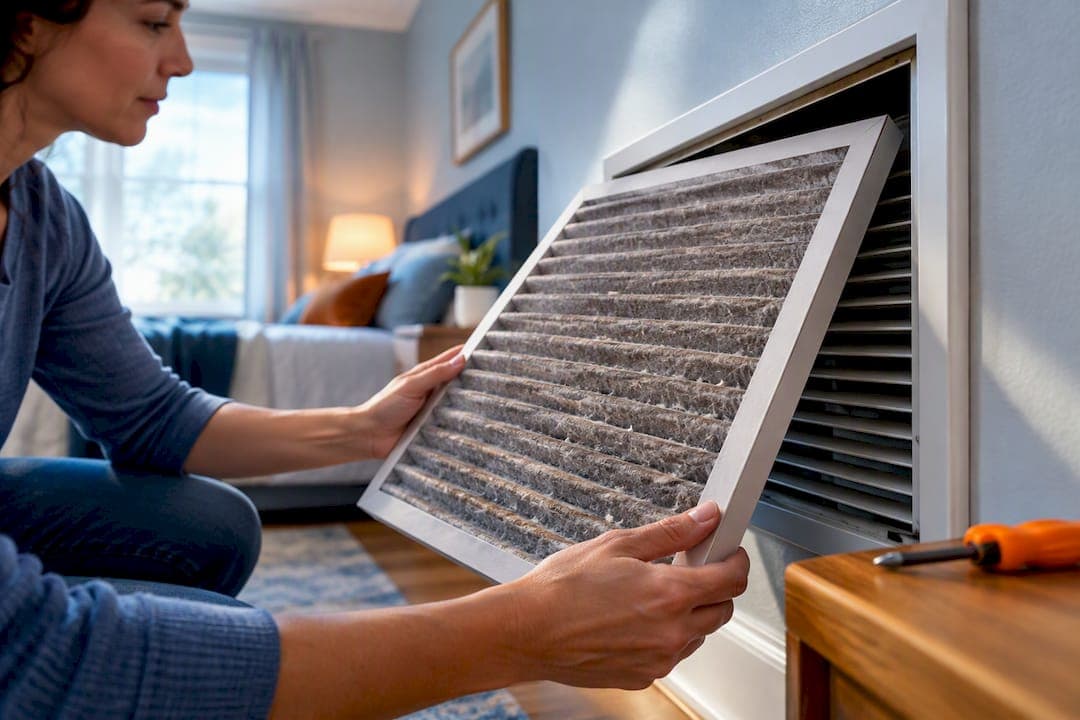
A clogged return air vent commonly cuts airflow, causes uneven room temperatures, and forces your HVAC system to work harder and run longer. Start by clearing the grille and checking your filter. The EPA notes that a dusty grille alone does not always mean you need full duct cleaning, so try simple fixes first, and call a technician if you spot mold, pests, or no improvement.
TL;DR:
- Return vent blockage can cause higher static pressure, longer system run times, and uneven room temperatures, especially if duct damage or mold is present.
- Regular checks and maintenance, like vacuuming the grille and replacing filters every 1 to 3 months, help prevent recurring airflow problems.
- Signs that require professional intervention include persistent weak airflow, mold growth, duct damage, or strange odors that do not resolve with DIY cleaning.
- Simple DIY cleaning is effective for surface dust but limited to accessible areas; deeper issues often need expert diagnosis with tools like pressure measurements and duct cameras.
- Proper airflow design involves clear, unobstructed return vents and routine maintenance, with professional assistance needed for ongoing or severe problems.
Table of Contents
- Why return vents matter for airflow and air quality
- How to tell if your return vent is actually clogged
- Cleaning your return grille safely at home
- Deciding when a professional needs to step in
- Keeping return vents clear for the long run
- What years of return vent calls have taught us
- Professional help when DIY reaches its limit
- Sources
- FAQ
Why return vents matter for airflow and air quality
Supply vents push conditioned air into a room. Return vents do the opposite job: they pull room air back into the system so it can be reheated or cooled again. Without steady return airflow, your HVAC system has nowhere to draw from, and the whole heat transfer cycle slows down.
When a return vent gets blocked, the system's static pressure climbs. That means less air moves through the equipment, run times stretch out, and the unit works harder to reach the temperature on your thermostat. In cooling mode, restricted return airflow can lead to frozen evaporator coils. In heating mode, it can push heat exchangers past their normal operating range, according to industry experts cited by Family Handyman, who warn that closed returns starve the system and can damage components.
These effects show up as symptoms long before most people think to check the vent itself: higher energy bills, short cycling, rooms that never quite reach the set temperature, and a system that seems to run constantly without catching up. The DOE and CEE's duct diagnostic guidance treats static pressure as the key measurement for figuring out where airflow is actually being lost, whether that's a blocked filter, a crushed duct, or something else entirely.

How to tell if your return vent is actually clogged
A few quick checks will tell you whether the problem sits at the grille or deeper in the ductwork.
- Hold a tissue near the return grille while the system runs; weak or absent suction suggests restricted airflow.
- Feel for airflow at nearby supply vents; if it's noticeably weaker than usual, the return may be starving the system.
- Check your filter first, since a clogged filter is the most common hidden cause of a "blocked" return.
- Remove any visible blockage such as furniture, rugs, or curtains sitting in front of the grille.
- Switch the thermostat fan setting to "on" instead of "auto" and listen for unusual rattling, whistling, or straining sounds.
- If you can safely access attic or crawlspace ductwork, look for obvious crushes, kinks, or disconnected sections near the return.
Some findings point straight to a professional: a musty odor, visible mold on the grille or nearby insulation, signs of vermin, or airflow that doesn't improve after you've checked the filter and cleared the grille. Recurring blockage within weeks of a cleanup is another sign something structural is going on.
Cleaning your return grille safely at home
Before touching anything, turn the system off, note which rooms feel affected, and take a photo of the grille if you want a record for later comparison.
- Turn off the HVAC system at the thermostat before removing any covers.
- Remove the grille if it's designed to come off, usually with a screwdriver or by unclipping it.
- Vacuum the grille and the immediately visible duct opening, but stop there. Pushing a vacuum hose or brush deeper into the duct can dislodge debris further into the system instead of removing it.
- Wash the grille with soap and water, dry it completely, and reinstall it securely.
- Check that your filter is the correct size, properly seated, and facing the right direction according to the airflow arrows printed on its frame.
Avoid aggressive brushes on porous or fiber-lined ducts. EPA field research found that mechanical cleaning removes adhered dust from smooth sheet-metal surfaces reasonably well, but results on fibrous or contaminated material are inconsistent, and rough handling can do more harm than good. Do not go past the first accessible section of duct, and skip any chemical sprays or treatments without professional guidance.
After cleaning, track how long it takes rooms to reach your thermostat's setpoint, whether airflow feels stronger at the grille, and whether any rattling or whistling has stopped. These notes are useful even if you end up calling a technician.
Pro Tip: Keep a simple log with dates and symptoms. It turns a vague "it's still not working right" into specifics a technician can act on immediately.
Deciding when a professional needs to step in
Some situations call for a technician rather than another round of DIY cleaning: visible mold growth, evidence of vermin, airflow that stays weak or absent after you've cleared the grille and changed the filter, ducts that look crushed or disconnected, or persistent odd noises and smells.
Professionals typically start with measurements rather than guesswork. Total external static pressure readings, flow hood tests, and smoke-pencil checks for leaks are standard diagnostic tools under DOE and CEE guidance, and a duct camera may come out if the problem seems to be buried deep in the system. Technicians also inspect the coil and plenum, since restricted airflow there often mimics a blocked-return complaint.

Common remedies include targeted cleaning at the source of contamination, coil or plenum cleaning, sealing and repairing leaky duct sections, and replacing damaged liner or ductwork outright. The EPA's own position is conservative here: professional duct cleaning is recommended only when there's substantial visible contamination, vermin, or particles actually being released from the supply registers, not simply because a grille looks dusty.
Keeping return vents clear for the long run
Most recurring blockages come down to a few habits that are easy to fix once you know what to watch for.
- Replace your filter every 1 to 3 months depending on its MERV rating and household conditions like pets or renovation dust.
- Keep about 12 inches of clearance in front of every return grille, and never let rugs, curtains, or furniture creep into that space.
- Vacuum or wipe down grilles every 3 to 6 months, and inspect them right after any renovation work.
- Replace torn or warped grilles and filters instead of patching them, since damaged edges let unfiltered debris straight into the duct.
- Schedule a professional inspection if airflow problems keep coming back despite regular upkeep.
After construction or a major renovation, seal registers off and run a full cleaning pass before putting the system back into regular use, a step the EPA recommends to keep drywall dust and debris from settling deep into the ductwork.
What years of return vent calls have taught us
Most return vent complaints we see trace back to something simple: a couch pushed against the grille, a filter that's been in place too long, or dust buildup after a remodel. The less common but more serious cases involve crushed ductwork in an attic, or mold that shows up after a roof leak or plumbing issue gets ignored for a few weeks.
What tends to surprise homeowners is how much a fully cleared return changes day-to-day comfort. Airflow improves, uneven rooms start balancing out, and the system stops running the marathon cycles that show up as high bills. When ducts are the actual problem rather than the grille, that's when a proper inspection earns its keep.
— Shaun
Professional help when DIY reaches its limit
If you've cleared the grille, changed the filter, and airflow still isn't right, it's usually a duct or equipment issue rather than something a vacuum can fix. Professional HVAC service providers offer air vent cleaning, air duct cleaning, air duct replacement, and air quality testing services for cases where DIY cleaning does not resolve airflow issues.
A booked visit typically starts with an inspection of your grilles, filter, and accessible ductwork, followed by diagnostic checks and a clear written estimate before any work begins. If you're dealing with persistent airflow loss, suspected mold, or ductwork damage, you can book an air vent cleaning and get a straight answer on what's actually needed.
Sources
This guide draws on the EPA's duct cleaning guidance, the DOE/CEE duct diagnostic guide, Family Handyman's return vent reporting, and Lennox's explainer on return air vents, alongside general ventilation standards for context on proper airflow design.
- Should You Have the Air Ducts in Your Home Cleaned? | US EPA
- Is It Bad to Block a Return Air Vent? | Family Handyman
- Duct retrofit decision guide (DOE/CEE)
- Results of a Pilot Field Study to Evaluate the Effectiveness of Cleaning Residential Heating and Air Conditioning Systems
FAQ
What happens if a return air vent is blocked?
A blocked return vent restricts the air your HVAC system needs to pull back in for reheating or cooling, which raises static pressure and forces longer run times. Left unaddressed, this can lead to uneven room temperatures, higher energy bills, and in severe cases frozen evaporator coils or heat exchanger strain, according to Family Handyman.
How do I clean my air return vents?
Turn the system off, remove the grille if it detaches, and vacuum the grille and the visible duct opening without pushing debris further in. Wash and fully dry the grille before reinstalling it, and confirm your filter is seated correctly, following the safe DIY steps the EPA outlines for surface-level cleaning.
What are the signs of a bad air return vent?
Common signs include weak airflow at supply vents, rooms that never reach the thermostat setpoint, longer than usual system run times, and unusual rattling or whistling noises. Musty smells or visible mold near the grille point to a problem that needs professional attention rather than routine cleaning.
How do you know if your air vent is clogged?
Hold a tissue near the grille while the system runs. Weak or no suction suggests a clog, and you should check the filter and clear any visible obstruction like furniture or rugs before assuming the ductwork itself is the problem.
When should I call a professional instead of cleaning it myself?
Call a technician if you see mold, evidence of vermin, or ducts that look crushed or disconnected, or if airflow stays poor after you've cleared the grille and changed the filter. The EPA recommends professional cleaning specifically when contamination is substantial, not for routine dust on a grille.