
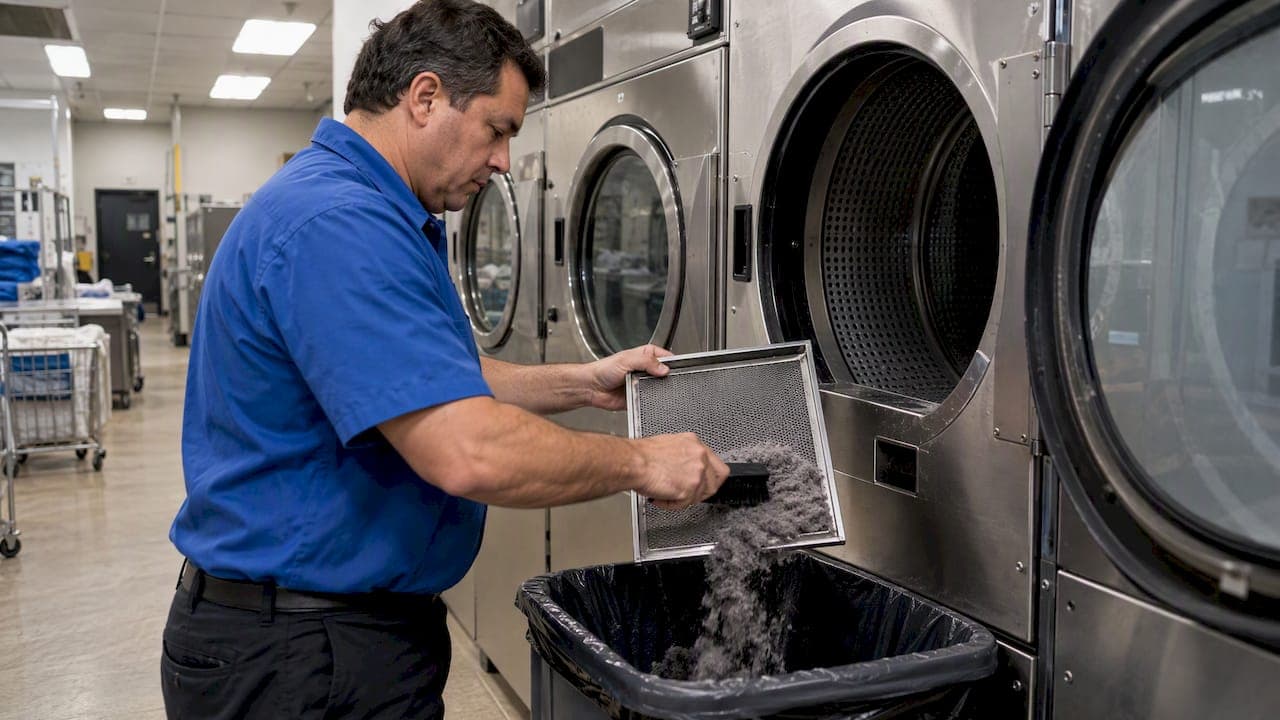
If lint is piling up in your commercial dryers, stop relying on screen-only cleaning. Empty every lint trap right now, check that exhaust airflow is unobstructed, and book a professional duct inspection this week. The lasting fix pairs daily operator checks with scheduled professional cleaning, an approach backed by OSHA housekeeping guidance and NFPA fire data, and one we build service plans around every day.
TL;DR:
- NFPA links 32% of dryer fires to failure to clean, while another 27% involve ignition of dust, fibers, or lint.
- Staff should clean screens after every load, inspect seals and surrounding areas weekly, and check secondary traps and accessible ductwork monthly.
- Keep metal duct runs short and straight, minimize 90 degree elbows, support horizontal sections, and seal joints with tape or clamps rather than screws.
- Schedule duct cleaning more than once a year for commercial systems, adjust frequency to machine use, and request airflow readings plus inspection photos.
Table of Contents
- Quick action checklist for staff this shift
- How lint accumulates and why buildup matters in commercial machines
- How to detect and measure lint buildup
- Recommended maintenance schedule and SOPs for commercial laundries
- Ductwork and installation best practices to reduce lint buildup
- Commercial lint-capture and filtration solution categories
- When to hire professional dryer-vent and duct cleaning services
- Treating lint control as an operational priority
- How Air Duct and Dryer Vent Cleaning Avondale supports your maintenance program
- FAQ
- Sources
Quick action checklist for staff this shift
Lint risk compounds fast in high-cycle commercial laundries, so give staff a short, repeatable routine instead of vague instructions.
- Empty and inspect every lint screen after each load, checking for tears or gaps that let fibers pass through.
- While the dryer runs, hold a tissue near the exhaust outlet to confirm steady outward airflow, a weak or fluttering response signals a blockage.
- Collect loose lint in closed, labeled containers rather than open bins, and dispose of it before it accumulates near heat sources.
- Pull a dryer from service immediately if loads stay damp, cycle times stretch out, the cabinet feels unusually hot, or you notice a burning smell.
How lint accumulates and why buildup matters in commercial machines
Every tumble cycle sheds fiber from fabric, and most of it collects on the lint screen. The fraction that does not gets pulled past the screen into ductwork, motor housings, and burner compartments, where it settles in elbows, seams, and slow-moving air pockets.
That hidden buildup restricts airflow, so dryers run longer to finish a load, pulling more gas or electricity and straining motors and heating elements with every extra cycle. The bigger concern is combustion risk: lint is a fine, highly combustible particulate, and NFPA research attributes 32% of dryer fires to failure to clean lint, with another 27% tied to ignition of dust, fiber, or lint itself.
How to detect and measure lint buildup
Most lint problems show up before they turn into fire hazards, if you know what to watch for.
- Track cycle times: a load that suddenly takes longer to dry than usual is often the first sign of restricted airflow.
- Feel the dryer cabinet and exhaust duct near the end of a cycle; excessive heat suggests trapped lint is blocking normal venting.
- Note any musty or burning odors, both point to fiber accumulation rather than a simple fabric issue.
- Run a simple airflow check at the exhaust termination using a tissue or smoke pencil; sluggish or absent movement means a closer inspection is due.
- For facilities with central exhaust systems, a static pressure reading with a Magnehelic gauge gives a measurable baseline to track airflow loss over time.
When any of these checks point to a blockage, treat it as an immediate maintenance item rather than something to monitor for another week.
Recommended maintenance schedule and SOPs for commercial laundries
A written schedule turns lint control from a reactive chore into a documented program, which matters both for safety and for compliance records.
- Daily: clean lint screens after every load, log who performed the check, and dispose of collected lint in closed containers.
- Weekly: inspect door seals and the area behind and under each dryer, where loose fiber tends to settle unnoticed.
- Monthly: empty secondary lint traps and inspect accessible duct sections for visible buildup.
- Periodically: schedule professional cleaning of exhaust ducts, motor end bells, and burner housings, with frequency tied to how heavily each machine runs.
OSHA guidance calls for lint to be removed from collection devices at least daily, alongside a written fire prevention plan covering housekeeping and lint control. Manufacturer service instructions for commercial dryers reinforce this: Dexter's preventative maintenance guide calls for clearing lint from motor end bells and exhaust systems as routine maintenance, not an occasional task.
Pro Tip: Keep a simple paper or digital inspection log at each machine; it takes thirty seconds per entry and becomes your strongest evidence of due diligence if an insurer or inspector ever asks.
Ductwork and installation best practices to reduce lint buildup
Cleaning habits only go so far when the ductwork itself is working against you. DOE venting guidance recommends rigid or semi-rigid metal ducting over vinyl or white plastic flex hose, since smooth metal walls resist lint adhesion far better than ribbed plastic.
Keep duct runs as short and straight as possible, minimize 90-degree elbows, and support horizontal sections so they don't sag and create low points where lint collects. Seal joints with UL 181B-rated tape or clamps rather than internal sheet-metal screws, which snag fiber and accelerate buildup at every connection point. Make sure exhaust terminations include a functioning backdraft damper and stay clear of debris, leaves, or nesting material outside the building. Where ducts pass through unconditioned spaces, insulate them to prevent condensation that can turn dry lint into a damp, clinging mass.

Commercial lint-capture and filtration solution categories
Facilities running multiple dryers on a shared exhaust system typically need more than screen cleaning alone, and several equipment categories address that gap.
- Inline lint traps and cartridge collectors mount in the duct run to catch fine particulate before it reaches long exhaust sections.
- Wet-capture and condensate systems suit specialty laundries where water-based filtration fits existing process equipment.
- Exhaust separators, collectors, and properly sized fans protect long duct runs from the pressure loss that heavy lint buildup causes.
- When evaluating any of these, weigh capture efficiency, how often the unit needs servicing, compatibility with existing equipment, and the availability of ongoing service support.
When to hire professional dryer-vent and duct cleaning services
Daily screen cleaning cannot reach lint packed into motor end bells, burner housings, or the far end of a long duct run, which is exactly where fire risk concentrates. A quality service visit should leave you with a written report covering before-and-after photos, measured airflow or static pressure, and any recommended repairs. Before booking, ask about insurance coverage, the equipment used, warranty terms, and how follow-up scheduling works. Facilities we service in and around Avondale typically combine this kind of documented visit with the daily and weekly tasks their own staff already handle.

Treating lint control as an operational priority
Lint control is not housekeeping, it's risk management with a measurable payoff, as explained in commercial floor maintenance approaches that emphasize cost-saving professional upkeep. Every duct cleaning that restores airflow cuts cycle times, trims energy use, and reduces the chance of an unplanned shutdown, which makes the expense closer to an investment than a cost. Documented inspection logs also matter beyond safety: they give you a paper trail if an insurer or inspector asks how your facility manages fire risk. Facilities that budget for scheduled service contracts tend to avoid the expensive, disruptive repairs that come from treating lint as an afterthought.
— Shaun
How Air Duct and Dryer Vent Cleaning Avondale supports your maintenance program
Our commercial service is designed to address areas that daily lint checks cannot reach. On a typical commercial visit, we inspect and clean exhaust ducts, motor end bells, and burner housings, then document airflow and condition so you have a record for your maintenance log.
- Dryer Vent Cleaning addresses the exhaust path and termination points most prone to hidden lint buildup.
- Commercial Air Duct Cleaning covers shared duct systems serving multiple machines.
- Ductwork Repairs fix sagging runs, loose joints, or damaged sections found during inspection.
| What you get | Why it matters |
|---|---|
| Documented before-and-after inspection | Supports your fire prevention plan and insurance records |
| Cleaning equipment | Reaches lint deep in duct runs and motor housings |
| Flexible scheduling for commercial sites | Helps minimize downtime for laundries |
If your facility is overdue for a professional check, scheduling a visit now is the simplest way to close the gap between daily screen cleaning and the deeper lint hiding in your exhaust system.
FAQ
How do I clean the lint from my dryer?
Remove the lint screen after every load and wipe away buildup by hand, then periodically clean behind and under the dryer where loose fiber settles. For the exhaust duct and internal components like motor end bells, a professional cleaning reaches areas daily screen care cannot.
How many times a year are you supposed to clean your dryer vent?
Commercial exhaust systems generally need professional duct cleaning more than once a year, with frequency depending on how heavily each dryer runs, while lint screens require daily attention. Facilities with multiple high-cycle machines often schedule service more frequently than lighter-use sites.
How can you tell if a dryer vent is clogged?
Watch for longer drying times, clothes that stay damp after a full cycle, an unusually hot dryer exterior, or a burning or musty smell. A simple tissue test at the exhaust outlet, checking for steady outward airflow, can confirm a suspected blockage.
How do I remove the lint trap from my Samsung dryer?
Lint trap removal varies by model, so check the owner's manual for your specific Samsung unit before attempting it. In general, most lint traps lift straight out from the top of the drum opening, but forcing a stuck trap can damage the housing.
Sources
- NFPA research on dryer fires
- OSHA eTool: Hospitals — Laundry — Fire hazards
- U.S. Department of Energy — Vent a clothes dryer (venting guidance)