
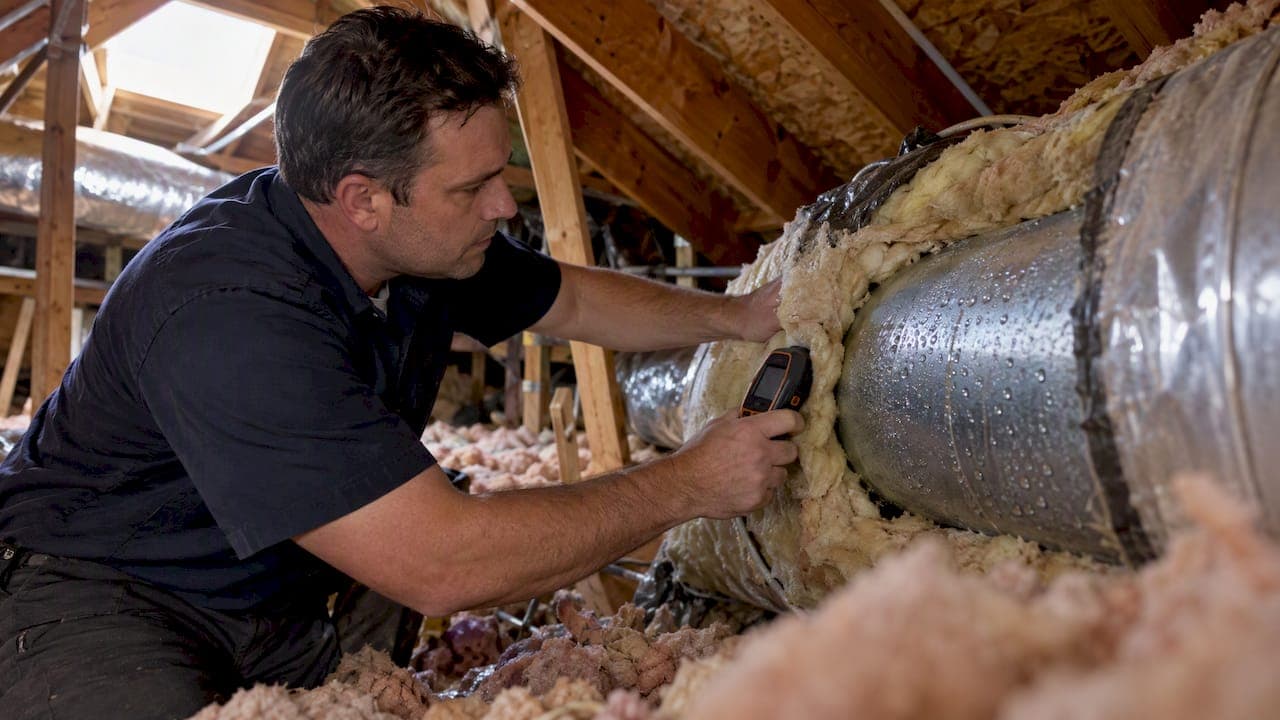
Condensation on air ducts means a duct's surface temperature has dropped below the surrounding air's dew point, so moisture is forming on the outside and dripping. The first steps are to catch the drips with a towel or tray, run your AC fan or a dehumidifier to cut indoor humidity, and pull out any insulation that's already soaked. Call a professional if puddles keep coming back, mold shows up, or you see water stains spreading on ceilings or framing.
TL;DR:
- Keep indoor humidity around 30% to 50% and dew point below 60°F; compare it with duct surface temperature using a hygrometer and infrared thermometer.
- Use duct insulation with an R value of 6 or higher in unconditioned spaces; many attics require an R value of 8, and seams need sealing.
- Recurring puddles, persistently soaked insulation, mold, or spreading ceiling stains warrant a professional; request a leak test, sealing, and a written report with photos.
- A properly sized dehumidifier can reduce active sweating temporarily, but never wrap soaked insulation in plastic or tape because trapped moisture encourages corrosion and mold.
Table of Contents
- Why Air Ducts Sweat: Dew Point and Surface Temperature
- What Damage and Health Risks Condensation Can Cause
- Short-Term Fixes You Can Try Right Away
- Long-Term Prevention and Contractor-Grade Solutions
- How to Diagnose the Cause Before Calling Anyone
- When to Call a Pro and What Services to Ask For
- What Field Inspections Typically Find
- Fixing It Right Without Overspending
- How We Can Help With Sweating Ducts
- FAQ
- Sources
Why Air Ducts Sweat: Dew Point and Surface Temperature
Sweating ducts come down to one simple rule: when a surface is colder than the dew point of the air touching it, water condenses out of that air and onto the surface. Supply ducts often carry air in the 50s°F, and when that duct sits in an attic running 80°F or hotter with high humidity, the gap between the duct's surface and the surrounding dew point can be wide enough to trigger condensation almost immediately, according to Lennox's explanation of duct condensation.
Some locations are simply more prone to this than others:
- Attics, where summer heat and humidity collide with cold supply ducts
- Vented crawlspaces, where ground moisture raises local humidity
- Unconditioned basements near air handlers and refrigerant lines
- Spots where insulation has shifted, gapped, or compressed, exposing bare duct metal
Leaky duct seams make the problem worse because they let humid outside air seep in and settle against cold metal, raising the local dew point right at the surface. This risk climbs sharply during hot, humid stretches of the cooling season, when outdoor air infiltration is at its peak.
What Damage and Health Risks Condensation Can Cause
Water that keeps forming on ducts doesn't stay put. It soaks into surrounding insulation, and wet insulation loses much of its R-value, which means your HVAC system works harder and burns more energy just to hold the same temperature.
Persistent dampness also creates conditions for mold and mildew. EPA moisture-control guidance treats uncontrolled moisture as a whole-building problem, recommending that indoor relative humidity stay roughly between 30% and 50% and that indoor dew point stay below about 60°F to limit dampness and the health concerns that come with it. ASHRAE's position on indoor dampness echoes this, noting that chronic moisture raises the risk of mold exposure for occupants.

Beyond health, there's physical damage to track: ceiling stains that spread and darken over time, corrosion on metal duct seams and hangers, and in bad cases, rot in nearby wood framing. None of this reverses on its own, and it tends to compound the longer standing moisture sits.
Short-Term Fixes You Can Try Right Away
While you're figuring out a permanent solution, a few temporary moves can keep things from getting worse.
- Set a drip tray, towel, or shallow pan under the worst spots and check it often; route drips toward a floor drain if one is nearby.
- Switch your thermostat fan to continuous "on" instead of "auto" so air keeps moving across cold surfaces and limits localized dew point buildup.
- If humidity is the clear driver, run a portable dehumidifier sized for the space, generally rated for the square footage of the attic or crawlspace involved.
- Shut off any attic fans or vents that could be pulling humid outdoor air toward the ductwork, and keep the attic access closed if it's safe to do so.
Resist the urge to wrap soaked insulation in tape or plastic. Sealing in trapped moisture only locks it against the duct, and that speeds up corrosion and mold growth instead of stopping it.
Pro Tip: Before touching anything near the duct, check for wet insulation around nearby electrical junction boxes or wiring; standing water and live electrical components are a combination worth stepping away from until a professional checks it.
Long-Term Prevention and Contractor-Grade Solutions
Temporary fixes buy time. Lasting fixes change the physics so condensation stops forming in the first place.
- Upgrade duct insulation to code minimums. Current residential energy code guidance calls for at least R-6 insulation on ducts in unconditioned spaces, with R-8 required in many attic locations, and a vapor-retarder facing matters because it keeps humid air from reaching the cold duct jacket in the first place.
- Seal the duct system itself. Mastic, approved foil tape at seams, or aerosol sealing methods like Aeroseal close leaks that let humid air infiltrate; the goal is airtightness, with Building Science and Department of Energy field guidance pointing toward keeping total leakage under roughly 5% of system airflow.
- Encapsulate ducts in hot-humid climates. Field demonstrations from Building America's research on encapsulated buried ducts found that closed-cell spray polyurethane foam (ccSPF) applied directly over airtight ducts before burial under loose-fill insulation eliminated condensation potential during monitored summer seasons.
- Consider relocating ducts into conditioned space. Moving ductwork inside the building's conditioned envelope, or converting an unvented attic into a conditioned one, removes the temperature differential that causes sweating altogether. It costs more upfront than a retrofit, but it's the most durable answer where attic duct problems keep recurring.
How to Diagnose the Cause Before Calling Anyone
A little measurement goes a long way toward getting the right repair the first time.
- Check indoor relative humidity with a basic hygrometer, available at most hardware stores, and use it to estimate your indoor dew point.
- Read duct surface temperature with an infrared thermometer at the spots where you're seeing moisture.
- Compare the two numbers. ASHRAE guidance suggests keeping dew point below 60°F; if your reading climbs above that and the duct surface sits at or below it, condensation is essentially guaranteed.
- Document what you see: saturated insulation, dark staining, musty odors, or active pooling, along with photos and the time of day or season it happens.
Our blog's guide to humidity and HVAC performance walks through how to take these readings step by step if you want more detail before a technician arrives.
When you do call someone, give them the locations, the timing pattern, and any recent attic or duct work, since that history often points straight to the cause.
When to Call a Pro and What Services to Ask For
Some signs mean it's time to stop troubleshooting and bring in a technician: insulation that stays soaked no matter what you do, puddles that return within days of drying them up, visible mold growth, ceiling staining, or a DIY fix that simply didn't hold.
When you do call, ask specifically for:
- A duct leakage test with sealing to close the gaps letting humid air in
- An insulation upgrade that includes proper vapor-retarder facing
- ccSPF encapsulation where ducts run through hot, humid attic space
- Duct cleaning or mold remediation if contamination has already set in
- An air-handler inspection to rule out a second moisture source
A reputable contractor should hand you a written inspection report with photos, a prioritized list of what needs fixing first, and some form of warranty on the work performed.
What Field Inspections Typically Find
Shaun, who writes for our blog, has reviewed enough attic duct inspections to notice a pattern: most sweating duct complaints trace back to one of two things, a leaky seam letting humid air in or insulation that's thin, compressed, or missing a vapor-retarder layer entirely. Our air duct cleaning visits in Avondale include a visual assessment of duct condition, moisture readings at problem spots, and specific repair recommendations, with an air quality test available when mold is a concern. We also recommend keeping written estimates and asking about workmanship warranties before approving larger repair work.
Fixing It Right Without Overspending
My honest read after looking at how homeowners handle this: the biggest mistake is treating a towel and a box fan as a permanent plan. Stop the dripping first, dry out what's wet, then diagnose before you spend a dollar on repairs. A portable dehumidifier might carry you through one humid summer, but sealing and insulation fixes the cause. For anything beyond a quick patch, get more than one written estimate so you know what you're actually paying for.
— Shaun
How We Can Help With Sweating Ducts
If you're past the towel-and-tray stage, we handle the parts of this that actually need a trained eye: sealing leaky duct seams, cleaning ducts that have already picked up mold or dust from moisture, and testing indoor air quality when dampness has you worried about what you're breathing. Our air duct cleaning service in Avondale includes a written quote, photos of what we find, and warranty options on completed work, so you know exactly what you're getting before anything starts.

If plumbing or boiler venting in a mechanical space is adding to your moisture problem, guidance on condensing boiler venting rules covers the mechanical side of that issue well.
Ready to get your ducts inspected? Request an estimate and we'll schedule a visit around your availability, including after-hours slots.
FAQ
Will a dehumidifier stop condensation on ductwork?
A properly sized dehumidifier can lower the surrounding air's dew point enough to stop active sweating, especially in attics or crawlspaces with high ambient humidity. It's most effective as a short-term or supplementary fix; if duct insulation is damaged or leaky, sealing and insulating the ducts addresses the root cause rather than just managing the symptom.
What causes condensation?
Condensation forms when a surface's temperature drops below the dew point of the air touching it, causing water vapor to turn back into liquid. On ducts, this typically happens when cold supply air inside the duct meets warm, humid air outside it, which Lennox describes as common wherever supply air in the 50s°F runs through a hot, muggy attic.
How can I stop my air ducts from sweating?
Start by sealing duct leaks with mastic or approved foil tape so humid air can't reach the cold duct surface, then bring insulation up to at least the R-6 to R-8 levels current codes call for in unconditioned spaces. In particularly humid climates, encapsulating ducts with closed-cell spray foam before burial under insulation has shown strong results in field studies.
Why is my attic sweating?
Attic sweating usually points to the same dew point problem affecting your ducts: warm, moist air meeting a cold surface, whether that's ductwork, roof decking, or HVAC equipment. Poor ventilation, insufficient insulation, or duct leaks dumping humid conditioned air into the attic space are the most common culprits.
Sources
- Lennox — Condensation on air ducts
- EPA — Moisture control guidance for building design, construction and maintenance
- Building America — Encapsulated buried ducts in hot-humid climates