
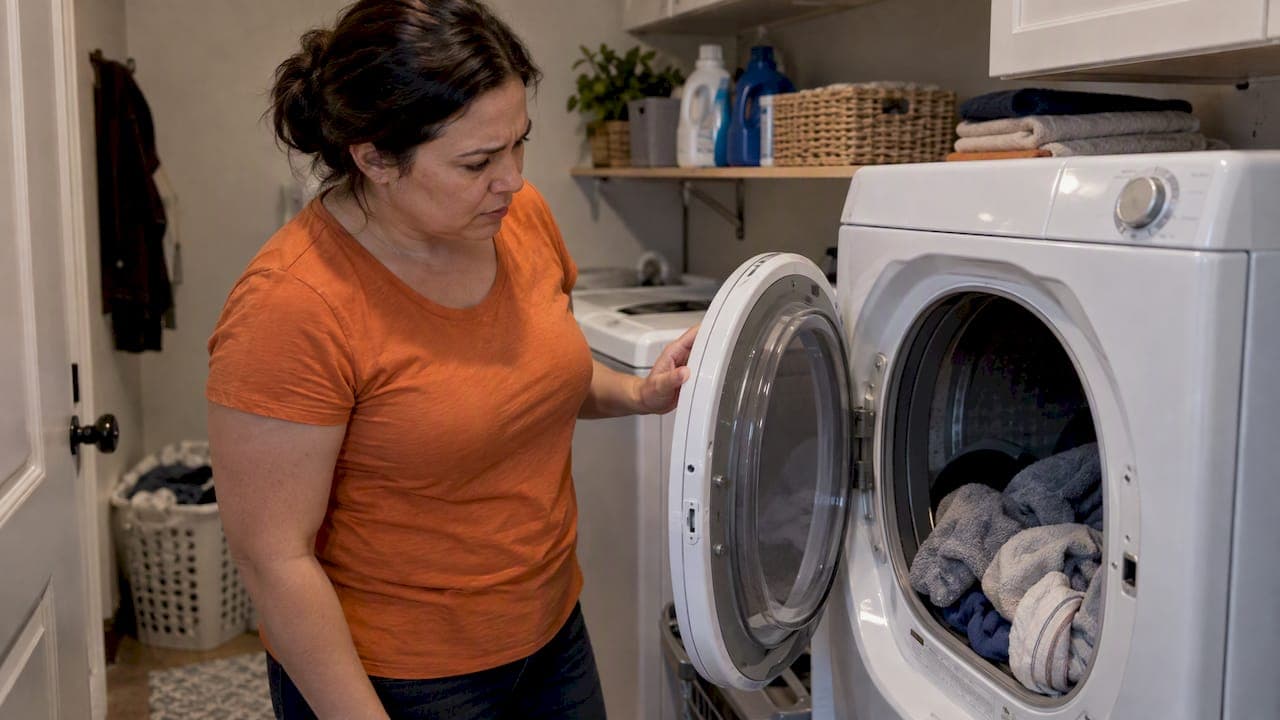
A burning smell from your dryer is a warning, so turn it off, then unplug it or shut off the gas valve, and do not restart it. Lint buildup is the most common cause, but overheating parts and electrical faults also produce that smell, and some of them need a technician. If you see smoke or smell gas, leave the house and call 9-1-1.
TL;DR:
- Weak airflow, a barely moving outside vent flap, longer drying times, or lint at the hood point to a blocked duct that needs cleaning.
- A hot rubber odor with thumping or squealing often signals a slipping belt or worn rollers, while humming or midcycle stops suggest motor trouble.
- Scorch marks, melted plastic, breaker trips, electrical odors, or a drum that stops call for an appliance technician; do not open electrical panels.
- Failure to clean accounted for 31% of dryer fires from 2018 to 2020; clean the screen each load and the full duct yearly.
Table of Contents
- What should you do the moment your dryer smells like burning?
- Why does my dryer smell like burning? Common causes and clues
- How do you safely check the lint, hose and outside vent?
- Which burning-smell faults need a technician?
- When should you call 9-1-1 and when should you call a pro?
- What maintenance keeps the smell from coming back?
- Why we never treat a burning smell as minor
- Dryer vent cleaning in Avondale: what our visit covers
- FAQ
- Sources
What should you do the moment your dryer smells like burning?
Work through these steps in order. They take a couple of minutes and cut the immediate fire risk.
- Stop the cycle, then unplug the dryer or pull the plug from the outlet. If you cannot reach the plug safely, switch off the breaker for the dryer circuit.
- If you have a gas dryer, close the gas shutoff valve behind the machine.
- If you smell gas strongly or see smoke, get everyone out and call 9-1-1 from outside. Do not flip light switches or use a phone inside the home.
- Open the door, pull out the laundry and let the drum cool. Hot clothes can still smolder, so keep them away from anything flammable.
- Do not run another load "just to test it." Wait until you know the cause.
- Write down what you noticed: burnt rubber, plastic, hot wires or scorched fabric, plus any visible smoke, discoloration or noise. A technician can use those details to narrow things down fast.
Pro Tip: Take a quick photo of the lint trap, the back of the dryer and the outside vent flap before you touch anything. Photos help a technician see what changed.
The scale of the problem is why we are strict about this. The Consumer Product Safety Commission (CPSC) estimates about 6,400 clothes dryer fires a year, which injure roughly 180 people and cause nearly $105 million in property damage. For a deeper checklist of warning signs, see our post on dryer vent fire signs.
Why does my dryer smell like burning? Common causes and clues
You can often guess the culprit from the type of smell and what else the dryer is doing. You do not need to open any electrical panels to do this.
- Lint buildup: Lint collects in the lint trap housing, inside the cabinet and along the vent. Clues include longer drying times, clothes that come out hot but damp, and lint around the vent opening. Lint is highly combustible, and when venting is compromised the dryer overheats.
- Blocked or kinked vent: Check the outside vent hood. If the flap barely lifts or the airflow feels weak while the dryer runs, air is not escaping. A crushed hose behind the machine does the same thing.
- Worn or slipping drive belt, idler pulley or rollers: These produce a hot rubber smell, often with a thumping or squealing drum. Manufacturer troubleshooting lists, such as Maytag's guidance, name the lint filter and drive belt as common causes and suggest having worn parts replaced by a technician.
- Motor overheating or failing bearings: Expect an electrical or burning-wire smell, a humming motor, or a dryer that stops mid-cycle. Do not keep trying to run it.
- Thermostat or control board faults: These give a sharp, acrid electrical smell. Scorch marks at the plug or on the rear panel are a serious sign. Asurion's repair guide notes that worn belts, malfunctioning thermostats and failing motors can all be behind a burning smell, and that a professional diagnosis may be needed when the source is not visible.
- Risky loads: Rubber or foam-backed items, such as bath mats, and anything soaked with oils or solvents can scorch or ignite on high heat. Overloading or drying unsuitable items also raises overheating and can create burning odors. If the smell shows up only with certain loads, start there.
- New-dryer off-gassing: A brand-new dryer can smell on its first few cycles as manufacturing oils and shipping materials burn off. Samsung support says running it empty for about 15 minutes can clear it, and UL describes the same pattern. A similar harmless smell is familiar to anyone who has fired up a new electric heater, which is why this guide on sauna heater smells is a handy comparison for telling a temporary new-element odor from a dangerous electrical one.
A temporary smell should fade as the dryer is used. A smell that persists, grows stronger or arrives with smoke is never a break-in smell.
How do you safely check the lint, hose and outside vent?
These checks do not involve electrical repairs. Do them only after the dryer is unplugged (or the gas is off) and fully cool.
- Clean the lint screen. Pull it out, peel away the lint and look at the trap housing. Use a vacuum crevice tool to remove loose lint from the slot.
- Check the drum. Look for foreign objects, melted material, stains or lint packed around the drum opening. LG's troubleshooting steps also suggest checking for stains that point to something pressing against the heating surface, and adjusting load size to avoid burn marks.
- Pull the dryer out carefully. Leave enough slack in the power cord or gas line. Never strain a gas connection.
- Disconnect the exhaust hose from the back of the dryer if you can reach it. Use a vent brush or a vacuum extension to clear lint from the hose and the first stretch of duct.
- Check the outside hood. Reconnect everything, run the dryer on air-only briefly and confirm the flap opens fully and the air coming out is strong. A flap that barely moves points to a blockage somewhere in the run.
- Look at the duct material. Flexible plastic or foil ducting traps lint, and manufacturers advise replacing it with rigid metal duct.
Some DIYers also remove the back panel to vacuum loose lint from the cabinet. Bob Vila's advice describes this for people who are comfortable doing it, and says to get professional service if troubleshooting does not solve the smell. If you are not comfortable opening the cabinet, skip it.
Pro Tip: If the vent run is long, has many bends or travels through a wall or attic, a brush from the dryer end will not reach all of it. That is the point to call a professional, because lint can sit in sections you cannot see.

For more on why clearing this lint matters, read our explainer on why removing dryer vent lint improves safety and efficiency.
Which burning-smell faults need a technician?
Some causes sit inside the machine, and guessing at them is how people get hurt. Here is what a technician typically finds.
- Slipping or melted drive belts and worn rollers: A belt that slips builds friction heat and gives off a rubber smell. Left alone, it can melt, snap or damage the drum and motor. Replacing it is routine for a technician but involves removing panels and handling tension parts.
- Motor windings and bearings: Failing bearings and overheated windings produce an acrid electrical smell. Heat from a damaged motor is a real ignition risk, so the dryer should stay off until it is inspected.
- Control board, timer or terminal block arcing: Burn marks, melted plastic or a blackened wire connection point to arcing. These parts carry full household current. A qualified technician should inspect and replace them.
- Heating element and thermostat issues: A stuck thermostat or a damaged high-limit control lets temperatures climb past safe levels, which can scorch lint inside the cabinet.
- Gas-specific risks: On a gas dryer, a smell of gas is different from a smell of burning fabric, and the response differs too. Gas odor means evacuate and call 9-1-1. Burning fabric with no gas smell still means shut it down. Periodic professional inspection of gas connections and burners is smart.
Electric dryers dominate the problem as well. USFA/NFPA data show that 78% of dryers involved in fires were electric, and mechanical or electrical failures were a significant contributor alongside failure to clean. CPSC staff have also noted that lint inside the cabinet and ducting can cause high-limit cycling and other abnormal dryer operation.
When should you call 9-1-1 and when should you call a pro?
The right call depends on what you see, smell and hear.
- Call 9-1-1 first if there is smoke, visible flames or a strong gas odor. Evacuate before you call, and do not go back for belongings.
- Call an appliance technician for electrical burning smells, scorch marks, a dryer that trips the breaker, or signs of mechanical failure. Keep the dryer off until it is repaired.
- Call a dryer vent cleaning service when airflow is weak, drying times keep growing or you can see lint at the vent hood.
- Have your details ready. Tell the dispatcher or technician what the smell was like, whether the dryer still runs, any visible damage, and whether it is gas or electric.
What maintenance keeps the smell from coming back?
A few habits do most of the work. The U.S. Fire Administration found failure to clean was the leading factor in clothes dryer fires from 2018 to 2020, at 31%. The same pattern shows up in NFPA's home fire research, where failure to clean accounted for roughly one-third of dryer fires, and where dust, fiber and lint were among the leading items first ignited.
- Every load: Clean the lint screen. Wash it now and then with warm soapy water and a nylon brush to clear the film that dryer sheets leave behind.
- Regularly: Check the outside vent hood and make sure the flap moves freely.
- At least once a year: Have the full exhaust duct cleaned. CPSC recommends cleaning lint out of the vent pipe at least once a year, and heavy use or a long run means more often. Our post on annual dryer vent cleaning walks through how to decide.
- Upgrade the ducting: Replace plastic or foil duct with smooth rigid metal, keep the run short and cut the number of bends.
- Mind your loads: Skip foam or rubber-backed items on high heat and never dry anything soaked with flammable solvents. Also avoid extension cords with major appliances, which can overheat.
- Keep alarms working: Install smoke and carbon monoxide alarms and test them regularly.
Pro Tip: Cabinet lint has a long list of places to hide. Maytag-style troubleshooting lists suggest cleaning the cabinet and vents every one to three years depending on use, so put it on the calendar next to your annual vent cleaning.
Why we never treat a burning smell as minor
Lint piles up in places homeowners rarely see: behind the drum, around the heating element and in the bends of long vent runs. You can empty the lint screen after every single load and still have a serious buildup deeper in the system. That is exactly where professional cleaning can help. If a burning smell keeps coming back, treat it as a reason to get help, not a quirk to live with.
— Shaun
Dryer vent cleaning in Avondale: what our visit covers
If lint or a blocked vent is behind the smell, our dryer vent cleaning service takes care of the part that is hard to reach on your own. A visit includes professional dryer vent cleaning.
Schedule us when airflow drops, drying times stretch out or a burning smell keeps returning after you have cleaned the lint screen. If you want to book or get a quote, start on our dryer vent cleaning page.
FAQ
Can I still use my dryer if it smells burnt?
No. Stop using it and unplug it or shut off the gas until you know the cause. A burning smell means something may be overheating, and running it again can turn a minor problem into a fire.
How do I get the smoke smell out of my dryer?
First find and fix the cause, such as lint buildup or a worn belt. Then clean the lint screen, wipe the drum and run an empty cycle in a ventilated area. If the odor stays, lint inside the cabinet or duct may still be burning off, which calls for a professional cleaning.
Why does my dryer smell burnt and won't spin?
A drive belt that has slipped, melted or snapped is a common reason, since it causes both a rubber smell and a drum that will not turn. A failing motor can do the same. Keep the dryer unplugged and call a technician.
Why does my dryer have a burning smell even after I clean the vent?
Lint may remain inside the cabinet, on the heating element or farther along the duct than a brush reaches. The smell can also come from a mechanical or electrical part, such as a belt, motor or thermostat. If cleaning does not clear it, have a technician inspect the machine.
Sources
- Cpsc
- Home Dryer Fires
- Maytag Dryer Has a Burning Smell
- Burning smell coming from your dryer? Here’s how to fix it | Asurion