
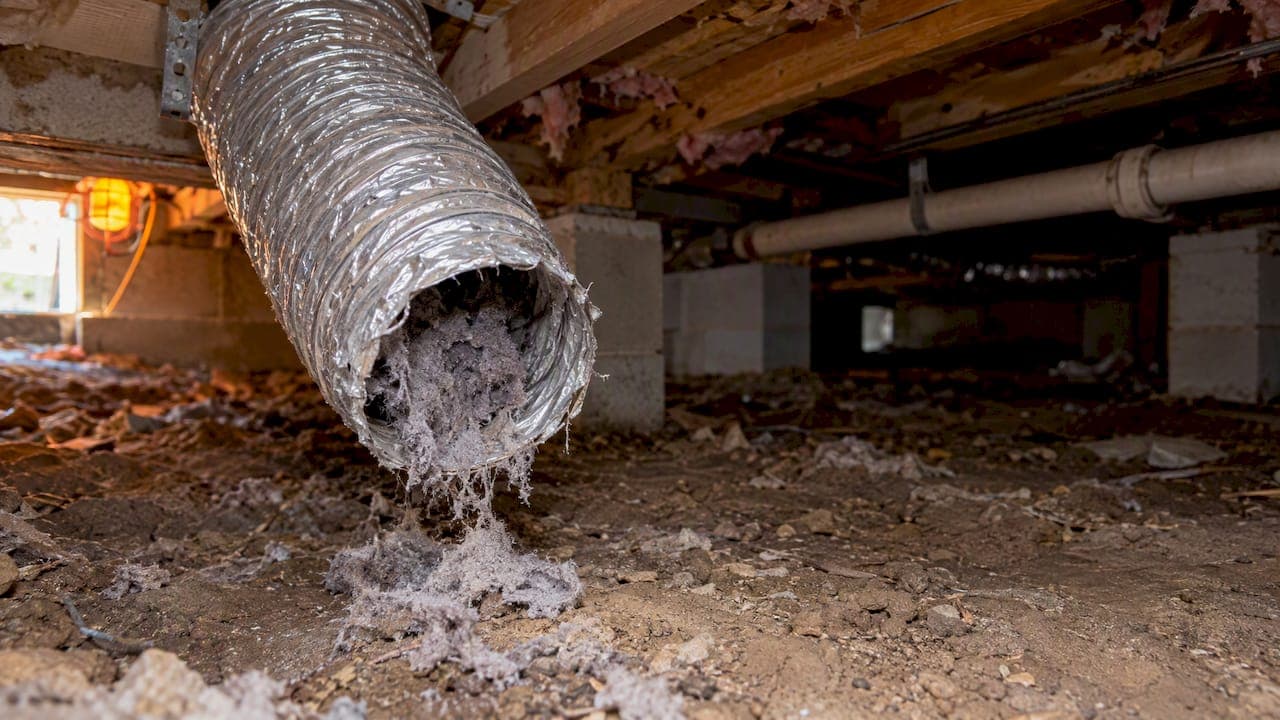
You can't safely run a dryer vent into a crawl space. Model codes require clothes dryer exhaust to end outdoors, and a duct that dumps hot, wet, lint-filled air under your house creates a fire hazard and a moisture problem. The fix is almost never complicated: either the duct gets rerouted to an exterior wall, or, if the duct already crosses the crawl space on its way outside, it gets rebuilt in rigid metal and cleaned. Below is how to tell which situation you have, what the code says, and what a proper repair looks like.
TL;DR
- A dryer must exhaust to the outdoors. Building codes prohibit terminating it in a crawl space, attic or any concealed cavity.
- A duct that merely passes through a crawl space on its way outside is a different case. It can be acceptable if it is smooth rigid or semi-rigid metal, sealed without screws, and kept clean.
- The risks are lint fires, trapped moisture, mold and a possible warranty problem with the dryer.
- Total duct length is limited to 35 feet, minus about 5 feet per 90-degree elbow, so a long crawl space run may need a shorter path.
- Cleaning or rerouting should be done by someone who works on dryer vents every week, not a general handyman.
Table of Contents
- Two very different situations
- Why venting a dryer into a crawl space is dangerous
- What the code actually says
- Is a duct through the crawl space ever acceptable?
- How to fix a vent that ends in the crawl space
- What about DIY?
- Our perspective
- Having us look at your dryer vent
- Warning signs your dryer vent needs attention
- FAQ
- Sources
Two very different situations
People searching this topic usually mean one of two things, and the answer changes between them.
1. The vent ends in the crawl space. The duct, or a loose flexible hose, opens under the floor. Sometimes it was installed that way. Sometimes a hose fell off its connection or a past owner disconnected it from a clogged exterior run. This is the dangerous one, and it needs to be corrected.
2. The vent crosses the crawl space and exits outside. The dryer sits on the first floor, and the duct drops through the floor, runs under the house and terminates at the foundation wall. That layout is legal in many places, but only if it is built and maintained correctly. Crawl space ducts are also the ones nobody looks at for years.
To find out which you have, go under the house with a flashlight and follow the duct from the floor penetration. If it ends in open air, a loose hose or a pile of lint, you have the first situation. If it reaches a hood on the outside wall, you have the second.

Why venting a dryer into a crawl space is dangerous
Fire
Lint is fuel. NFPA data for 2014 to 2018 shows fire departments responded to an average of 13,820 home structure fires involving dryers each year, and about one-third of them were attributed to a failure to clean. In a crawl space, lint that leaves the duct does not disappear. It settles on joists, insulation, wiring and pipes, in a dark space where you won't see it building up.
The U.S. Fire Administration has tracked this specific pattern. Its topical report on residential dryer fires found that a small share of dryer fires, roughly 2% to 3%, start in substructure areas such as crawl spaces. That is a minority of the total, but those fires start where nobody notices them early.
Moisture and mold
A dryer pushes a lot of water out of your laundry. The USFA material describes venting into crawl spaces as a cause of indoor air quality problems, including mold growth, with about a gallon of water from a single load going into the foundation area. Crawl spaces are already the dampest part of a house. Add a regular source of warm humid air and you get condensation on cold surfaces, wet insulation and mold on wood framing.
That mold does not stay put. Air moves from a crawl space up into the living area, so spores and musty odors end up in the rooms above. If someone in your household has allergies or asthma, a wet crawl space is worth taking seriously.
Backpressure and a dryer that never finishes
A vent that doesn't reach the outdoors can't move air well, and a lint-clogged one is worse. The dryer runs longer, the heating element cycles harder, and clothes still come out damp. Insiders see this pattern often: someone has a dryer that won't dry, the exterior run is long or clogged, and instead of cleaning or shortening it, the duct gets cut and left open under the floor. It solves nothing and creates two new problems.
Warranty
Dryer manufacturers specify the venting they require. Per the research we reviewed, flexible vinyl or thin foil ducting can violate those installation terms, which can leave you paying for repairs the warranty would otherwise cover. Check your dryer's installation manual for the exact wording on your model.
What the code actually says
In the International Residential Code, clothes dryer exhaust belongs outdoors. The Building America Solution Center summarizes it: vent directly outdoors (the exception is a ventless dryer with a condensate drain), use smooth metal ducting, and never terminate in a crawl space or attic.
The termination details matter too. Under IRC 2024 section M1502.3, the exhaust must end outdoors, at least 3 feet from doors, windows and other openings, at least 12 inches above finished grade, with a backdraft damper and no screen. Cities and counties adopt their own code editions and amendments, so confirm the version in force with your local building department. In the West Valley, that means checking with the city building office before any major rerouting.

Duct material
Use rigid or semi-rigid metal duct, 4 inches in diameter at minimum. Vinyl, nylon and foil "slinky" hose are what safety experts point to as a primary factor in dryer fires: they sag, trap lint and can melt or burn. The only flexible piece that belongs in the system is a short listed transition between the dryer and the wall or floor connection.
Joints and fasteners
Sheet metal screws that poke into the duct catch lint and build a lump that grows. The Department of Energy's clothes dryer venting job aid calls for fasteners that do not penetrate into the duct, and for a run that is as short and straight as possible. Seams are sealed with foil HVAC tape, not cloth duct tape.
Length and elbows
The usual maximum is 35 feet from the dryer to the exterior terminal. Each bend takes away from that: roughly 5 feet for every 90-degree elbow, though local code adoptions vary. A crawl space run often needs a drop through the floor, a turn, a long horizontal stretch and a turn up or out. Add those up before you assume it complies.
Here is a quick worked example. A duct with two 90-degree elbows loses about 10 feet of its allowance, leaving about 25 feet of straight duct. If your crawl space route needs 30 feet of straight pipe plus two elbows, it is over the limit, and the dryer will probably struggle.
No screens
Homeowners often add a mesh over the exterior opening to keep bugs and birds out. Don't. Lint packs into the screen, airflow drops and the dryer overheats. The right answer to critters is a proper hood with a working damper that closes when the dryer stops. The USFA report notes that blockages also come from nests of birds and small animals, which is another reason to look at your termination regularly.
Is a duct through the crawl space ever acceptable?
Often, yes, when the duct reaches the outdoors. It is not ideal, though, and these are the conditions it should meet:
| Check | What you want to see |
|---|---|
| Material | Smooth rigid or semi-rigid metal, 4 in. minimum, no vinyl or foil hose |
| Joints | Taped with foil HVAC tape, no screws protruding inside |
| Support | Straps that hold the duct straight, no sagging where lint can pool |
| Termination | Outside wall hood, 12 in. above grade, damper, no screen |
| Length | Within 35 ft after deducting for elbows |
| Condition | No crushed sections, no gaps leaking warm air into the space |
| Slope | No low spots that collect lint or moisture |
A duct in an unconditioned space also cools the exhaust as it travels. Warm, humid air meeting a cold metal surface can condense inside the pipe, and wet lint sticks. A shorter route, or an insulated run, helps. If you see rust, stains or water drips on the duct, the system is telling you something.
How to fix a vent that ends in the crawl space
This is the process a professional follows, described so you know what to expect and can judge a quote.
- Stop using the dryer. If the hose has fallen off or the duct is open, don't run loads until it's corrected. Hot humid air and lint are going straight into the space.
- Inspect the crawl space. Look for lint accumulation, damp or stained insulation, mold on framing and signs of rodents. Lint should be removed and moisture issues dealt with before the new duct goes in.
- Plan a route to the exterior. The shortest, straightest path to an outside wall usually wins. Sometimes that means moving the termination point or running the duct up through a wall rather than across the whole crawl space. Our article on dryer vent relocation considerations explains what drives the scope of that kind of job.
- Install rigid metal duct. Use 4-inch smooth duct, seal the seams with foil tape and support it properly. The NCHH's dryer vent installation detail shows the basic method of a rigid metal duct from the dryer connection through the floor.
- Fit a proper hood. Damper that opens with airflow, no screen, correct clearance from grade and openings.
- Clean the dryer and any old duct sections. Lint left in the dryer's own exhaust path will carry over.
- Test. Run a load and check at the exterior that air is flowing strongly, and under the house that every joint is tight.
If your new run turns out to be near the length limit, consider a shorter route rather than adding a booster fan. Fans can collect lint and complicate the system, and some codes limit them.
What about DIY?
Many handy homeowners can replace a short section of duct. The risk is in the details: the wrong material, screws in joints, an extra elbow that puts the run over the limit, a termination too close to grade. Crawl spaces are also cramped, can hide wiring, pests and standing moisture, and are not pleasant to work in. If you see widespread mold, wet insulation or evidence of animals, stop and bring in a professional first. For a suspected mold problem covering a large area, a mold remediation specialist is the right person to assess it. Dryer vent work itself is what a vent specialist handles.
Our perspective
We clean and service dryer vents, air ducts and related HVAC components, and we focus on that work rather than treating it as a side service. Here is how we think about crawl space dryer vents.
First, the vent is a system, not a hose. Everything from the back of the dryer to the outside hood matters, and the weakest section sets the performance. We would rather look at the whole path than clean one end.
Second, a dryer that takes two cycles is a warning. Before anyone cuts, reroutes or vents somewhere convenient, the duct should be cleaned and measured. In many cases lint is the problem, not the layout.
Third, a fix should be one you never have to think about again: rigid metal, smooth interior, sealed seams, a hood with a damper and a termination you can reach and inspect. We also like to see the exterior hood checked at least once a year, because it's the part of the system you can look at without crawling anywhere.
If you're not sure what's under your floor, ask for an inspection before you ask for a price. A good technician will tell you what they find, show you, and recommend only what the system needs.
— Shaun
Having us look at your dryer vent
We handle dryer vent cleaning in Avondale, AZ for homeowners, property managers and commercial clients, with flexible scheduling and warranties on our services. If your dryer takes too long, the laundry room smells hot, or you've found a duct that ends somewhere it shouldn't, contact us through our dryer vent page and we'll check the run, clean it and tell you what, if anything, needs to be rerouted or replaced. Our services page lists related work such as ductwork repairs and vent replacement.
Warning signs your dryer vent needs attention
Whether the duct ends in a crawl space or at an outside wall, these signs mean a vent check is overdue:
- Clothes need more than one cycle to dry.
- The dryer or the laundry room feels unusually hot.
- A burning smell during a load.
- Lint around the outside hood, or a flap that doesn't open.
- A musty smell from the floor registers or under the house.
- Visible moisture, staining or mold near the floor penetration.
Our dryer vent fire signs checklist goes through them in more detail, and our explainer on removing dryer vent lint covers why buildup matters so much for safety and energy use. If you want a plain summary of the duct size and termination rules, see our guide to dryer vent code requirements.
FAQ
Can you vent a dryer under a house?
No, not if the duct simply ends there. Model codes require dryer exhaust to terminate outdoors, and a crawl space counts as a concealed area. A duct can cross the crawl space if it continues to an exterior termination and meets the material, length and sealing rules.
Can a dryer vent have a 90-degree angle?
Yes, but every elbow cuts into your allowed length. A common rule takes about 5 feet off the 35-foot maximum for each 90-degree elbow, and local adoptions differ. Use as few bends as possible, and avoid tight crushed corners that catch lint.
Can bugs get in through a dryer vent?
They can if the damper is missing or stuck open, and birds and small animals sometimes nest in vents. A screen is not the answer, because it clogs with lint. Use a proper hood with a damper that closes when the dryer is off, and check it regularly.
Does venting a dryer into a crawl space void the warranty?
It may. Manufacturers set venting requirements, and flexible vinyl or foil ducting or venting inside the building can conflict with them. Read the installation instructions for your model, and keep records of any professional installation or cleaning.
Sources
- Proper Clothes Dryer Venting, Building America Solution Center
- Topical Fire Report Series: Clothes Dryer Fires in Residential Buildings (2008-2010), U.S. Fire Administration
- Home Dryer Fires, NFPA
- Arapahoe County Dryer Duct Policy
- IRC 2024 Dryer Vent Termination
- Vent a Clothes Dryer, U.S. Department of Energy
- Dryer Vent Installation, NCHH Healthy Housing Challenge