
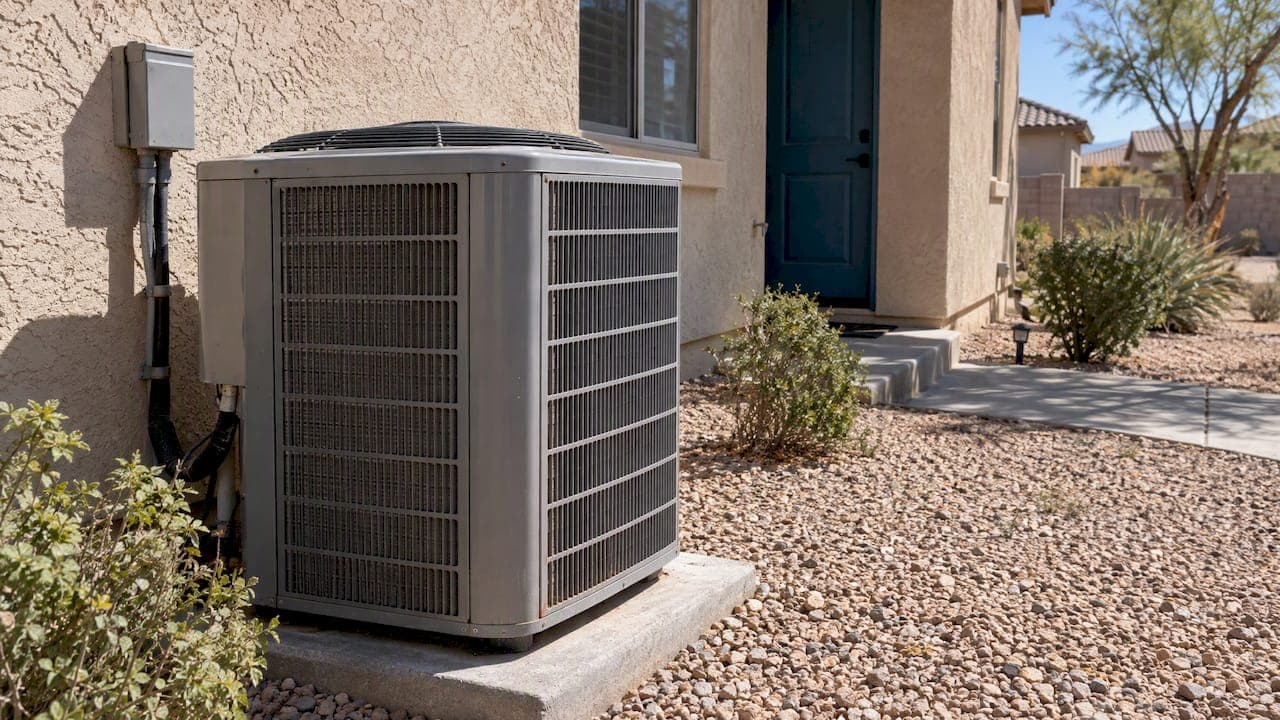
A heat pump cools your house exactly the way an air conditioner does, and it can also heat it by running in reverse. A standard AC only cools, so it needs a furnace or other heat source next to it. In Avondale, where summers are brutal and winters are mild, that difference matters less for comfort than it does for your utility bill, your equipment age and what you already have in the garage or closet.
This guide walks through how the two systems differ, what the choice looks like in the West Valley's climate, how the furnace question changes the answer, and what to ask before you sign a quote.
TL;DR
- In cooling mode a heat pump and an AC work the same way. The heat pump adds a reversing valve so it can also heat.
- Heat pumps work well in hot climates like Arizona's, and in winter they typically deliver more heat per unit of electricity than combustion heating does.
- If your furnace is young and reliable, a new AC alone can be the lower-cost move today. If the whole system is aging, a heat pump usually makes more sense.
- The federal Section 25C credit for heat pumps does not apply to systems placed in service after December 31, 2025, so budget without it.
- Ducts decide how well either system performs. Leaky or dirty ductwork wastes whatever you buy.
Table of Contents
- How a heat pump and an AC differ
- Is a heat pump a good fit for Avondale's climate?
- Heat pump vs furnace: the question behind the question
- Cost: what to expect and what changed
- Efficiency, humidity and thermostat habits
- Maintenance and lifespan
- Your ducts matter more than the label
- A quick way to decide
- Our perspective
- Work with a local team on the ducts and the system
- FAQ
- Sources
How a heat pump and an AC differ
Both machines use refrigerant, a compressor and coils inside and outside the house. EnergySage explains that in cooling mode the two function identically. The heat pump adds a reversing valve that lets it switch to heating, while a standard AC needs a separate heating system such as a furnace or boiler.
The Department of Energy describes the principle in simple terms: heat pumps use electricity to move heat from a cool space to a warm one, like a refrigerator. In summer they pull heat out of your home. In winter they pull heat from outdoor air, even cool air, and bring it inside.
So the real comparison is not "cooling system versus cooling system." It is:
| AC + furnace | Heat pump | |
|---|---|---|
| Cooling | Yes | Yes, same method |
| Heating | Separate gas or electric furnace | Same outdoor unit, reversed |
| Equipment to maintain | Outdoor condenser plus furnace | One outdoor unit plus indoor air handler |
| Fuel in winter | Natural gas or electric resistance | Electricity |
| Upfront cost | Lower if you keep the furnace | Higher for the equipment, one system instead of two |
Is a heat pump a good fit for Avondale's climate?
The old rule of thumb was that heat pumps belong in moderate climates and ACs in hot ones. That no longer holds up. The Department of Energy calls heat pumps an efficient option for all climates, and modern inverter-driven units can adjust their output instead of simply switching on and off, which helps them hold comfort in extreme heat.
Avondale is close to an ideal case for them. According to Weather Spark, the temperature here typically ranges from 42°F to 107°F and is rarely below 34°F. July averages a high of 106°F. January's average low is 43°F. Heat pumps are comfortable in that kind of winter. The hard part of your year is the cooling season, and a heat pump does that job the same way an AC does.
Can a heat pump cool a house at 100°F and above?
Yes. Cooling capacity is sized to your home's load, not to a particular outdoor temperature. What matters is that the system is sized correctly and the ducts deliver the air. A unit that is too small will struggle on a 110°F afternoon whether it is a heat pump or a straight AC. Ask any installer to show you the load calculation, not just a tonnage guess based on square footage.
Winter in the desert is where heat pumps shine
Avondale's heating season is short, with an average high below 73°F from late November to late February, per Weather Spark. That is gentle work for a heat pump. A federal field study of inverter-driven heat pumps in cold climates noted that these systems are gaining ground even in places that see subzero temperatures. If they can do that, a Valley winter is not a problem.
Heat pump vs furnace: the question behind the question
Most people typing "heat pump or furnace" are really asking what to do about winter heating. Here is how the main options stack up for a house that already has a cooling-only AC and a gas furnace.
Option 1: replace the AC only
Experts quoted by EnergySage say the decision often hinges on the furnace's age and remaining life. If the furnace has years of reliable service left, a dedicated AC can be the more cost-effective choice in the short term. In Avondale, where the furnace may run only a few weeks a year, a furnace can last a long time simply because it sees so little use. That makes this option more reasonable here than in a cold state.
Option 2: replace both with a heat pump system
If the AC is failing and the furnace is also near the end of its life, a heat pump is generally the better full-system upgrade, since you buy one system instead of two. The Department of Energy notes that heat pumps are inherently more efficient than combustion heating because they move heat instead of making it, often delivering two to three times as much energy as heat as they consume in electricity.
Option 3: heat pump with the furnace as backup
A hybrid, or dual-fuel, setup pairs a heat pump with your existing furnace. The heat pump handles summer and the mild shoulder seasons, and the furnace covers a rare cold snap. EnergySage describes this as a practical path when a high-efficiency furnace is still in good shape. In a mild-winter place like Avondale, the furnace would rarely have to step in.
Heat pump vs gas furnace: how to think about operating cost
What you pay in winter depends on your electric rate versus your gas rate, and no article can settle that for your house. Ask your installer to estimate winter use for both setups using your actual utility rates. Your electric provider and gas provider both publish current rate plans, and those change.
Cost: what to expect and what changed
Heat pumps usually cost more upfront than a cooling-only central AC, as NerdWallet notes, but they can heat and cool with higher efficiency. The gap narrows if you were going to replace a furnace too, because you are no longer buying two machines.
We do not publish flat prices for installation, because the number depends on your home's size, duct condition, electrical panel and permit needs. For a local sense of ranges and what drives them, see our guides on HVAC installation cost in Avondale and high-efficiency HVAC cost in Avondale.
The federal tax credit is gone for new installs
This is the biggest change for anyone reading older articles. Under IRS guidance on the 2025 budget law, the Section 25C credit for energy-efficient home improvements, which covered heat pumps, is not allowed for property placed in service after December 31, 2025. Any article promising a $2,000 credit on a heat pump installed this year is out of date. Talk to a tax professional about your own situation.
Utility rebates are a separate matter. Programs run by your electric provider change often, so check its current offer before you buy and ask your installer which models qualify.
Efficiency, humidity and thermostat habits
Efficiency. Look at the SEER2 rating for cooling and the HSPF2 rating for heating on a heat pump. A cooling-only AC has just the SEER2 number. In Avondale, cooling hours dwarf heating hours, so cooling efficiency deserves most of your attention.
Humidity. Arizona is dry for most of the year, but monsoon season brings humid days. The Department of Energy notes that heat pumps can offer better dehumidification in humid conditions. Our guide on humidity and HVAC covers what that means for a home here.
Thermostat strategy. Heat pumps respond differently than furnaces. The federal cold-climate study above found that frequent set-back and set-up schedules can trigger inefficient backup heating or force the system to work hard to recover, wiping out savings. With a heat pump, steadier settings often work better than big swings. Ask your installer how to program your specific thermostat.

Maintenance and lifespan
A heat pump runs all year, so it works more hours than an AC that sits idle in winter. That makes regular filter changes and coil care more important, not less. Neither system should go years without service.
In Avondale's dust, filters and coils load up fast, and construction dust in newer neighborhoods adds to it. A dirty system moves less air and wastes energy regardless of type. Our post on HVAC cleaning and energy savings lays out the evidence behind keeping the airflow path clean.
Your ducts matter more than the label
The best equipment can underperform if the ductwork is leaky, crushed, undersized or full of debris. Before you commit to a new system, have someone inspect the ducts. Replacing a system and keeping old, damaged ducts is one of the most common ways homeowners end up disappointed.

A heat pump also moves air differently from a gas furnace. Heat pump air is warmer than room temperature but not as hot as furnace air, and the system needs good airflow to heat well. Ducts that were barely adequate for cooling may need attention. See our page on duct repair and replacement if your inspection turns up problems.
While planning work on your home's mechanical systems, tell your installer about anything else tied into the house's ventilation. For example, if you have a radon mitigation system, a guide to radon fan repair and replacement shows how those systems rely on a working fan. Radon is less common in the Valley than in some regions, but it is worth knowing about if you have one installed.
A quick way to decide
- AC dead, furnace under about 10 years old and working: price a new AC against a hybrid setup. Both are reasonable.
- Both AC and furnace are old: price a full heat pump system. One system is simpler to maintain.
- Building an addition or finishing a garage: a ductless or separately zoned heat pump may suit the space.
- Rental or commercial property: weigh tenant comfort, utility metering and maintenance schedules. Our commercial air duct cleaning service is built around flexible scheduling for that situation.
- Ducts in poor shape: fix the ducts first or alongside any equipment change.
Our perspective
We clean and repair the air paths in Avondale homes and businesses, so we see what happens after the equipment is installed. The new system gets all the attention, and the ducts get none.
Our view is simple. Neither a heat pump nor an AC is the wrong answer here. A heat pump makes the most sense when you are replacing the whole system or the furnace is near the end. A new AC alone makes sense when the furnace is healthy and you want to spread out spending. In both cases, we would not install anything until the ducts have been checked, since leaks and buildup quietly eat efficiency.
We also tell homeowners to ask any installer for a written load calculation, a model number with its efficiency ratings, and a clear note on permits. If a quote lacks those, ask why.
— Shaun
Work with a local team on the ducts and the system
We handle A/C installation, A/C repair and heating services, air duct installation and air duct cleaning for homes and businesses in Avondale, AZ, with flexible scheduling and warranties on our services. If you are weighing a heat pump against an AC, we can look at your current system and ducts and tell you what we see. See all our services.
FAQ
What are the disadvantages of heat pumps?
They usually cost more upfront than a cooling-only AC, and they run year-round, so they need steady maintenance. Their performance depends on proper sizing and good ductwork. In very cold climates some need backup heat, which rarely applies in Avondale.
Can a heat pump replace both my AC and my furnace?
Yes. A heat pump cools in summer and heats in winter from the same outdoor unit. In a mild-winter area like Avondale, many homes can rely on one without a furnace, though a hybrid setup is an option if you want a backup.
Is a heat pump cheaper to run than a gas furnace?
It depends on your electric and gas rates. Heat pumps move heat rather than burn fuel, so they often deliver two to three times more heat energy than the electricity they use, according to the Department of Energy. Ask your installer to run the numbers with your actual utility rates.
Is there still a federal tax credit for heat pumps?
Not for systems placed in service after December 31, 2025, according to IRS guidance. Utility rebates may still exist, so check your provider's current programs. Confirm anything tax-related with a tax professional.
Should I replace only my AC or the whole system?
If your furnace is young and reliable, replacing only the AC can cost less right now. If both are aging, a heat pump system is generally the better overhaul. Inspect the ducts either way.
Sources
- EnergySage: Heat Pump vs. AC
- Field Performance of Inverter-Driven Heat Pumps in Cold Climates (DOE Building America)
- NerdWallet: Heat Pump vs. Central Air Conditioning
- IRS: FAQs on changes to energy credits under Public Law 119-21
- Weather Spark: Average Weather in Avondale, Arizona