
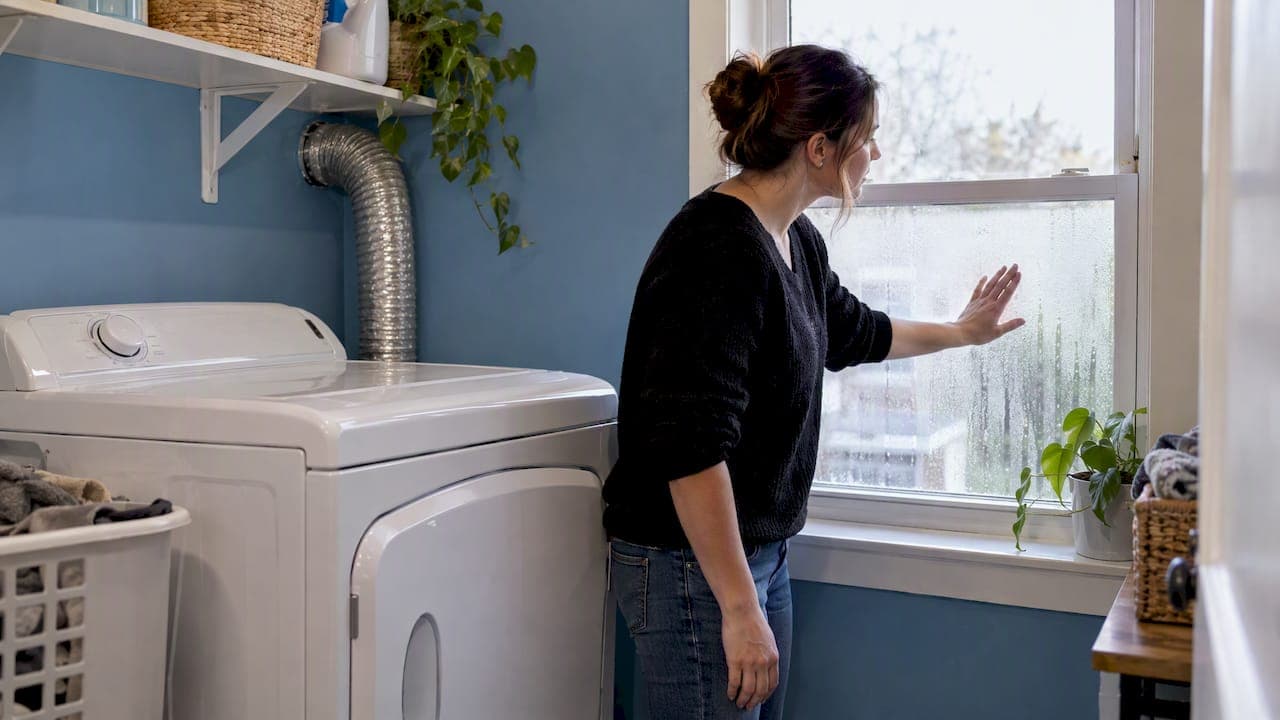
If your laundry room turns muggy, foggy or clammy whenever the dryer runs, the moisture is almost always going somewhere it shouldn't. In most homes the first suspect is the dryer exhaust duct: when it is crushed, disconnected, clogged or poorly routed, the warm, wet air from your clothes stays in the room. The fix usually starts with a 10-minute vent check, then moves to airflow, laundry habits and, if needed, a dehumidifier.
This guide walks through what a healthy humidity level is, how to find the source of the moisture, and what to do about it, in the order that saves you the most time and money.
TL;DR
- Aim for indoor relative humidity of 30 to 50 percent, and keep it below 60 percent when you can. A cheap humidity meter tells you where you stand.
- A dryer pushes heat and moisture out of your clothes. If the vent duct is blocked, crimped, torn or not connected to the outside, that moisture ends up in the room.
- Check the duct first, clean the lint filter every load, and have the dryer exhaust duct professionally cleaned at least once a year.
- Add ventilation, insulate cold pipes and use a dehumidifier only after the vent is sorted out.
- Persistent dampness, condensation on walls or a musty smell means it is time to call a pro before mold gets a foothold.
Table of Contents
- What humidity level is normal for a laundry room?
- Why the room gets humid when the dryer runs
- Start with the vent: a 10-minute check
- Clean the lint filter and the duct on a schedule
- Other reasons the room stays damp
- Stopping condensation on walls, windows and pipes
- Ventilation and dehumidifiers: when they help
- When humidity turns into a mold concern
- Our perspective: treat the vent as part of the system
- Get the vent cleaned in Avondale
- FAQ
- Sources
What humidity level is normal for a laundry room?
The U.S. Environmental Protection Agency says indoor relative humidity should ideally sit between 30 and 50 percent, and below 60 percent if possible. The same page explains that mold can grow when spores land on wet surfaces, which is why a damp laundry room deserves attention even when nothing looks wrong yet.
You do not need to guess. The EPA notes that a moisture or humidity meter, sold at many hardware stores, can measure relative humidity in your home. Put one on a shelf in the laundry room, away from the dryer's front, and read it at three moments:
- Before you start any laundry, to get your baseline.
- Halfway through a dryer cycle.
- An hour after the cycle ends.
If the number jumps well past 60 percent during the cycle and takes hours to come back down, the room is not getting rid of the moisture your appliances produce. If it stays high even when nothing is running, look beyond the dryer: a leaking supply line, a washer drain problem or poor air circulation in a closed closet-style room can all play a part.
Why the room gets humid when the dryer runs
A dryer works by heating air, passing it through wet clothes and carrying the water out as vapor. As one appliance-parts guide puts it, a dryer emits heat and moisture, and if the moisture has no exit it stays in the room. A single load can release a lot of water, and all of it is supposed to leave through the exhaust duct and out of the house.
That is why EPA guidance says to vent clothes dryers to the outside. Federal building research is more specific: clothes dryers must vent directly outdoors, with the exception of ventless dryers that have a condensate drain. If your dryer dumps its exhaust into the room, into a wall cavity or into an attic, you will see humidity problems, and you may eventually see damage.
When the duct is the problem, the dryer itself often gets blamed. The same Building America resource guide points out that dryer performance problems may come from a restricted or poorly designed exhaust duct rather than the machine. Long drying times, an overheated dryer or a burning smell are all clues that the exhaust path is struggling.
Start with the vent: a 10-minute check
Before you buy a dehumidifier or a new dryer, walk the exhaust path from the machine to the outside wall. This is the single most common fix, and most of it needs nothing but a flashlight.
Step 1: Look behind the dryer
Pull the dryer a foot or two from the wall, carefully, and keep the power cord and any gas line undisturbed. Confirm that the transition duct is connected to the dryer outlet and runs to the wall. A discussion among homeowners dealing with a very humid front-load dryer lands on the same checklist: the duct should be connected to the dryer and to the outside, and not crimped, squashed or torn.
Step 2: Check the duct material
Building research says vinyl, nylon and foil ducts are not recommended, and that using them can void most dryers' warranties. Rigid, smooth metal is the standard. One appliance-parts guide describes the ideal as a four-inch diameter, rigid smooth metal duct with short, straight runs where possible. Accordion-style flexible tubing traps lint in its ridges and kinks easily, so it is worth replacing.
Step 3: Go outside
Find the exterior vent hood. Does air push out firmly when the dryer runs? Is the flap stuck, packed with lint or blocked by a nest or debris? If water drips from the hood, that is its own diagnostic clue, and our guide on checking a dripping dryer vent from the outside first covers it in detail.
Step 4: Test the airflow
Run the dryer on a timed or air-fluff setting and hold your hand at the exterior hood. Weak airflow, or air that feels barely warm, means the duct is restricted somewhere between the machine and the wall. A restriction is the reason for most of those hot, wet, foggy laundry rooms.
Step 5: Note the warning signs
Clothes that take two cycles to dry, a dryer cabinet that is hot to the touch, a musty smell on towels and a lint buildup around the outside hood all point to a clogged duct. Lint is not only a humidity issue. It is fuel, and our checklist of dryer vent fire signs for homeowners and property managers explains what to look for.
Clean the lint filter and the duct on a schedule
The habits are simple. The Building America guidance recommends cleaning the lint filter before or after each load, and having a professional technician clean the dryer exhaust duct at least once a year. The filter catches only part of the lint. The rest travels into the duct, settles on the walls of the pipe and gradually narrows the passage, which slows the exit of moist air.
A yearly duct cleaning is especially worth it if:
- The duct run is long or has several bends.
- The dryer is in an interior room, so the vent has to travel far to the outside.
- You have pets, or you wash a lot of towels, blankets or bedding.
- You recently moved in and have no idea when the vent was last cleaned.
- The home is a rental, where the duct history is unknown.
If you manage rentals or live in a multi-unit building, our safety guide to annual dryer vent cleaning for homeowners and landlords explains how to set a service rhythm that makes sense for the property.
We also see the other side of a dirty vent: what comes out of it. Our article on the top contaminants found in dryer vents shows what builds up inside and why the moisture and debris combination is worth removing.
Other reasons the room stays damp
A clear vent does not always end the problem. These are the next things to look at.
Overloaded dryer
Stuffing the drum restricts airflow. A troubleshooting guide from an appliance-parts retailer notes that overloading can reduce drying performance and cause moisture to condense inside the drum. Smaller loads dry faster and release their moisture in a steadier stream that the duct can handle.
Indoor drying racks
Air-drying a full load on a rack in the laundry room puts the same amount of water into the air as a dryer would, only with no exhaust at all. If you hang clothes indoors, do it in a room with a working fan or an open window, or keep a dehumidifier running nearby.
A closed, cold room
Warm, moist air condenses on any cold surface. A forum thread about a humid laundry room makes the point that if the room is kept cool, moisture from the dryer and washer can condense on the cooler surfaces rather than staying in the air, which is why walls and windows can look wet even when the air feels fine.

That is a practical reminder that where the air is warmer than the walls, the water goes to the walls.
Hidden leaks
A slow drip from a washer hose, a drain pan or a utility sink can add humidity without any visible puddle. Look behind the washer, inside the cabinet under the sink and along the baseboards for soft spots, stains or a smell that does not go away. Our friends who cover property care explain the same logic for rentals in a piece on preventing mold after leaks: dry the area fast and find the source.
Stopping condensation on walls, windows and pipes
If you see droplets on a wall, a window or a cold water pipe, three moves work together. The EPA's guidance on preventing condensation is to reduce humidity, increase ventilation or air movement, and insulate cold surfaces such as cold water pipes. A separate EPA building air quality guide adds that insulating cold surfaces or improving air circulation can reduce relative humidity near those surfaces and help inhibit mold growth.

The same guide draws a useful distinction: mold problems can be driven by cold surfaces or by high moisture levels, and the two need different control strategies. If only the pipe or the exterior wall is wet while the room's humidity reads normal, insulation and air movement are your answer. If the humidity meter itself reads high, the answer is moving moisture out of the room.
Temperature matters too. One dryer manufacturer's support page advises keeping the room where the tumble dryer sits at around 20°C (68°F) to help prevent condensation on cold surfaces, and says not to install or use the appliance where the temperature is below 5°C (41°F) or above 35°C (95°F). That page is written for UK tumble dryers, but the principle applies to any dryer: a very cold garage or an unconditioned utility closet invites condensation.
Ventilation and dehumidifiers: when they help
Once the exhaust path is sound, extra ventilation handles the rest. The EPA suggests venting moisture-producing appliances outdoors where possible and using air conditioners or dehumidifiers when needed. It also notes that opening doors or windows and running fans increases air movement and helps prevent condensation.
A few practical rules:
- Run an exhaust fan or open a window during and after laundry if the room has one. Exhaust fans should send air outdoors, not into an attic, as the EPA says in its guidance on controlling moisture.
- Leave the door open after a cycle so the room can mix with the rest of the house.
- Use air conditioning, which the EPA lists alongside dehumidifiers as a way to cut moisture in hot, humid climates.
- Add a dehumidifier for rooms that stay damp. A compact unit, such as this 14-liter room dehumidifier, shows the kind of capacity people look at for a utility space. Match the size to the room and empty or drain the tank regularly.
A dehumidifier is a helper, not a repair. If the dryer is dumping a load of vapor into the room because the duct is clogged, the dehumidifier will run constantly and the vent will still be the problem. Fix the exhaust first, then let the dehumidifier handle what remains.
When humidity turns into a mold concern
Mold needs moisture, and a laundry room supplies plenty. Watch for these signs:
- A musty smell that returns after cleaning.
- Dark spots on the ceiling, the wall behind the dryer or the caulk around the sink.
- Peeling paint or bubbling drywall.
- Humidity readings that stay above 60 percent for days.
- Persistent condensation on windows or walls.
Surface moisture caught early is manageable: dry it, find the source and increase airflow. If you see widespread growth, or the dampness is inside the wall, call a qualified professional rather than scrubbing it yourself. If your household has allergy, asthma or other respiratory sensitivities, a conversation with your doctor about reducing exposure is the right move. If you are unsure what is in your indoor air, an indoor air quality test can tell you more than your nose can.
Our perspective: treat the vent as part of the system
Most of the laundry rooms we hear about are not suffering from a bad dryer. They are suffering from a vent that was never given the attention it needed. Dryers are installed, used for years and forgotten until something goes wrong: a hot room, a damp wall, towels that never quite dry.
That is why we specialize in cleaning. Dryer vent and air duct cleaning is our core work, not an add-on to something else. Our approach is built around commercial-grade equipment, trained technicians and a thorough look at the whole exhaust path, so the moisture and lint that cause humidity do not have a place to hide.
If you live in Avondale and your laundry room feels heavy every time the dryer runs, we would start at the vent. Clear the path, check the connections, and confirm the air is moving outside. Then look at the rest of the system, including your air ducts and vents, because indoor air quality is connected from one room to the next.
We also offer warranties on our services and flexible scheduling, including after-hours options, so a fix does not have to interrupt your week.
Shaun
Get the vent cleaned in Avondale
If your checks point to a restricted duct, or you simply cannot remember the last time anyone cleaned it, our dryer vent cleaning service in Avondale, AZ is built for exactly this. We clear the full exhaust path from the dryer to the outside, and we can also look at your air vents and ductwork if the rest of the house feels stuffy. We serve homeowners, property managers and business owners, with bundled discounts when you combine services.

Contact us through the dryer vent cleaning page to book a visit, and we will work out a time that suits you.
FAQ
Why is my dryer humid inside?
Moisture condenses inside the drum when warm, wet air cannot leave fast enough. The usual causes are a restricted or crushed exhaust duct and an overloaded drum, both of which slow airflow. Check the duct and lint filter first, then try a smaller load.
Is it safe to sleep in a room with condensation?
Condensation means the room has more moisture than its surfaces can handle, and the EPA links wet surfaces to mold growth. Dry the surfaces, improve ventilation and track humidity with a meter. If anyone in the home has asthma or allergies, or you see mold, talk to your doctor and have the source of the moisture fixed.
Is it illegal to vent a dryer indoors?
Rules differ by jurisdiction, so check with your local building department. What the guidance is clear on is that clothes dryers should vent directly outdoors, unless they are ventless models with a condensate drain, as federal building research states. Venting indoors floods the room with moisture and lint.
Where should you not use a dehumidifier?
A dehumidifier is no substitute for a working dryer vent, so do not rely on it to hide a blocked duct. Avoid placing it in a tight spot that blocks its air intake, and keep it away from cold areas where the unit's coils may ice up, as its manual will explain. Follow the maker's instructions for placement.
Sources
- A Brief Guide to Mold, Moisture and Your Home, US EPA
- What are the main ways to control moisture in your home? US EPA
- Building Air Quality: A Guide for Building Owners and Facility Managers, US EPA
- Proper Clothes Dryer Venting, Building America Solution Center
- How Do I Get Rid of Humidity in My Laundry Room?
- Electric front load dryer making room extremely humid and wet
- How to fix dryer condensation: A troubleshooting guide
- Excessive moisture in room, on walls and windows where the tumble dryer is located
- Preventing mold after leaks
- 14-liter room dehumidifier