
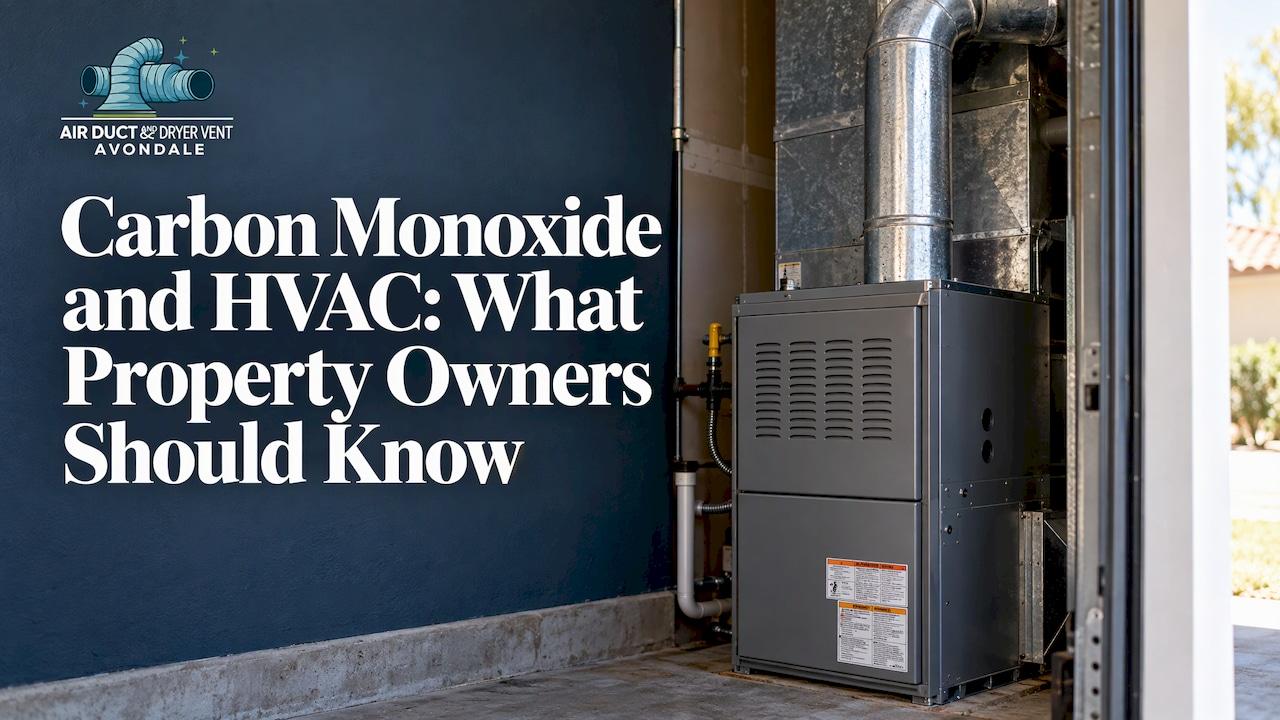
Your air conditioner does not make carbon monoxide (CO). Combustion equipment does: gas and oil furnaces, boilers and gas water heaters. When that equipment is clean, correctly vented and serviced every year, the CO goes outside. When it is not, CO can enter your home or building, and you cannot see or smell it. For homeowners, landlords and property managers in Avondale, the practical answer is a CO detector on every sleeping level, a yearly heating inspection, and a qualified HVAC company that looks at the whole system, from the equipment to the ductwork that carries the air. That is the work we do every day at Air Duct and Dryer Vent Cleaning Avondale, including A/C repair and heating services.
TL;DR
- Central, window and portable air conditioners do not burn fuel, so they do not produce carbon monoxide. Gas and oil furnaces, boilers and gas water heaters can.
- CO is colorless and odorless. The warning signs look like the flu without a fever: headache, dizziness, nausea, weakness and confusion.
- If a CO alarm sounds or you suspect poisoning, get everyone outside into fresh air and call 911. Do not move back in until a qualified professional has found and repaired the source.
- Put battery-powered or battery-backup CO detectors near every sleeping area, test them monthly, and have heating equipment serviced once a year.
- Dry indoor air is a comfort issue, not a CO issue. In the desert the fix is humidity control, not guesswork.
Table of Contents
- Does an air conditioner produce carbon monoxide?
- How a furnace ends up releasing carbon monoxide
- Warning signs of carbon monoxide poisoning
- What to do if the alarm sounds or you suspect a leak
- Detectors: where to put them and how to keep them working
- The yearly heating check
- For property managers and commercial owners
- Why the air feels dry, and what to do about it
- Book the work that keeps your system safe
- Our perspective
- FAQ
- Sources
Does an air conditioner produce carbon monoxide?
No. An air conditioner moves heat by circulating refrigerant through coils. Nothing is burned, so there is no combustion gas. HVAC.com explains that this holds for central, window and portable units, and that heat pumps and electric furnaces are CO-free for the same reason.
That matters in Avondale, where cooling runs most of the year. The confusion usually starts because one house often has two systems sharing the same ducts: a cooling coil and a gas furnace. The air conditioner is not the problem. The gas heating side is the part that needs a combustion safety check.
So the first question to ask about your property is simple: what fuel does the heating burn?
| Equipment | Burns fuel? | Can it produce CO? |
|---|---|---|
| Central, window or portable A/C | No | No |
| Heat pump | No | No |
| Electric furnace | No | No |
| Gas or oil furnace | Yes | Yes, if burning is incomplete or venting fails |
| Boiler | Yes | Yes, under the same conditions |
| Gas water heater | Yes | Yes, under the same conditions |
The table follows the same HVAC.com summary. If you are not sure which type of heating you have, the nameplate on the unit or your installation paperwork will say.
How a furnace ends up releasing carbon monoxide
CO is the result of incomplete burning of a carbon-based fuel. The EPA explains in its overview of what carbon monoxide is that it interferes with how your blood carries oxygen, and that at very high concentrations it is fatal. The CDC's furnace safety fact sheet describes it as an invisible, odorless gas that can kill without warning.
A healthy gas furnace still makes a small amount of CO. The difference is where it goes. According to the AHRI gas furnace safety guidance, a clean, efficiently burning furnace vents very small amounts outside, while a dirty, inefficient one can produce deadly amounts. AHRI also notes that small cracks in the combustion chamber, too fine to see, are one way CO leaks into the living space.
The EPA lists the common failure points in its page on sources of combustion products:
- Chimneys or flues that were improperly installed or maintained
- Cracked heat exchangers in furnaces
- Blocked, leaking or damaged chimneys and flues, which can release combustion gases including fatal concentrations of CO
The EPA adds that even new furnaces can corrode and leak. Age is not the only factor, and a furnace that has sat unused through a long Arizona cooling season is not automatically ready for its first cold night.
Where ducts and vents fit
Ducts and vents do not make carbon monoxide. They carry air. But they are part of the same system as the furnace, and a property owner usually wants one team to look at all of it: the equipment, the airflow and the condition of the ductwork. We clean and replace air ducts, air vents and dryer vents, and we repair ductwork and install new systems. If you want to see what damaged vents look like, our guide to examples of vent damage shows what to watch for.
Warning signs of carbon monoxide poisoning
The symptoms are easy to dismiss. The EPA's CO poisoning factsheet lists flu-like symptoms without a fever, headache, dizziness, nausea, weakness, shortness of breath and confusion. The CDC lists a similar set, adds vomiting and chest pain, and warns that people who are asleep or intoxicated can die before symptoms appear.
Two patterns are worth noticing:
- Everyone in the building feels sick at once, or symptoms ease when you leave and return when you come back.
- Symptoms appear when the heat comes on, especially the first cold days of the season, when windows are closed.
MedlinePlus notes that many poisonings occur in winter, when furnaces, gas fireplaces and portable heaters run in closed-up homes. You can read its full symptom list on the MedlinePlus CO poisoning page.
The EPA states that fetuses, infants, older adults and people with anemia or heart or respiratory disease are especially sensitive to CO. If any of those people live in or use your property, treat every alarm as urgent.
The effects can also outlast the exposure. Mayo Clinic notes that nervous-system symptoms such as memory loss, personality changes and movement problems can appear after recovery, with higher risk in older people and in those who lost consciousness. That is one more reason to get medical attention rather than wait it out.
What to do if the alarm sounds or you suspect a leak
Can you stay in a house with a CO leak? No. Mayo Clinic's guidance is to believe the alarm, leave and call 911 or emergency medical help. Here is the sequence, based on the EPA's guidance for suspected combustion appliance problems:
- Get to fresh air immediately.
- If you can do it without delay, open windows and doors and turn off combustion appliances.
- Leave the building and bring everyone with you, including pets.
- Contact a doctor right away and say you suspect CO poisoning. A doctor may take a blood sample to measure CO levels.
- Do not go back in until the source has been found and repaired.
The national Poison Help line, 1-800-222-1222, is listed by MedlinePlus for poisoning questions. For an alarm or any symptoms, call 911 first.
Mayo Clinic is clear on the last step: if poisoning occurred in the home, a qualified service professional must check and repair any appliance that might have caused it before anyone stays there again. This is where a licensed heating technician comes in. Our heating services and A/C repair team is the place to start for equipment in Avondale once the emergency services have cleared the building.
A word on fumes from other sources. Some household cleaning products, ammonia among them, also give off fumes that call for good ventilation, as covered in this overview of ammonia cleaning risks. If a smell or headache is tied to cleaning rather than heating, the same rule applies: fresh air first.
Detectors: where to put them and how to keep them working
A detector is the only way you will know. Your nose will not help. The CDC and EPA recommendations agree on the basics:
- Placement: the CDC advises battery-operated or battery-backup detectors near every sleeping area. The EPA advises a central location on every level of livable space, including the basement, at least 15 feet from any fuel-burning appliance, so normal start-up emissions do not set it off.
- Testing: the EPA says to test monthly and to interconnect alarms where possible. The CDC says to check the batteries when you change your clocks each spring and fall.
- Replacement: replace the detector according to the manufacturer's instructions, or every 5 years, per the CDC.
- Height: a local fire department, Urbana, Illinois, points out that CO mixes evenly through a room, so a working alarm does not have to sit high on the wall the way a smoke alarm does.
- Generators: the EPA says never to run a portable fuel-fired generator inside, or within 20 feet of a building.
A battery or backup matters because a power outage is exactly when people reach for fuel-burning heaters and generators.
The yearly heating check
The CDC recommends having heating systems, water heaters and other gas, oil or coal appliances serviced every year by a qualified technician. It also recommends buying gas equipment that carries the seal of a national testing agency such as Underwriters Laboratories. AHRI recommends cleaning and checking a gas furnace before heating season with a NATE-certified technician (NATE is the industry's technician certification).

In Avondale, that means scheduling the check in early fall, before the first cold nights, when the furnace has been idle for months and the schedule is not yet crowded. A useful annual visit covers the whole system, not just the furnace. It is also a good time to look at filters, vents and ducts. Our air filter replacement, ductwork repairs and air quality test services can be booked in the same visit window, and bundled discounts are part of how we price multiple services.
If an inspection or a poor-performing system points to equipment that is past repair, we also handle A/C installation and air duct installation. Our guide on the role of HVAC in property safety explains how these pieces fit together.
For property managers and commercial owners
Buildings carry their own rules. The International Fire Code, as published by UpCodes, requires CO detection in new buildings where a CO source exists. That includes buildings with a CO-producing forced-air furnace, buildings with attached private garages, and buildings where a CO-producing vehicle is used indoors. Section 915.2.4 requires detection in enclosed rooms served by a fuel-burning forced-air furnace, with exceptions where detectors in the first room served by each main duct send signals to an approved location. Local jurisdictions adopt their own versions, so confirm the requirements that apply to your building with your local fire authority.
For tenants and staff, the practical points are the same as at home: working detectors, documented annual service, and a clear plan for who calls 911 and who shuts equipment down. We offer commercial air duct cleaning with flexible scheduling, including after-hours options, so maintenance does not interrupt business. Our maintenance strategies for commercial vents guide helps facility managers plan the year.
Why the air feels dry, and what to do about it
People searching for CO and HVAC often have a second complaint: the air feels dry. The two are unrelated. Dry air does not signal a CO leak, and a CO leak does not dry out the air.
What dries it out is the equipment doing its normal job. In Arizona the outdoor air is already low in humidity, and air conditioning removes more moisture as it cools. In winter, heating air raises its temperature without adding water, so relative humidity falls. Eller Services describes this effect and notes that warm, dry air pulls moisture from skin, sinuses, wood floors and furniture.
The American Lung Association says to keep home humidity between 30% and 50%. Too little moisture can irritate the airways and dry the eyes and skin, and too much encourages mold. Its suggestions include running bathroom exhaust fans during and for 30 minutes after bathing, using exhaust fans when cooking, and using a dehumidifier if humidity climbs above 50%. In a dry climate, a small hygrometer (a humidity gauge, usually under $20) tells you where you stand.
A clean filter and clear vents help your system run as designed. Eller Services recommends checking the furnace filter monthly and using MERV 8 to 13 filters. (MERV is the filter efficiency rating.) You can see our own household air quality indicators guide for what to track at home, and our air quality test is available when you want a professional look at your indoor air.
Book the work that keeps your system safe
We are a local team in Avondale, and HVAC cleaning and maintenance is our specialty, not a side line. Our technicians use commercial-grade equipment, our services carry warranties, and we offer flexible scheduling for homes and businesses. If your heating needs service before the cold season, start with our A/C repair and heating services page. For ducts, vents and filters, see our full list of services, or contact us through our main site.
If you already have a CO alarm going off, do not call us first. Leave the building and call 911. Once the building is cleared, we can help with the repair and system work that follows.
Our perspective
We work in the part of the building most owners never see: the ducts, the vents, the equipment behind the closet door. Most of the trouble starts when a system is treated as separate pieces. The furnace belongs to one person, the ducts to nobody, and the filter to whoever remembers.
Our view is that carbon monoxide safety and indoor air quality are the same habit. You keep a working detector on every sleeping level. You have the heating checked once a year. You keep filters fresh and vents clear. You treat a change in how the system sounds, smells or performs as a reason to look, not to wait.
That is why we focus on HVAC cleaning and maintenance as our main business, and why we back our work with warranties. Owners and property managers in Avondale should have one local team that can clean, repair, replace and install, and schedule around the way they actually live and work.
Shaun
FAQ
Can a dirty or blocked air duct cause carbon monoxide?
Ducts carry air and do not make CO, because nothing burns in them. The source is combustion equipment such as a gas or oil furnace, boiler or water heater. Ducts are still worth keeping clean and in good repair as part of the whole heating and cooling system, and a technician can inspect them with the equipment.
How do I know if my furnace is giving off carbon monoxide?
You cannot tell by smell or sight, so rely on a working CO detector and a yearly inspection. Warning signs in people include headache, dizziness, nausea and weakness that ease when they leave the building. A cracked heat exchanger or damaged flue can release CO, and only a qualified technician can confirm either.
What are two warning signs of carbon monoxide poisoning?
Headache and dizziness are the two most commonly listed, along with nausea, weakness and confusion. They feel like the flu without a fever. If several people or pets in the same building have them at once, leave and call 911.
Does running my A/C make the air in my home worse for carbon monoxide?
No. Air conditioners do not burn fuel and do not produce CO. If your home has gas appliances, such as a furnace, water heater or stove, those are what to have inspected, and detectors cover you year-round.
Is dry air from my HVAC a sign of a problem?
Usually it is just how heating and cooling affect humidity, especially in the desert. The American Lung Association suggests aiming for 30% to 50% humidity. If the air stays dry or you notice other changes in comfort, a system and air quality check can help you find the cause.
Sources
- Do Air Conditioners Produce Carbon Monoxide? | HVAC.com
- What is carbon monoxide? | US EPA
- Furnace Safety Fact Sheet | CDC
- Gas Furnace Safety | AHRI
- Sources of Combustion Products | US EPA
- Carbon Monoxide Poisoning: Protect Your Family and Yourself | US EPA
- Carbon Monoxide (CO) Poisoning Basics | CDC
- Carbon monoxide poisoning | MedlinePlus
- Carbon monoxide: Symptoms and causes | Mayo Clinic
- What do I do if I suspect that combustion appliances are affecting my health? | US EPA
- Carbon Monoxide | Urbana, IL Fire Department
- Carbon Monoxide (CO) Detection | UpCodes
- Staying Safe from Indoor Air Pollution This Winter | American Lung Association
- How Does My Gas Furnace Affect My Home's Indoor Air Quality? | Eller Services
- Ammonia Cleaning Risks: What Households Should Know | Kinetic Clean