
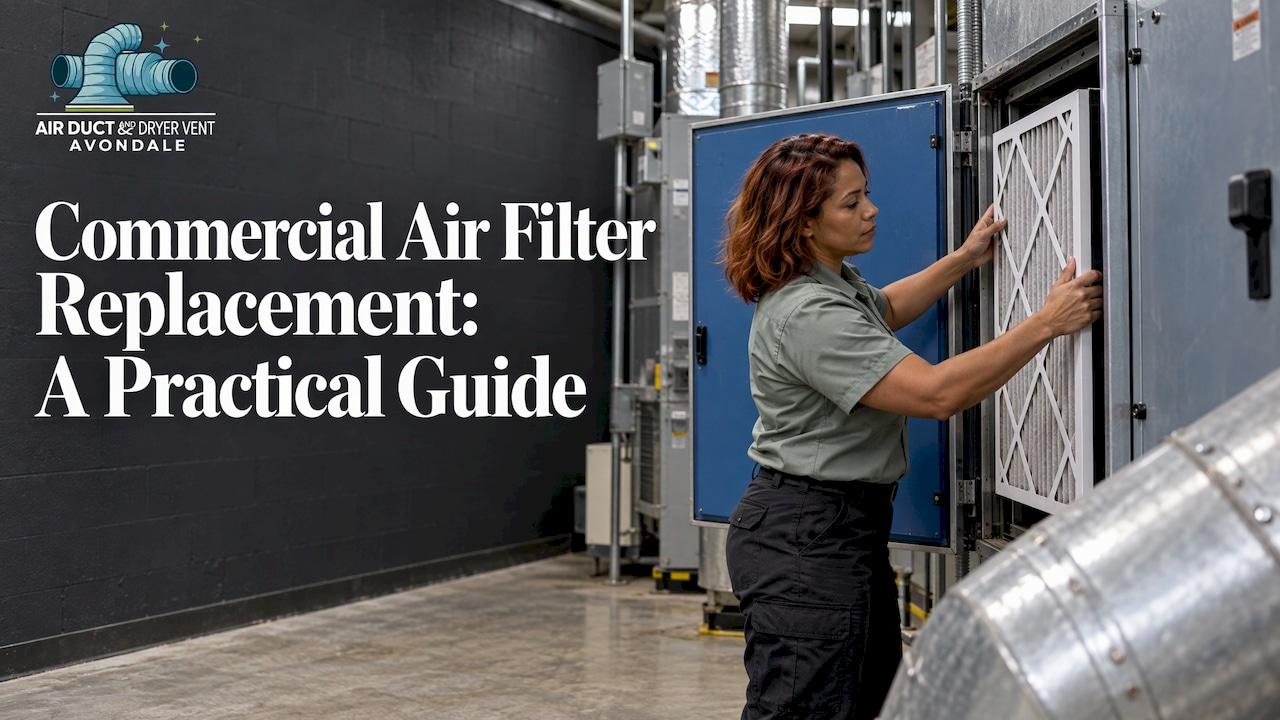
The best way to replace commercial air filters is to stop treating it as a calendar chore. Change them when the system's measured pressure drop says so, match the size and MERV rating to the equipment, seal them in properly and write down every change. That routine protects airflow, energy use and indoor air. It is also easy to get wrong when it competes with everything else a building owner has to run. For businesses and property managers in Avondale, AZ, our air filter replacement service takes the job off your list, and the rest of this guide shows what a correct replacement involves.
TL;DR
- Replace a commercial filter when its pressure drop passes the maximum in the equipment manual or manufacturer data. Time alone is only a baseline.
- Many 1-, 2- and 4-inch panel or pleated filters are changed every two to three months. Runtime, air quality and humidity can shorten that.
- Check the filter's height, width and depth, the system's MERV rating and the number of filter banks before ordering. A higher MERV is not automatically better, because it raises airflow resistance.
- A good install means the airflow arrow points the right way, the media is sealed in the frame, there are no gaps, and the change is logged.
- Monthly inspection is the commercial-office best practice, and it is a good point at which to hand the work to a specialist.
Table of Contents
- How to tell when a commercial filter needs replacing
- How often commercial HVAC filters should be changed
- Choosing the right size and MERV rating
- How to replace a commercial filter correctly
- What dirty or wrong filters cost you
- Our perspective
- Filter replacement in Avondale, handled for you
- FAQ
- Sources
How to tell when a commercial filter needs replacing
A home filter is usually changed by the calendar. A commercial air handler gives you a better signal: the pressure drop across the filter. A filter that fills with dust resists airflow more and more. The pressure difference between the air before and after the filter is called differential pressure. Larger systems often have a gauge that shows it, or a building automation system (BAS) that trends it.

ASHRAE's Indoor Air Quality Preventive Maintenance Checklist says to read the filter gauge or BAS trend at each air-handling unit. A filter that exceeds the maximum pressure drop listed in the operation and maintenance manual or the manufacturer's data should be replaced. That maximum is the number to work from, not a guess about how dirty the filter looks.
The EPA's appendix on HVAC systems and indoor air quality explains the mechanism. As a filter loads with particles, pressure drop rises and airflow can fall. Weak airflow in a suite or a hot room can therefore point to a loaded filter. It is not proof, because other faults cause the same symptom.
Physical condition counts too. The American Society for Health Care Engineering (ASHE) advises inspecting filters and filter banks for damage and moisture, checking rack seals for leaks and replacing damaged filters right away. Tears or punctures can let dirt into the ductwork, and moisture can contribute to microbial growth.
What to look at during a walk-through
- The gauge reading compared with the manufacturer's maximum.
- Tears, bent frames or crushed pleats.
- Damp media or staining along the edges.
- Light visible around the frame, which means air is bypassing the filter.
- Rooms with weaker airflow than the rest of the building.
How often commercial HVAC filters should be changed
There is no single interval, but there is a sensible starting point. Anaheim Public Utilities' air filter fact sheet says most 1-, 2- and 4-inch panel or pleated filters are usually changed every two to three months. It adds that runtime, air quality and humidity affect the interval. A system that runs long hours, or sits in a dusty or humid space, loads its filters faster.
The ASHE guide treats replacement as preventive maintenance. It recommends using measured static pressure as the trigger rather than relying only on time. It also says to replace filters more often under extreme conditions and to treat the manufacturer's recommended schedule as the baseline.
The National Air Filtration Association (NAFA) goes further for offices. Its commercial-office best practice guidelines recommend inspecting the filtration system monthly. That does not mean changing filters monthly. It means someone looks at the gauge and the filters every month, so a change happens when it is needed and not a season late.
A simple schedule that works
- Start with the manufacturer's interval for each unit.
- Inspect monthly and record the gauge reading.
- Move the change date earlier when readings climb faster than expected, for example after a busy season or construction nearby.
- Keep one log per air handler, so the next change is based on the last one.
If you manage several properties, our guide on an air filter replacement schedule for property managers lays out how to organize this across buildings. For a full year of planning, see the operations-first commercial filter program.
Choosing the right size and MERV rating
Most wrong replacements come down to one of two mistakes: the wrong dimensions or the wrong rating. MERV (minimum efficiency reporting value) is a scale that rates how well a filter captures particles. A higher number captures smaller particles.
Size and system details
The ASHE guide lists what to confirm before ordering:
- Filter height, width and depth
- Whether a humidifier is present
- The system's MERV rating
- The space designation
- The number of filter banks
Read the nominal size off the old filter or the rack, and measure the actual size too. A filter that is even slightly undersized lets air slip around it.
MERV is a trade-off
NAFA's guidance says a two-stage central air handler can pair a MERV 8 prefilter with a final filter of MERV 13 or higher. A single-stage system may use MERV 13 or higher. The choice depends on particulate load, life-cycle cost and energy conservation.
The trade-off is airflow. Higher-efficiency media generally creates more airside pressure drop and more fan energy, while more media surface area generally lowers pressure drop and holds more dirt. So the right filter is the one the unit can breathe through, not simply the highest rating. If you want the ratings explained plainly, see our MERV 8 to 13 guide. If you are wondering whether a HEPA filter can go in your system, read what fits and what does not.
| Question | What to confirm |
|---|---|
| Does it fit? | Height, width and depth, plus the number of banks |
| Can the unit handle it? | The system's rated MERV and allowable pressure drop |
| Is there extra load? | Humidifier, high occupancy, dusty surroundings |
| What will it cost over time? | Filter price, change frequency and fan energy together |
How to replace a commercial filter correctly
The steps below follow ASHE and NAFA guidance. Each one shows what it takes and where it usually goes wrong.
1. Plan around the building
Notify occupants before work starts, since the equipment will be shut down. Where it goes wrong: changing filters in the middle of business hours, then rushing. We offer flexible scheduling for commercial clients, including after-hours options, so the work can happen when your staff and customers are not in the space.
2. Shut down and lock out the equipment
NAFA recommends that filter-service technicians know shutdown and lockout procedures and use proper protective equipment: eye protection, masks, gloves, coveralls and safety boots. Where it goes wrong: skipping the shutdown because the job looks quick. A fan that restarts during a change is a hazard to the person working, and loose debris gets pulled into the system.
3. Inspect before you remove
Look at the existing filters and the racks for damage, moisture and leaking seals. Note what you find. Where it goes wrong: pulling the old filters out and throwing them away before anyone has looked at what they reveal about the system.
4. Remove the old filters carefully
Handle them gently so trapped dust stays in the media. Bag them where possible. Where it goes wrong: dropping or shaking a loaded filter, which puts the dirt right back into the air handler.
5. Install the new ones with the airflow arrow correct
ASHE's guidance is to install filters with the airflow arrow pointing away from the cooling coil, with the media sealed in the frame. Where it goes wrong: backwards filters, crushed pleats and mixed sizes in one bank.
6. Seal every gap
NAFA says to check for leaks or gaps around frames, fasteners, caulking and gaskets, because unfiltered bypass air undermines filtration performance and indoor air quality. A MERV 13 filter with a gap around it filters far less than the label suggests.
7. Restart, read, and log
Restart the unit and record the new baseline pressure drop, the filter type, size and date. Where it goes wrong: no record, so the next change is a guess. A written log is what turns a single change into a program.
Our air filter replacement is a service we do for commercial and residential clients in Avondale, and our warranties apply to all of our services. If you want the same sequence in more detail, our filter change sequence guide covers it step by step.
What dirty or wrong filters cost you
ASHE says overloaded filters raise fan energy demand, reduce supply air and harm indoor air quality. Tears and punctures let dirt into the ductwork, and leaks permit bypass. For a business, that shows up as uneven temperatures, higher energy bills and a system working harder than it should.
When filters have been neglected, the dirt does not stay in the filter rack. It travels into the supply side. If you suspect that has already happened, our commercial air duct cleaning removes dust and debris that has built up in the ducts. We also offer an air quality test, which is a good starting point when occupants complain about the air.
For background on how airflow, filters and efficiency fit together, read how HVAC airflow affects air quality and energy use.
Our perspective
Most filter problems we hear about are not about the filter. They are about the routine around it. Nobody owns the log, the size was guessed, the change was squeezed between other tasks, and the gauge was never read.
We specialize in HVAC cleaning. It is not a side service for us. That is why we think of filters as part of a system: the filter, the ducts, the vents and the air handler all work together, and a clean filter in a dirty duct system only solves part of the problem.
For commercial clients we offer flexible scheduling, including after-hours work, so replacement does not disrupt the people in your building. We use commercial-grade equipment, our technicians are highly trained, and our services carry warranties. If you want one team to handle filters, ducts and vents, that is what we are built for.
Shaun
Filter replacement in Avondale, handled for you
If you own or manage a business, a rental property or an office in Avondale, AZ, we can take over your filter replacement along with duct, vent and HVAC cleaning and repair. Bundled discounts are available when you combine services, and you can schedule around your hours.
To get started, see our services page or contact us through the Air Duct and Dryer Vent Cleaning Avondale site.
FAQ
How often should commercial filters be changed?
Many 1-, 2- and 4-inch panel or pleated filters are changed every two to three months, according to Anaheim Public Utilities. Long runtimes, poor air quality and humidity shorten that. The better trigger is the pressure drop reaching the manufacturer's maximum.
Can I use a higher MERV filter to get cleaner air?
Only if the system is rated for it. Higher-efficiency filters generally raise pressure drop and fan energy. Check your system's MERV rating and allowable pressure drop first, and choose media with more surface area if you want a higher rating without as much resistance.
What does a commercial filter replacement include?
A proper job covers occupant notice, equipment shutdown, inspection of the old filters and racks, correctly sized new filters installed with the airflow arrow right, sealed gaps and a written log. In Avondale you can book it through our air filter replacement service.
How do I know my filter is causing weak airflow?
Look at the pressure drop and the filter condition. The EPA notes that a loading filter increases pressure drop and can reduce airflow, but other faults can cause the same symptom. If the filter is clean and airflow is still weak, an A/C repair or duct inspection is the next step.
Sources
- ASHRAE, Indoor Air Quality Preventive Maintenance Checklist
- ASHE, Replace air-handling unit filters regularly
- Anaheim Public Utilities, Air Filter FAQ Sheet
- NAFA, Best Practice Guidelines for commercial office spaces
- EPA, Appendix B: HVAC Systems and Indoor Air Quality