
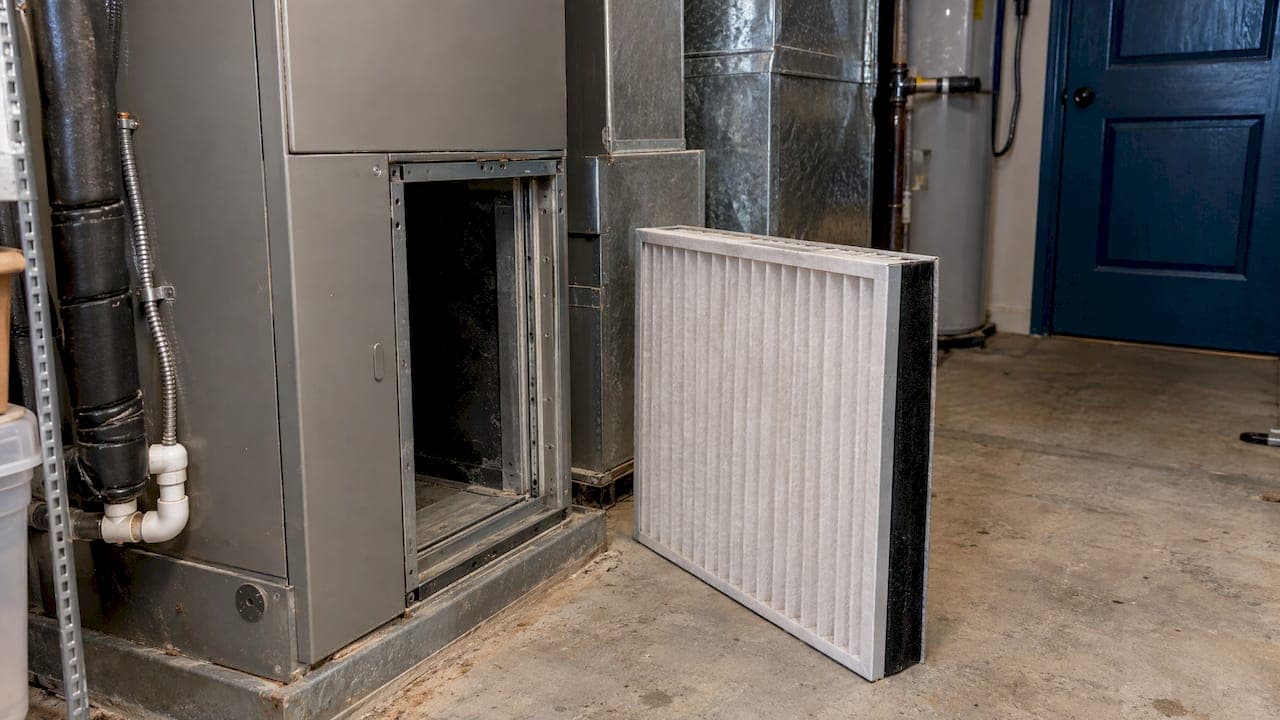
In most homes, a true HEPA filter does not belong in the central HVAC system or furnace. HEPA media is so dense that the blower can't push enough air through it. The practical upgrade is a MERV 13 filter, or the highest MERV your system can handle, plus a portable HEPA air cleaner in the rooms where you want the cleanest air. Here is how to decide, what each option does, and when to have a technician look at your equipment.
TL;DR
- A true HEPA filter captures at least 99.97% of 0.3 micron particles, but most residential HVAC systems can't move air through one.
- Forcing a HEPA filter into a system not built for it can cut airflow, ice up the coil or trip the furnace's safety limit.
- For central air, the EPA suggests a MERV 13 filter, or the highest rating your fan and filter slot can take, changed on schedule.
- For HEPA-level cleaning, a portable HEPA air cleaner in the bedroom or living room is the simpler fit.
- Not sure what your system can take? Have a technician check static pressure and the filter slot first.
Table of Contents
- What a HEPA filter actually does
- Does your HVAC system filter air at all?
- Can you put a HEPA filter in a furnace or central HVAC system?
- HEPA vs. MERV: how the two scales compare
- The better upgrade: MERV 13 or the highest your system allows
- When you want HEPA-level cleaning: portable units
- Does a dirty duct system undo a good filter?
- A note on whole-house humidifiers
- Our perspective
- Get your system checked in Avondale
- FAQ
- Sources
What a HEPA filter actually does
The EPA describes a HEPA filter as a pleated mechanical filter that can theoretically remove at least 99.97% of dust, pollen, mold, bacteria and other airborne particles at 0.3 microns, the most penetrating particle size. ASHRAE puts HEPA efficiency above MERV 16, the top of the MERV scale.

That performance comes from tightly packed fibers, and tightly packed fibers resist airflow. A HEPA filter is built to clean air, not to protect your furnace or air conditioner. That tradeoff explains everything that follows.
Does your HVAC system filter air at all?
Yes. Every forced-air system has a filter in the return duct or at the air handler. It catches dust and lint, keeps the blower and coil clean, and takes some airborne particles out of the air that passes through.
There is one catch. The EPA's air cleaner guide notes that furnace and HVAC filters only work while the system is running, and in most homes that is usually less than 25% of the time during heating and cooling seasons. Running the fan longer cleans more air but raises electricity costs and may make humidity control less reliable in cooling season.
Can you put a HEPA filter in a furnace or central HVAC system?
In almost every ordinary home, no. Here is what the authorities say.
- The CDC says that outside a few unique applications, HEPA filters are rarely used in central HVAC systems. The pressure drop needed to move air through them exceeds what most traditional systems can handle.
- ASHRAE says it is usually not feasible to retrofit existing systems with HEPA filters. It cites high pressure drops and the need for new filter racks that seal well enough to prevent bypass. It also warns that adding HEPA filters to systems not designed for them may cause significant damage.
- A paper from the American Academy of Allergy, Asthma & Immunology reports that HEPA filters for HVAC use need bypass systems where up to 80% of the intake air skips the filter because of airflow resistance. It adds that furnace HEPAs are generally not cost-effective in open residential settings.
What goes wrong with too much restriction
A furnace blower is sized for a limited amount of static pressure. One HVAC contractor notes that most new furnaces have a total external static-pressure limit around 0.5 to 0.8 inches of water column. When airflow drops below what the system needs:
- In cooling mode, capacity falls and the evaporator coil can freeze.
- In heating mode, the temperature rise climbs and the high-limit switch can shut off the burners.
The Allergy & Asthma Network adds that improperly sized filtration can make a unit ice up or burn out, and in some cases void the manufacturer's warranty. It says a whole-house HEPA filter needs a professional HVAC company and sizing for the specific air handler.
The same restriction problem applies to a filter that is simply dirty. The EPA's Indoor airPLUS bulletin says a clogged filter can dramatically reduce airflow, which means longer furnace run time, more motor wear and higher energy use. If you want the details on how pressure shows up in a real system, our guide on measuring HVAC static pressure walks through it.
HEPA vs. MERV: how the two scales compare
MERV rates how well a filter captures particles between 0.3 and 10 microns. The EPA says a MERV 13 filter captures at least 50% of particles in the 0.3 to 1.0 micron range, 85% in the 1.0 to 3.0 micron range and 90% in the 3.0 to 10.0 micron range, per its MERV rating page.
| Option | Typical fit | Capture performance | Airflow demand |
|---|---|---|---|
| Standard 1-inch filter (low MERV) | Most systems | Catches larger dust and lint | Low |
| MERV 11 to 12 | Many systems, with a contractor's sizing | Particles down to about 2 microns per the Allergy & Asthma Network | Moderate |
| MERV 13 | Most furnaces and HVAC systems if replaced often, per the EPA | At least 50% at 0.3 to 1.0 microns | Moderate to higher |
| True HEPA | Specially designed systems, in-room or portable units | At least 99.97% at 0.3 microns | Very high |
For a deeper look at the lower end of the scale, see our explainer on MERV 8 to 13 ratings.
The better upgrade: MERV 13 or the highest your system allows
The EPA recommends a furnace or HVAC filter rated at least MERV 13, or as high as your fan and filter slot can accommodate. It says most systems can take a MERV 13 filter without equipment problems as long as the filter is replaced frequently. The CDC gives the same advice: pick MERV 13 or the highest efficiency possible without hurting system performance.
Three practical points make this work.
- Fit and seal matter as much as rating. ASHRAE notes that filters must be sealed well, and that a lower-efficiency filter can outperform a higher one if its seal is better. Air that slips around the edges isn't filtered at all.
- Depth helps. The EPA's technical bulletin explains that higher-MERV filters tend to restrict airflow. That is why contractors size ducts and filter boxes for thicker or wider filters, which create less static pressure. A 4 or 5 inch media cabinet is often a better path to higher filtration than a thin filter with a high rating.
- Change it on schedule. The Allergy & Asthma Network suggests changing a MERV 11 or 12 furnace filter usually every 3 months, and running the fan continuously to pull more air through it. Your home's pets, dust and system run time may call for sooner. Our filter change sequence guide covers the steps.
If you want to see what common filter types look like side by side, our post on HVAC filter examples helps, and HVAC filters explained for Avondale homes covers the local picture.
When you want HEPA-level cleaning: portable units
The EPA notes that portable air cleaners often reach a high Clean Air Delivery Rate (CADR) by using a HEPA filter. For gases and odors, a unit with an activated carbon filter can be used, and a unit with high CADR and carbon can handle both particles and gases.
This gives you the best of both setups: your central system keeps its airflow with a properly sized MERV filter, and a HEPA unit does the fine-particle work in the bedroom or main living area. The same EPA guide is clear that no air cleaner or filter removes every pollutant, that most filters target either particles or gases, and that every filter needs regular replacement because an overloaded one won't work well.

Other whole-home add-ons
Some homeowners also look at ultraviolet lighting in the air handler. If you go that route, it is worth understanding what UVC lighting installation involves before anything is mounted near your equipment, and having it sized and placed for your specific unit.
Does a dirty duct system undo a good filter?
A filter only protects what sits downstream of it. Dust, debris and construction residue already in the ductwork, vents and registers can keep circulating regardless of the filter you choose. That is why we pair filter advice with cleaning: a better filter keeps new dust out, and clean ducts mean there is less old dust to move. Our post on removing pollutants from HVAC systems explains where that buildup collects, and the one on air duct size and efficiency shows why duct design affects how much filter your system can carry.
A note on whole-house humidifiers
Readers who ask about HEPA and furnaces often ask about whole-house humidifiers too, so here is the short version.
Benefits. Carrier's guide says a furnace humidifier can ease dry, itchy skin, dry nasal passages and chapped lips. It adds that humidified air feels warmer, which may let you lower the thermostat, and that the unit needs only annual maintenance with no tank to refill.
Do you need one? The target range matters more than the gadget. Trane cites the EPA's recommended indoor humidity of 30 to 50% for comfort and mold prevention, and describes anything under 30% as low humidity that can cause symptoms and damage belongings. A GreenBuildingAdvisor article by building scientist Allison Bailes explains that air leakage and ventilation rate strongly affect indoor humidity, so measure before you add equipment.
Upkeep and moisture risk. Mayo Clinic warns that humidifiers can make you sick if they aren't maintained or if humidity stays too high, because mold and bacteria can grow in dirty units and high humidity can cause condensation that feeds dust mites and mold. If you have allergies or asthma, talk to your healthcare provider before using one. Bryant's maintenance guide describes a three-step routine: clean, replace the water panel each heating season and calibrate. Trane also advises lowering the setting before outdoor temperatures drop, to avoid condensation.
Our perspective
We get this question from homeowners who have read that HEPA is the gold standard and want it in their system. The honest answer is that HEPA is the right tool for a room, and a well-chosen MERV filter is the right tool for a duct system.
What we see matter most is the whole path the air travels: a correctly sized filter slot, a good seal, ducts that are clean and sized properly, and a filter swapped on time. Specializing in HVAC cleaning, not treating it as an add-on, is how we approach it. Our technicians use commercial-grade equipment, and we stand behind our work with warranties on all services.
If you aren't sure what filter your system can handle, we can look at the equipment, the filter slot and the ductwork together, and recommend a setup that protects your airflow and improves your air.
Shaun
Get your system checked in Avondale
If you are weighing a filter upgrade, we can help you choose one that fits your equipment, and clean the system it sits in. Our air duct cleaning removes the dust and debris that build up over time, and air vent cleaning covers the registers you see. We also handle air filter replacement, air quality testing and duct repair and replacement through our services page, with flexible scheduling including after-hours options.
For homes and businesses in Avondale, contact us to book a visit. Property managers and business owners can also ask about commercial air duct cleaning and our replacement schedule guidance.
FAQ
Can I use a HEPA filter in my furnace?
Usually not. Most furnace blowers can't overcome the resistance of HEPA media, and the CDC notes HEPA filters are rarely used in central systems for that reason. Low airflow can freeze the coil in cooling mode or trip the high-limit switch in heating mode. A MERV 13 filter, or the highest your system accepts, is the standard recommendation.
What is the best filter for a home HVAC system?
The EPA recommends at least MERV 13, or as high as your fan and filter slot can accommodate, and says most systems can take MERV 13 if the filter is replaced frequently. A deeper media cabinet can make a higher rating easier on the blower. A technician can confirm what your unit tolerates.
Is a HEPA air purifier better than an HVAC filter?
They do different jobs. A portable HEPA unit cleans the air in one room very well, while your HVAC filter treats air only when the system runs and has to protect the equipment. Many homes use both.
Do I need a whole-house humidifier?
Only if your indoor humidity is regularly below the 30 to 50% range the EPA recommends. Check with a hygrometer first, since air leakage and ventilation also affect humidity. If you have allergies or asthma, ask your healthcare provider before adding one, and keep it maintained to avoid mold.
Sources
- What is a HEPA filter? | US EPA
- What is a MERV rating? | US EPA
- Guide to Air Cleaners in the Home | US EPA
- Guide to Air Cleaners in the Home, 2nd edition (PDF) | US EPA
- Indoor airPLUS Technical Bulletin: Filtration | US EPA
- Ventilation FAQs | CDC NIOSH
- Air filters and air cleaners | AAAAI, via PMC
- Filtration / Disinfection | ASHRAE
- HEPA Filters: Help or Hype? | Allergy & Asthma Network
- Can Furnace Fans Handle HEPA Filters? | Eco Temp HVAC
- Guide to Furnace Humidifiers | Carrier
- Whole-House Humidifier vs Portable Humidifier | Trane
- Is a Humidifier in an Airtight House Ever Needed? | GreenBuildingAdvisor
- Humidifiers: Ease skin, breathing symptoms | Mayo Clinic
- Whole House Humidifier Maintenance Guide | Bryant
- What Is Involved In UVC Lighting Installation