
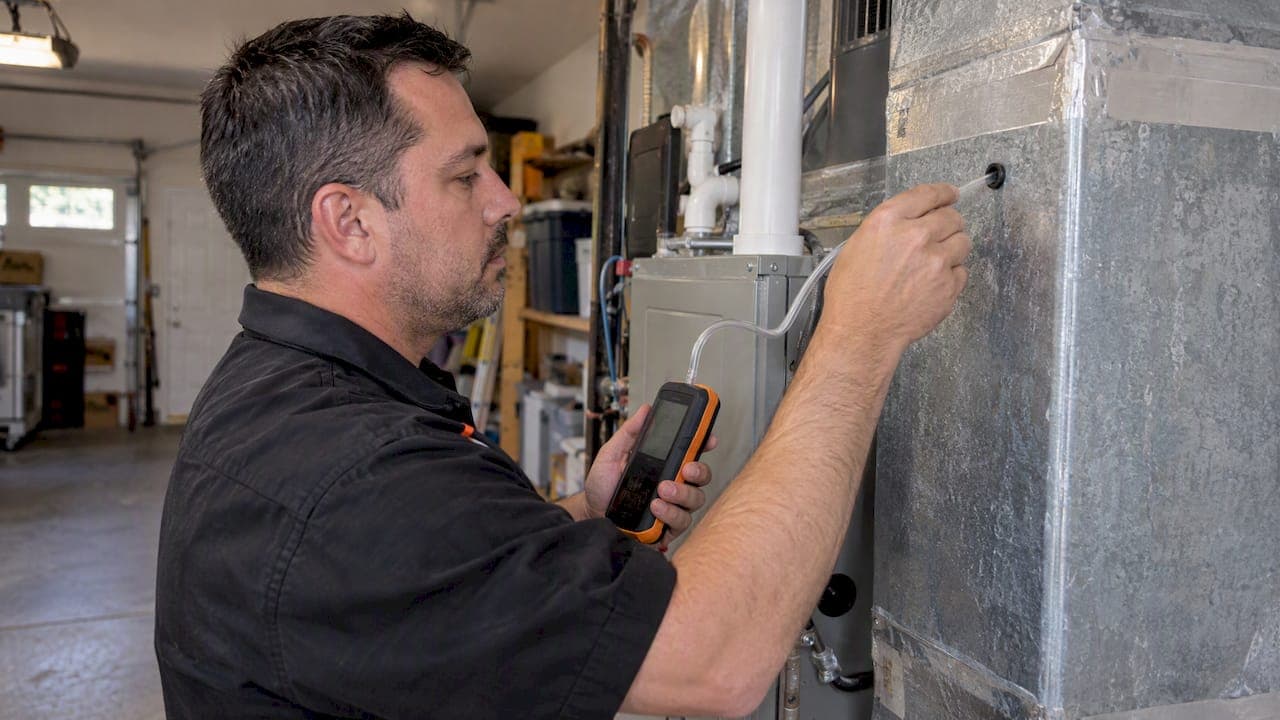
Static pressure is the resistance your ducts, filter, and coil put up against moving air, measured in inches of water column (in. w.c.). The number that matters most is total external static pressure (TESP), the combined supply and return readings. When TESP runs high, airflow drops, the blower works harder, rooms get noisy and uneven, and motors and compressors wear out faster.
TL;DR:
- Measure supply and return pressure near the equipment with the blower at normal speed, add absolute readings, then compare total pressure with the model’s rated maximum.
- Probe filter and coil pressure drops separately; a filter drop above 0.1 in. w.c. calls for replacement and a new TESP test.
- Dirty coils or blower wheels can make readings falsely low, so clean those parts first and keep the reading afterward as your baseline.
- Change one restriction at a time, starting with the filter and blocked returns; persistent high pressure may require duct repairs or added return capacity.
- Call a professional if TESP stays above its rated limit after basic fixes, and request pressure drop readings, a duct inspection, and written findings.
Table of Contents
- What is static pressure, and how does TESP fit in?
- Why does static pressure affect comfort, bills, and equipment life?
- How do you measure static pressure step by step?
- What causes high static pressure, and what fixes it?
- How do you interpret your readings?
- When should you call a professional?
- Why I trust numbers over a flashlight
- How we help you bring static pressure down
- FAQ
- Sources
What is static pressure, and how does TESP fit in?
Think of static pressure the way you think of blood pressure: a single reading that tells you whether the whole system is under strain. Lennox describes it as the resistance to airflow, read with a manometer in inches of water column.
Three pressures show up in technician talk:
- Static pressure: the push of air against duct walls, regardless of motion.
- Velocity pressure: the pressure created by air actually moving down the duct.
- Total pressure: static plus velocity pressure combined.
Residential work lives in a relatively small range. The ACCA guidance discusses readings up to 1.0 in. w.c. TESP is the sum of the supply reading (positive) and the return reading (negative). You treat the return number as positive when adding the two readings to get TESP.
Why does static pressure affect comfort, bills, and equipment life?
Think of a restricted duct system as breathing through a straw. The blower still runs, but less air arrives where you need it.
- Lower airflow: high resistance cuts delivered CFM, so some rooms never reach the thermostat setting while others overcool.
- Higher energy use: the blower motor draws more power to push against the restriction, and that shows up on your bill.
- Faster wear: strained motors, overheated heat exchangers, and compressors that see too little air all age earlier.
- Noise: air squeezed through undersized runs whistles at registers, and thin duct panels can pop in and out, a sound technicians call oil-canning.
- Air quality: weak airflow moves less air across the filter, and dirt that collects in restricted spots stays there.
If noise is your main complaint, the practical noise-reduction steps from a renovation builder show how much of it comes from duct design rather than the equipment itself.
Maintenance priority: the U.S. Department of Energy's ventilation guidance names periodic testing and balancing of the air distribution system as a recommended preventative maintenance practice.
How do you measure static pressure step by step?
A measurement is only useful when it is repeatable, so the sequence matters as much as the tool. Residential technicians use an analog Magnehelic gauge or a digital manometer suited to the system being tested. Our air balance testing guide shows what a full visit looks like.
- Pick the test points. Drill small holes in the supply plenum and in the return side, close to the equipment.
- Set the probe correctly. A static tip is positioned perpendicular to the airflow. A total-pressure tip faces into the airflow. Mixing them up is the most common source of bad numbers.
- Read supply and return. Record both with the blower on at its normal speed.
- Add the absolute values. As the CEE decision guide lays out, TESP is the sum of the two readings with the return treated as positive.
- Check the nameplate. Compare your TESP to the manufacturer's rated maximum for that model.
- Measure the drops separately. Probe above and below the filter, and across the coil, then record each one.
- Plot the airflow. Use the fan table with measured TESP and blower speed to estimate delivered airflow.
The National Comfort Institute method adds the internal filter and coil drops to the external TESP before plotting, which gives the most accurate airflow estimate.
Pro Tip: Seal each test hole with a plug or metal tape when you finish, or the hole itself becomes a new leak.

What causes high static pressure, and what fixes it?
Work from the cheapest, fastest fix to the most invasive one.
- Restrictive filter: probe above and below it. If the drop exceeds 0.1 in. w.c., the CEE guide says to change it and retest TESP.
- Blocked or leaky returns: clear furniture and rugs off return grilles, reseal gaps, or relocate a return that starves a room.
- Crushed or kinked flex duct: straighten sags, remove tight bends, and shorten runs that snake around for no reason.
- Undersized or overlong runs: a duct that is too small forces air through at high speed. Our piece on why duct size matters explains how to spot it.
- Dirty coil or blower wheel: clean them, then measure again.
- Design limits: when the numbers stay high, the answer is more returns, larger trunk lines, or a Manual D redesign.
Pro Tip: Change one thing at a time and re-measure after each fix. You will see which action actually moved the number.
How do you interpret your readings?
Start with the nameplate. A TESP 10 to 20 percent above the rated maximum usually points to a meaningful restriction somewhere in the system, according to ACCA guidance.
Budgeting rule: under the NCI approach, internal filter and coil drops are measured separately and added to external TESP when you plot fan airflow.
- Use budgets when factory data is missing: the NCI commercial method assigns roughly 20 percent of rated fan static to the filter and 30 percent to the coil. Any excess over those shares gets added to your measured TESP.
- Watch for false lows: a dirty coil or blower wheel can drag airflow down and make measured pressure look better than it is. ACCA's Hey Ed column notes that dirty components on an existing system can produce falsely low readings.
- Clean first, then baseline: a reading taken after cleaning is the one worth keeping.
- Keep the record: write down the as-shipped or factory data when you can find it, so next year's test has something real to compare against.
For packaged and commercial units the accessory drops are treated differently, so the NCI commercial test methods are the better reference.
When should you call a professional?
Call someone when TESP stays well above the rated value after you have changed the filter and cleared the returns. The same goes for uneven rooms, new noises, or utility bills that creep up without explanation.
- Plan testing and balancing at equipment change-out, and periodically after that.
- A good diagnostic includes TESP, filter and coil drops, a duct inspection, and a written comparison to the nameplate.
Our air balancing overview covers what to expect.
Why I trust numbers over a flashlight
A visual look down a duct tells you what is dirty. It does not tell you what is restricting air. Clean first, then measure, then decide. Guessing wastes money.
— Shaun
How we help you bring static pressure down
We match the work to the cause. Air duct cleaning and coil cleaning address internal drops, air filter replacement and vent cleaning handle grille and return problems, and duct repair or replacement covers compression and sizing trouble. Ask us about the work your system needs. Book a visit in Avondale today.
FAQ
How do you reduce high static pressure in an HVAC system?
Start with the easy restrictions: replace the filter, open blocked returns, and clean the coil. If TESP stays high, repair crushed duct, add return capacity, or upsize trunks. Re-measure after each change.
Is 0.4 static pressure good?
It depends on the equipment. Check the nameplate's rated TESP rather than relying on a general figure. Compare your reading to the manufacturer's rated TESP rather than a general rule.
How is a static pressure test done?
A technician drills small test holes in the supply and return sides and reads each with a manometer. They add the two values together, treating the return as positive, to get TESP. Filter and coil drops are measured separately, as the National Comfort Institute method describes.
How does static pressure change with fan speed?
Airflow rises roughly in proportion to fan speed, while static pressure rises with the square of speed. Sanyo Denki's fan primer notes that doubling speed doubles airflow but quadruples static pressure.
Sources
- Lennox
- DECISION GUIDE
- Measure and Interpret Static Pressures
- Ventilation Assessment and Action Guide