
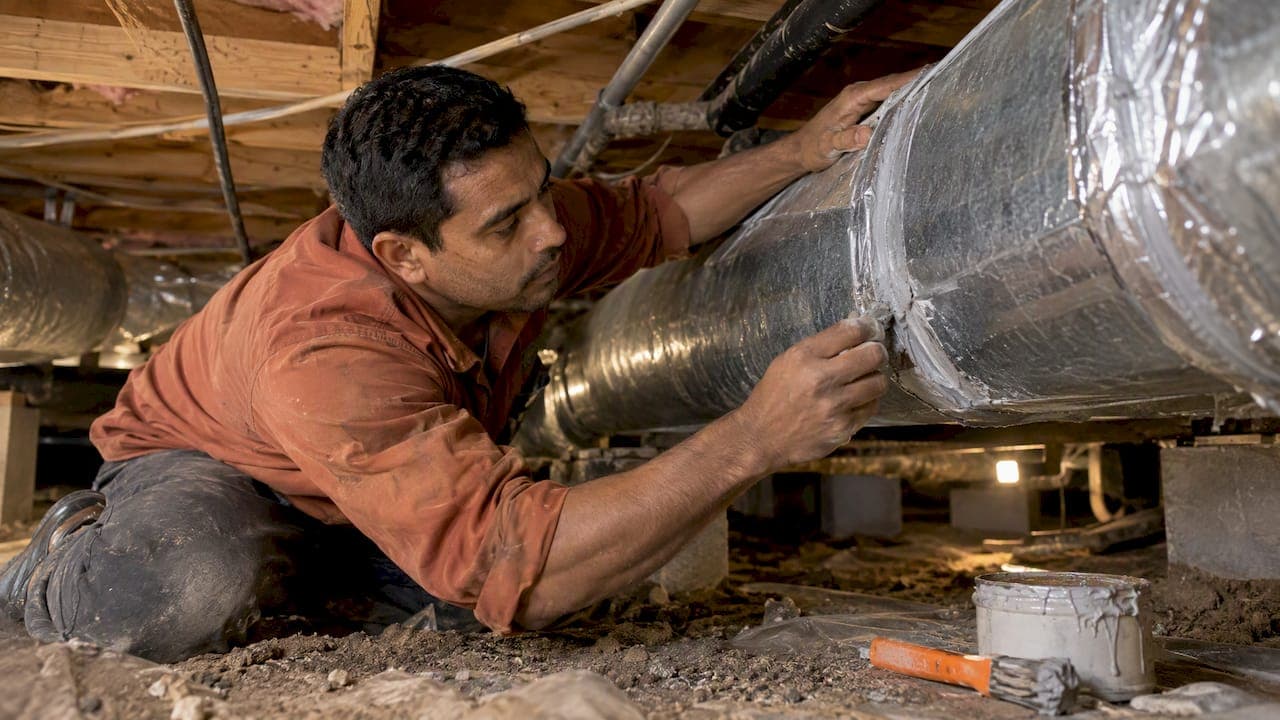
Most homeowners pay between $1,000 and $3,500 to have their ducts professionally sealed, though published ranges run from as low as $300 to as high as $6,000 depending on the source and the house. Home size, how reachable the ducts are and the sealing method decide where you land. Below we explain what is inside those numbers, how to read a quote, and where a Southwest summer makes sealing worth more than it is in milder places.
TL;DR
- Professional duct sealing averages $1,000 to $3,500 nationwide, and a typical 2,000 sq ft home often lands between $2,000 and $4,000 once complexity is counted.
- Manual sealing with mastic or foil tape usually runs $1,000 to $3,500. Aerosol sealing such as Aeroseal runs about $1,500 to $4,000.
- Typical houses lose 20 to 30 percent of the air moving through the ducts to leaks, so sealing is mostly a bill and comfort fix, not a cosmetic one.
- Ask for leakage testing before and after the work, and a combustion safety check if you have gas appliances.
- Check utility rebates before you book. Some programs only pay when a certified contractor does the testing and repair.
Table of Contents
- What duct sealing costs on average
- Cost by sealing method
- What pushes your quote up or down
- A worked example
- Is duct sealing worth the cost?
- Why sealing is rarely a standalone fix
- Why duct tape is the wrong material
- Safety: what a careful contractor checks after sealing
- Rebates and tax credits that can lower the price
- How to get a fair quote
- Our perspective on duct sealing
- When replacement beats sealing
- Need a duct check in Avondale?
- FAQ
- Sources
What duct sealing costs on average
The published figures disagree, and that is normal. Cost guides draw on different contractors, regions and job types. Here is how the main ones compare:
| Source | Reported range | Notes |
|---|---|---|
| HomeGuide | $1,000 to $6,000 total, about $1 to $2 per sq ft | Covers manual and aerosol methods |
| Angi | $500 to $4,000, average around $2,250 | Depends on home size and duct layout |
| PICKHVAC | $300 to $3,800 | Driven by method, duct length and access |
| Electrify Home | $1,000 to $3,500 professional, $300 to $1,000 DIY | Estimates $200 to $800 a year in savings |
Treat the overlap as your planning zone. For a single-family house with one system, budget roughly $1,000 to $3,500, and expect the upper end if the ducts are tangled, buried in attic insulation or split across several systems.
We do not publish a flat duct sealing price, and we would not trust anyone who quotes one without seeing your ducts. The leak count and the access decide the labor, and labor is most of the bill.

Cost by sealing method
There are two professional approaches, and they suit different houses.
Manual sealing with mastic or foil tape
A technician finds the leaks they can reach and seals joints, seams and connections by hand with mastic or metal-backed tape. Expect about $1,000 to $3,500. It fits ducts that sit in an accessible attic, basement or garage.
The weak spot is reach. If the leaks are inside wall cavities or under floors, hands cannot get there. Manual work typically cuts leakage by roughly 40 to 60 percent, according to the same pricing guide.
Aerosol sealing (Aeroseal-type)
Aerosol sealing blows a sealant mist through the closed duct system. The particles collect at leak edges and close them from the inside. It costs about $1,500 to $4,000 and can cut leakage by up to 90 percent, according to that guide. It is the better tool for hidden leaks, and a measured result is part of the process.
Which one fits your home
| Situation | Usually the better fit |
|---|---|
| Ducts in an open attic, clear access | Manual mastic and tape |
| Leaks suspected in walls or floors | Aerosol sealing |
| Disconnected, crushed or torn ducts | Repair or replacement first, then seal |
| Very old, damaged ductwork | Replacement, which can cost less over time than patching |
Sealing cannot fix a duct that has fallen off its boot or been crushed. Those problems are repairs, and our guide to ductwork repair costs in Avondale explains how they are priced.
What pushes your quote up or down
Home size. Most contractors price in part by square footage, with cost guides citing roughly $0.50 to $2.00 per square foot of living area, per HomeGuide's 2026 data. A 1,200 sq ft house and a 3,500 sq ft house with two systems are different jobs.
Access. Tight attic crawlspaces, ducts buried under blown-in insulation and runs behind finished ceilings all add hours. Manual sealing is mostly labor: Angi reports about 90 percent of manual job cost is labor, so every hour of awkward access shows up on the invoice.
Number of systems. Two air conditioners means two duct systems to test and seal. Some guides quote per system, which is why one home can see very different totals.
Leak severity. A system with a few loose joints is a half-day job. One with leakage of 30 to 50 percent needs far more material and time.
Condition of the ducts. Torn flex duct, sagging runs and failed insulation can make sealing pointless until they are fixed. Our post on why duct insulation matters covers the attic side of this.
Testing. Pre- and post-work leakage tests add cost, but they are the only way to know what you paid for. More on that below.
A worked example
Take a 2,000 sq ft single-story house with a single system and ducts in the attic. Using the ranges above:
- Per-square-foot pricing at $0.50 to $2.00 puts the job between $1,000 and $4,000.
- If the attic is open and the leaks are at accessible joints, manual sealing at the lower-middle part of that range is realistic.
- If a duct test shows large leaks you cannot reach, an aerosol job in the $1,500 to $4,000 band becomes the sensible option.
- If a rebate covers part of the testing and repair, your net cost drops.
This is an illustration built from published ranges, not a quote. Your attic decides the number.
Is duct sealing worth the cost?
The ENERGY STAR guidance says that in a typical house about 20 to 30 percent of the air moving through the duct system is lost to leaks. In Arizona, where much of that air is cooled and often travels through a hot attic, a leak means you pay to cool the attic.
One cost guide estimates savings of $200 to $800 a year with a payback of two to five years. That is a general estimate, not a guarantee. Your savings depend on your leakage before the work, your ductwork and your utility rates.
There are benefits that are not on the bill:
- Comfort. Rooms at the end of a run that never cool properly often have a leak upstream.
- Air quality. Leaks in return ducts can pull attic dust and insulation particles into the airflow. This guide to sealing leaky ducts explains how leaks affect energy use, dust and household safety.
- Equipment load. A system that loses a quarter of its air runs longer to reach the thermostat setting.
If you want a deeper look at the link between leaks and your air, read how air ducts affect energy savings and indoor air quality.
Why sealing is rarely a standalone fix
Sealing the seams you can see is not the same as fixing the system. ENERGY STAR notes that effective sealing means addressing the physical gaps, often hidden in attics or crawl spaces, and sealing only the reachable seams can leave a large share of the leakage in place. Disconnected ducts and poor air balance are frequent real culprits behind high bills.
That is why a testing-first approach matters. A technician who pressurizes the system and measures leakage tells you whether you have a sealing problem, a repair problem or an airflow problem. The U.S. Department of Energy's Building America program describes verified testing as the way to measure results from different sealing methods. If you know you have visible damage, our write-up on duct leak repair methods shows what a homeowner can handle and what needs a pro.
Why duct tape is the wrong material
Standard cloth duct tape dries out and lets go as the ducts heat and cool. ENERGY STAR points instead to mastic, metal tape or an aerosol-based sealant for sealing duct leaks and connections. Look for UL-181 rated products on the quote.
This also answers the common DIY question. Homeowners can seal accessible joints with the right mastic or foil tape, and cost guides put DIY at roughly $300 to $1,000. What they cannot do is find, measure or reach the hidden leaks, or run a combustion safety check.
Safety: what a careful contractor checks after sealing
Tightening a duct system changes air pressure inside the house. If you have a gas furnace or gas water heater, that can in some cases cause backdrafting, where exhaust gases including carbon monoxide are pulled back into the living space instead of going up the flue. This is why a reputable contractor performs a combustion safety test after sealing a system with gas appliances.
If your home has gas appliances, ask any contractor directly whether the quote includes that test. Make sure working carbon monoxide alarms are installed. If an alarm sounds or anyone has headaches or nausea that clear when they leave the house, leave, call 911 and your gas utility, and do not go back in until it is cleared.
Rebates and tax credits that can lower the price
Utility rebates in Arizona
Utilities in the Phoenix area run programs that pay toward duct testing and repair. SRP, for example, lists a duct test and repair rebate. Its rebate application says you must be a residential SRP electric customer in an existing home, and the work has to be done by an Arizona-licensed contractor who holds a Building Performance Institute Building Analyst certification. You submit the paid invoice with the form.
The practical lesson: confirm your electric provider and read the rules before you hire, because a rebate can be refused if the contractor does not meet its requirements. If your home is served by another utility, check that utility's site for its own program.
Federal tax credit
The IRS has published a fact sheet on the Energy Efficient Home Improvement Credit, which describes a 30 percent credit capped at $1,200 a year for qualifying improvements in a primary residence. Federal energy credit rules have been changing, so do not assume a particular improvement qualifies for work done this year. Ask a tax professional, and check the IRS page, before you count on it.
How to get a fair quote
- Get at least two written quotes that name the method, the materials and the areas covered.
- Ask for pre- and post-work leakage numbers. A result such as "leakage went from X to Y" is verifiable. "Sealed all leaks" is not.
- Ask about the combustion safety test if you burn gas.
- Ask what happens to damaged ducts. Sealing a crushed or detached duct wastes money.
- Check the rebate rules before signing.
- Confirm the warranty in writing, including what it covers and for how long.
Be cautious about very low flat prices over the phone and about anyone who says every house needs the same treatment.
Our perspective on duct sealing
We clean and repair ducts across Avondale, so we see what the inside of local systems looks like. Our view is simple: the cheapest sealing job is the one that finds the real problem first.
In a Valley home, ducts usually run through a very hot attic. A small gap there does more damage than the same gap in a mild climate, because the cooled air you paid for escapes into heat. We would rather you spend your money on a test and the right fix than on a blanket treatment.

We also think sealing and cleaning belong in the same conversation. If a system has been leaking for years, it has probably been pulling in attic dust. Sealing a dirty system locks that dust in, so we look at both. Our specialty is HVAC cleaning, not a side service, and we bring commercial-grade equipment and trained technicians to ductwork repairs. Put that against a general contractor who treats ducts as an afterthought, and you can see why we like to look at the whole system.
One more thing we tell people: do not let anyone rush you. Get the diagnosis, get the numbers in writing, and then decide.
— Shaun
When replacement beats sealing
Sometimes patching is the expensive option. If the ducts are decades old, crushed, mold-affected or have failing insulation, sealing them is spending money on materials that will not last. Compare the sealing quote against replacing the worst runs. Our post on what ductwork repair costs shows the range, and our air duct replacement service covers the full job when it is the better choice.
Need a duct check in Avondale?
We serve homeowners, property managers and business owners in Avondale, AZ. Our ductwork repair and installation services cover leaks, damaged runs and filters. If your system also needs a cleaning, see air duct cleaning. Tell us what you are seeing, such as uneven rooms, dust or high summer bills, and we will tell you plainly what the job involves. We do not publish set prices because every attic is different, so you get a quote based on your own ducts.
FAQ
How much does duct sealing cost for a 2,000 sq ft house?
National guides put it between about $1,000 and $4,000, depending on the method and access. HomeGuide says average totals for a 2,000 sq ft home cluster between $2,000 and $4,000 when complexity is counted. A written quote after an inspection is the only way to pin it down.
Is duct sealing worth the cost?
Often, yes, if your ducts leak noticeably. Typical homes lose 20 to 30 percent of duct airflow, and sealing recovers part of that. Savings vary by house, so ask for a before and after leakage test to see what your money bought.
How long does duct sealing last?
It depends on the materials and the condition of the ducts. Mastic and foil tape are designed to stay flexible and airtight, while ordinary duct tape fails quickly. Ask your contractor for the warranty terms in writing instead of relying on a general lifespan.
Can I seal my ducts myself?
You can seal reachable joints with mastic or foil tape, and DIY materials are far cheaper than a professional job. You cannot easily measure leakage, reach buried runs or test combustion safety. If you have gas appliances, have a professional handle it.
Does duct sealing replace duct cleaning?
No. Sealing closes leaks, and cleaning removes dust and debris already inside. Many homes benefit from both, and it is more efficient to plan them together.
Sources
- HomeGuide: Air duct sealing cost
- HVAC Pricing Guide: Ductwork cost
- Angi: Duct sealing cost
- PICKHVAC: Air duct sealing and Aeroseal cost
- Electrify Home: Duct sealing cost guide
- South Mountain Cleaners: Arizona duct sealing cost
- ENERGY STAR: Duct sealing
- ENERGY STAR: Duct sealing flyer
- U.S. DOE Building America: Air distribution retrofit strategies
- SRP: Duct test and repair rebate
- SRP: Rebate application
- IRS: Energy Efficient Home Improvement Credit fact sheet