
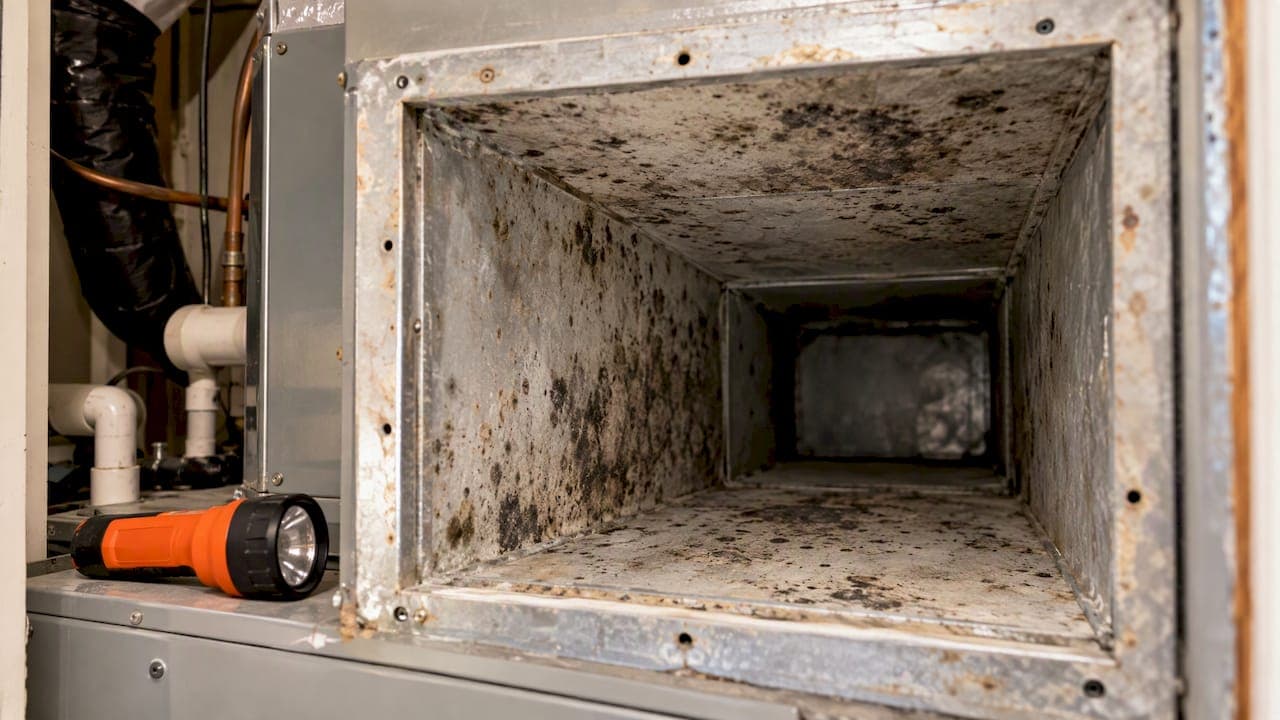
Mold in air ducts usually shows up in two ways: in how you feel and in what you see or smell at the vents. The body signs are sneezing, a stuffy nose, itchy eyes, coughing and, for people with asthma, wheezing. The home signs are a musty odor when the system runs and dark spots on or around vents and registers. One sign alone proves nothing. Several together, especially with a moisture problem, mean it's time for an inspection.
Below we cover what mold in a duct system can do to your health, how to tell mold from ordinary dust, what to do first, and when cleaning is enough and when it isn't.
TL;DR
- Typical symptoms are hay-fever-like: sneezing, runny or stuffy nose, coughing, itchy or watery eyes, skin irritation. Asthma can flare.
- Warning signs at the vents: a musty smell when the A/C or heat starts, and dark or fuzzy spots on vent covers, registers or nearby ceilings and walls.
- Not every dark mark is mold. Dust and soot also stain vents, so get it confirmed before paying for mold work.
- Cleaning won't last unless the moisture source is fixed first, such as a clogged drain pan, a leaking duct or poorly insulated ductwork.
- If you suspect mold, turn the system off and have a qualified technician inspect it.
Table of Contents
- Symptoms mold in your ducts can cause
- Signs of mold in your vents and ducts
- Where mold actually grows in an HVAC system
- What to do if you suspect mold in your ducts
- When cleaning is enough, and when it isn't
- Our perspective: why we start with the moisture, not the vacuum
- Fixing it for good: moisture and prevention
- Get it inspected in Avondale
- FAQ
- Sources
Symptoms mold in your ducts can cause
The CDC describes the usual reaction to mold as allergy-like: sneezing, a runny or stuffy nose, coughing, postnasal drip, itchy, watery or red eyes, and dry, itchy skin. People with asthma can get attacks with wheezing, chest tightness and shortness of breath. The EPA's mold and health page says mold produces allergens and irritants, and that it has the potential to cause health problems once it grows on a damp spot.
The Cleveland Clinic adds that black mold may trigger your immune system if you're sensitive to it. The usual symptoms are sneezing, coughing, congestion and eye irritation. It rarely causes serious illness, but it can worsen asthma.
The pattern that points to the ducts
Mold symptoms look a lot like a seasonal allergy or a cold. What suggests your HVAC system is involved is the pattern:
- Symptoms get worse when the system runs, or right after it kicks on.
- They ease when you spend a day or two away from home.
- Several people in the household have them, or a pet does.
- They come with a musty smell or visible staining at the vents.
None of this is a diagnosis. Allergies, a cold, dust, pet dander and dry air cause the same complaints. If you have persistent symptoms, trouble breathing or an asthma flare-up you can't control, see your doctor or allergist. Don't wait for a duct inspection. If you have chest tightness or severe shortness of breath, get urgent medical care.
What about "toxic black mold"?
Search results are full of scary claims about toxic mold syndrome. The research we reviewed says the public-health picture is more modest. The CDC says health concerns from mold are mainly allergic or inflammatory, and the EPA says there is no conclusive evidence linking indoor airborne mycotoxins to systemic illness. That doesn't make mold harmless. It means the realistic risks are irritation, allergy and asthma, and the fix is the same whatever the color: find the moisture and remove the growth. You can't tell a species by its color, so don't rely on "black" or "green" to judge danger.
Signs of mold in your vents and ducts
Symptoms are only half the picture. These are the physical clues, from most to least reliable.
A musty smell when the system starts
The CDC says mold can look like spots of many colors and can smell musty. A damp, earthy odor that appears when the A/C or heat comes on, and fades when it shuts off, is one of the most common reasons homeowners call us. It points to growth somewhere in the air path: ducts, the air handler, the coil or the drain pan.
Dark spots on or around vent covers
Look at the registers in bedrooms, bathrooms and the rooms farthest from the unit. Mold tends to show as fuzzy, speckled or slimy patches, often with a damp feel. Black stuff around a vent can also be dust or soot that the airflow has carried and deposited. Our guide to diagnosing black stuff around air vents walks through the difference.
A quick field check:
| What you see | More likely | What to do |
|---|---|---|
| Gray, dry, fuzzy dust line along the vent edge | Ordinary dust and air-flow staining | Vacuum and wipe; monitor |
| Dark ring on the ceiling around a supply vent | Dust or soot carried by airflow, sometimes condensation | Check for sweating ducts, then clean |
| Damp, speckled or slimy dark patches on the cover or inside the boot | Possible mold | Stop the system, photograph it, get an inspection |
| Musty smell with no visible source | Possible growth inside the system | Inspection of coil, drain pan and ducts |
| Visible growth on insulation or duct liner | Likely mold on a porous surface | Professional assessment, replacement may be needed |
Condensation, drips and damp insulation
Mold needs moisture. Look for water stains on ceilings under ductwork, wet or sagging duct insulation in the attic, rust on the air handler, water in the drain pan, and ducts that sweat in hot weather. The EPA states plainly that the key to mold control is moisture control. If you can see moisture, mold is a matter of time.

Dust is not mold
Don't panic at a dusty register. The EPA notes that duct cleaning is likely unnecessary if no one in the household has allergies or unexplained symptoms and there is no musty odor or visible mold. Dust on a return grille is normal accumulation, not proof of contamination inside the system.
Where mold actually grows in an HVAC system
Homeowners tend to picture a black coating inside a metal duct. In practice the trouble often starts at the wettest points in the system:
- The evaporator coil and drain pan. Cooling air produces condensate. If the pan or line clogs, standing water feeds growth right at the source of your airflow. Trane's guidance on mold in an air handler points to the air handler, evaporator coil and drain pans as the usual moisture-driven sources.
- Duct sections with leaks or poor insulation. A cold duct running through a hot attic can sweat. Moisture collects on the surface or in the insulation.
- Fiberglass duct liner and duct board. Porous material holds moisture and dirt, and it's very hard to clean once colonized. EPA research on HVAC sealants found that duct cleaning alone may not prevent regrowth on fiberglass duct liner.
- Vent boots and registers. Where cold supply air meets warm, humid room air, condensation forms on the cover and can start growth at the edge.
Our own write-ups on mold in HVAC systems and what causes duct contaminants go deeper on each of these.
What to do if you suspect mold in your ducts
- Stop running the system if you can. Trane's guidance is to turn the HVAC system off so it doesn't keep circulating spores through the house. In an Arizona summer, use judgment: if you can't safely go without cooling, especially with young children, older adults or anyone medically vulnerable, call a technician the same day rather than waiting.
- Photograph what you see. Take close-ups of vent covers, registers and any stains, with a note of when the smell occurs.
- Don't spray bleach or fogger products into the ducts. You can't reach the growth, and you may irritate your lungs.
- Get an inspection. A technician should look at the air handler, evaporator coil, drain pan, accessible ductwork and the registers. Ask them to show you any mold they claim to find, and to show you the moisture source.
- Confirm if you're unsure. The EPA says not all mold-like substances are mold, and labs can analyze a sample. If a contractor says there's mold but you only see dust, a lab test is a reasonable second opinion.
- Fix the moisture, then clean. Repair the drain, seal and insulate leaking ducts, and replace damaged components before or alongside cleaning.
When cleaning is enough, and when it isn't
The EPA says you should consider duct cleaning if there is substantial visible mold growth inside hard surface ducts, such as sheet metal, or on other components of the heating and cooling system. It also says that if mold is a problem in your home, you should clean it up promptly and fix the water problem.
That gives a practical rule:
- Sheet-metal ducts with surface growth: mechanical cleaning, then fixing the moisture source, is the standard route.
- Fiberglass-lined or duct board sections with growth: replacement is often the better answer, because the porous material can't be reliably cleaned.
- Mold only on registers or vent covers: clean or replace the covers, then find out why they were damp.
- Mold at the coil or drain pan: the repair is the priority, and the cleaning follows.
Be wary of anyone who treats "mold removal" as a spray-and-go product. The research we reviewed notes that the EPA and industry groups do not recommend routine use of ozone generators or sealants in HVAC systems, as they can mask odors and leave regrowth unaddressed. Look for mechanical removal and a moisture fix, not a chemical shortcut.
Our perspective: why we start with the moisture, not the vacuum
Most calls we get about mold in vents begin the same way: someone saw dark spots, cleaned them, and the spots came back. That tells us the cleaning wasn't the problem. The water was.

As a business that specializes in HVAC cleaning rather than treating it as an add-on, we think the honest order of work is: inspect, find where moisture is entering the system, confirm what the growth is, then clean with commercial-grade equipment and repair or replace what can't be cleaned. Cleaning a duct that will sweat again next month is money wasted, and we'd rather tell you that than sell you the job.
We also don't think every dusty vent needs work. If nobody in your home has symptoms and there's no odor or visible growth, a full duct cleaning may not be needed, and the EPA says as much. When there's a real reason, we'll show you what we found. Our services cover cleaning, duct repair and replacement, filter replacement and air quality testing, so the fix doesn't have to be split across several contractors.
— Shaun
Fixing it for good: moisture and prevention
Once the system is clean, keep it dry and keep it filtered.
- Keep the drain pan and condensate line clear. Have them checked at each seasonal tune-up.
- Repair duct leaks and insulate ducts in unconditioned spaces. Sweating ducts are a classic source.
- Change filters on schedule. A clogged filter strains the system and lets debris reach the coil.
- Watch indoor humidity. The EPA guidance on mold says to dry water-damaged areas and items within 24 to 48 hours, so clean up leaks, spills and roof or plumbing damage fast.
- Dry out after storms and leaks. Arizona monsoon storms and roof leaks can put water where it doesn't belong, so check the attic and ceilings after heavy weather.
Our HVAC mold prevention tips lay out a seasonal routine. If you manage a building rather than a house, the facility manager's guide to mold in commercial ducts covers larger systems. If you want to see what a careful removal on accessible vents involves, see our step-by-step guide to removing mold from vents. It's most useful for light surface growth on covers, not for growth inside the system.
Get it inspected in Avondale
If you have a musty smell, dark spots at your vents or symptoms that follow the system, we can inspect it. We serve homes and businesses in Avondale, AZ. Start with air duct cleaning, air vent cleaning or an indoor air quality test. If the problem is a failing duct, we also handle duct repair and replacement and A/C repair. Property managers can ask about commercial air duct cleaning, including flexible and after-hours scheduling. We don't publish prices, because the cost depends on your system, so we quote after we see it.
FAQ
Can mold in air ducts make you sick?
It can cause symptoms in sensitive people, mostly allergy-type reactions such as sneezing, congestion, coughing and itchy eyes. It can also worsen asthma, according to the CDC. Serious illness is rare. If symptoms persist or breathing is difficult, see a doctor.
How do I know if the black stuff on my vents is mold?
You can't be sure by looking. Dust and soot also leave dark marks. Mold is more likely when the spots are damp, slimy or fuzzy, come with a musty smell, or appear where there is moisture. A lab can confirm a sample, and any contractor who says it's mold should be willing to show you.
Does the EPA recommend duct cleaning?
Not routinely. The EPA advises considering it when there is substantial visible mold growth inside hard-surface ducts or on other parts of the system, among other reasons. It isn't a blanket recommendation for every home.
Will cleaning the ducts get rid of mold for good?
Only if the moisture source is fixed. The EPA says to clean up mold and fix the water problem. Porous materials like fiberglass liner may need replacement, because cleaning alone may not stop regrowth.
What should I do first if I smell mold from my vents?
If you can do so safely, switch the system off so it stops circulating spores, then look for visible growth or moisture at the vents and around the air handler. Call a technician to inspect the coil, drain pan and ducts. Don't spray chemicals into the ducts.
Sources
- CDC: About mold
- EPA: Should You Have the Air Ducts in Your Home Cleaned?
- EPA: Should I have the air ducts in my home cleaned?
- EPA: Mold and Health
- EPA: Investigation of the Potential Antimicrobial Efficacy of Sealants Used in HVAC Systems
- Cleveland Clinic: Black Mold Exposure
- Trane: Mold in an air handler