
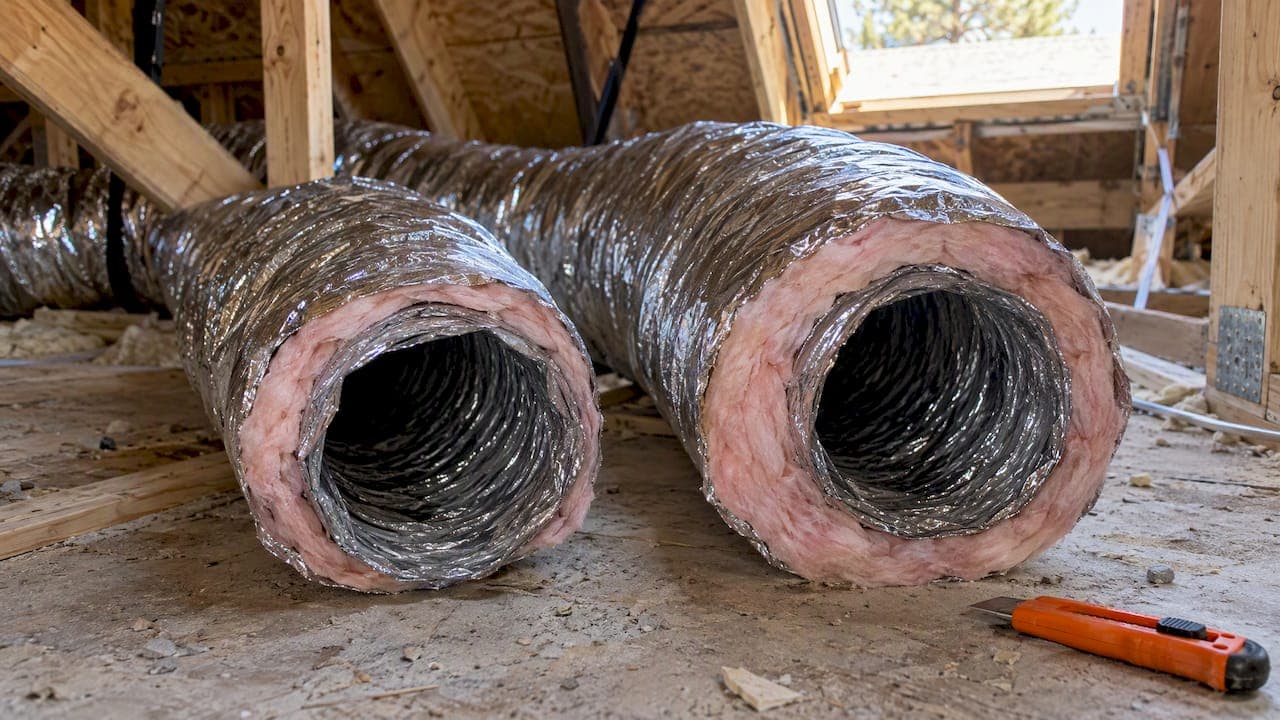
R8 flex duct has a thicker insulation blanket than R6, so less heat moves through the duct wall. In an unconditioned attic, R8 is the version most codes ask for on supply ducts. In a modest run that sits in a cooler space, R6 usually does the job for less money. The difference in yearly savings is smaller than most sales pitches suggest, and the code in your area often decides the question before cost does.
This guide covers what the two ratings mean, what the federal research says about savings and price, what the energy codes require, and how to decide for your own house or building.
TL;DR
- R6 and R8 are the R-values of the fiberglass blanket around flex duct. Higher means more resistance to heat flow, and R8 is the thicker product.
- In federal modeling, going from bare ducts to R6 saved about $100 a year, and R8 added only about $5 a year on top of that.
- R8 costs more per square foot of duct than R6, so the upgrade pays back slowly on energy alone. Code compliance and condensation control are the stronger reasons to choose it.
- Supply ducts in unconditioned attics are where R8 matters most. Sealing and installation quality matter more than the jump from R6 to R8.
- Check what your local permit office requires before you order duct, because the code can settle the choice for you.
Table of Contents
- What R6 and R8 actually mean
- R6 vs R8 at a glance
- How much energy does R8 really save over R6?
- What the codes say about R6 and R8
- When R8 is worth it
- When R6 is enough
- What does the upgrade cost?
- Moving ducts is sometimes better than thickening them
- Checklist before you choose
- Our perspective
- Need duct replacement or repair in Avondale?
- FAQ
- Sources
What R6 and R8 actually mean
Flex duct is an inner plastic liner on a wire helix, wrapped in a fiberglass blanket and covered with an outer jacket. The R-number describes that blanket. According to the Building America guide on sealed and insulated flex ducts, flex ducts come pre-insulated and R-4, R-6 and R-8 are the common options.
The R-value measures resistance to heat flow. A higher number means less heat gets through. In practice, R6 flex is built with a blanket about 1.5 inches thick and R8 with about 2 inches, which also makes R8 a bit bulkier. That extra half inch changes four things:
- Heat transfer. Less heat enters the cold air in your supply duct in summer, and less escapes from the warm air in winter.
- Surface temperature. A warmer outer surface in a humid space means less chance of condensation.
- Outside diameter. Bulkier duct needs more room in tight framing, around joists and in crowded attics.
- Price. More material means a higher cost per foot.
If you want a refresher on how this duct type is built and where it is used, our guide to flexible ductwork covers it.
R6 vs R8 at a glance
| Factor | R6 flex duct | R8 flex duct |
|---|---|---|
| Insulation thickness (typical) | About 1.5 inches | About 2 inches |
| Heat resistance | Medium | Higher |
| Installed cost per sq. ft. of duct area (2011 federal figures) | $0.70 to $1.50 | $0.82 to $1.80 |
| Extra savings over R6 in federal models | None | About $5 per year |
| Code use | Return ducts in some attics, smaller ducts, other spaces | Attic supply ducts under many code editions |
| Best fit | Runs in cooler or semi-conditioned spaces | Hot attics, long supply runs, code-required spaces |
The cost figures come from the Building America measure guideline on sealing and insulating ducts, which lists R-6 at $0.70 to $1.50 per square foot of duct area and R-8 at $0.82 to $1.80. Those are 2011 numbers. Material and labor are higher today, so use them to compare the two options with each other, not as a quote.
How much energy does R8 really save over R6?
This is the question behind most searches, and the honest answer is: not much on its own.
The same federal guideline modeled houses in Boston and Houston. Going from uninsulated ducts to R-6 saved roughly $100 per year. Stepping up from R-6 to R-8 added about $5 per year. That is the pattern with insulation: the first layer does most of the work, and each extra increment buys less.
You will see sales material claiming R8 cuts duct losses by a few percent. That is consistent with the small gain above, and it is not a reason to rip out working R6 duct. Where the gain is larger, it is usually because the duct runs through a very hot attic and the air inside it is very cold. A bigger temperature gap pushes more heat through the wall. Our Avondale attics in summer are a good example of that situation.
Two things matter more than R6 versus R8:
- Air sealing. Leaky duct wastes cooled air no matter how thick the blanket is. The Building America guide says connections should be sealed and the insulation should cover ducts and connections without gaps. See our notes on duct leak repair and duct sealing cost.
- Installation. The same guide says insulation must be aligned and in contact with the duct walls. Duct that is kinked, sagging, crushed under a plank or stretched until the blanket thins loses much of its rated value.
A well-sealed, properly supported R6 system will usually beat a sloppy R8 one.
What the codes say about R6 and R8
Code is where R8 earns its place. Rules differ by edition, by duct size and by where the duct sits.
- 2009 IECC. At least R-8 for supply ducts in unconditioned space, while return ducts can be insulated to R-6, according to the Building America flex duct guide.
- 2015 IECC. Ducts in attics need R-8 if they are larger than 3 inches in diameter and R-6 if smaller. In other locations, ducts larger than 3 inches need R-6 and smaller ones R-4.2, as laid out in the DOE summary of 2015 residential requirements.
- 2018 IECC. The same size-and-location logic holds: ducts under 3 inches need R-6 in attics and R-4.2 elsewhere. The 2018 edition also lets buried ducts count as inside conditioned space in the simulated-performance path when set criteria are met, including R-8 minimum duct insulation, per the DOE overview of the 2018 IECC residential provisions.
The pattern is consistent. Larger ducts in attics get R-8. Ducts in other places, such as a crawl space or a wall cavity, can often use R-6 on prescriptive paths.
What this means in Avondale
The City of Avondale publishes a residential plan review checklist that asks plans to show the air duct insulation R-value, along with equipment efficiencies and the insulation values of ceiling and walls. So the duct R-value is something the city looks at on new construction, and it is worth confirming the current requirement with the building department before you order material. For a replacement in an existing home, ask whether your project needs a permit and which edition applies. A licensed installer should know the answer without looking it up.
When R8 is worth it
R8 makes sense in these situations:
- Supply ducts in a hot attic. This is the textbook case, and the one most codes target. In the Phoenix Valley, an attic can run far hotter than the outdoor air, so the duct wall faces a large temperature difference for months.
- Long supply runs. The farther cold air travels through hot space, the more it warms before reaching a room. Rooms at the end of a long run often feel weaker, and thicker insulation helps a little.
- Humid or condensation-prone spaces. The ENERGY STAR duct insulation fact sheet notes that properly insulated ducts help prevent condensation on duct surfaces. Condensation can stain ceilings and feed mold, so a warmer outer surface is useful.
- High-capacity systems. A larger system moves more air through bigger ducts, and bigger ducts are exactly where code asks for R-8.
- Whenever your permit says so. If code requires R-8, the savings math is irrelevant.
When R6 is enough
R6 is a reasonable choice when:
- The duct sits in a space that is not extreme, such as a crawl space, and your local code allows R-6 there.
- The run is a short return duct. The 2009 IECC language above allows R-6 on returns.
- Framing is tight and a 2-inch blanket will not fit without being compressed. Squashed R8 can perform worse than clean R6.
- Branch ducts are under 3 inches in diameter, where the 2015 and 2018 editions set lower values.
- You are on a tight budget and the whole system is otherwise well sealed.
One owner question on a popular home-improvement forum is whether a replacement job costing about 39% more for R8 is worth it when ducts sit in a crawl space and returns sit in the attic. Both spaces are unconditioned, which is the case where R8 is least controversial. Our reading of the federal numbers: if the code allows R6 and your budget is the issue, spend the money on sealing first.
What does the upgrade cost?
Using the 2011 federal range, R-8 duct insulation runs $0.82 to $1.80 per square foot of duct area, which the guideline translates to $365 to $801 for its example home. Against R-6 at $0.70 to $1.50 per square foot, the gap between the two is modest for the whole house, in the low hundreds of dollars on that example. Against roughly $5 per year of modeled extra savings, a pure payback calculation is poor.
That does not make R8 a bad purchase. The comparison changes when:
- You are replacing ducts anyway, so you pay only for the material difference and not for a second labor visit.
- The code requires R-8, so the real alternative is a failed inspection.
- Comfort and condensation are the problem you are solving, not the utility bill.
What if you are thinking of going higher? A Building America case study in Cocoa, Florida, found that upgrading attic ducts from R-6 to R-12 had a net cost of $530 and projected energy savings of 242 kWh per year, according to the case study report. Even a big jump in R-value produces a modest result when the savings are measured in kilowatt-hours, which is why sealing and location matter so much.
For local pricing on replacement work, see our guide to ductwork repair costs in Avondale.
Moving ducts is sometimes better than thickening them
The federal guideline points out that moving ducts into conditioned space, or expanding conditioned space to include them, is sometimes a viable retrofit. If your ducts run through a scorching attic and a remodel opens the door to a soffit, a dropped ceiling or a sealed attic, a duct that no longer sees extreme temperatures needs far less insulation fighting against it. This is a bigger project, and it is not right for every house, but it is worth a question during an estimate.
Checklist before you choose
- Where does the duct run? Attic, crawl space, wall, or inside conditioned space.
- Is it supply or return? Supply ducts get the stricter treatment.
- What diameter? Code thresholds change at 3 inches.
- What does the permit office require? Ask for the current edition and any local amendments.
- Is there room? Measure clearances, because R8 is bulkier.
- How is the duct sealed and supported? Ask about mastic or approved tape at joints, and about support spacing to prevent sags.
- How old is the existing duct? If the jacket is torn or the blanket is damp, replace it. Our piece on inspecting duct insulation explains what to look for.
Our perspective
Most homeowners ask us R6 or R8 as if it were the whole decision. It rarely is. When we open an attic in the Avondale area, the worst losses we see are usually disconnected boots, crushed or kinked runs, torn jackets and joints that were never sealed, not the R-number printed on the sleeve.

Our advice is simple. If you are replacing supply ducts in an attic, specify R8 and confirm it against the permit requirements. The added cost is small next to the labor, and it protects you at inspection. If you are patching a few runs of sound R6 duct, do not tear it out for a few dollars a year. Fix the leaks, support the duct properly and keep the insulation dry and in full contact with the liner.
What we would never do is quote a duct upgrade based on a promised percentage of savings. The honest numbers are small, and comfort and durability are the better reasons. If you want a second opinion on what is in your attic, ask us to look at it before you sign anything.
— Shaun
Need duct replacement or repair in Avondale?
If your attic ducts are old, leaking or under-insulated, our team handles air duct replacement as well as duct installation, ductwork repairs and vent replacement for homes and commercial properties. We can inspect what you have, explain whether R6 or R8 fits the space and the permit, and give you a plan. You can see everything we do on our services page. For the bigger picture on replacement, read what ductwork replacement involves.
FAQ
What is the difference between R6 and R8?
Both are ratings of the insulation around flex duct. R8 has a thicker blanket, about 2 inches against about 1.5 inches for R6, so it resists heat flow better and runs a little warmer on the outside in cold air. R8 also costs more and takes up more space.
Is R8 a good insulation value for ducts?
Yes, for ducts in an attic it is the value most code editions point to for larger supply ducts. The 2015 IECC requires R-8 for attic ducts over 3 inches in diameter. For ducts in other spaces, R-6 is often enough under that same code.
Is R4 or R8 better?
R8 insulates better. R-4 is a common flex duct option, but it is thinner and does not meet the attic requirements of the 2015 IECC, which sets R-4.2 as the value for small ducts outside attics. For a new attic installation, R4 is rarely the right choice.
Is R8 worth it over R6 for a replacement?
Often, if you are replacing the duct anyway and it runs through an attic. The energy gain is small, about $5 a year in federal modeling, but the extra material cost is also small and R8 may be required for your permit. If your existing R6 is in good shape, sealing it is a better use of money.
Sources
- Sealed and Insulated Flex Ducts, Building America Solution Center
- Measure Guideline: Sealing and Insulating of Ducts in Existing Homes, DOE Building America
- Building America Case Study: Impact of Improved Duct Insulation
- 2015 IECC residential requirements, DOE Building Energy Codes Program
- Residential Provisions of the 2018 IECC, DOE Building Energy Codes Program
- Duct insulation fact sheet, ENERGY STAR
- Residential Plan Review Checklist, City of Avondale