
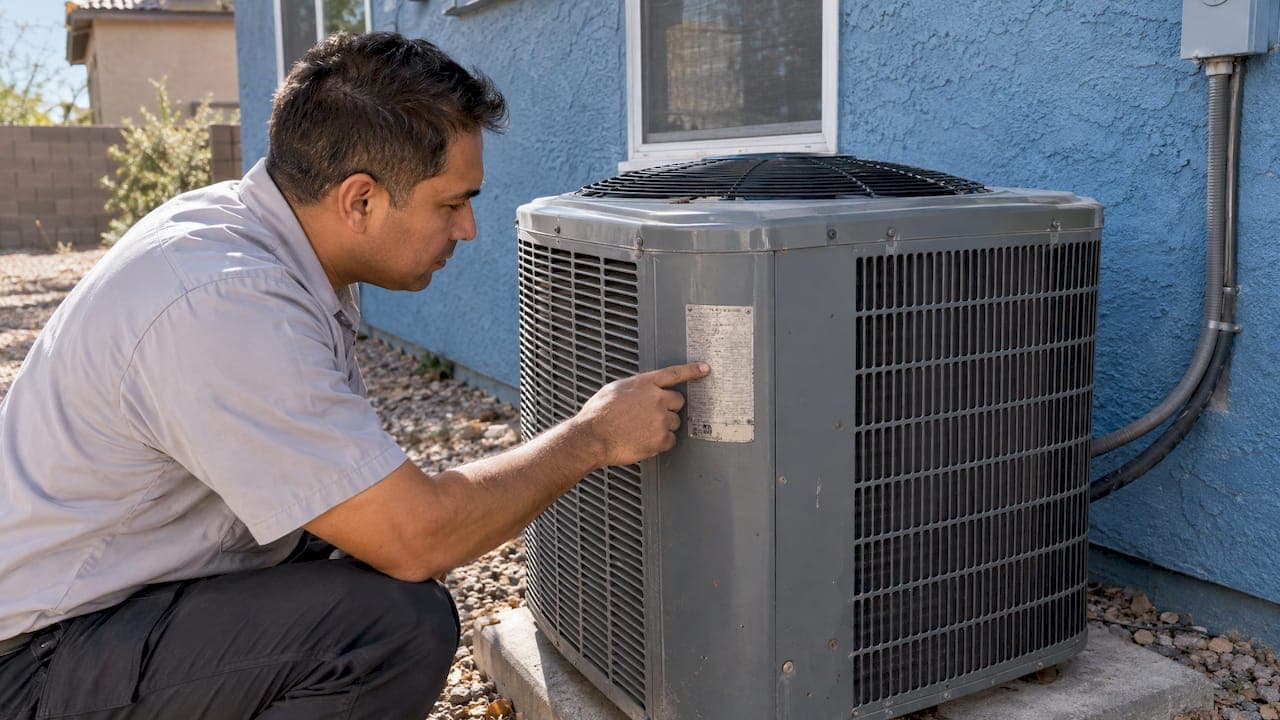
SEER2 is the current way the U.S. rates how efficiently a central air conditioner or heat pump cools over a season. SEER is the older method. Both measure the same idea, but SEER2 is tested under tougher, more realistic conditions, so the two numbers are similar but not directly comparable. A system labeled 16 SEER is not the same as one labeled 16 SEER2. If you are shopping in Avondale, you will see SEER2 on every new system sold today.
TL;DR
- SEER2 replaced SEER for new residential central AC and heat pumps under U.S. Department of Energy standards that took effect January 1, 2023.
- The tests differ, so a SEER2 number runs lower than the old SEER number for similar equipment. Do not treat them as the same scale.
- Compare systems on one scale only. Check the SEER2 printed on the equipment's certification, not a number someone converted for you.
- Furnaces use a different rating, AFUE, so SEER2 tells you nothing about heating efficiency.
- Ducts can cost you efficiency no matter what the label says, so the rating is only part of the picture.
Table of Contents
- What SEER and SEER2 actually measure
- What changed when SEER became SEER2
- Can you convert SEER2 to SEER?
- SEER vs. SEER2 at a glance
- Is a 14.3 SEER2 rating good?
- How to read a rating when you compare quotes
- SEER2 doesn't cover heating: furnaces use AFUE
- The rating is not the whole story: ducts decide what you actually get
- Perspective
- Get your system and ducts checked in Avondale
- FAQ
- Sources
What SEER and SEER2 actually measure
SEER stands for Seasonal Energy Efficiency Ratio. It compares how much cooling a system delivers over a typical cooling season with how much electricity it uses to deliver it. A higher number means more cooling for each unit of electricity.
The U.S. Department of Energy describes SEER2 as a type of SEER metric, measured differently under test procedures designed to better reflect real-world installation and use. It is not a new idea. It is the same idea, measured under conditions closer to what happens in an actual home.
The Department of Energy's consumer guide puts the family of ratings in plain terms: SEER measures seasonal cooling output relative to electricity use, while AFUE measures the heat a furnace delivers relative to the fuel it burns. They are different yardsticks for different jobs.
What changed when SEER became SEER2
As of January 1, 2023, the DOE put new, higher nationwide efficiency standards in place for residential central air conditioners and heat pumps. The same change moved the industry from the legacy SEER, EER and HSPF metrics to SEER2, EER2 and HSPF2.
In practical terms, the new test is stricter about how a system performs once it is hooked up to ductwork. The older test was run under more forgiving conditions. The updated procedure accounts for more resistance to airflow, which is what a real duct system creates. That is why the new numbers look lower. Your equipment did not get worse. The test got more honest.
Three things to keep straight:
- Same job, new test. SEER2 still describes seasonal cooling efficiency.
- Lower-looking numbers. The same hardware will usually carry a smaller number under SEER2 than it did under SEER.
- New names for the companion ratings. EER becomes EER2, and HSPF becomes HSPF2 for heat pump heating.
Can you convert SEER2 to SEER?
Not reliably, and the DOE says why. SEER2 and SEER ratings are similar but not directly comparable, and compliance has to be determined from a model's own measured SEER2 rating.
You will find online charts and formulas that apply a rough percentage to move between the two scales. They are fine for a quick sense of scale, for example when you are curious how an old 14 SEER unit in your garage compares with a new quote. They are not a substitute for the real rating of the specific equipment you are buying.
Here is how to handle it:
- Shopping for new equipment: every new split system is rated in SEER2. Compare SEER2 to SEER2.
- Looking at an older system: its label says SEER. Do not read that number as if it were SEER2.
- Comparing old to new: treat the conversion as an estimate. If a contractor quotes you savings, ask which scale the figure is on.
- Need the exact figure: ask for the rating certificate for the exact indoor and outdoor combination, because a rating belongs to the matched system, not to the outdoor unit alone.
The question "is 15 SEER2 the same as 16 SEER?" comes up a lot. They are close in spirit and different in measurement, and because the scales are not the same, the honest answer is "roughly in the same neighborhood, but check the paperwork."
SEER vs. SEER2 at a glance
| SEER (older) | SEER2 (current) | |
|---|---|---|
| What it rates | Seasonal cooling efficiency | Seasonal cooling efficiency |
| Test conditions | Less airflow resistance | Closer to real installations |
| Where you see it | Systems made before the 2023 change | New central AC and heat pumps |
| Number for similar hardware | Higher | Lower |
| Companion ratings | EER, HSPF | EER2, HSPF2 |
| Can be compared directly with the other? | No | No |
Is a 14.3 SEER2 rating good?
It is the floor, not the ceiling. The DOE's nationwide minimums are 13.4 SEER2 for split-system air conditioners, and 14.3 SEER2 and 7.5 HSPF2 for split-system heat pumps. So a 14.3 SEER2 heat pump is the least efficient split-system heat pump that can legally be sold under the current standard.

That does not make it a bad choice. It means it meets the legal baseline. Whether to pay for more depends on how much you run your system, how long you plan to stay in the house, and what your electric rate is.
Why Avondale buyers should look at the regional rules
The standards are not identical everywhere. The DOE sets separate regional minimums for split-system and single-package air conditioners across the North, Southeast and Southwest. Southern requirements are tied to the installation date, while northern ones are tied to the manufacture date. Arizona sits in the Southwest region, so the national minimum is not necessarily the one that applies to your home.
Your installer is responsible for selling you equipment that is legal to install in Arizona. It is still worth asking directly: "Does this exact model meet the Southwest minimum for my system type and size?"
How much efficiency is worth paying for in a desert climate
Avondale cooling seasons are long and hot, and air conditioners here run for many months. That tilts the math toward higher efficiency, because the savings of a better rating accumulate over more running hours than they would in a mild climate. A few practical guidelines:
- Long ownership: if you plan to stay for many years, a higher SEER2 has more time to pay back.
- Big, older house: more cooling load means more kilowatt-hours saved per point of efficiency.
- Short horizon: if you may sell soon, a unit that meets the legal minimum and is installed well may be the smarter spend.
We go through the cost side in more detail in our guide to high-efficiency HVAC costs, ducts and rebates in Avondale. If you are weighing a heat pump against a conventional AC, see Heat Pump vs AC: Which One Fits an Avondale Home?
How to read a rating when you compare quotes
When you hold two or three quotes, the SEER2 figure is easy to over-focus on. Use this checklist instead:
- Confirm the scale. Is every number a SEER2 number? Mixed scales are the most common source of confusion.
- Confirm the match. Ratings apply to a combination of outdoor unit, indoor coil and air handler or furnace. A mismatched coil can erase the rating.
- Check the size. Capacity in tons should come from a load calculation of your home, not from the size of the old unit.
- Ask about the ducts. A premium rating tested on a lab duct layout does not follow the equipment into a leaky attic duct system.
- Look at comfort features. Multi-stage or variable-speed operation affects how steady the house feels, not only the label number.
- Read the warranty. Know what is covered, for how long, and what maintenance keeps it valid.
If you want a second set of eyes on how ratings line up, a resource on AC efficiency and installation services can help you see what a typical equipment conversation looks like.
SEER2 doesn't cover heating: furnaces use AFUE
People searching for SEER2 often end up asking about furnaces too, because a replacement project often covers both. SEER2 only rates cooling. A gas furnace is rated by AFUE, Annual Fuel Utilization Efficiency.
The DOE's Building America guide defines AFUE as the ratio of heat delivered to the home to the fuel supplied. A 90% AFUE furnace converts 90% of its fuel energy into home heat, and the rest leaves through the vent and furnace jacket.
Standard vs. high-efficiency furnace
Federal standards set a floor of 80% AFUE for non-weatherized gas furnaces, and 90% in the Northern region. So a standard furnace is the 80% class, and a high-efficiency furnace is the 90%-plus class. In a warm place like Avondale, heating runs a fraction of the year, so the efficiency gap matters far less to your annual bill than the SEER2 of your air conditioner does.
Condensing vs. conventional furnace
The label "high efficiency" usually means a condensing furnace. The DOE guide describes condensing furnaces as sealed-combustion, direct-vent systems that typically rate 90% to 98% AFUE. They use a secondary heat exchanger to pull water vapor out of the exhaust and recover heat that a conventional furnace sends up the flue.
The practical differences:
| Conventional (standard) | Condensing (high efficiency) | |
|---|---|---|
| Heat exchangers | One | Two, the second recovers latent heat |
| Typical efficiency | 80% class | 90% to 98% class |
| Exhaust | Metal flue | Plastic vent pipes, sealed combustion |
| Extra requirement | None | Condensate drain |
If you replace both pieces of equipment, ask for the AFUE of the furnace and the SEER2 of the AC or heat pump as separate line items. A heat pump changes this picture again, since it moves heat instead of making it, so it is judged by HSPF2 for heating.
The rating is not the whole story: ducts decide what you actually get
A 17 SEER2 air conditioner can deliver far less than its label if the air it makes leaks into an attic, or if returns are starved by clogged filters and dirty coils and registers. The new test was introduced precisely because real installations push against more resistance than the old lab setup assumed.
For homeowners, that turns the ductwork into a first-class part of the efficiency decision. Things worth checking before or alongside a replacement:
- Leaks and disconnected runs, especially in attic spaces where summer temperatures are extreme.
- Insulation condition on supply trunks. See why inspecting duct insulation lowers costs.
- Dust and debris buildup that restricts airflow and loads the blower.
- Filter fit and cleanliness, since a clogged filter forces the system to work harder.
Our article on how air ducts affect energy savings and indoor air quality covers these in detail, and HVAC energy saving tips lists the habits that help whichever system you own.
A caution about expectations: ratings of any kind are comparison tools. Actual energy savings also depend on home insulation, local energy costs and how the equipment operates, so any promised percentage should be treated as a rough estimate until someone measures your home.
Perspective
We see the SEER2 change from the inside of people's ceilings. The label on a new outdoor unit is the number everyone asks about, but the part of the system we actually get our hands on, the ducts, vents, filters and returns, is where a lot of that efficiency is won or lost.
Our view is simple. Pick equipment on the right scale, SEER2 against SEER2, and meet the Southwest requirements. Then make sure the air has a clean, sealed, properly insulated path to travel. Cleaning specialists are built for exactly that job, which is why we treat HVAC cleaning as our core work, not an add-on, and why we use commercial-grade equipment and trained technicians on every call.
If you are about to replace a system, have your ducts looked at first or at the same time. If you are keeping your current system, a thorough cleaning, new filters and a check of vents and returns are the most direct way we know to help it run the way it was designed to.
Shaun
Get your system and ducts checked in Avondale
We clean, repair and install HVAC components for homes and businesses in Avondale, Arizona. That includes air duct cleaning, duct replacement, air filter replacement, A/C installation and A/C repair. We offer warranties on our services, flexible scheduling and after-hours options for commercial clients, and bundled discounts when you combine services.
If you are comparing quotes or planning a new system, tell us what you are looking at and we will help you see how the ducts fit into the picture.
Ready to book? Start on our services page or reach us through the main site.
FAQ
Which is better, SEER or SEER2?
SEER2 is the current standard, so it is the one that matters for new equipment. It is not that SEER2 equipment is automatically better. SEER2 is a more realistic test, so its numbers are a more trustworthy guide to how a system will perform once installed. Compare SEER2 ratings with other SEER2 ratings.
Can you convert SEER2 to SEER?
Only roughly. The DOE states that the two ratings are similar but not directly comparable, and that compliance is determined from a model's measured SEER2 rating. For a precise figure on a specific system, use the SEER2 on its certification instead of a converted value.
Is a 14.3 SEER2 rating good?
It is the federal minimum for split-system heat pumps, so it meets the legal baseline but does not stand out for efficiency. For split-system air conditioners the national minimum is 13.4 SEER2, and regional rules apply on top of that. In a long cooling season like Avondale's, many homeowners choose a higher rating to lower running costs.
Does SEER2 apply to my furnace?
No. SEER2 rates cooling only. Gas furnaces are rated by AFUE, and standard models sit in the 80% class while condensing high-efficiency models reach 90% or more. Heat pumps are rated by SEER2 for cooling and HSPF2 for heating.
Will my old SEER-rated AC be replaced because of SEER2?
No. The 2023 change applies to new equipment being manufactured and installed, not to systems already in homes. A well-maintained older system can keep running. Clean ducts, fresh filters and regular service help it perform closer to its rating.
Sources
- U.S. Department of Energy: 2023 Central Air Conditioner and Heat Pump Standards FAQ
- U.S. Department of Energy: Consumer Guide to Home Heating and Cooling
- U.S. Department of Energy: Building America Best Practices Series Vol. 14
- U.S. Department of Energy: Regional Standards Enforcement Framework Document